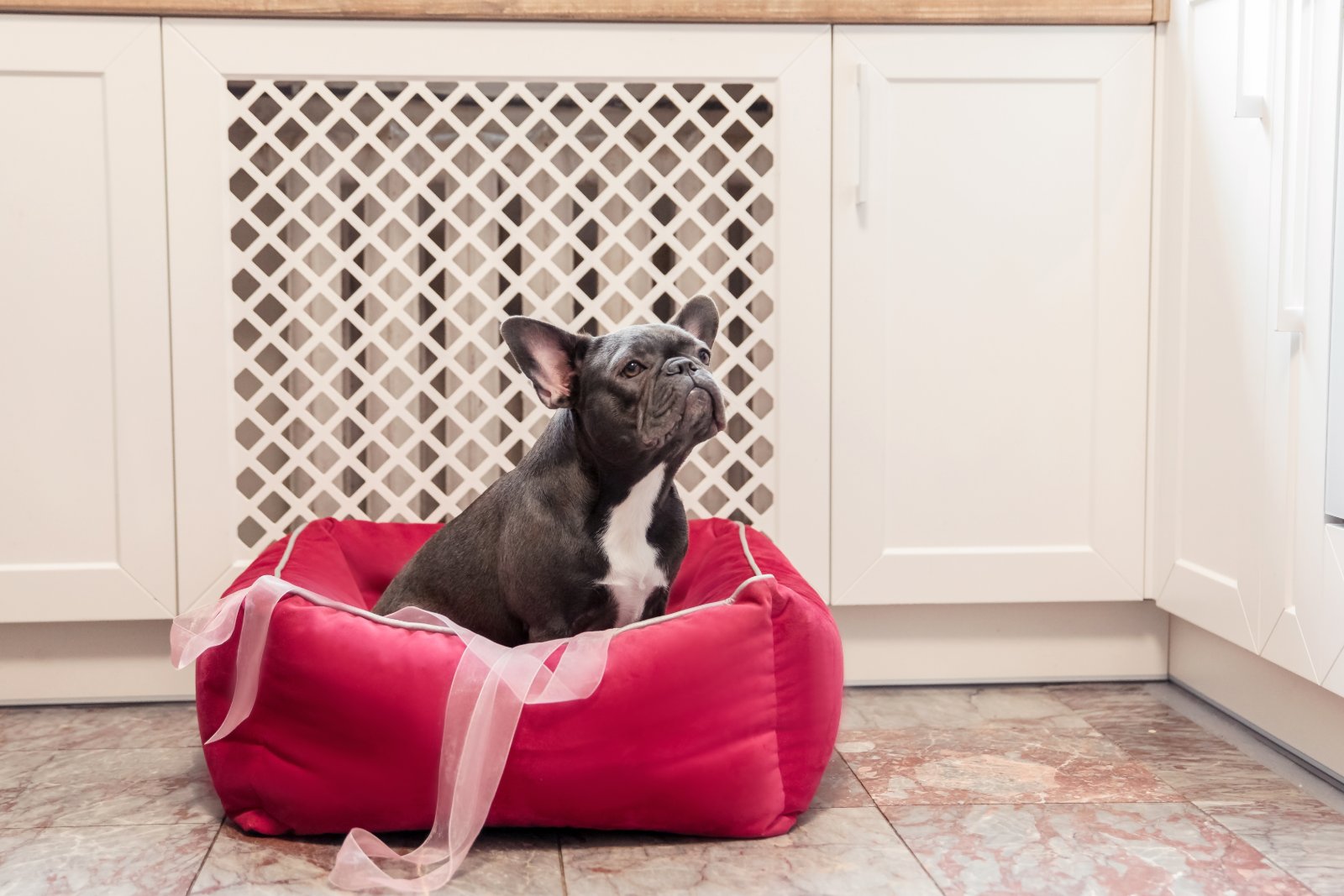

An indoor dog bed works when the sleeping surface fits how the dog actually lies, the fill supports that dog’s weight without collapsing to the floor, and the cover can be washed without ruining the bed. Breed charts and styled photos are secondary. Most unused beds fail the size test first: a dog measured while standing looks smaller than the same dog stretched on its side, and raised bolsters shrink the usable area further.
The rest of the choice is matching shape and material to sleep style, age, and the room. A stiff senior needs a different bed from a puppy that still has accidents, and a thick-coated dog in a warm apartment needs a different surface from a small dog that burrows. Supportive foam can make rest more comfortable for dogs with joint stiffness, but it does not treat arthritis or replace veterinary care.
Match the shape to how your dog sleeps
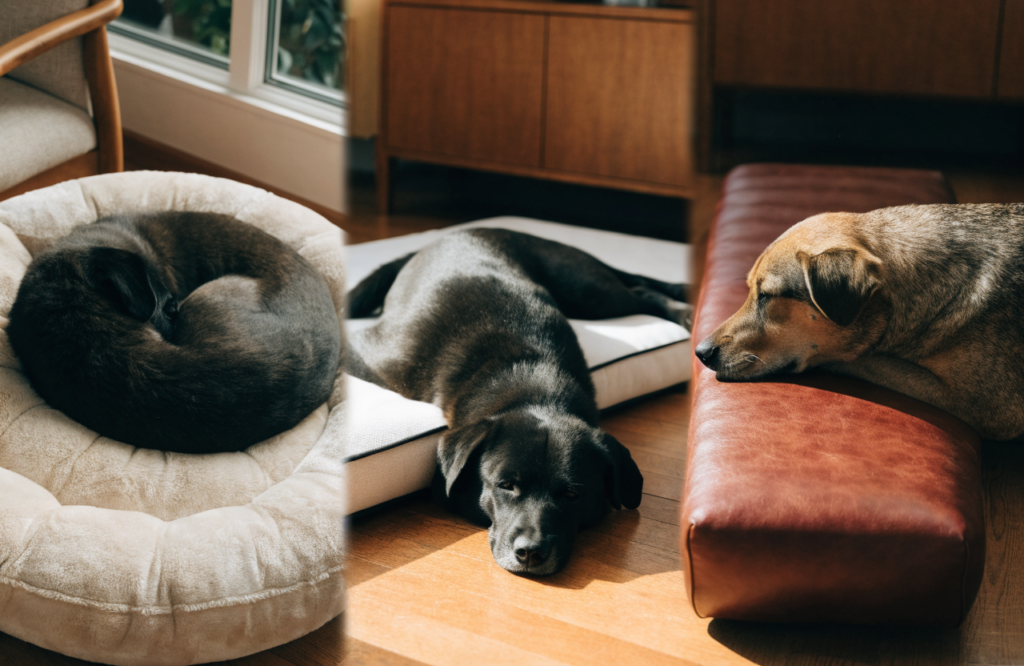
Watch the dog for a few nights before you buy. The pose they return to is more useful than the pose in a product photo.
- Curlers tuck into a circle and often rest a head or back against a wall. Round, donut, and bolster beds suit them because the raised edge gives a boundary. A very large open mattress can feel less secure to a small curler.
- Side sleepers need their full nose-to-tail length, plus room to extend the legs. A rectangular mattress or a bolster bed with a clear interior works better than a tight round bed.
- Sprawlers fling limbs outward and often hang off edges no matter the size. They need a flat or lightly bolstered rectangle, sized to the stretched body, not the curled one.
- Head-resters use a bolster, sofa arm, or wall as a pillow. A raised edge on one or more sides is the feature that matters, not extra plush in the middle.
- Burrowers push under blankets or into hooded and cave beds. Those shapes can help anxious dogs settle, but they trap heat and are harder to supervise if the dog chews.
A dog can use more than one pose. If they curl in the evening and sprawl overnight, a rectangular bed with a bolster on one or two sides is usually more flexible than a fully enclosed donut.
Measure the sleeping surface, not the label
Weight-based size charts are a rough filter. Body length in a sleeping position is the measurement that predicts whether the dog will stay on the bed.
- Wait until the dog is relaxed and lying down, not standing.
- Measure from the tip of the nose to the base of the tail, not the tip of the tail.
- For sprawlers, also measure across the body at the widest point while they are on their side.
- Add about 6 to 12 inches (15 to 30 cm) to the length. Use the lower end for a dog that stays tightly curled, and the higher end for a dog that stretches.
- Read the product’s interior dimensions if the bed has bolsters. Outer length includes walls the dog cannot lie on. A bolster bed often needs to be one size larger than a flat mat for the same dog.
When you are between sizes, size up, with one exception: a tiny curler may ignore a bed so large that the raised edge no longer feels like a boundary. Nothing else fixes a bed that is too small. A folded blanket can make a slightly large bed cozier.
These ranges are starting points, not a substitute for measuring your dog. Labels vary by brand.
| Dog | Typical weight | Starting bed size | Notes |
|---|---|---|---|
| Toy / XS | Under 12 lb (5 kg) | About 18 x 14 in (45 x 35 cm) | Curlers can use a smaller round bed |
| Small | 12–25 lb (5–11 kg) | About 24 x 18 in (60 x 45 cm) | Check width on barrel-chested dogs |
| Medium | 25–50 lb (11–23 kg) | About 30 x 24 to 36 x 28 in (76 x 60 to 91 x 70 cm) | Bolster interiors run smaller |
| Large | 50–90 lb (23–41 kg) | About 36 x 28 to 42 x 32 in (91 x 70 to 107 x 81 cm) | Foam thickness matters as much as floor area |
| Giant | 90 lb+ (41 kg+) | About 44 x 34 in (112 x 86 cm) and up | Confirm the foam will not bottom out |
Crate pads are the exception to “size up.” They should match the crate floor so the pad does not bunch against the walls.
Choose the bed type for the dog and the room
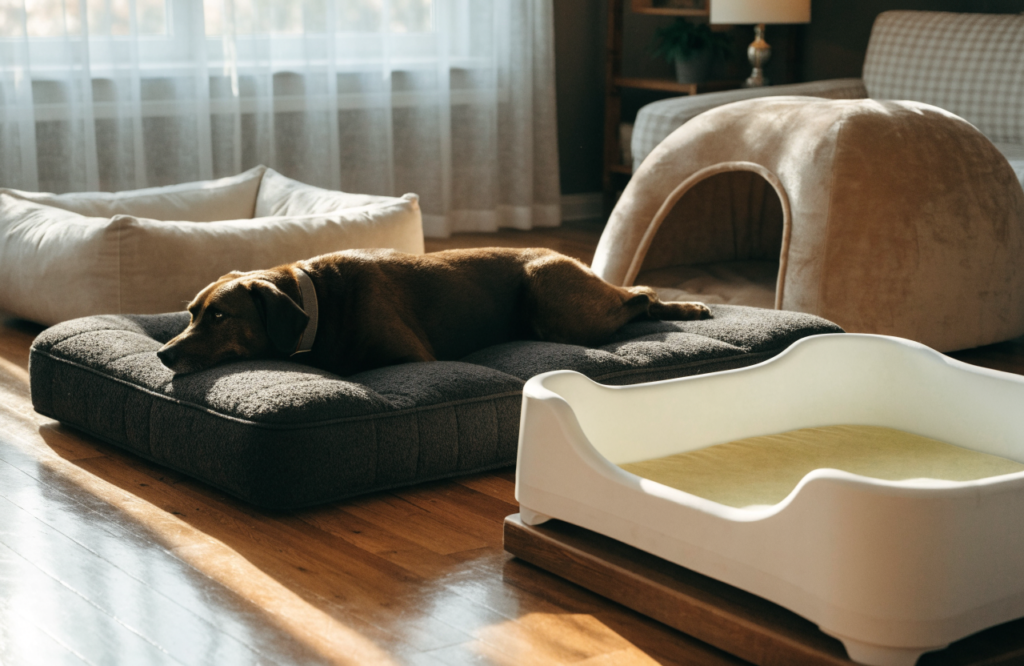
Indoor beds fall into a few useful categories. The right one depends on mobility, chewing, temperature, and how much floor space you can spare.
Orthopedic mattresses use a foam slab, sometimes with a memory-foam or egg-crate top layer. They suit seniors, large dogs, and dogs that settle in one position for long stretches. Look for a low front edge so a stiff dog can step on and off. A high bolster on every side can trap a dog that struggles to stand.
Bolster and sofa-style beds add a raised rim for head and back support. They work well for curl-up sleepers and for dogs that like to lean. The tradeoff is a smaller sleeping area and more fabric to wash.
Donut and calming beds are deep, round nests. Small and medium dogs that want enclosure often take to them. Large dogs rarely get full-body support from a donut, and the high walls are a poor fit for dogs with hip pain who need an easy exit.
Cave and hooded beds give a den-like cover. They can help noise-sensitive dogs, but they hold heat and hide damage if a dog chews the interior.
Elevated cots lift the dog on a mesh or fabric surface over a frame. Airflow underneath makes them a practical indoor option for hot sleepers and thick coats. They offer less cushioning than foam, so they are a weaker choice for a senior who needs pressure relief, unless the cot has a padded mat.
Crate pads and flat mats are the simplest indoor beds. A waterproof mat is the sensible first bed for a puppy. Mats also work as a second bed in a kitchen or office when a full bolster bed would block the room.
Two modest beds in the places the dog already rests often get more use than one expensive bed in a corner the dog does not visit.
What the filling and cover actually change
“Orthopedic” is a marketing word. There is no single regulated standard behind it. Judge the bed by foam depth, whether the maker states a density, the cover, and the return policy.
| Fill or cover | What it does | Better for | Watch-outs |
|---|---|---|---|
| Solid high-density foam | Even support that holds shape | Large dogs, long rest periods | Thin slabs bottom out under heavy dogs |
| Memory foam | Softens and contours under weight and warmth | Dogs that settle in one spot | Can sleep warm; quality varies widely |
| Egg-crate foam | Peaks spread pressure and allow some airflow | Budget supportive toppers | Peaks compress under big dogs |
| Polyester or fiber fill | Soft, light, inexpensive | Small dogs, light use, spare beds | Clumps and flattens; weak joint support |
| Gel-infused foam or a gel layer | Slows heat buildup at the surface | Hot sleepers who still need foam | Cooling is relative, not cold all night |
| Waterproof liner | Blocks accidents from reaching the foam | Puppies, incontinent seniors | Can feel clammy if it cannot dry |
| Fleece or sherpa | Warm, soft surface | Small dogs, cool rooms | Holds hair; some dogs overheat |
| Canvas, oxford, or ballistic nylon | Tougher weave | Chewers, diggers | Less plush |
Foam thickness is the practical check when density is not listed. Guides aimed at heavier dogs commonly look for roughly 4 inches (10 cm) or more of supportive foam, and more than that for giant breeds. A 7 cm pad that feels fine under a 10-pound dog can compress to the floor under a 100-pound dog. If a listing will not say how thick the foam is, assume it is thinner than the photo suggests.
Shredded foam can feel plush and is easier to adjust, but it shifts. A solid slab is more predictable for a dog that needs the same support every night. A removable, machine-washable cover matters more indoors than the outer color. Zippers should be covered or lockable if the dog investigates them. A non-slip base keeps the bed from skating on hardwood and tile.
For a determined chewer, a tough cover is not enough if the dog can open the bed and reach the foam. Exposed foam is a swallowing risk. A flat, durable mat or a cot with no loose fill is safer until chewing settles. Do not leave a bed with torn foam where the dog can keep working at it.
Placement matters as much as the bed
Dogs often reject a good bed because of where it sits.
- Put the first bed where the dog already lies, even if that is not the corner you prefer. You can move it a short distance later.
- Keep it out of drafts, direct sun, and the blast from a heater or vent. Foam holds heat; a bed beside a radiator is a common reason a dog abandons it in warm weather.
- Leave a clear path on and off. A bed jammed against furniture is awkward for a senior and easy for a puppy to drag.
- If the household is busy, a bed in the main room usually wins over a quiet spare room. Many dogs rest better where they can see people.
- In a multi-dog home, separate beds reduce guarding. Identical beds placed a little apart work better than one shared nest.
- A waterproof layer under the bed protects wood floors. Check that it does not make the non-slip base slide.
New beds smell like the factory. A worn T-shirt or a blanket the dog already uses, washed with the cover if the care label allows, helps the bed smell familiar. Do not force the dog onto it.
Why a new indoor dog bed gets ignored
The bed is too small, and the dog hangs off it within a night or two. Bolster beds are the usual culprit because the listed size is the outside.
The fill is wrong for the dog. A memory-foam bed in a warm room, or a deep sherpa donut on a double-coated breed, can be abandoned for the tile. Offer a cooler mat in summer and a warmer bed in winter rather than expecting one surface to work year-round.
The entry is too high. Seniors and dogs recovering from orthopedic surgery often need a low step-in. A plush sofa bed can be harder to climb than the floor.
The dog prefers a hard surface sometimes. That is common and not always a sign the bed failed. Keep the bed available; many dogs use it for longer sleeps and the floor for short naps.
Chewing or digging starts at the seams. Rotate to a tougher bed, and do not treat a shredded foam bed as still safe.
How long a bed should last
Fiber-fill beds flatten first, sometimes within months under daily use. Foam lasts longer if it is dense enough for the dog’s weight and stays dry. Sagging in the middle, a permanent body impression, or a cover that no longer protects the core are reasons to replace the bed. A waterproof liner only works if accidents are cleaned and the bed is dried; moisture trapped against foam leads to odor that washing the cover will not fix.
A warranty against foam compression is more meaningful than a lifetime warranty that covers only stitching defects. If the maker does not state foam thickness, density, or what the warranty actually covers, price is a weak guide to durability.
Frequently asked questions
Is memory foam better than regular orthopedic foam? Memory foam contours, which some dogs like, and it often sleeps warmer. A firmer high-density foam slab keeps its shape longer under heavy dogs. Either can work if it is thick enough that the dog does not hit the floor through it.
Do indoor dogs need an orthopedic bed? Not every dog does. Puppies and healthy small adults often do fine on a washable mat or modest bolster bed. Orthopedic foam is the more useful spend for seniors, large breeds, and dogs that are stiff after lying down. Pain, limping, or trouble standing should be checked by a vet rather than treated with a bed alone.
Can an outdoor cot be used inside? Yes, if the frame is stable and the mesh is comfortable for that dog. Cots are a good indoor cooling option. They are less suitable as the only bed for a dog that needs thick cushioning.
How often should the cover be washed? A removable cover every few weeks is a reasonable baseline, and sooner after muddy walks or accidents. Wash the liner and let the foam air dry completely before reassembling. Constant high-heat drying shortens the life of both foam and fabric.
What if my dog only sleeps on the couch? A bed placed beside the couch, with a familiar blanket on it, is more likely to be used than a bed in another room. Some dogs will still prefer the sofa. A washable cover on the sofa and a supportive bed as the overnight option is a practical compromise.