
Crate training a puppy works when the crate is introduced as a small, predictable resting place the puppy can enter willingly, not as a lockup for the hours you cannot supervise. Done that way, it supports house-training, protects the puppy from household hazards, and gives a young dog a spot to settle. Rushed, used as punishment, or stretched past what a puppy can physically hold, it teaches the opposite: that the crate is somewhere to avoid.
What crate training is actually solving
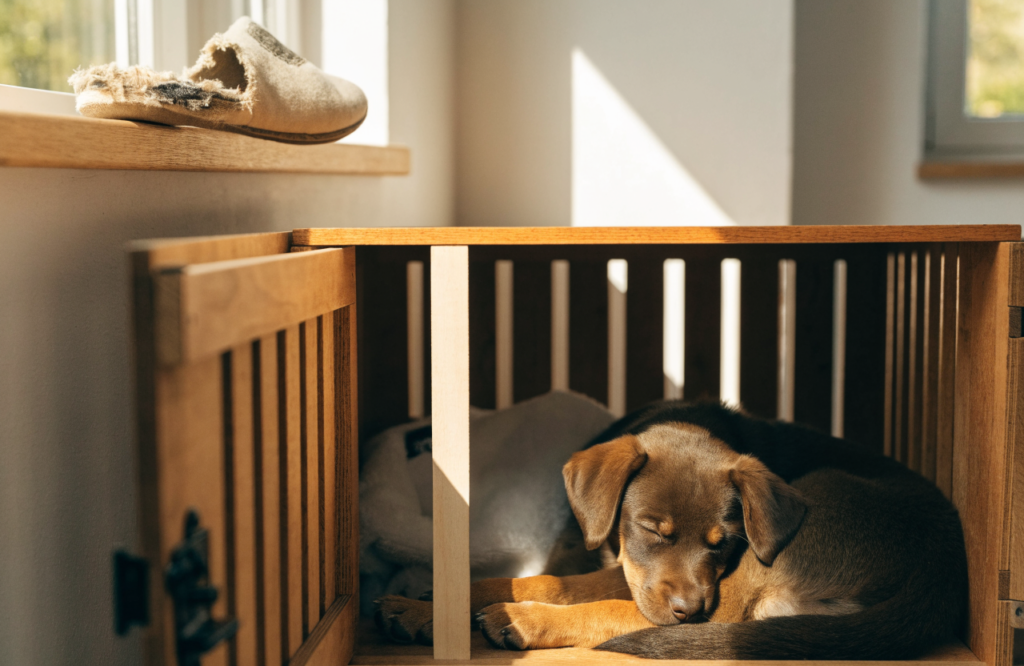
A puppy does not arrive knowing which rooms are off-limits, which objects are toys, and when the household is asleep. A correctly sized crate limits those choices while the puppy is learning. Most dogs also prefer not to soil the place they sleep, so short, well-timed crate periods reduce indoor accidents while you are building a potty routine.
That benefit has a boundary. The American Society for the Prevention of Cruelty to Animals notes that a crate should not be used simply because a dog keeps getting into trouble and needs attention, and that the longer-term goal is a dog who can eventually be left free once they know where to eliminate and what not to chew. An exercise pen or a puppy-proofed room is often a better daytime setup for dogs who do not settle in a crate, or for stretches when you need containment but the puppy also needs room to move.
A crate is also not a substitute for exercise, training, or company. Puppies sleep a large part of the day, but the time outside the crate is when house manners, bite inhibition, and confidence are actually learned.
Choosing a crate the puppy can use
Size matters more than style. The crate should be large enough for the puppy to stand, turn around, and lie down comfortably, and not much larger. Extra floor space lets a puppy sleep at one end and eliminate at the other, which undoes the house-training advantage. For a growing puppy, buy a crate sized for the expected adult weight and use a divider panel so the usable space stays snug until the dog fills it.
Wire crates let the puppy see the room and are easy to cover on three sides if a darker den effect helps them settle. Plastic travel crates feel more enclosed and work well for car trips, but they can hold heat. Either can work. What fails is a crate the puppy has already learned to fear, a door that slams, or bedding that gets shredded and swallowed. Many trainers start without soft bedding until accidents and chewing are under control, then add a washable pad once the puppy is reliable.
Remove collars and tags before closing the door. A collar caught on crate wire is a real injury risk.
How to introduce the crate
The introduction is the training. Closing the door on day one and leaving the house is the pattern most often behind later barking, drooling, and refusal to enter.
- Put the crate in a room where the household spends time, with the door fixed open. Drop a few treats near the entrance, then just inside, without calling the puppy in. Let them investigate and leave.
- Feed meals in the crate with the door open. Start with the bowl near the entrance and move it farther back over several meals. A puppy who eats calmly inside is already building the association you want.
- Toss a treat in, let the puppy enter, and reward while they stay. A useful early pattern is a treat every few seconds for remaining inside, then an easy exit. Do not push, lift, or shut the door on a puppy who is still hesitating at the threshold.
- Once entry is voluntary, close the door for the length of a meal or a short chew, stay in the room, and open it before the puppy finishes and starts asking to come out. Build from seconds to a few minutes only while the puppy is quiet.
- Add brief absences after closed-door sessions with you nearby are easy. Step out of sight, return, and open the door during a pause in any noise. Mix the lengths rather than climbing in a straight line every session.
- Pair longer rests with a stuffed food toy and a puppy who has just been outside to eliminate, then played or trained, then given a few minutes to wind down. Crating a wired puppy straight from a game is a common reason the first closed-door sessions fall apart.
Teach a cue such as “crate” or “kennel” only after the puppy is already choosing to go in for food. The cue should mean “good things happen in there,” not “you are in trouble.”
If the puppy paces, shakes, scratches or bites the door, drools, or howls in long bouts, that session is too hard. Shorten it or go back to an open door. The American Kennel Club’s guidance is explicit on this point: do not force a dog in, and do not leave a dog to cry it out when the crate is causing stress.
How long a puppy can stay in a crate
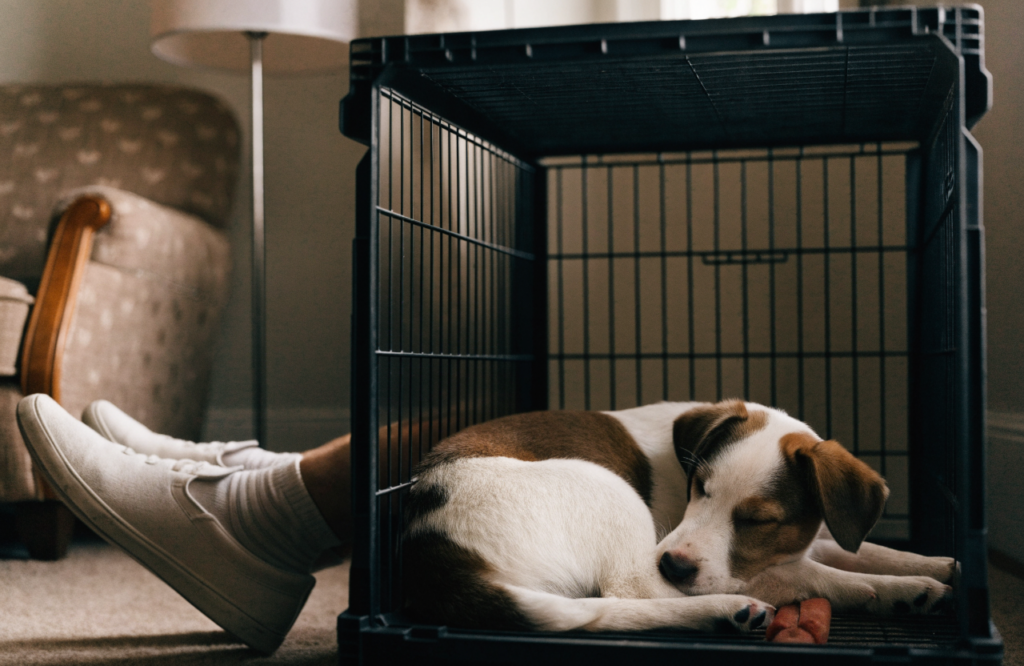
The limit is bladder control and welfare, not the length of a workday. ASPCA guidance is that young puppies should not be crated for more than an hour or two at a time except at night, and that an adult dog should not be crated for more than about four hours at a stretch. A widely repeated rule of thumb is about one hour of daytime crate time per month of age. Treat that as a ceiling to stay under, not a target to hit.
| Age | Practical daytime limit | Overnight |
|---|---|---|
| 8–10 weeks | 30–60 minutes | Usually needs at least one toilet break |
| 11–14 weeks | 1–3 hours | Often one break, then longer stretches |
| 15–16 weeks | Up to 3–4 hours | Many sleep through if the last outing is late |
| 4–6 months | About 4 hours as a ceiling | Usually through the night |
| Adult | About 4 hours at a time; 6–8 hours only as an exception | Through the night for most healthy dogs |
These ranges assume the puppy was taken out just before crating and is not recovering from a big drink or a meal. Right after waking, eating, playing, or drinking, most puppies need to go out sooner than the table suggests. If you are gone longer than the puppy can hold, a midday visit, a walker, or a pen with a potty area is the responsible setup. A puppy who is forced to eliminate in the crate learns that soiling the bed is unavoidable, and house-training slows down.
Night stretches can be longer than daytime ones because metabolism and activity drop during sleep. That does not mean an eight-week-old puppy can be left from 10 p.m. to 7 a.m. Plan on a boring, lights-low toilet trip when a young puppy wakes, then straight back to the crate.
The first nights
Most of the noise in week one is a puppy who has never slept away from littermates. Putting the crate in the bedroom, close enough that the puppy can hear you, removes a large part of that shock. A cover on three sides, a fan or steady background sound, and a safe chew can help. A hand resting near the door for the first night or two is a reasonable bridge, not a permanent arrangement.
Take the puppy out late, keep the trip dull, and return to the crate. If they whine, wait for a brief pause before you open the door. Opening the door in the middle of barking teaches the puppy that noise ends the session. A pause of a few seconds is enough at the start.
Distinguish need from protest. A puppy who just ate and drank, then wakes after a couple of hours, usually needs the toilet. A puppy who was out 20 minutes ago and escalates the moment you move may be asking for company or play. Meet the toilet need, skip the play.
Some puppies settle faster once a familiar-smelling item is in the crate. Others pee on every pad until house-training is further along. If bedding causes accidents, use a towel you can wash and reassess in a week or two.
Mistakes that create a crate-resistant puppy
- Using the crate as a penalty after chewing, barking, or an accident. A few repetitions are enough to poison the place you need for sleep and safety.
- Skipping the open-door phase. A puppy who is fine on night one and frantic by night three was often never taught that the crate predicts food and rest, only confinement.
- Leaving a crate too large. If the puppy soils one corner and sleeps in another, shrink the space with a divider before you add more training.
- Releasing on demand barking. Waiting for quiet is not the same as ignoring distress. Quiet release works when the puppy can already settle for short periods. It does not work when the puppy is panicking.
- Crating for the workday and again all night. That schedule leaves too little time awake for training, play, and toileting. The crate stops being a rest spot and becomes the default location.
- Making departures and arrivals emotional. A calm exit and a low-key return keep the crate from predicting a big event.
When crying is a training issue, and when it is not
Short fussing that fades within a minute or two, in a puppy who eats in the crate and naps there during the day, is usually adjustment. Check the basics first: last toilet trip, temperature, water earlier in the evening, and whether the puppy had any real activity and then a wind-down before bed.
Persistent panic is different. Drooling, frantic digging, broken nails, escaped crates, or noise that does not ease when you are visibly home can be separation anxiety or a medical problem such as a urinary tract infection. In those cases, stop closed-door crating and use a safer confined area while you get help. Reward-based training is the standard veterinary behavior guidance recommends. A certified professional or a veterinary behaviorist is the right next step if the puppy cannot settle even for meals with the door open.
Crate training can take a few days or several weeks. A puppy who voluntarily naps in the crate with the door open is further along than a puppy who only stays quiet when exhausted.
Questions owners ask after the first week
Should every puppy be crate trained? No. It is a useful tool for house-training, travel, and recovery from surgery, and many dogs keep using a crate as a bedroom for life. A dog who has already had a bad experience, or who panics in close confinement, may do better in a pen or a puppy-proofed room. Comfort is the measure, not whether the dog will tolerate a closed door.
Can I put the crate in another room right away? You can, but many puppies sleep more readily for the first several nights if they can hear you. Move the crate toward its long-term spot in small steps after overnight stretches are already quiet.
What if my puppy only cries at night? Daytime naps with you nearby are an easier context. Night adds darkness, quiet, and distance. A late toilet trip, a short calm chew, the crate in the bedroom, and a predictable bedtime usually close that gap. If the puppy sleeps in the crate by day and screams only when left in another room, location is the variable to change first.
Is it cruel? Confinement that exceeds bladder control, replaces social time, or continues through panic is a welfare problem. A properly sized crate used for rest, introduced with food, and paired with enough time outside it is a management tool, not a punishment. The misuse is what makes it cruel, not the object.