
Potty training a puppy is mostly a timing problem, not a discipline problem. A young puppy cannot hold urine the way an adult dog can, and most indoor accidents happen because the opportunity arrived before the puppy was outside. The reliable method is simple and repetitive: take the puppy out on a schedule, reward elimination in the right place within a second or two, and block unsupervised access to the rest of the house until the habit is solid. Punishment does not teach location. Prevention does.
Major veterinary and welfare groups, including the ASPCA and the American Kennel Club, describe the same core: supervision, short confinement, frequent trips to one elimination area, and immediate rewards. Dr. Jerry Klein, the AKC’s chief veterinarian, has noted that a puppy started early is often dependable outdoors most of the time by about six months — not accident-free in every new situation, and not on a fixed calendar. If progress stalls, a veterinary check comes before another training tweak, because a urinary tract infection or digestive problem can look exactly like a training failure.
Why the schedule matters more than the cue
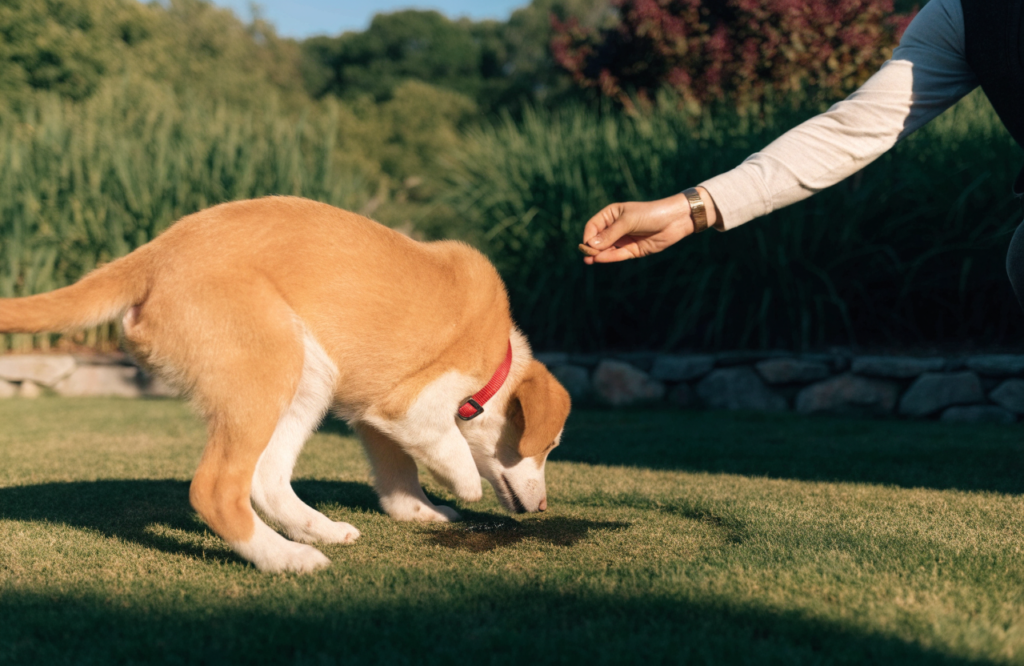
A puppy learns “this surface, this spot” by repeating the successful trip, not by hearing a word. The phrase you use — “go potty,” “outside,” or anything short and consistent — only becomes useful after the puppy has already eliminated in the right place many times while hearing it. Say it calmly as the puppy starts to go, then pay the reward the moment they finish.
Three constraints shape every good plan:
- Bladder and bowel control are immature. Very young puppies often need a trip every 45 to 90 minutes while awake, plus an extra trip after sleep, food, drink, and play.
- A commonly cited maximum is about one hour per month of age, sometimes stated as age in months plus one. That figure is a ceiling for a calm or sleeping puppy in a properly sized crate, not a target for an awake puppy running around the living room. A three-month-old who can manage a few quiet hours overnight still needs far more frequent breaks during the day.
- Dogs generally avoid soiling the place they sleep, but only if that space is small enough that they cannot pee in one corner and lie down in another. A crate that is too large removes the advantage.
Expect accidents in the first weeks even with a good routine. Success at eight to twelve weeks is mostly the adult getting the puppy outside in time.
How often to take a puppy out
Use the table as a starting interval while the puppy is awake, then add the event-based trips on top. Small breeds and toy puppies often need the shorter end of each range. Individual puppies vary, and any puppy who is drinking more, straining, or having diarrhea needs a vet before the schedule is blamed.
| Age | While awake | Overnight, if settled | What usually changes |
|---|---|---|---|
| 8–10 weeks | Every 45–60 minutes, plus after sleep, meals, and play | Often 1–2 trips | Accidents are normal; your timing does the work |
| 10–12 weeks | About every hour | Sometimes one trip, sometimes none | Sniffing and circling become easier to read |
| 3–4 months | Every 1.5–2 hours | Many sleep through | Some puppies start moving toward the door |
| 4–6 months | Every 2–3 hours | Usually sleeps through | Reliable at home, slips when excited or in new places |
| 6–12 months | Every 3–4 hours | Sleeps through | Bladder capacity approaches adult range around a year |
The ASPCA recommends starting a new dog on a trip every couple of hours, and more often if the dog is active or still having accidents. The AKC’s timeline advice is the same idea: out immediately after waking, within about 5 to 30 minutes of a meal (sooner for younger puppies), after drinking, after play, and last thing at night.
A practical day for an 8- to 12-week-old puppy looks like this. Shift the clock to your household, and keep the gaps.
- Wake, carry or leash straight outside before greetings, breakfast, or play. Give the puppy several quiet minutes in the same spot.
- Breakfast, then outside again about 10 to 15 minutes later. Most puppies urinate soon after eating and defecate within about half an hour.
- Short supervised play or a training game, then outside again.
- Nap in a crate or pen. Outside the moment they wake.
- Repeat through lunch and the afternoon: meal, potty, supervised time, nap, potty.
- Last meal in the early evening, not right before bed. Water stays available during the day. A modest reduction in the hour or two before bed can cut overnight trips, but do not withhold water all evening from a puppy who has been active.
- Final trip outside, then crate in or near the bedroom so you can hear whining that means “I need to go,” not just “I want company.”
If the puppy does not go within about five minutes, bring them in, keep them tethered to you or back in the crate, and try again in 10 to 15 minutes. Free roaming after a failed trip is how most “mystery” accidents happen.
Supervision and the crate
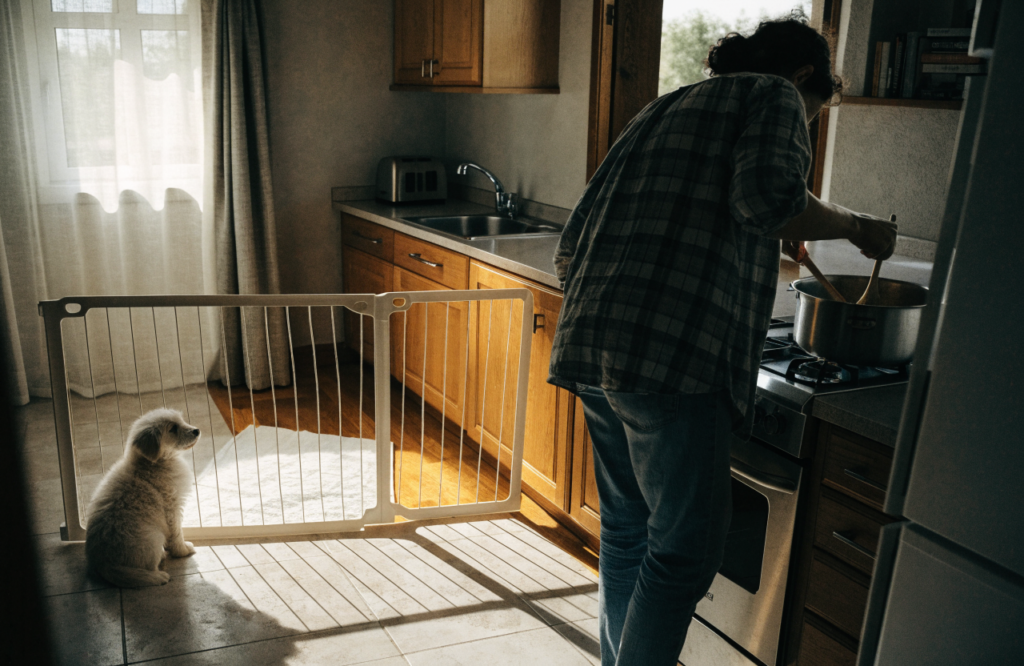
Until the puppy is reliable, the rule is simple: watched, or contained. Not both off. Close doors, use a baby gate, or keep a light leash on indoors so the puppy cannot vanish behind a sofa. The ASPCA’s house-training guidance centers on this management, because a puppy who is out of sight will often find a quiet corner and practice the wrong habit.
A crate helps for two reasons. It uses the tendency not to soil a bed, and it stops the puppy from rehearsing indoor elimination when you cannot watch. Size it so the puppy can stand, turn around, and lie down, but not much more. A divider panel lets you buy an adult-sized crate and shrink it now. The ASPCA notes that young puppies should not be crated for more than about an hour or two at a time during the day, aside from sleep, and that an adult dog’s crate limit is often discussed around four hours. Overnight, puppies usually last longer because they are asleep, but an eight-week-old may still need a middle-of-the-night trip. Put the crate where you can hear it.
If the puppy soils the crate, the usual causes are too much space, too long a confinement, stress, or a medical issue. Do not respond by leaving them in a dirty crate. Clean it, shorten the interval, and check the size. A crate should never be a punishment. If confinement is frightening, an exercise pen with a bed at one end and, if needed, a potty surface at the other is a better daytime setup than forcing the crate.
Freedom expands only after a stretch of success, not after one clean afternoon. A common working standard is two or three accident-free weeks in the current space before you open one more room. New flooring, visitors, and exciting play reset the clock.
Rewards that actually teach the location
The reward has to land outside, at the spot, immediately after the puppy finishes. A treat given back in the kitchen rewards coming inside. Praise and a small, high-value piece — a bit of cooked meat, cheese, or freeze-dried liver, used only for this — work better than a dry biscuit the puppy can take or leave. The ASPCA specifically suggests reserving a better treat for correct elimination and being generous early on.
A few details change the result:
- Be boring on the way out and while you wait. Excited talk and play delay the puppy or make them forget why they are there.
- After they go, then play or walk. If the only way to get a walk is to hold it, some puppies learn to delay.
- Carry small puppies to the grass in bad weather or first thing in the morning so they do not leak on the way.
- Use the same door and the same patch of yard. Scent helps the next trip happen faster.
Bells on the door can work later, once the puppy already goes outside reliably. Teaching a bell too early often produces a puppy who rings for attention, not for elimination.
Accidents, cleanup, and what not to do
If you catch the puppy starting to squat, interrupt with a calm clap or a short “uh-oh,” pick them up, and finish the trip outside. Reward only if they finish in the right place. If you find a puddle later, clean it and adjust the next interval. A puppy cannot connect scolding to an accident that already happened. Rubbing a nose in it, yelling, or punishing after the fact teaches the puppy to hide from you when they need to go, which produces more secret indoor spots.
Clean with an enzymatic cleaner made for pet urine, not ammonia. Ammonia smells related to urine and can bring the puppy back to the same corner. Blot first, then saturate the area so the cleaner reaches what soaked into the pad or subfloor. Visible stains are not the problem; residual odor is.
Submissive urination — a small leak during greetings or when the puppy is unsure — is not a house-training failure. Keep arrivals calm, crouch sideways instead of looming, and skip excited greetings until the puppy is steady.
Pads, indoor grass, and apartment living
Pee pads and indoor grass patches are a management tool, not a required step. They make sense if you cannot get outside often enough for the puppy’s age, if the puppy is very small, or during weather that makes outdoor trips unsafe. The tradeoff, noted by AKC training experts, is that you are teaching two legal bathrooms. Some puppies then treat any soft indoor surface as fair game.
If you use pads:
- Put them in one fixed spot, not scattered through the house.
- Take the puppy there on the same schedule you would use for the yard, and reward on the pad.
- Do not leave pads down in every room “just in case.” That removes the distinction you are trying to teach.
- When you switch outdoors, move the pad to the door, then just outside, and phase it out once outdoor trips are consistent.
A long-term indoor toilet can be the right choice for some city dogs and owners with mobility limits. Decide that on purpose. Accidental pad training followed by frustration that the puppy “still goes inside” is the usual failure mode.
Nights, rain, and the first days home
The first 48 hours in a new home are noisy and confusing, and house-training accidents are expected. Keep the world small: one room, a crate, frequent quiet trips out, and no parade of visitors. Feed on a clock so elimination stays predictable. Puppies eight to twelve weeks old are often on three or four meals a day; that meal rhythm is part of the potty plan.
At night, the last trip is non-negotiable. Set an alarm for a middle-of-the-night break with very young or small puppies rather than waiting for a mess. Keep the trip dull — outside, eliminate, treat, back to bed — so it does not become a play session. Whining needs a quick check: if it has been long enough that the puppy might truly need to go, take them out. If they just came in and are clean, wait briefly so crate time does not become an on-demand exit.
Rain and cold slow puppies down. A towel by the door and a treat that appears only on wet-weather trips keep those outings from becoming a battle. Some owners move the potty spot closer to the door in bad weather, then walk it back out once the puppy is reliable.
When progress slips
A puppy who was doing well and then starts missing again has usually not “forgotten.” Common reasons are a longer interval than the bladder can handle, a new room, teething and growth around four to six months, adolescent distraction later in the first year, a change in feeding schedule, or incomplete cleanup of an old spot. The fix is a return to the earlier routine for a week or two: shorter gaps, leash or pen, rewards outside, no added freedom.
Regression that is sudden, frequent, or paired with other signs is a medical question first. Contact a veterinarian if you see blood in urine or stool, straining, crying while eliminating, very frequent small urinations, accidents during sleep, marked thirst, diarrhea, or a puppy who seems unwell. Diet that produces loose or bulky stool also makes timing harder; that is a feeding conversation with your vet, not a stricter scolding plan.
If medical causes are ruled out and a tight routine for several weeks still produces daily accidents, a reward-based trainer can look at timing, confinement, and whether the puppy is afraid to go while someone is watching. That last pattern is almost always created by punishment.
Frequently asked questions
How long does potty training a puppy take? Many puppies show a clear drop in accidents within a few weeks of a consistent schedule, and are mostly reliable at home by about six months if training started early. Full reliability in new places, during excitement, and through adolescence often takes longer. Owner reports vary from days to several months; the puppy’s age, size, and how often someone can get them outside explain most of that spread.
Should I wait for the puppy to signal? No, not at first. Young puppies often do not signal clearly. Take them on the schedule, and treat a trip to the door as a bonus once it appears. Waiting for a signal is how the first quiet puddle happens.
Is crate training required? No. A pen, a gated kitchen, or a leash tied to your belt can replace the crate for supervision. The crate is effective because of size and the sleeping-space instinct, and it is worth using if the puppy accepts it. It is a poor fit if confinement causes panic.
What if I work all day? A puppy under four or five months cannot be left a full workday without a break. Arrange a midday visit, a walker, or a pet sitter. For longer absences, the ASPCA suggests a small confined area with a bed, water, a food toy, and a legal elimination surface, rather than a crate the puppy is forced to soil.
Why does my puppy pee outside and then pee again inside? They were not finished, the reward came too late to mark the outdoor spot, or play started before the bladder was empty. Stay out a minute or two after the first squat, reward at the grass, and supervise closely for the next 10 minutes indoors.