
A puppy does not need to “settle in” before training starts. The useful work begins the day they come home, usually around eight weeks: short reward-based sessions, a tight potty routine, and calm exposure to ordinary life before the early socialization window closes. Obedience cues matter, but they are not the main job. Preventing accidents, hard bites, and fear is what makes the rest of the year easier.
Most of what looks like a training failure in the first months is a management problem. A puppy who can wander the house will practice the wrong habits faster than you can reward the right ones. Confinement, supervision, and well-timed food solve more problems than corrections.
Why the first 16 weeks matter more than later obedience
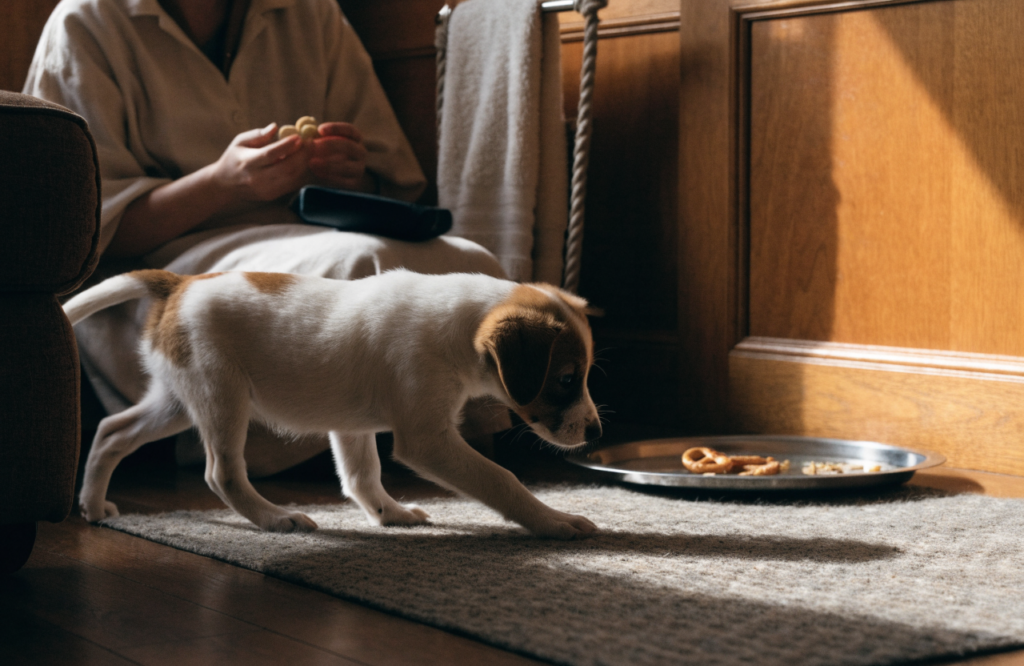
The American Veterinary Society of Animal Behavior treats the first three months of life as the primary socialization window, the period when sociability outweighs fear. Incomplete socialization in that window raises the later risk of fear, avoidance, and aggression. Behavioral problems, not infectious disease, are the leading cause of death in dogs under three and the leading reason dogs are given up. AVSAB’s position is that puppies should be socialized before they are fully vaccinated, and that puppy classes can start as early as 7–8 weeks once the puppy has had at least one vaccine set at least seven days earlier and a first deworming.
That does not mean dog parks, pet-store floors, or chaotic meet-and-greets. It means controlled, positive exposure: sounds, surfaces, handling, calm vaccinated dogs, and people of different ages, done at a level the puppy can still eat and explore. Waiting for the full vaccine series to finish often means missing most of the window.
Reward-based methods are the standard here for a second reason. AVSAB’s humane-training position recommends reinforcement of wanted behavior and removal of reinforcement for unwanted behavior, and advises against pain, intimidation, leash jerks, and tools such as prong, choke, and electronic collars. A puppy who is startled or forced learns to avoid the situation, not to understand the cue.
What to train first, by age
Puppies can learn simple cues at eight weeks. What changes with age is how long they can focus and how much distraction they can handle. Five sessions of two or three minutes beat one long lesson. End on something easy.
8 to 12 weeks: name, potty, handling, and a safe place
Teach the name as a look, not a recall. Say it once. If the puppy turns toward you, mark that with a short word such as “yes” and give a tiny treat. Repeat in a quiet room, then in the next room.
Potty trips are the other priority. Take them out after waking, after eating or drinking, after play, and about every hour while they are awake. A common rule of thumb is that a puppy can hold urine for roughly one hour per month of age during the day, so an eight-week-old is closer to one or two hours, not a morning-to-night stretch. Small breeds, excited puppies, and puppies who just drank often need more frequent trips. Overnight, many young puppies still need one break.
Also practice handling: brief touches of paws, ears, collar, and mouth, followed by food. This is vet and grooming preparation, not a wrestling match.
12 to 16 weeks: sit, come, and a short stay
Lure a sit by moving a treat from the nose up and slightly back. The moment the rear hits the floor, mark and give the treat. Add the word “sit” only after the motion is reliable. For come, start a step or two away in a hallway, crouch, and reward arrival. Do not call a puppy to you for something unpleasant, and do not repeat the word if they ignore it. Go get them, then make the next rep easier.
A stay at this age is two or three seconds, then a release word. Duration comes later.
4 to 6 months: leash, leave it, and mild distraction
Let the puppy wear a well-fitted harness indoors before any walk. Reward a loose leash every few steps rather than correcting a tight one. For leave it, cover a treat with your hand, wait for a pause or a look away, then reward from the other hand. The covered treat is not the prize.
This is also when many puppies hit a first fear period, often described around 8–11 weeks and again later in adolescence. If a surface or sound that was fine yesterday is suddenly scary, lower the goal. Reward a look or a step toward it. Do not drag them closer.
6 to 12 months: proofing, not new tricks
Adolescent dogs often “forget” cues they knew at four months. That is normal. Hormonal changes, more independence, and a second fear period commonly placed between about 6 and 14 months all show up here. Go back to shorter sessions, higher-value food, and easier settings. Reliability in the kitchen does not transfer to the sidewalk until you practice the sidewalk.
House training works when you stop the rehearsal of accidents
The ASPCA’s house-training method is supervision, confinement, frequent trips, and a clear reward for going in the right place. Keep the puppy in the room with you, or on a leash clipped to your belt, so they cannot slip off and practice an indoor habit. If you cannot watch them, use a crate sized so they can stand, turn, and lie down, or a pen. Dogs tend not to soil a sleeping area if the space is not so large that one corner becomes a bathroom.
Take them to the same outdoor spot. Stand still and stay boring for at least five minutes. If nothing happens, confine them for about 15 minutes and try again. The moment they finish outside, deliver a small, high-value treat right there: a bit of meat, cheese, or freeze-dried liver works better than a dry biscuit. Then, if you have time, walk. If you rush indoors the second they finish, outside becomes the thing that ends the fun.
If you catch a squat starting, interrupt with a calm “uh-oh,” pick them up, and finish the trip outside. Reward the outdoor finish. Do not scold an accident you did not see. Punishment often teaches the puppy to hide the next one, or to avoid eliminating in front of you. Clean with an enzymatic cleaner so the smell does not mark the spot as a toilet. Ammonia-based products can smell like urine to a dog.
Stretch freedom only after several accident-free days in a given area. Two accidents in a day means the interval was too long. Tighten the schedule before you add rooms.
The first cues, taught so they still work later
Use one word per behavior, and make sure everyone in the house uses the same word. A marker (“yes,” or a clicker charged by pairing click then treat) tells the puppy the exact moment they earned the food. Deliver the treat within a second or two.
Keep criteria honest. A sit in the kitchen with no one moving is a different skill from a sit at the door when guests arrive. Add one difficulty at a time: duration, distance, or distraction, never all three. If the puppy fails twice, you asked for too much. Reset to the last version they could do.
Food should be pea-sized. Training before a meal, not after a full bowl, keeps the reward worth working for. A clicker is optional. The marker only works if it always predicts something the puppy wants.
Mouthing and biting: teach a soft mouth, then end the game
Puppies bite in play. Littermates and the mother stop hard bites with a yelp and a pause. You can copy that. When teeth land too hard, say a short high “ow” and let the hand go still. If the puppy pauses or licks, praise and offer a toy. If the yelp makes them more excited, skip it. The American Kennel Club notes that a loud reaction can rev some puppies up.
The clearer rule is that teeth on skin end the game. Hands away, body still, or a brief turn away. Resume only when the mouth is soft. Keep a tug toy nearby for ankle-chasing. Freeze your feet, offer the toy, and move again once they have the toy. A short crate break can help an over-aroused puppy settle, but only if the crate is already a good place. Do not use it as a scolding spot.
Bite inhibition matters because a dog who has practiced a soft mouth is less likely to break skin if they ever mouth someone out of fear or pain. It does not replace management of real fear or resource guarding. Those need a qualified behavior professional.
Socialization that builds confidence instead of overwhelm
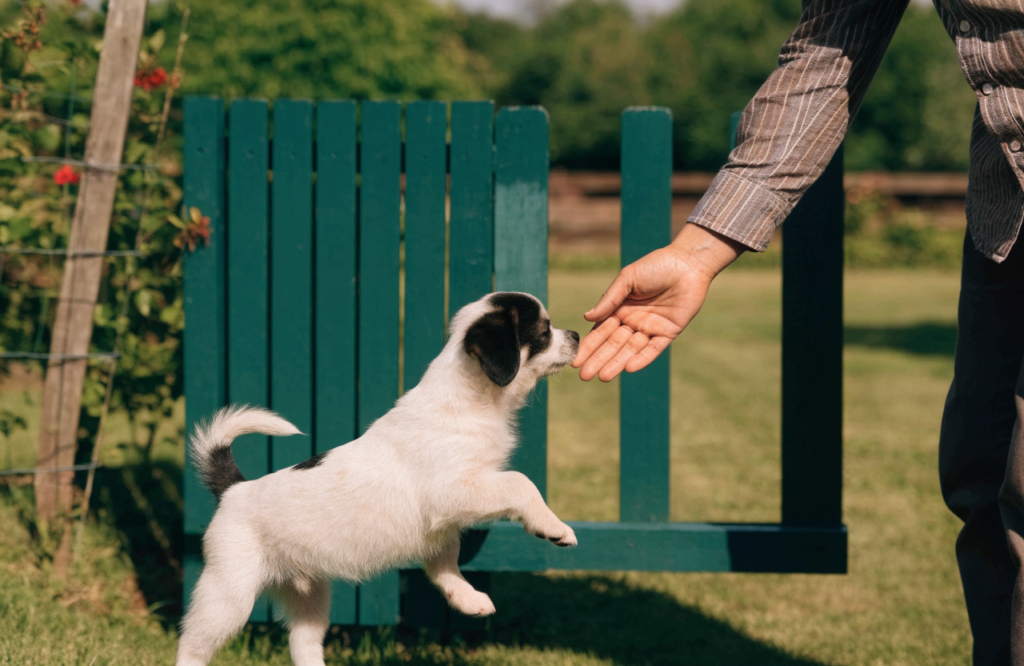
Good socialization is a list of ordinary things paired with good outcomes, not a quota of new dogs. Useful targets in the first months include different floor surfaces, traffic noise at a distance, umbrellas, hats, children sitting quietly, the crate, the car, nail trimmers in sight, and a calm adult dog you know is healthy and vaccinated.
Watch the body, not your schedule. A puppy who is still taking treats, investigating, and recovering quickly can continue. A puppy who freezes, hides, or will not eat is over threshold. Increase distance, shorten the exposure, and pair the sight of the thing with food before you ask them to approach. Flooding, forcing them to stay in a scary situation until they shut down, is not socialization.
Skip dog parks for young puppies. Disease risk and rude adult dogs both undo the point of the outing. One-on-one play with a known, gentle dog teaches more than a free-for-all.
Crate and pen: a den, not a penalty box
Introduce the crate with the door open, meals inside, and a chew they only get there. Close the door for a few seconds while you are still in the room, then build to a few minutes. A puppy who is crated for longer than they can hold urine will soil the crate and learn that the den is not special.
Nighttime is easier if the crate is in the bedroom for the first weeks. You will hear them, and they are less likely to panic. Daytime absences should match the potty interval, not an adult workday. A pen with a bed at one end and a potty patch at the other is the better tool if you must be gone longer than they can hold it.
Mistakes that keep puppies stuck
- Free roam from day one. Every unsupervised accident or chewed cord is a rehearsal.
- Repeating cues. “Sit, sit, sit” teaches that the word is background noise. Say it once, help them succeed, then try again.
- Rewarding the jump by pushing them off while talking. Attention is the prize. Turn away, then reward four paws on the floor.
- Using the same dry kibble for potty and for everything else. The outdoor reward should be clearly better at the start.
- Training only when you are frustrated. A tired, overstimulated puppy after a long play session will not learn a new cue.
- Correcting fear. A puppy who backs away from a stranger needs distance and food, not a leash pop.
When to get help
House-training accidents that continue past six months despite a tight schedule, growling over food or resting spots, or panic when left alone are not “puppy phase” problems to wait out. A veterinarian should rule out medical causes for sudden indoor soiling. For fear, aggression, or separation distress, look for a certified behavior consultant or a board-certified veterinary behaviorist who uses reward-based methods.
Frequently asked questions
How long should a puppy training session last? Two to five minutes for an 8- to 12-week-old, several times a day. By four to six months, 5 to 10 minutes is realistic if the puppy is still working willingly. Stop before they quit.
Can I train before vaccines are finished? Yes for home cues, handling, and sound exposure. For classes and dog contact, follow your veterinarian and the AVSAB guidance: at least one vaccine set seven days prior, deworming, and a clean class that requires vaccine records. Carry the puppy in public areas where the ground is a disease risk.
What if the puppy will not take treats outside? The environment is too hard, or the food is too boring. Shorten the outing, increase distance from the distraction, and use a higher-value reward. A puppy who cannot eat is not in a learning state.
Is crate training cruel? Not if the crate is introduced with food, the puppy is taken out on schedule, and it is not used as punishment. It is a management tool while bladder control and chew habits are still developing.
Why did training fall apart at seven months? Adolescence. Cues that were solid in the kitchen often fail on walks. Return to easier versions, raise the reward, and practice in the places that actually matter. Progress usually returns if the foundation was reward-based rather than forced.