
Shih Tzu puppy training works best as a short, reward-based routine built around a tight potty schedule, early handling, and gradual alone time. These dogs are bright companion animals, not working dogs. They learn cues quickly when the payoff is clear, and they stall or shut down when training feels harsh, long, or pointless. House training is usually the slow part. Basic manners and handling can start in the first week home.
The breed was developed to live close to people. That history explains both the easy affection and the training friction: a small bladder, a strong preference for staying near their person, a coat that needs daily handling, and a shortened muzzle that limits how hard outdoor sessions can be pushed.
What makes Shih Tzu puppy training different
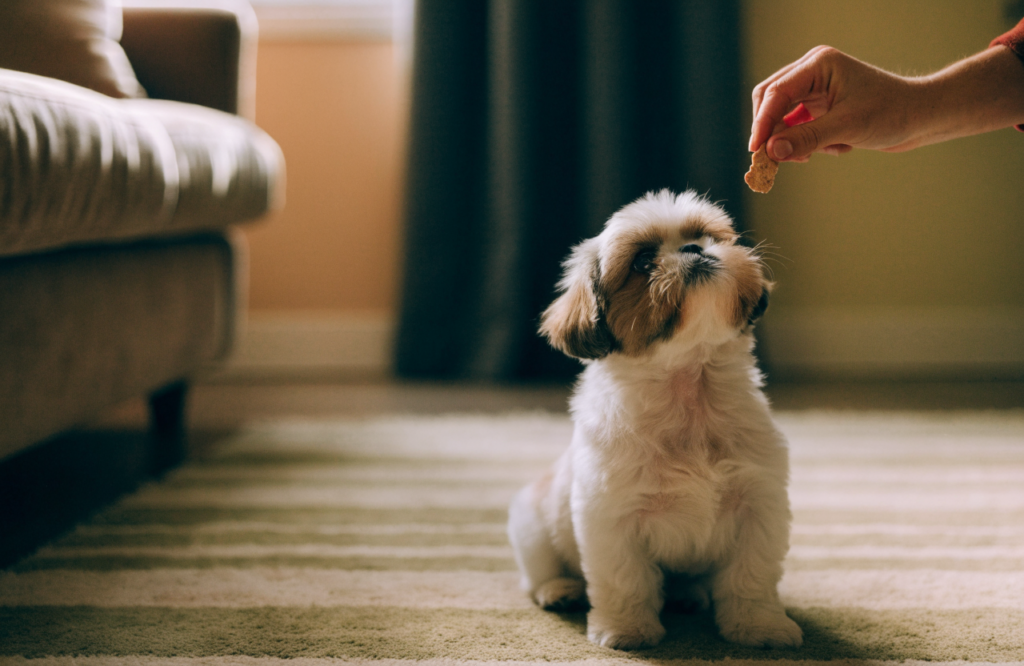
A Shih Tzu is typically about 9 to 10.5 inches tall and 9 to 16 pounds as an adult. Puppies are much smaller, and dogs under about six pounds have less body control than larger breeds. Stairs, long walks, and “hold it until we get home” are harder for them than for a Labrador puppy of the same age.
Three traits shape almost every training plan:
- They respond to ritual. Feeding, naps, and potty trips at predictable times do more than repeating a command.
- They are sensitive. Yelling after an accident, jerking a collar, or calling them over only to scold them teaches avoidance, not the cue. Breed resources and force-free trainers consistently recommend praise, food, and play instead of punishment.
- They were bred for company. Left alone too long, too soon, many become distressed. That distress shows up as crying, soiling, or chewing, which owners sometimes misread as “stubbornness.”
Sessions should stay short. Five minutes is plenty for a young puppy, a few times a day. End while the puppy is still interested. An overworked Shih Tzu often looks stubborn when it is simply done.
Outdoor work also has a hard limit. Shih Tzus are brachycephalic: the shortened muzzle makes panting a less effective way to cool the body. Skip midday heat, stop at the first change in breathing, and use indoor scent games on hot or humid days. A well-fitted harness is a better default than steady pressure on a collar.
Start with management, not a long list of commands
The first two weeks are mostly about preventing practice of the wrong behavior.
Keep the puppy in sight, on a leash indoors, or in a small puppy-proofed area. Freedom of the whole house before house training is reliable is how accidents become a habit. Use baby gates on stairs until the puppy can go down as confidently as up. Feed on a schedule so elimination is more predictable. Offer legal chews before the puppy chooses a baseboard or a hand.
Name the puppy only for good things. If the name predicts treats, play, or a recall, the puppy comes when called. If the name predicts being grabbed or told off, the puppy learns to hesitate.
House training a Shih Tzu puppy
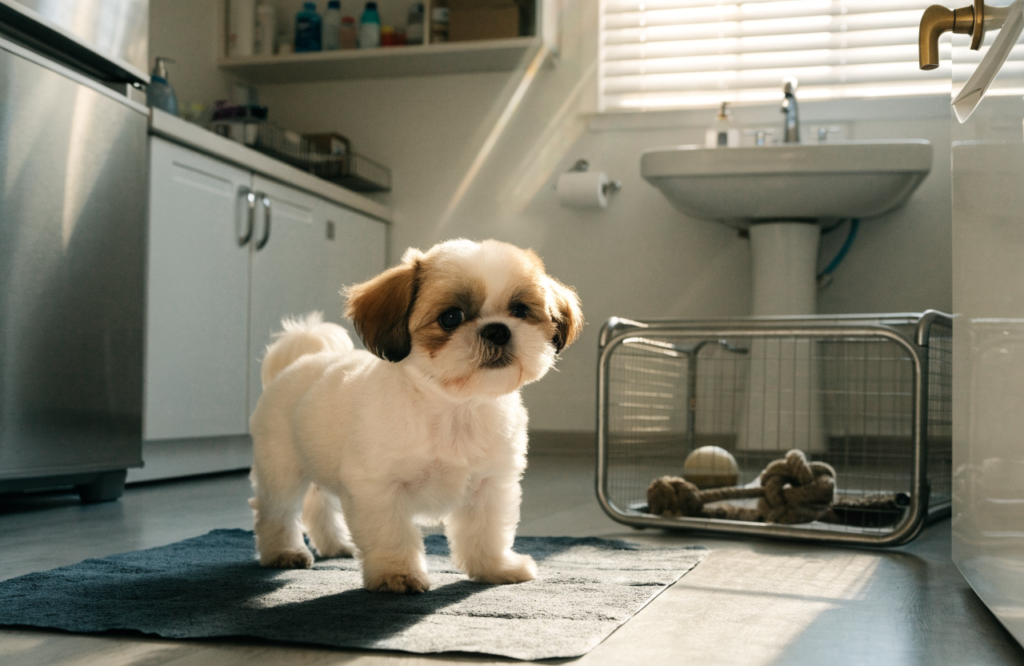
House training is the task most new owners underestimate. Toy-breed puppies often need more frequent trips and more months of consistency than larger puppies. Many owners report indoor accidents well past four months, with real reliability closer to six to twelve months. That is not failure. It is a small bladder plus a dog that has not yet connected “outside” with “always.”
Take the puppy out:
- Right after waking, including naps
- After meals and drinks
- After play
- Before crate time
- On a timer between those events, often every 60 to 90 minutes for a young puppy, and more often if accidents are still common
Use one cue, such as “go potty,” said once the puppy is in the spot. Reward within a few seconds of finishing, not after you walk back inside. A small treat and quiet praise work better than excited play, which can interrupt the next attempt.
If you cannot watch the puppy, use a crate or pen that is only large enough to stand, turn, and lie down. Dogs usually avoid soiling a bed. A crate big enough for a bathroom corner removes that advantage. Clean accidents with an enzymatic cleaner so the spot does not keep smelling like a toilet. Do not rub the puppy’s nose in it or scold after the fact. By the time you notice, the puppy is no longer connecting the mess with the act, and punishment often creates a dog that hides to eliminate.
Puppy pads are a reasonable bridge in apartments, bad weather, or before vaccines are complete. They also teach “indoors is allowed” unless you phase them out on purpose. If the goal is outdoor-only, use pads only in a transition plan and move them toward the door, then outside.
A simple night routine is water available through the evening, a last trip out right before bed, and a middle-of-the-night trip if the crate is wet in the morning. Holding urine all night is a physical skill. It arrives with age, not with stricter rules.
Crate training without creating fear
A crate is a management tool and a safe den, not a penalty box. Place it where the family spends time. Leave the door open, drop treats inside, and feed a meal or two in there before you ever close the door.
Build duration in steps: a few seconds with you beside the crate, then a minute, then you stepping out of sight, then a few minutes alone. Pair the closed door with a stuffed chew so the crate predicts something good. If the puppy panics, soils immediately, or cannot settle, shorten the absence. Confinement fear and separation distress are different problems from ordinary crate training, and forcing longer stretches usually makes both worse.
Daytime crate time should stay within what the puppy can physically hold. A rough guide is about one hour per month of age, and often less for toy breeds. Overnight, a nearby crate plus one planned potty break is more realistic than expecting an eight-week-old to last until morning.
Teaching sit, come, and leash manners
Start cues around 8 weeks, once the puppy is settled at home. One behavior at a time.
Sit. Hold a treat just above the nose and move it slightly back. Most puppies fold into a sit. Say “sit” as the bottom hits the floor, then pay. Do not push the hips down.
Come. Practice indoors on a leash first. Say the name, then “come,” and reward the moment the puppy reaches you. Never call the puppy to you for nail trims, scolding, or the end of play. Go get the puppy for those jobs. Recall has to stay better than whatever the puppy is already doing.
Leash. Let the puppy wear a lightweight harness around the house before the first walk. The first outing should be short, boring, and successful: a few steps, a treat, home. A bad first walk — pulling, a loud noise, a slip on a slick floor — can stick. Sniffing is part of the walk for this breed, not a failure of heeling. Formal heel can wait.
Drop it and leave it. Trade for a better chew instead of prying the mouth open. Shih Tzus pick up small objects easily, and a reliable trade prevents a chase game.
Keep the reward rate high at first. Once the puppy offers the behavior easily, reward most repetitions with praise and save food for harder moments, such as coming away from a distraction.
Socialization that fits a toy breed
The period up to about 16 weeks is when puppies form lasting impressions of people, sounds, surfaces, and handling. Missing it is harder to fix than a late sit cue. Full vaccine status and public dog parks do not have to happen at the same time.
Useful early exposures, many of them carried or done at home:
- Different people, including children who have been shown how to sit and offer a treat
- Household sounds: vacuum, dishes, doorbell, traffic from a window
- Surfaces: carpet, tile, grass, a rubber mat
- Gentle restraint for a vet-style exam: ears, mouth, paws, tail
- Calm, vaccinated adult dogs in a controlled setting, once your veterinarian says the puppy can meet other dogs
If the puppy freezes, hides, or tries to escape, increase distance and pair the sight of the new thing with treats. Dragging a scared puppy closer does not build confidence.
Shih Tzus often alert-bark at arrivals. That is easier to shape if visitors are routine and the puppy has a job, such as going to a mat for a treat when the door opens, than if the only practice is rare, exciting guests.
Handling practice for grooming and vet care
A Shih Tzu coat mats if it is not brushed, and the face, eyes, and ears need regular cleaning. Professional grooming every 8 to 10 weeks is common; a shorter pet clip is easier to maintain at home. Either way, the puppy has to accept being touched.
Practice for a minute or two a day:
- Lift each paw and touch the nails
- Wipe the face and the fold under the eyes
- Look in the ears without probing
- Brush one small section, then stop and treat
- Stand the puppy on a stable, non-slip surface that will later feel like a grooming table
Stop before the puppy struggles. A puppy that only meets the brush when it is already matted learns that handling predicts a fight. Eye rubbing on carpet and trapped moisture in ears are common reasons these dogs need calm handling; pain makes training look like defiance.
Common problems and what to do instead
Indoor accidents after a good week. Check the interval between trips, whether the crate is too big, and whether the puppy had unsupervised access. Regression around 7 to 9 months is also common as adolescence hits. Return to the earlier schedule for a couple of weeks rather than adding corrections.
Mouthing and biting. Normal in teething puppies. End the game when teeth hit skin, offer a chew, and reward gentle mouths. A yelp works for some puppies and winds others up. Watch the result and keep the version that reduces pressure.
Refusing to walk. Carry the puppy a short distance from home and let them walk back, or train indoors first. For a flat-faced puppy, refusal on a warm day can be fatigue or heat, not attitude. End the session.
Crying when left. Build absence in minutes, not hours. A puppy that soils or panics only when you leave is practicing distress, not bladder control. Longer confinement will not fix that.
“They only listen when they feel like it.” Often true of this breed, and usually fixed by clearer payoffs and shorter sessions, not by repeating the cue louder. If a previously willing puppy suddenly refuses handling, walks, or food, rule out pain — eyes, teeth, ears, or breathing — before treating it as a training problem.
How long training usually takes
Sit and a name response often appear in days. A useful recall and loose leash take weeks of short practice. House training commonly takes several months, with fewer accidents each month if the schedule stays consistent. Full reliability, including when guests arrive or the routine changes, can take longer.
Adolescence, often starting around 7 to 8 months and lasting a couple of months, is when some puppies seem to forget cues and become more independent. That window is also when rehoming risk rises, according to long-time breeders. Keeping the ritual, the rewards, and the exercise appropriate for a small, heat-sensitive dog carries most puppies through it.
Puppy classes are worth it if the instructor uses food and play rather than collar corrections, and if the class allows you to watch a session first. Private help is a better fit if the puppy is already afraid of the crate, other dogs, or being left.
Frequently asked questions
Are Shih Tzus hard to train? They are trainable and often eager for treats, but they are not automatic obeyers. House training takes patience, and harsh methods backfire. Short, consistent, reward-based sessions suit the breed.
When should training start? Handling, name games, and potty trips start the day the puppy comes home, often around 8 to 12 weeks. Formal classes can wait until your veterinarian clears group exposure.
Can a Shih Tzu puppy be left alone all day? Not at first. Build up to short absences. A young puppy still needs potty breaks every couple of hours, and this breed does poorly with long, empty days even as an adult.
Should I use puppy pads? They help in apartments and during bad weather. If you want outdoor-only habits, treat pads as temporary and reward outdoor elimination more heavily so the pad does not become the permanent toilet.
What if my puppy hates the crate? Slow down. Feed meals in the open crate, close the door only for seconds, and stay nearby. Panic, immediate soiling, or nonstop distress when you leave needs a slower plan, and sometimes a trainer who understands separation issues, not a longer lock-in.