
Dachshund puppy training works best when you treat the breed as a small hunting dog, not a toy. These puppies are smart enough to learn sit, come, and house rules quickly, but they were bred to work alone underground, so they decide whether a request is worth their attention. Housetraining usually takes longer than with many other breeds, barking and digging are instinct rather than defiance, and the long back means everyday habits like jumping off the sofa are part of training, not a side issue. Start on day one with a schedule, short reward-based sessions, and calm exposure to people and sounds. Consistency from everyone in the house matters more than any single trick.
What Makes Dachshund Puppy Training Different
Dachshunds were developed to track, dig, and bay at quarry in burrows. That history still shows up in a puppy’s living room. They follow scent hard, often ignore a cue mid-sniff, and bark in a way that carries. Many owners call this stubbornness. A more useful description is independence: the dog is asking what it gets out of cooperating.
Positive reinforcement fits that mindset. Food, a favorite toy, or brief play after the behavior lands faster than scolding. Harsh corrections often shut a dachshund down or make it more wary, which then looks like refusal. Sessions should stay short—about five minutes, a few times a day—because attention fades once the novelty wears off. End on a success so training stays worth showing up for.
Two physical facts shape the plan. A young dachshund’s bladder is small, so accidents are common even with a good schedule. The long spine is also vulnerable to intervertebral disc disease (IVDD), a common and serious problem in the breed. Training that builds jumping, stair-racing, or collar-yanking as normal habits works against the dog later.
Housetraining and Crate Training Come First
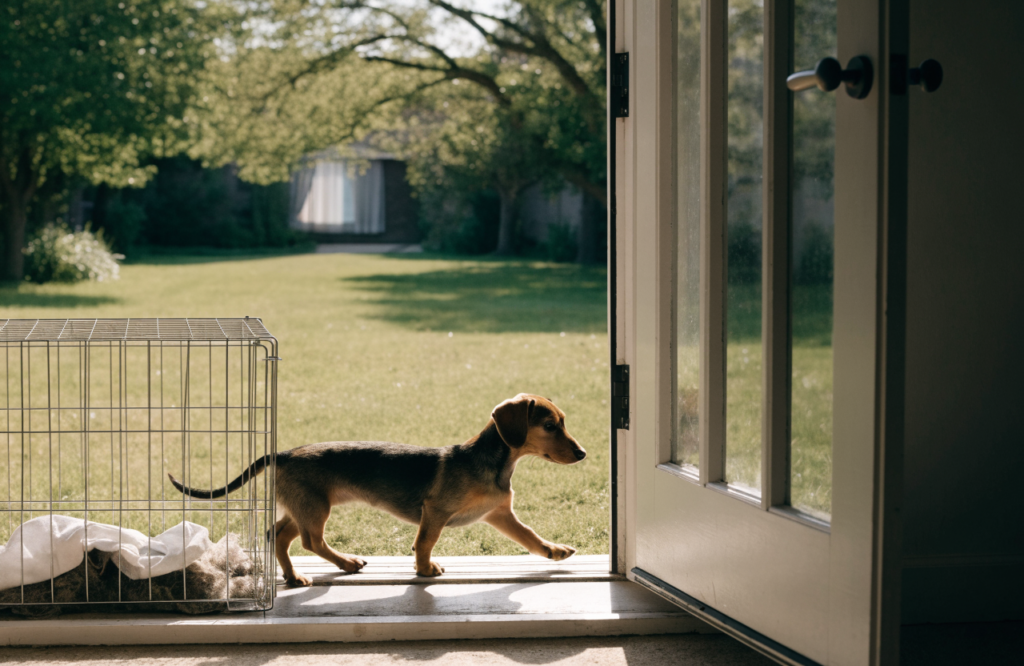
Housetraining is the skill most new dachshund owners struggle with, and it is reasonable to expect it to take longer than the “fully reliable in a few weeks” timeline some breeds manage. Small size, a low-to-the-ground view of indoor messes, and a dislike of cold or wet ground all slow the process. Some dogs remain less reliable in bad weather as adults and do better with a covered potty spot.
A schedule that matches a small bladder
A common guide is that a puppy can hold urine for roughly one hour per month of age, plus overnight sleep once crate trained. A three-month-old may manage about three hours, but many dachshund puppies need to go sooner after meals, play, or waking. Do not wait for a perfect signal.
Take the puppy to the same outdoor spot:
- First thing in the morning
- After every meal and drink
- After naps and play
- Before bed
- At least every one to two hours while awake in the early weeks
Use one short cue, such as “go potty,” then wait quietly. The moment the puppy finishes outside, mark it with praise and a treat right there. Delayed rewards teach the wrong lesson. Keep the trip boring if the goal is elimination, then offer a short walk or play afterward so the yard is not only a bathroom.
Use the crate as a den, not a punishment
Dachshunds often take to small enclosed spaces because denning fits the breed. A crate that is only large enough to stand, turn, and lie down stops the puppy from soiling one end and sleeping in the other. Feed meals in the crate, toss treats in for voluntary entries, and never use it for time-outs after a mistake.
Do not leave a young puppy crated longer than it can physically hold urine. Overnight is usually fine once the dog is settled, with a last trip out and a first trip out the moment the crate opens. If you cannot supervise, a crate or a small pen is safer than free roam.
Clean accidents without a lecture
If you catch the puppy mid-accident, interrupt calmly and carry it outside to finish, then reward any outdoor success. Rubbing a nose in a mess does not teach housetraining and can make the dog hide to eliminate. Clean indoor spots with an enzymatic cleaner so the scent does not invite a repeat. Pads can be a bridge in apartments or bad weather, but they slow outdoor training if the puppy never has to choose the yard.
Teach Core Cues in Short Sessions
Name recognition, sit, come, and a simple “leave it” cover most early needs. Train in a quiet room first, then practice in the yard, then near mild distractions. Dachshunds often need more repetitions to perform a known cue in a new place because scent and movement pull focus.
For sit, hold a treat at nose level and move it slightly up and back so the rear lowers. Mark and reward the moment the bottom hits the floor. For come, start a step away, say the cue once, and reward generously at your feet. Never call the puppy for something unpleasant, or the cue loses value. “Leave it” is worth early work: cover a treat with your hand, wait for the puppy to back off, then reward from the other hand. That skill later helps with shoes, food on counters, and interesting smells on walks.
Keep food rewards small so training does not become a calorie problem. Extra weight adds strain to the spine. If the puppy is more toy-driven than food-driven, use a short tug or chase as the reward instead.
Socialize While the Early Window Is Open
The most important socialization period runs from early puppyhood through roughly 12 to 16 weeks. A dachshund that misses calm exposure to people, dogs, sounds, and surfaces in that window is more likely to grow into a suspicious or snappy adult. The goal is not maximum excitement. It is short, positive meetings that end before the puppy is overwhelmed.
Useful early exposures include different people at home (including hats, beards, and children who know how to be gentle), household noises, car rides, and varied walking surfaces. Puppy classes are a good next step once your veterinarian says the vaccine timing is appropriate. Avoid dog parks and unknown dogs until the full puppy series is complete. One bad scare can outweigh several good introductions.
Alone-time practice belongs in this stage too. Dachshunds can develop separation distress if they are never left. Start with seconds of absence while the puppy is settled in the crate with a safe chew, then build duration slowly.
Train Habits That Protect the Back
IVDD risk is high enough in dachshunds that spinal habits are a training topic, not only a veterinary one. Jumping off beds and sofas, repeated stair sprints, and pulling into a collar all load the discs.
Teach a wait at furniture edges and lift the puppy down, supporting the chest and hindquarters so the back stays level. Ramps or pet stairs at the spots the dog uses every day reduce the daily jump count. On walks, a well-fitted harness spreads pressure better than a neck collar, especially while leash manners are still messy. Keep play low-impact: no repeated launching off laps, no tug games that wrench the spine, and no encouragement to race stairs.
Weight control is part of the same plan. Ask your veterinarian what a healthy body condition looks like for your puppy’s size, whether standard or miniature, and adjust treats accordingly.
Channel Barking, Digging, and Scent Drive
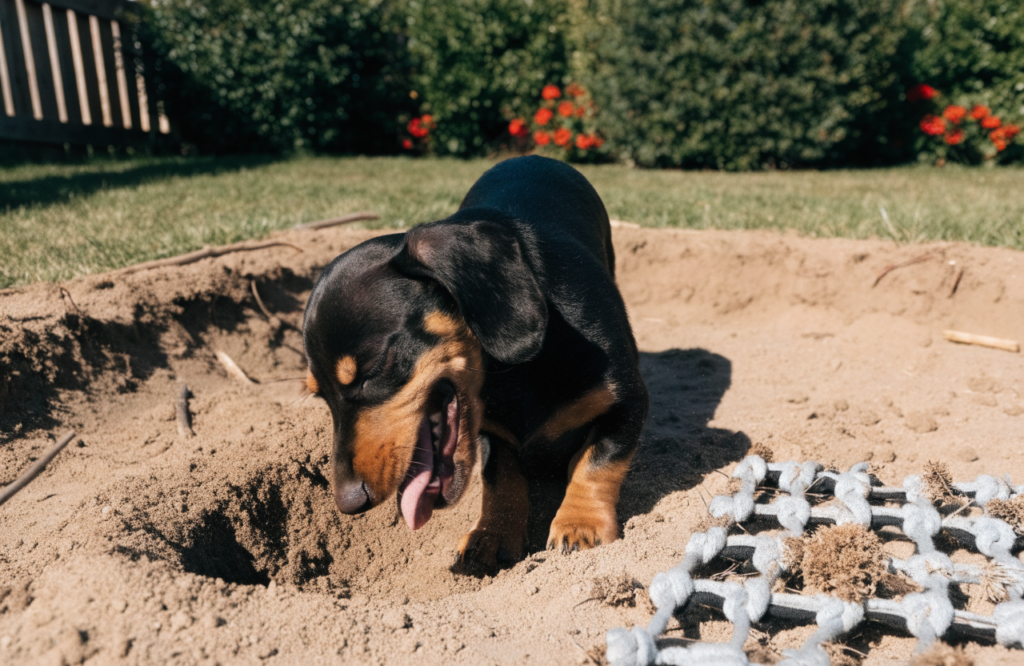
Barking and digging are not training failures. Dachshunds were selected to bark so a hunter could find them underground and to dig after burrowing prey. Punishment rarely removes the instinct. Management and an outlet work better.
For barking, reward quiet rather than only yelling “no” over the noise. When the puppy barks at a door or window, wait for a brief pause, mark the silence, and treat. A “quiet” cue can be added once silence is predictable. Reduce triggers you can control—covering a window, not answering demand barks with attention—and give enough exercise and sniffing so boredom is not the main fuel.
For digging, a sandbox or a corner of the yard where digging is allowed gives the behavior a legal place. Redirect from garden beds to that spot and reward digging there. Chewing gets the same treatment: acceptable chews available, forbidden items removed, and a swap when the puppy grabs a shoe.
On walks, expect scent lock. A loose-leash habit is easier to build if you stop or change direction when the puppy pulls, then continue when the leash softens. Sniff breaks, where the puppy is explicitly allowed to investigate, often reduce frantic pulling between those breaks.
Mistakes That Slow Dachshund Puppy Training
Several patterns show up often with this breed.
- Treating small size as a reason to skip rules. Jumping, counter-surfing, and door-dashing are harder to undo once they are cute habits.
- Long, repetitive drills. Boredom looks like stubbornness.
- Inconsistent cues between family members. One person allowing sofa access and another forbidding it teaches the puppy to test every request.
- Skipping socialization because the puppy seems fine at home. Wariness of strangers often appears later.
- Expecting housetraining on a large-dog timeline. Frequent outdoor trips and supervision beat frustration.
- Letting the puppy jump off furniture “because it wants to.” Early lifting and ramps are easier than rehab after a back injury.
Progress is rarely linear. Many dachshunds test boundaries more between about four and eight months. Known cues can slip. Returning to shorter sessions and higher-value rewards usually recovers the habit faster than escalating corrections.
Frequently Asked Questions
How long does it take to housetrain a dachshund puppy?
Many owners see fewer accidents within a few months of a strict schedule, but full reliability often takes longer than with easier breeds, and some dogs stay weather-sensitive. Plan on frequent trips out through at least four to six months, and keep the crate available for unsupervised time until accidents are rare.
Are dachshund puppies good for first-time owners?
They can be, if the owner expects a vocal, independent dog with a slower housetraining curve and a real need for back-safe habits. They are a poor match for someone who wants a quiet, instantly obedient companion with little daily structure.
When should training start?
Start the day the puppy comes home, usually at eight weeks or older. Name, potty schedule, crate, handling, and gentle socialization can begin immediately. Formal classes should follow your veterinarian’s vaccine advice.
Should I use a collar or a harness?
A harness is the better default for leash walking because it avoids pressure on the neck. Collar tags are still useful for identification. Teach the puppy that harness time predicts a walk so gearing up stays calm.