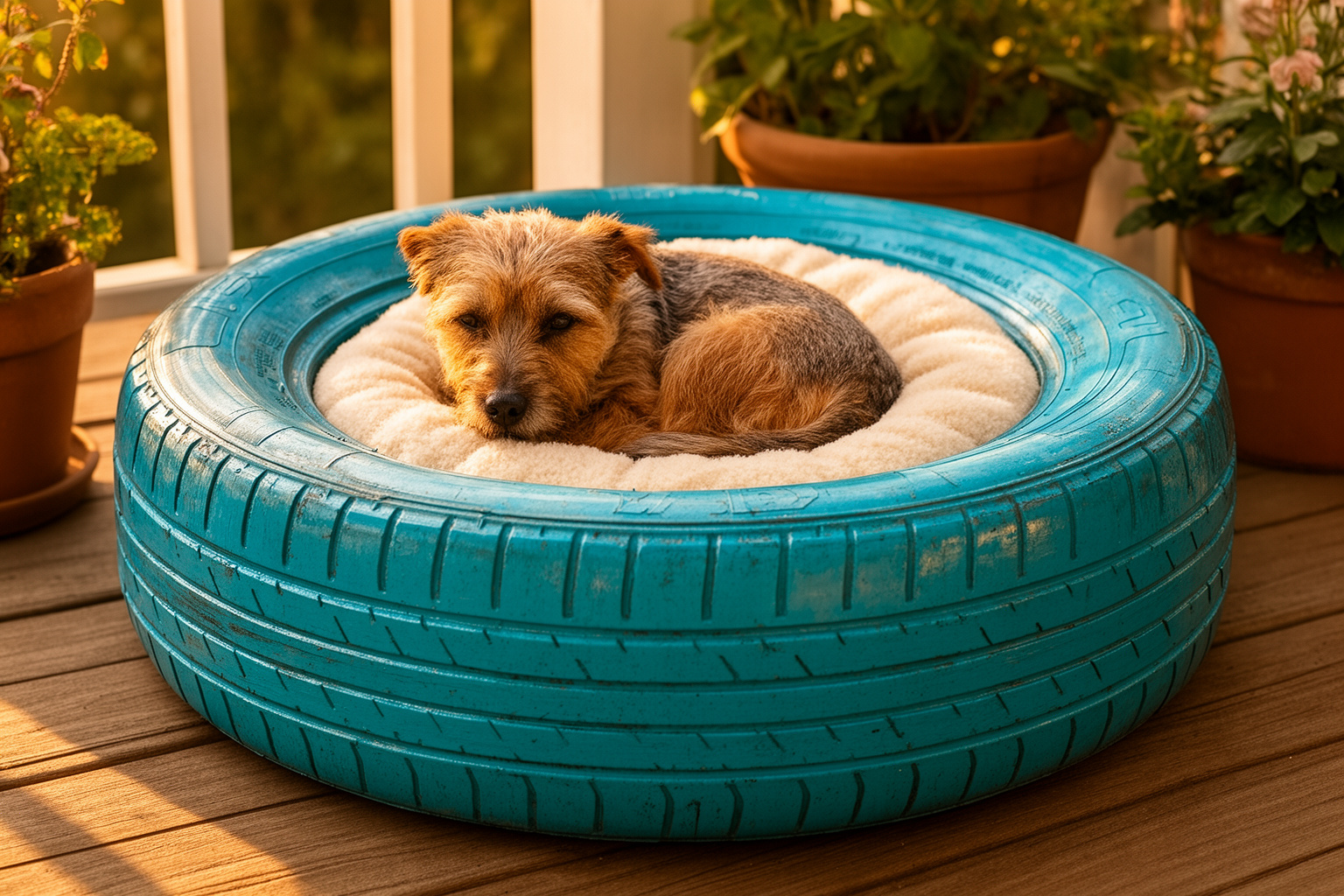

A tire dog bed is a used car or light-truck tire laid flat, cleaned, and fitted with a cushion so the rubber ring acts as a bolster. It works best for small and medium dogs that curl up, costs little if you already have a spare tire, and fails when the opening is too small, the cushion has no support, or the tire is left in full sun.
The project is popular because the shell is free or cheap, tough enough for moderate chewers, and easy to repaint. It is not a substitute for an orthopedic bed, and the rubber is not chemically inert. The useful version is the one sized to the dog’s curled sleeping space, sealed off from standing water, and built so the dog mostly touches fabric rather than bare tread.
Who a tire dog bed is actually for
The tire does one job: it gives a round, chew-resistant edge that dogs who nest can push against. The cushion does the sleeping. If those two jobs are split clearly, the project makes sense. If you expect the tire itself to be soft, cool, or large enough for a sprawling Labrador, it will disappoint.
It tends to suit:
- Dogs under about 50 pounds that sleep curled rather than stretched flat
- Chewers that destroy fabric bolsters but will mostly leave a thick rubber ring alone
- Covered porches, mudrooms, and kennel runs where a lightweight bed gets dragged or soaked
- A spare bed, not the only bed, especially for seniors
It is a poor fit for giant breeds, dogs with serious joint disease who need thick supportive foam, and anyone who wants a bed they can toss in the washer as a single piece. A passenger-car tire is also heavy. Moving it up stairs or into a crate every night gets old quickly.
Two ways to build it
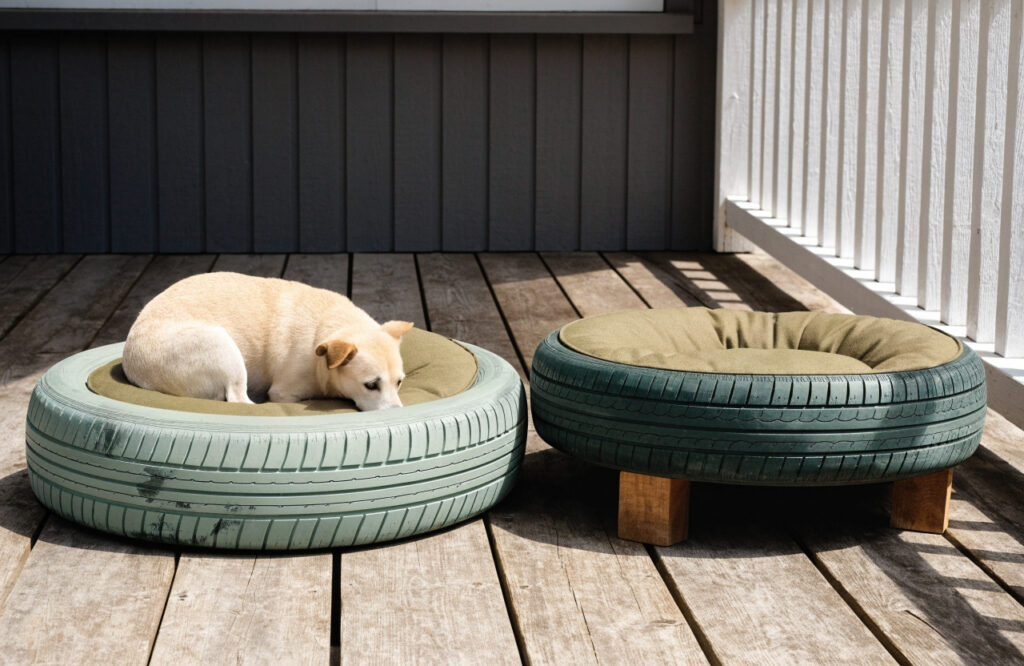
Most finished beds are one of two builds. The first is enough for most people. The second is worth the extra work if the dog is medium-sized or the bed will live outside.
Simple bolster bed
This is the version that shows up in most tutorials. Clean the tire, paint it if you want, stick felt pads on the bottom so it does not mark floors, and set a round cushion in the center.
Materials are an intact used tire, dish soap and a stiff brush, optional rubber-bonding spray paint, furniture pads, and a round dog-bed insert or spare pillow. Active work is about an hour. Drying and airing take longer than the build.
The cushion has to bridge the center hole and rest on the inner sidewalls. If it is smaller than the opening, it drops into the hollow and the dog lies on a sagging pocket.
Open bed with a solid base
Some builders cut away part of the upper sidewall so the dog can step in more easily, then screw a plywood or exterior-grade board into the bottom bead as a floor. A fitted foam pad sits on that board, with a washable cover.
This version sleeps larger because the dog is not balancing on a cushion stretched over a hole. It also keeps stuffing from collapsing into the tire. Cutting rubber is the risky step: steel belts hide in the tread and sidewall, and a poor cut leaves wire. If you are not set up to cut and then file or cover every exposed edge, stay with the simple bolster.
Size the opening, not the outer tire
People measure the outside of the tire and assume that is the bed. It is not. A common passenger tire is roughly 25 to 28 inches across the outside. The hole in the middle is closer to the rim diameter, often 15 to 17 inches. The dog’s usable nest is that opening plus whatever cushion overhangs onto the rubber ring.
Match the tire to how the dog actually sleeps:
| Dog | Typical weight | What usually works | What fails |
|---|---|---|---|
| Toy and small | Under 25 lb | Passenger-car tire, cushion filling the center | A huge truck tire the dog will not settle in |
| Medium curler | 25–50 lb | Larger passenger tire or small light-truck tire, cushion about 24–34 inches across the ring | A cushion smaller than the hole |
| Large sprawler | Over 50 lb | Truck tire only if the dog still curls; otherwise skip it | Expecting one car tire to replace a 40-inch bed |
Measure the dog from nose to the base of the tail in a normal curl, then compare that length with the inner opening plus the flat top of the sidewalls. If the dog cannot turn around without hanging off the cushion, the tire is too small. Stacking tires makes a taller bolster, not a wider bed.
Cleaning, paint, and the chemical question
Used tires pick up road grit, oil, and stones in the tread. Those are the immediate hazards, and they are fixable.
Scrub with dish soap and a stiff brush, dig out embedded stones, rinse, and dry in the sun. Inspect for cuts, bulges, and exposed wire. Reject any tire with metal showing. A worn but intact tread is fine. A shredded or belt-exposed tire is not a pet project.
Paint is optional. If you use it, choose a paint labeled for rubber or outdoor plastic, apply thin coats, and let it cure for several days in open air before the dog lies on it. Fresh paint fumes are a more immediate problem than the tire itself. Felt pads on the bottom protect both the floor and the paint.
On chemicals, the honest limit is this: tire rubber contains additives, including zinc compounds and preservatives such as 6PPD, that can leach, especially from shredded rubber in water. Research on tire particles and crumb rubber has found metals and organic compounds that matter for waterways and for close human contact with ground rubber. A whole, weathered tire that has been washed and aired is a lower exposure than fresh crumb rubber, which is why old tires are commonly reused as shelters and planters. It is not the same as chemical-free. Practical precautions are an intact tire, a fabric cover on every surface the dog chews or licks, no standing water in the center, and no use as a teething toy. If the dog is a determined rubber chewer, this is the wrong bed.
The cushion is the actual bed
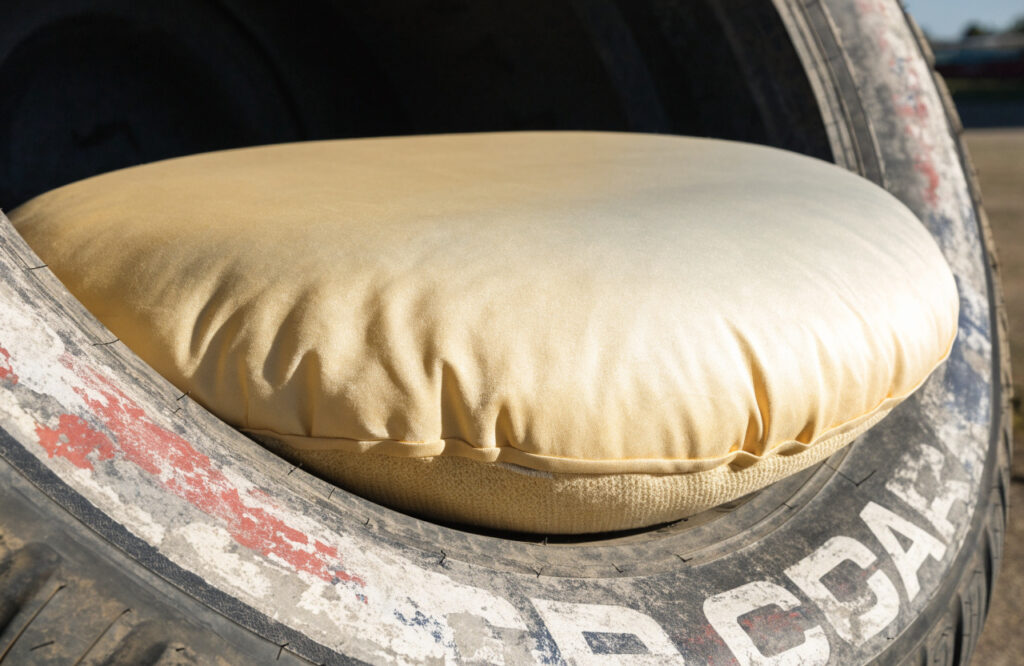
A bare tire is a ring, not a mattress. Comfort, warmth, and joint support all come from what you put inside.
A round dog-bed insert with a removable cover is the easiest option. Memory foam or a dense polyfoam pad is better for heavier dogs than loose stuffing, which packs down. For seniors, thickness matters more than the tire: if the foam bottoms out, the dog is effectively on the floor. Four inches is a reasonable minimum for a medium dog; large dogs need more, and at that point a purpose-built orthopedic bed is usually the better buy.
Outdoors, skip uncovered fiberfill. Use a waterproof or water-resistant cover, or a closed-cell foam pad that can be hosed off. Straw and old blankets are common in farm builds and work until they get wet, then they hold odor and moisture against the dog. Whatever you use, it should lift out so the tire can be rinsed.
Outdoor use without creating a heat or water problem
The rubber shell shrugs off rain. The bed as a whole does not.
Black rubber in direct sun gets hot enough to be uncomfortable, and on a very hot day it can be unsafe for prolonged contact. Place the bed in shade, paint it a light color if it must sit in partial sun, and check it with your hand before you assume the dog is fine. Elevated feet or a couple of blocks under the tire improve airflow and keep the base out of puddles.
An upright tire holds water. A tire laid flat can still pool in the center if the cushion is removed. Empty it after rain. Standing water in tires is a known mosquito breeding site, which is a reason not to leave an empty tire in the yard.
For a permanent kennel, an elevated cot often beats a tire bed in hot, wet weather because air moves underneath and there is no foam to soak. The tire version earns its place when you want a bolster the dog can lean on and a shell that survives being dragged.
Mistakes that make the bed unusable
- Sizing from the outer diameter and then wondering why a 40-pound dog will not stay in it
- Dropping a small pillow into the hole with no board or oversized cushion to span it
- Letting the dog on fresh paint
- Cutting into the tread and leaving wire ends
- Using the tire as the dog’s chew toy
- Leaving a dark tire in full afternoon sun
- Treating a thin stuffed cover as joint support for an older, heavy dog
- Forgetting the bed is heavy and building it in a room you cannot easily clean
A spare passenger tire from a shop is often free because shops pay to dispose of them. The cushion, paint, and pads are the real cost. If those add up to the price of a basic bolster bed the dog already likes, the recycling benefit is the only remaining reason to build one.
Frequently asked questions
Can a tire dog bed live inside?
Yes, if it is cleaned, fully dry, and padded on the bottom. The smell of an old tire usually fades after a wash and a few days outdoors. It will still read as industrial unless you paint it and use a covered cushion.
Do I have to cut the tire?
No. The simple bolster build needs no cutting. Cut only if you want a wider opening and you can deal with steel belts and sharp edges.
Will it stop a destructive chewer?
Often it slows one down. The rubber ring survives teeth better than a fabric bolster. It will not stop a dog that swallows pieces. Supervise at first, and do not use a tire with exposed wire.
Is a bike tire the same project?
A wide bicycle tire can make a bed for a cat or a very small dog. Narrow road tires do not have enough sidewall to form a bolster. The method is the same: clean, cover, and fill the center.