
A bed frame with a dog kennel underneath only works if the open space under the mattress is taller than the crate, wide enough for the door to swing or slide, and free of a center rail that stops the kennel halfway in. Most ordinary platform frames fail that test. They leave about 6 to 12 inches of clearance, which is enough for a flat dog bed and not enough for a wire crate a medium dog can stand in.
The useful versions are raised platforms, open storage frames, and custom beds built around a kennel compartment. The difference is not style. It is whether your dog can enter, turn, lie down, and get out without scraping the frame, and whether you can still clean the crate without dismantling the bed.
Two different products share this search
Shoppers use “bed frame with dog kennel underneath” for two setups that solve different problems.
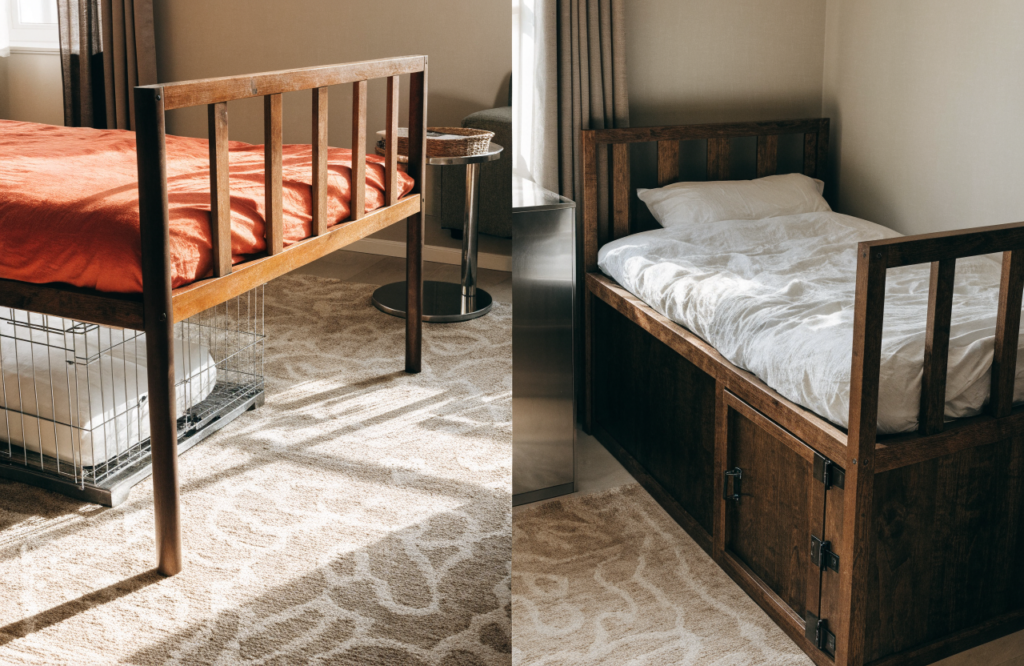
An open raised frame leaves a cavity under the slats. You slide a normal wire or plastic crate into that cavity, or you put a cushion there and skip the crate. The bed stays a normal bed. The kennel stays a normal kennel. This is the version that saves floor space in a small bedroom.
A built-in kennel bed is furniture made for the job. The platform sits on a wood cabinet, and one or more bays have a door, mesh, or barred opening sized for a dog. Custom makers such as WWBeds build queen platforms with a front kennel bay, sometimes paired with drawers at the back, and price a single kennel section in the hundreds of dollars before the platform. Ready-made “pet nook” frames exist too, but many of those nooks are only tall enough for a cat or a small dog on a cushion, not a crate.
A third category shows up in search results and is easy to buy by mistake: a furniture-style crate used as a nightstand or bench. That piece sits beside the bed. It does not go underneath it.
Measure the crate, not the breed chart
Crate length is what most size charts talk about. Height is what decides whether it fits under a bed.
Standard folding wire crates, such as the Midwest iCrate line, are sold by length, and the height comes with that size. Typical exterior dimensions are about 19 inches high for a 24-inch crate, 21 inches for a 30-inch crate, 25 inches for a 36-inch crate, 31 inches for a 42-inch crate, and 33 inches for a 48-inch crate. Those figures are the crate itself. Add the plastic pan lip, any feet, and a mat if the mat lifts the floor.
| Crate length name | Typical exterior height | Dogs it usually fits |
|---|---|---|
| 24 inch | about 19 inches | Toy and small dogs |
| 30 inch | about 21 inches | Beagle-size, many French bulldogs |
| 36 inch | about 25 inches | Border collie, smaller Aussies |
| 42 inch | about 30–31 inches | Lab, golden, boxer |
| 48 inch | about 33 inches | Larger shepherds, some rottweilers |
A 42-inch crate is the usual size for a Labrador. That crate is roughly 30 inches tall. A bed frame has to clear that height with an inch or two left so the crate does not bind on the slats when you slide it. A frame advertised as “14 inches of under-bed space” will not take it.
Measure your own dog as well. Standing height to the top of the head, or to the ear tips if the ears stand up, plus a few inches, is the minimum interior crate height. Sitting height matters too, because many dogs sit up when they hear you move. Interior height is usually a little less than the exterior number on the box.
What the frame has to clear
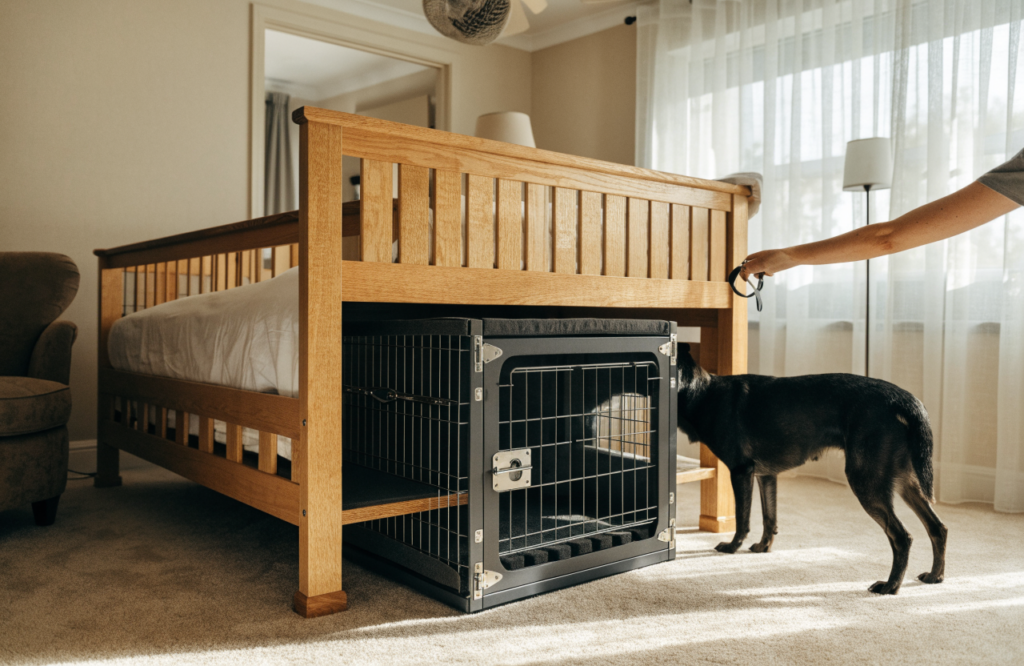
Height is the first filter. Width and the path in are the second.
The opening at the side or foot of the bed has to be wider than the crate, including the door latch. A double-door crate is often the better choice under a bed, because a door on the long side lets the dog exit parallel to the frame instead of into a narrow walkway at the foot. RV owners run into the same problem: an end door faces the bedside path and becomes useless once the crate is pushed in.
Center support bars are the detail product photos hide. Many metal platform frames have a rail running down the middle, sometimes with legs. A crate that fits the listed clearance still will not slide under if that rail cuts the cavity in half. Look for frames with side rails and a clear span, or plan to place the kennel only in the open half and accept that it will not sit centered.
Weight is the other structural check. The frame is carrying a mattress and one or two people. A kennel does not add much load, but a DIY platform built from thin lumber can sag once the mattress is on it, and that sag eats the clearance you measured empty. Custom and hacked builds that work for a California king, such as the Expedit-and-plywood platforms people have posted for condo bedrooms, use a real substructure, not the stock slats alone.
Getting into the bed is part of the same measurement. A frame tall enough for a 42-inch crate sits well above a normal platform. Owners who have built loft-style kennel beds in rooms with 8-foot ceilings have ended up needing a step or bench. That is fine if you plan for it. It is a daily annoyance if you do not.
Frame styles that can work, and the ones that usually do not
| Style | Typical under-bed space | Fits a real crate? | Tradeoff |
|---|---|---|---|
| Low metal platform | 6–12 inches | No, except a very small crate or a flat bed | Easy to buy, wrong height |
| Drawer storage bed | Drawers fill the cavity | No, unless you remove drawers and the runner height still clears | Storage and a kennel compete for the same space |
| Tall open platform | 18–24 inches or more | Small and some medium crates | Check the center rail and the step up |
| Open cubby or bookcase bed | Depends on the bay | Only if one bay is taller than the crate | Bays are often too shallow |
| Built-in kennel platform | Designed around the dog | Yes, if the maker sized the bay to your crate | Costs more, harder to move |
| Murphy or cabinet bed | Floor is free when the bed is up | The kennel is not “under” the bed all day | Useful in a studio, different product |
Prices split the same way. A metal platform with honest clearance is often a few hundred dollars. Custom wood beds with a kennel bay and a platform commonly land from several hundred to a couple of thousand dollars, depending on size and whether the back of the bed is drawers or a second kennel. DIY lumber builds are the cheap route, and they are also where clearance mistakes and weak joints show up.
If the goal is only a soft place to sleep near you, skip the crate and use a raised frame with 12 to 18 inches of open space and a washable mat. That is a dog bed under the bed, not a kennel. It does not contain a dog that is not trustworthy alone in the room.
When the built-in version is the better buy
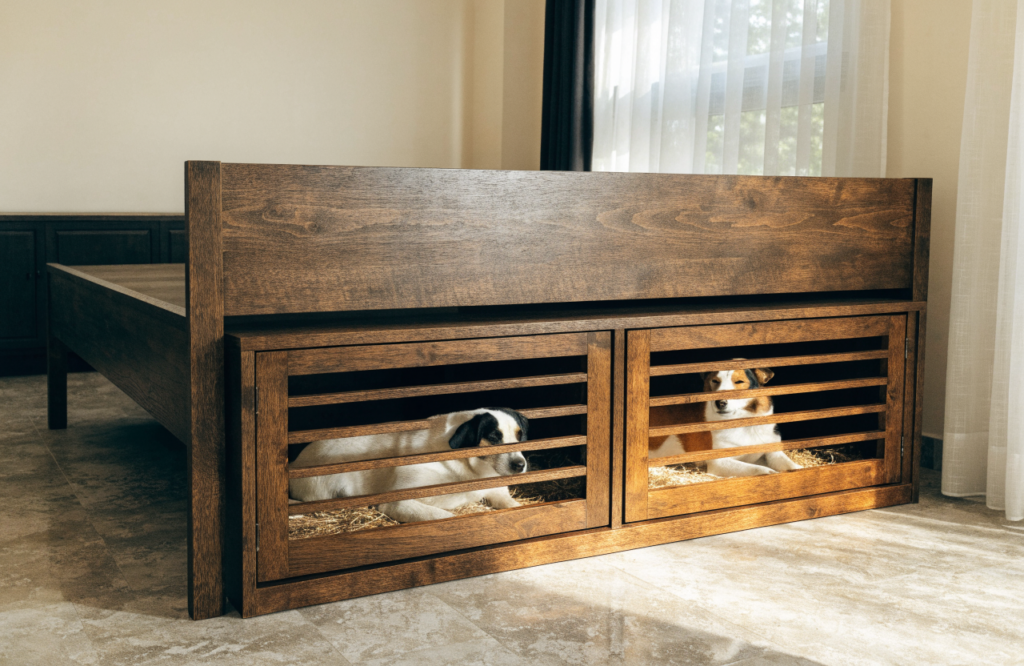
An enclosed bay makes sense if you want the kennel to look like furniture, if you have more than one dog and want separate doors, or if the crate has to stay put so it cannot be shoved into the walkway. A front opening with vertical bars or mesh, spaced so a head or paw cannot pass through, keeps the dog from feeling walled in while still holding them.
The bay should be sized to the crate you already own, or built so a standard wire crate drops in. Building a wood box and calling it a kennel leaves you with a chewing surface, a urine-absorbing floor, and no slide-out pan. A wire crate inside the bay solves those three problems. You can pull the pan without crawling under the mattress.
Leave the bay ventilated on at least two sides. An under-bed cavity traps heat because the mattress blocks the top and the frame blocks the sides. In an RV bed box, builders treat this as a design requirement: open or mesh sides so air can cross, not a solid wood tunnel. The same rule applies in a bedroom. A solid door with a small vent is a worse choice than a barred or mesh front, especially in summer or if the dog is brachycephalic.
Setup details that decide whether the dog uses it
Door direction matters more than fabric. Face the opening toward the side of the room the dog already walks, not toward a wall or a nightstand.
Bedding should be something you can remove without dragging the whole crate out. A slim crate pad fits better than a bolster bed, which steals the height you just paid for. Washable covers matter because this spot collects fur against the underside of the frame, where a normal vacuum pass does not reach.
Sound travels straight up. A dog who paws the pan at 2 a.m. is now doing it under your mattress. A plastic pan with a mat is quieter than a bare metal tray. If the dog is still being crate trained, the first week under the bed is a bad time to find out they bark when they cannot see the door. Let them sleep in the crate on the open floor for a few nights, then slide it under once the routine is boring.
Chewers need the crate, not exposed frame lumber, as the interior surface. Screws, brackets, and slat edges should sit outside the dog’s reach. A determined chewer can still damage a door latch or a wood bay; nothing in this setup is chew-proof.
Problems that show up after the first week
The crate fits on paper and binds in practice. Pan lips, latch handles, and floor vents add height the listing did not include. Measure the crate as it will be used, with the pan in and the door closed, then compare that to the frame with the mattress on it. Mattresses compress the clearance if the slats can flex.
The dog will not go in. The cavity is darker and lower than the crate was in the living room. A barred front and a clear view of the room fix this more often than a better bed. If the dog already hides under furniture, an open cushion may be what they wanted, and a closed kennel will get ignored.
Cleaning becomes a chore. If you cannot pull the crate out, you will not wipe the pan. Frames on legs, or a bay with a full-width door, are easier to live with than a kennel that only opens by lifting the mattress.
The bed is now too tall for the room. A 30-inch crate plus a 10-inch mattress puts the sleep surface near 40 inches. In an 8-foot room that still clears the ceiling, but it changes how the room feels and how you sit on the edge to put shoes on. A bench at the foot is a common fix, and it also stops the crate from being the thing you stub a toe on.
Odor settles in the wood. Untreated plywood inside a bay holds urine smell. A sealed floor, a plastic pan, and a crate you can remove are the practical answer. Painting the bay after the smell is in the wood does not fix it.
Frequently asked questions
Can a standard queen platform hold a kennel underneath? Only if the listed clearance is higher than your crate and there is no center rail in the way. Most queen platforms sold for under-bed storage bins are too low for anything bigger than a 24-inch crate.
Is a furniture crate the same thing? No. An end-table crate is a good small-space piece, and it keeps the dog in the bedroom. It does not free the floor area a full-size crate would have used beside the bed.
How much extra height should I allow? At least an inch above the crate as it sits on the floor, with the pan and mat installed. Two inches is more forgiving if the slats sag.
Will this work for a large dog? A Lab-sized crate is about 30 inches tall and about 28 inches wide. You need a deliberately tall frame or a custom bay, not a storage bed with the drawers removed. Giant-breed crates, around 33 to 37 inches high, push the bed into loft territory and are a poor fit for most bedrooms.
Does the dog need a crate at all if the space is enclosed? Only if you need containment. An open den under the bed keeps a calm dog nearby. It does not stop a dog from leaving the room, chewing the frame, or having an accident you cannot block off.