
A dog bed with storage only earns its place if the sleeping surface is large enough and supportive enough for how your dog actually rests. The drawer or lift-up compartment is useful for dry toys, leashes, and a spare blanket. It is a poor place for food, damp gear, or anything you need several times a day. Most listings lead with the hidden compartment and treat the cushion as an afterthought. Reverse that order. Size and support decide whether the dog uses the bed. Storage decides whether the clutter around it disappears.
Dogs spend a large share of the day sleeping or lounging, so a thin pad on a toy box is not a minor compromise. It is the part of the product they will use for hours.
The three designs sold as a dog bed with storage
These products share a footprint. They do not share a job.
Lift-top ottoman beds
The cushion or lid hinges up and the cavity underneath holds toys, a folded blanket, or grooming tools. Some are furniture ottomans with a pet cushion on top. Others are cave-style boxes: the dog sleeps inside, and the lid is a seat or footrest for people, sometimes with a basket or shelf for gear.
Lift-tops hide more bulk than a shallow drawer, and the closed lid keeps dust off spare blankets. The tradeoff is access. Every retrieval means lifting the sleeping surface, so the compartment works for items used a few times a week, not for the ball your dog wants at the door. Gas struts or a simple hinge both need clear space behind the lid. On human ottoman beds, manufacturers warn against letting pets near a rising or falling platform because of pinch and entrapment risk. The same caution applies to any pet ottoman with a heavy lid.
Drawer and furniture-frame beds
A raised wooden or metal frame holds a cushion on top and one or more drawers underneath, sometimes built as an end table with an open cubby for the dog and a drawer beside it. Drawers are the better design when you reach for leashes or waste bags daily, because you do not disturb the dog to open them.
Check the drawer depth, not the product photo. Many “storage” drawers are only deep enough for flat toys and a coiled leash. Also check the stated pet weight limit. Furniture-style frames in this category are often rated for small and medium dogs, sometimes around 50 pounds, and the legs or particleboard base can rock if a heavier dog jumps on and off.
Step and ramp ottomans
These fold into a footstool and open into a ramp or steps for a sofa or bed, with a small cavity for toys. They solve a different problem: repeated jumping down from furniture, which is hard on short-legged and older dogs. Treat them as a ramp that stores a few items, not as the dog’s main bed, unless the top is large enough to lie on fully and the foam is more than a thin pad.
| Design | Best use | Weak point |
|---|---|---|
| Lift-top ottoman | Spare blankets, bulky toys, a tidy living room | Daily access means lifting the bed; hinge pinch risk |
| Drawer frame or end table | Leashes, waste bags, flat toys used often | Shallow drawers; low weight ratings on many frames |
| Cave ottoman | Small dogs that like an enclosed den | Interior sleeping space is smaller than the outside looks |
| Ramp or step ottoman | Getting on and off the sofa, plus a few toys | Too small and too firm to replace a real bed |
When the storage is worth giving up a standard bed
A dog bed with storage makes sense in a small apartment, a shared living room where a toy basket looks out of place, or a hallway corner that has to hold both a nap spot and the walk kit. It is less useful if you already have a closet or crate for gear, or if your dog needs a thick orthopedic mattress and sprawls across most of a room.
The honest comparison is not “storage bed versus no storage.” It is “this bed versus a better mattress plus a separate bin.” A washable basket next to a supportive bed often beats a stylish ottoman whose cushion is two inches of soft fill. Choose the combined product when the footprint is the constraint, not when you want the best sleep surface available.
Size the sleeping surface before the compartment

Listings advertise outside dimensions. Bolsters, rails, and the frame eat into the flat area the dog can actually use. A bed sold as 36 inches long can leave roughly 28 to 30 inches of interior once raised sides are counted.
Measure your dog in the position they actually sleep in, from nose to the base of the tail, then add about 6 to 10 inches (15 to 25 cm). Sprawlers need that measurement taken fully stretched. Curlers can use a smaller oval or bolstered shape, but limbs hanging off the foam are a sign the bed is too small. Unsupported joints at the edge matter more for large, senior, or arthritic dogs than for a young small dog who curls tight.
Weight range on the label is a shortcut, not a fit. Confirm three numbers before you buy:
- Interior length and width of the flat sleep area, not the outer frame.
- Cushion thickness. A storage lid with a thin pad will not support a heavy dog the way a 4-inch foam mattress does.
- Frame weight rating, separate from how much the drawer can hold.
If the brand does not publish interior sleep dimensions, assume the photo is optimistic.
What belongs in the compartment
Closed storage stays useful only if what you put in it stays dry and does not attract pests.
Good fits:
- Clean, dry toys that are not the current favorite
- A spare leash, poop bags, and a brush
- A spare blanket that is fully dry
- Grooming tools in a pouch
Poor fits:
- Dog food or treats. Most pet-bed compartments are not airtight. Kibble draws moisture and pantry pests, and a food-motivated dog will work at a lid or drawer that smells like dinner.
- Anything damp from a walk. Moisture trapped against fabric or a wood bottom is how a compartment starts to smell.
- Rawhide, bully sticks, or stuffed toys that already smell strongly. Those odors transfer to the spare blanket stored beside them.
- Items you need at the door every outing, unless the design is a drawer you can open without moving the dog.
Open the cavity or drawers fully every few weeks so air can move through. The same habit is recommended for human storage beds, where a closed base collects humidity and a stale smell if it is never aired.
Materials that decide whether the bed stays usable
Storage does not change the rules that make an ordinary dog bed last.
The cover should come all the way off with a zipper you can actually use, and it should be machine washable. Spot-clean-only covers get washed rarely, and beds collect fur, saliva, dander, and dirt that washing is meant to remove. The American Kennel Club notes that regular washing helps with odor, allergens, and bacteria that build up in bedding.
A waterproof or water-resistant liner between the cover and the fill matters more than a “odor resistant” claim. Smell that returns after washing usually means liquid reached foam or fiber fill, which cannot go through a machine the way a cover can. If your dog has accidents, drools heavily, or comes in wet, skip any storage bed whose cushion has no barrier layer.
Foam should be dense enough that it does not collapse under your dog’s weight within a few months. Memory foam contours and spreads pressure, but it also holds heat. A dog in a warm room may prefer a firmer, more open support foam. Press the center of the cushion in the product description’s terms: if the only spec is “soft plush,” you are buying a pillow, not support.
Non-slip feet or a non-slip base matter on wood and tile. A raised frame that slides when the dog jumps off is both annoying and a tip risk.
Safety checks listings rarely spell out
- Hinges and gas struts. Do not let the dog stand under or against a lid while you open or close it. Keep fingers and paws clear of the hinge line.
- Tip-over. Tall end-table beds and narrow ottomans should be stable when a dog puts both front paws on the edge. If the listing suggests wall anchoring, use it.
- Chew points. Zippers, piping, drawer handles, and fabric lids are easy targets. Puppies and known shredders often destroy stuffed or lightly upholstered beds. A heavy chewer is usually better on a chew-resistant flat bed or elevated cot, with toys in a separate bin, until the chewing phase passes.
- Pinch points on drawers. Some furniture-style pet tables warn about fingers near the drawer. The same gap can catch a paw or tail.
- Low entry for seniors. A tall ottoman or railed frame can undo the point of the bed if an older dog has to hop up. Steps beside it only help if the dog will use them.
Who should skip this category
A storage bed is the wrong primary bed for a giant breed that needs a wide orthopedic mattress, a puppy still in a shredding phase, a dog with frequent accidents unless the cushion is truly protected and washable, or any dog that already refuses enclosed or raised beds. It is also a weak choice if the storage volume is the selling point and the cushion specs are missing. In that case buy the bed your dog will sleep on, and put a lidded basket beside it.
Two dogs rarely share one storage bed well unless the sleep surface is sized for both stretched out. The compartment does not fix a bed that is too small.
How to set it up so both jobs get done
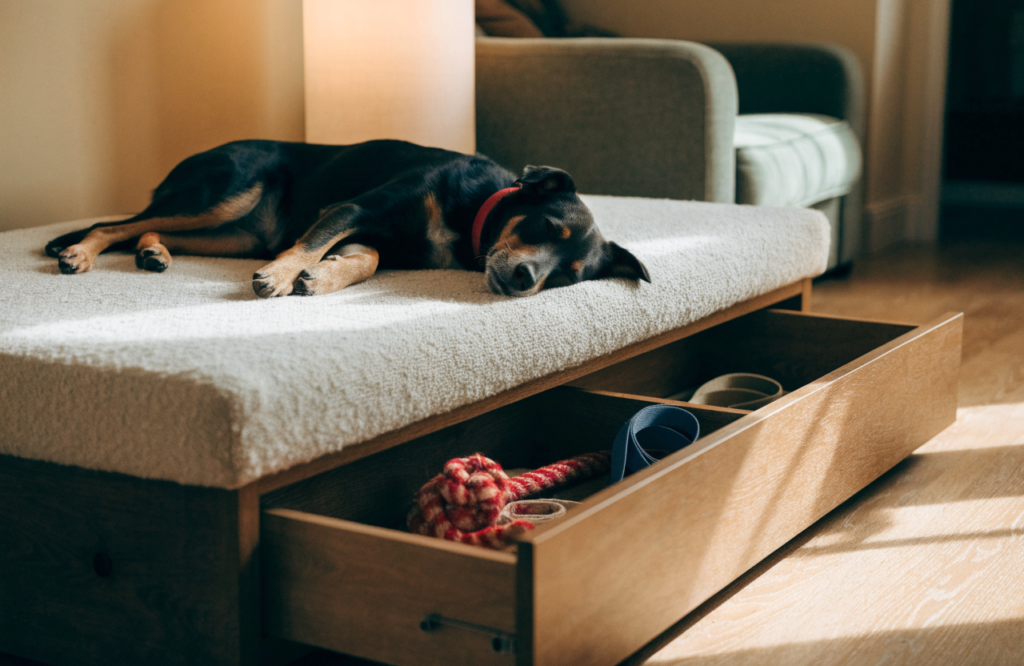
Place it where the dog already naps, not where the storage would be most convenient for you. A perfect toy drawer in a drafty hallway will sit empty of dog.
Keep daily items in the drawer and weekly items under a lift-top, so you are not raising the bed every walk. Wash the cover on the schedule you would use for any dog bed, and more often if your dog sheds heavily or sleeps in the bedroom. Air the compartment when you wash. Replace the cushion when it stays flat, smells after washing, or the cover no longer closes over the fill.
If the dog ignores the new bed for a few days, that is common. Move an unwashed blanket they already use onto the cushion so it smells familiar. Do not store that blanket in the closed compartment while you are trying to build the habit. The smell needs to be on the sleep surface.
Frequently asked questions
Can a dog bed with storage replace a toy basket?
For a small or medium dog with a modest toy pile, yes. Measure the cavity against the actual toys, not the styled photo. Large rope toys, puzzle feeders, and a full spare bed often will not fit. Keep the current favorite outside the compartment so the dog is not pawing at a closed lid.
Are lift-top lids safe around dogs?
Only if the dog is clear of the lid while it moves, and the hinge holds the lid open without slamming. Do not leave a heavy lid propped on a weak hinge. Children and pets should not operate gas-lift lids.
Will the storage area make the bed smell?
It will if wet fabric, food, or soiled toys go in and the cavity stays shut. Dry gear and occasional airing prevent most of that. The cushion is the more common odor source, especially without a washable cover and a moisture barrier.
Is an end-table dog bed sturdy enough to sit on?
Only if the listing gives a human weight rating for the top. Many pet tables are rated for the dog alone. Sitting on a frame built for a 20-pound dog is how legs loosen and drawers rack.
What if my dog is a heavy chewer?
Delay a fabric storage bed. Drawer handles, zippers, and upholstered lids are easy to destroy, and the foam inside is a mess once the cover is open. Use a durable flat bed or cot now, and revisit furniture-style storage when chewing has slowed.