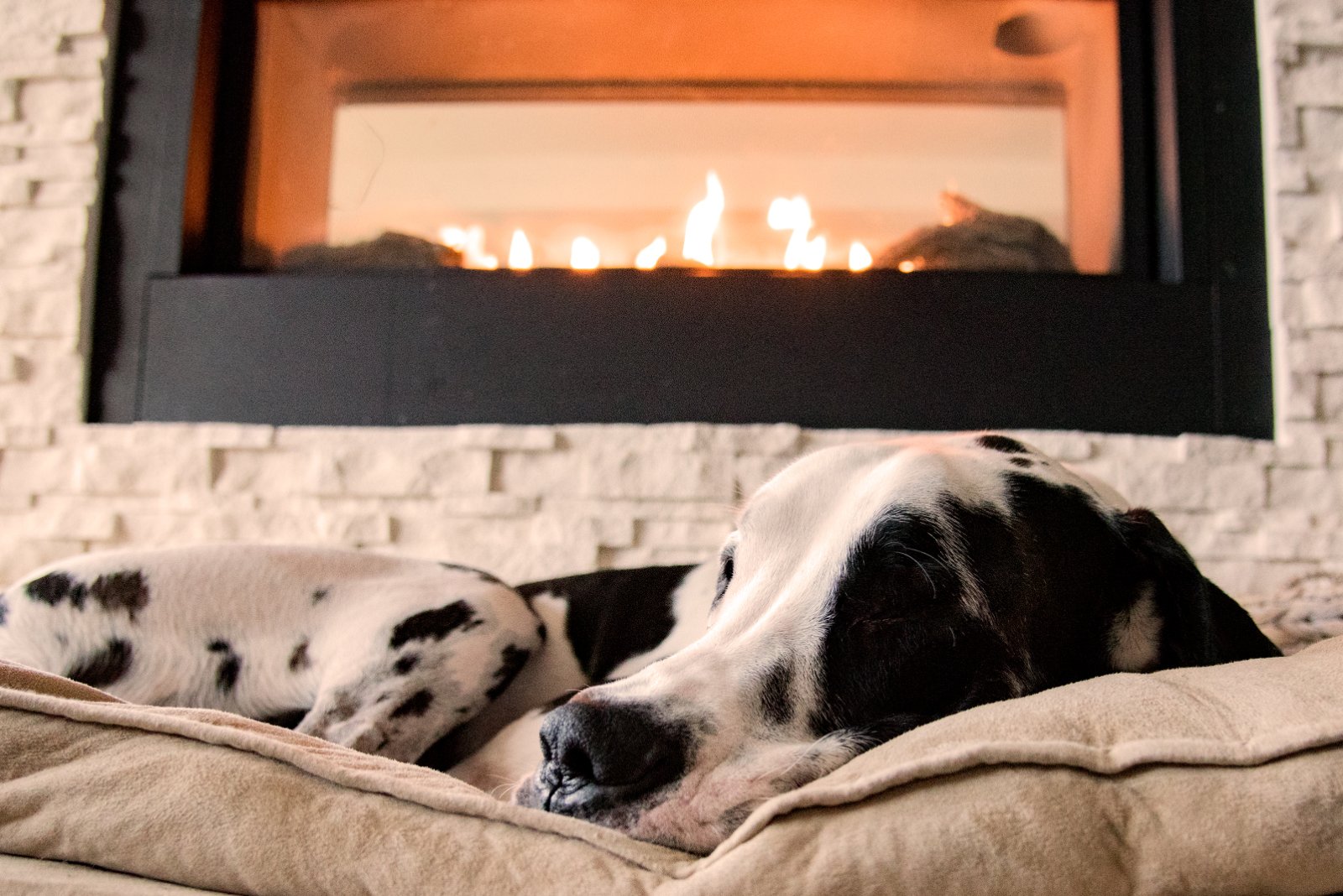

A fireplace dog bed is either a bed set near a working fire or a bed built into a fireplace that is no longer used. Those are different projects. Near an active fire, the useful setup is a supportive bed several feet back from the opening, behind a screen, where the dog can feel the room warm up without lying on hot stone or under falling embers. Inside an unused firebox, the useful setup is a cleaned, sealed alcove with a raised platform and a cave-style cushion. Putting a plush bed on the hearth of a lit fire is the version that causes singed coats and burnt paws.
Dogs choose the hearth because radiant heat feels good and because a recessed opening reads as a den. Owners then try to formalize that choice with a nicer bed. The decision that matters is not the fabric. It is whether the fireplace can still produce flame, hot glass, sparks, or gas.
A bed by the fire and a bed in the firebox solve different problems
If the fireplace is used, the bed stays in the room, not in the opening. The goal is indirect warmth: the dog settles where you would sit, not where the tools stand. ASPCA guidance on fireplace safety for pets is to train animals to stay back from the area directly in front of the opening, and to keep blankets and beds from becoming an invitation to lie in the ember zone. A screen or glass door reduces the chance of a log rolling out, but the screen and the glass themselves get hot enough to burn a nose or a flank.
If the fireplace is retired, the firebox can become a nook. Greyhounds, dachshunds, and other den-sleepers often claim an unused opening because it is enclosed on three sides, quieter than the middle of the room, and cooler in summer than a sunny floor. That only works after the flue, ash, and any gas connection are dealt with. A cushion dropped onto soot is not a conversion.
Where to put the bed when the fireplace is in use
Place the bed where the dog already naps if that spot is clear of the opening, and move it if it is not. Veterinary placement advice treats fireplaces the same way it treats radiators and strong sun: as heat sources that interrupt real rest. A common household rule is to keep the bed no closer than the nearest chair. Furniture guidance often starts around three feet from the fireplace face; pet-safety write-ups are stricter and often recommend about six feet from an active opening so a tail wag or a roll does not close the gap. Follow the larger of those distances, and follow the appliance maker’s clearance if you have a gas insert or stove.
Three hazards sit inside that gap:
- Embers and shifting wood. An open hearth can throw sparks onto bedding. A mesh screen catches some of them. It does not make the hearth a sleeping surface.
- Hot glass and metal. Doors, grates, and tool sets stay hot after the flames drop. Dogs investigate a fire that looks finished.
- The bed itself. Foam, poly fill, and fleece ignite or melt if an ember lands on them. A wagging tail can also drag a blanket forward.
Use a fixed screen or a freestanding hearth gate, and keep toys, extra throws, and the bed’s loose cover outside that zone. Ash belongs in a lidded metal can only after it is fully cold. Some dogs eat ash; it irritates the mouth and gut, so the firebox is not a snack spot between fires.
Dogs that should not have a hearth bed at all
Puppies, heavy chewers, and dogs that do not move away from heat on their own are poor candidates. Senior dogs and dogs with arthritis often sleep deeply and rise slowly, which is the same reason veterinary sources warn that heating pads can burn pets who cannot shift off a hot spot. A brachycephalic dog, a thick-coated northern breed, or any dog that already pants in a warm room does not need a bed aimed at the fire. Long feathering on tails and ears is the fur that owners report smelling singed after a winter of hearth time.
If the dog will not stay back, a pet gate across the fireplace alcove is more reliable than a verbal “off.” The bed then lives on the room side of the gate.
How to turn an unused fireplace into a dog bed
Only do this if the fireplace will not be lit. A working flue, a live gas line, or a shared chimney with a furnace or water heater makes the opening unsafe as a den.
Before any cushion goes in:
- Confirm the flue is not shared with another appliance. Sealing a shared flue can trap carbon monoxide.
- Have a chimney professional inspect the stack if you plan to block it. Unused flues still take on rain, animals, and cold air. A top cap plus a proper plug or damper seal is the usual fix; a decorative log pile does not stop drafts.
- If there is a gas log set, have a qualified technician cap the line. Closing the valve is not a permanent seal.
- Remove ash, soot, and creosote. Those soils stain covers and can be licked off paws.
- Cover any exposed pipe or rough masonry so the dog is not lying on metal or crumbling mortar.
A low platform of sturdy plywood, raised on furniture feet or a simple frame, does three jobs: it covers floor-level hardware, it lifts the bed off cold stone, and it gives you a flat surface that a standard cushion can sit on. Measure the opening at several heights. Fireboxes are rarely square, and the bed has to slide in without bowing the bolsters. Leave enough height for the dog to stand and turn. A tight cave feels secure; a box the dog cannot exit easily does not.
A baby gate or two gate panels in a V at the front is optional. Some owners use it at night so a sleeping dog is not stepped on. It should never trap a dog in a space that can still get hot, smoky, or drafty.
In summer, the same alcove is often chosen because masonry stays cool. That is fine if the flue is sealed against debris and the bed can be pulled out to wash. If the dog only uses the opening when the fire is out and abandons it when you light a match, treat that as the correct preference and keep the in-use bed in the room.
What to look for in the bed itself
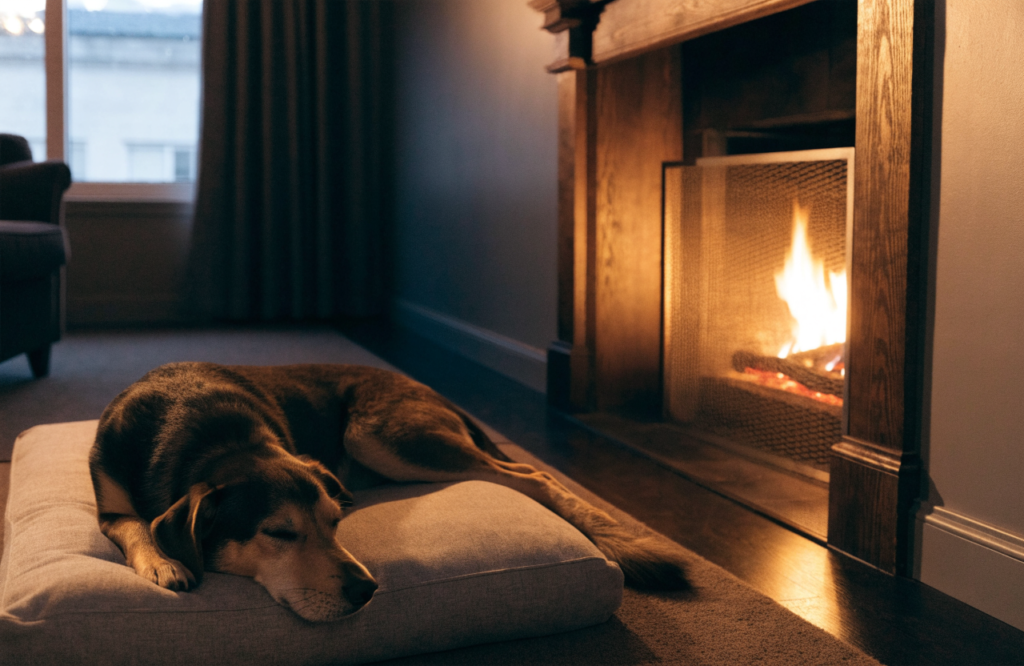
Match the bed to the job, not to a hearth-themed product name. Most “fireplace” appeal is placement and shape.
Fill and cover
A dog that lies by the fire for an hour and then moves off does well on a medium-firm orthopedic foam or a bolstered sofa bed, at least about four inches thick for a medium or large dog, so hips are not on the floor. Solid foam supports more evenly than a thin poly-fill pillow. Removable, machine-washable covers matter more here than in a bedroom: soot, ash film, and drool collect fast on a hearth.
Wool and sheepskin char and self-extinguish more readily than polyester fill, which can melt. That is a material property, not permission to park the bed in the ember zone. Wool also breathes, which helps a dog that wants warmth without a sweaty belly. Avoid adding a household heating pad or a heated pet bed aimed at an already warm hearth. Pet-safe heated beds are a separate product, with their own chew and burn rules, and they do not belong beside an open flame.
Shape
Bolstered and cave beds earn their place. Dogs that pick the hearth often want a backrest: the sofa, the wall, or the firebox jamb. A three-sided bolster with a low front lets an older dog step in without hopping. A cave bed suits the unused-firebox project because the opening already supplies the den; the bed only has to cushion it. Flat mats are the right call for dogs that sprawl and overheat, and for tile that you want to keep easy to sweep.
Floor and size
Hearth tile and stone are slick. A non-slip base, or a low rug under the bed that itself sits outside the screen zone, keeps the bed from migrating toward the opening. Size the bed to the dog stretched on its side, not to the dog curled in a catalog photo. If you are filling a firebox, the limiting measure is the smallest width of the opening, not the dog’s weight chart.
Mistakes that make a hearth bed unsafe
- Bedding inside the screen line, or a bed the dog can drag there.
- Assuming glass doors mean the fire is contained. The glass is a burn surface for hours.
- Leaving matches, starter logs, and lighter fluid at dog height. Those are toxic if chewed, not just a fire risk.
- Building a cute alcove in a fireplace that still has a gas supply or a shared flue.
- Using the firebox as storage for the bed while ash is still warm.
- Stacking blankets “so they can burrow closer.” Extra layers are what embers land on.
- Ignoring the draft. An unsealed flue pulls warm room air up the chimney and can make the nook colder and dustier than the floor beside it.
A second bed is often the practical answer: one orthopedic bed in the living room at a safe distance, and a washable mat for supervised hearth time while you are in the room and the screen is closed. When you leave, the mat comes with you.
Frequently asked questions
Can my dog sleep in the fireplace if we never light it?
Yes, if the flue is capped or properly sealed, any gas line is professionally capped, the firebox is cleaned, and the dog can get in and out easily. A platform keeps the cushion off rough stone and hidden hardware. Do not seal a chimney that vents another appliance.
How far should a dog bed be from a lit fireplace?
Far enough that the dog cannot roll, wag, or drag bedding into the opening. A practical floor is no closer than the nearest seating, commonly at least three feet, with many pet-safety sources preferring about six feet from an active face. Use a screen either way. Hot glass still burns.
Are wool dog beds fireproof?
No bed is fireproof. Wool resists ignition better than many synthetic fills and tends to char instead of melt, which is why it is a reasonable cover choice near a heat source. It does not make embers safe.
My dog refuses every bed except the hearth. What should I do?
Move a bed to the closest safe spot the dog already uses, not to the stone lip. Reward settles on that bed while the fire is lit, and block the opening with a screen or gate. If the fireplace is unused, converting the firebox is the version that matches the preference without the burn risk.