A bench with a dog bed under it only works when the dog can stand, turn, and stretch without hitting the seat, and when the spot is quiet enough for real rest. Shoving a cushion under a low hallway bench fails both tests. The useful split is between an open nook under an ordinary bench and a furniture-style crate that looks like a bench and locks. Photos of either setup skip the measurements that decide whether your dog will use it.
Open nook or enclosed crate: two different pieces of furniture
An open bench with a dog bed underneath is a seat with clear floor space below it. The bed slides in and out. The dog is not contained. That suits a dog who already settles near people, does not guard the bed, and does not need to be shut in when guests arrive or the door opens.
A furniture crate bench is a wooden or composite kennel with a cushioned top, mesh or spindle sides, and a door. Listings market these as end-of-bed benches and entryway seats. One common model is about 47 inches long, 24 inches wide, and 22 inches high outside, with an interior closer to 41 by 22 by 17 inches, and a seat rated around 220 pounds. Larger versions run past 50 inches long, with seat ratings around 300 pounds. Prices for mass-market versions often sit in the $160 to $370 range; solid-wood custom kennels cost far more.
Choose the open nook if the goal is a nearby nap spot and you can leave the dog loose. Choose the crate bench if you need a door, a den with walls, or a place the dog can be closed into for short periods. A crate that is only used as a pretty box, with the door always open, still has to meet crate sizing rules, because the dog will treat the walls as the limits of the space.
Measure the dog before you measure the bench
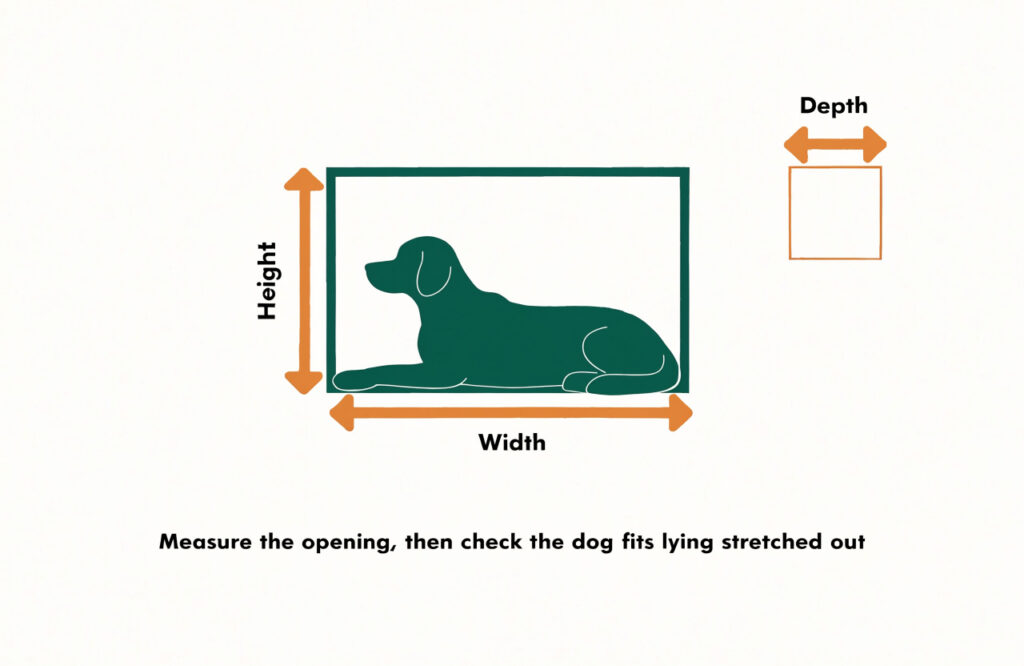
Weight bands on product pages are a starting guess, not a fit. PetMD’s crate sizing guide, written by a certified veterinary technician, uses a functional test: the dog should stand up easily, turn around, and lie on their side with limbs fully extended. When sitting, there should be at least 2 inches of clearance above the head. Bedding counts against that space, so a thick orthopedic pad can turn a “medium” interior into a crouch.
Measure three things with the dog standing and then lying down:
- Length from nose to the base of the tail, not the tail tip. Add a few inches so the dog can stretch. For an open bed, dog-bed sellers commonly add 6 to 12 inches to that length; a sprawler needs the higher end.
- Height from floor to the top of the head or ears, whichever is higher, plus at least 2 to 4 inches. Subtract the thickness of the bed. The remaining number is the minimum clear height under the seat.
- Width across the shoulders or hips in the position they actually sleep in. A side-sleeper needs more width than a dog who curls.
PetMD’s chart puts a 30-by-20-by-23-inch crate in the range for dogs up to about 40 pounds and 24 inches long, and a 36-by-24-by-26-inch crate for dogs up to about 70 pounds and 30 inches long. A 42-inch crate is the band that starts to fit many Labs and Goldens. An interior height of 17 inches, which shows up on some bench-style crates, is tight once a 4-inch bed is inside. A French bulldog may clear it. A beagle who sits upright may not.
For an open nook, the same body measurements apply, but the dog can step out to stretch. Still leave enough height to stand without scraping the back. A 10-inch gap under a floating bench works for a low, short dog and a thin mat. Medium dogs generally need something closer to 14 inches of clear space after the bed is in place. Large dogs rarely fit under a normal seat height without a purpose-built frame.
Where the bench should go, and where the bed should not
Entryway and mudroom benches dominate idea roundups because the seat is useful for shoes. That is a human reason, not a sleep reason. In a September 2026 Good Housekeeping piece, Dr. Carly Fox, a senior veterinarian at Schwarzman Animal Medical Center in New York, said a bed works best in a corner of the room where the family actually spends time, with easy access in and out, and that the dog should never feel cornered or trapped. Dr. Karen Halligan, a veterinarian in California, advised against hallways, spots near the front door, and frequently used walkways, because foot traffic and noise keep dogs on alert.
An entryway bench can still be the right furniture if the dog’s real bed is elsewhere and the under-bench spot is only a short wait while you put on shoes. It is a poor primary bed if the door opens onto it all day. A corner of the living room, the end of a bed that is not in a traffic lane, or a window seat set back from the walkway fits the veterinary advice better: the dog can see the room and is not in the path.
Avoid a nook the dog has to jump down from, especially for seniors. Also skip drafty exterior doors, radiators, and full sun on the bedding. If two dogs will share the bench, give each a separate opening or a divided nook. One shared cushion under a long seat turns into a resource the more assertive dog claims.
What ready-made crate benches are actually for
Furniture crates earn their price when you need containment that does not look like a wire pen. Check four numbers on the listing, not the lifestyle photo:
- Interior length, width, and height, not the outside frame.
- Seat weight rating. Around 220 to 300 pounds is common on bench-top models. That covers one adult sitting to tie shoes. It is not a promise that two people can perch on a particleboard top.
- Door hardware. Two locks matter more than a decorative barn door if the dog is a pusher.
- Floor. A removable tray or a bed with a washable cover is what you will actually clean.
A 47-inch exterior bench with roughly 41 inches of interior length is a small-to-medium dog piece once bedding is in. A 56-inch bench with a higher seat is the size that starts to look plausible at the foot of a bed for a larger medium dog, provided the interior height still clears the head. If the listing only gives outside dimensions, assume the walls and cushion steal several inches and size up.
These units are heavy once assembled. Measure the doorway and the turn into the room before you order. Chew strips or metal edges help if your dog mouths corners. Wood veneer and particleboard are not chew-proof.
Using a bench you already own
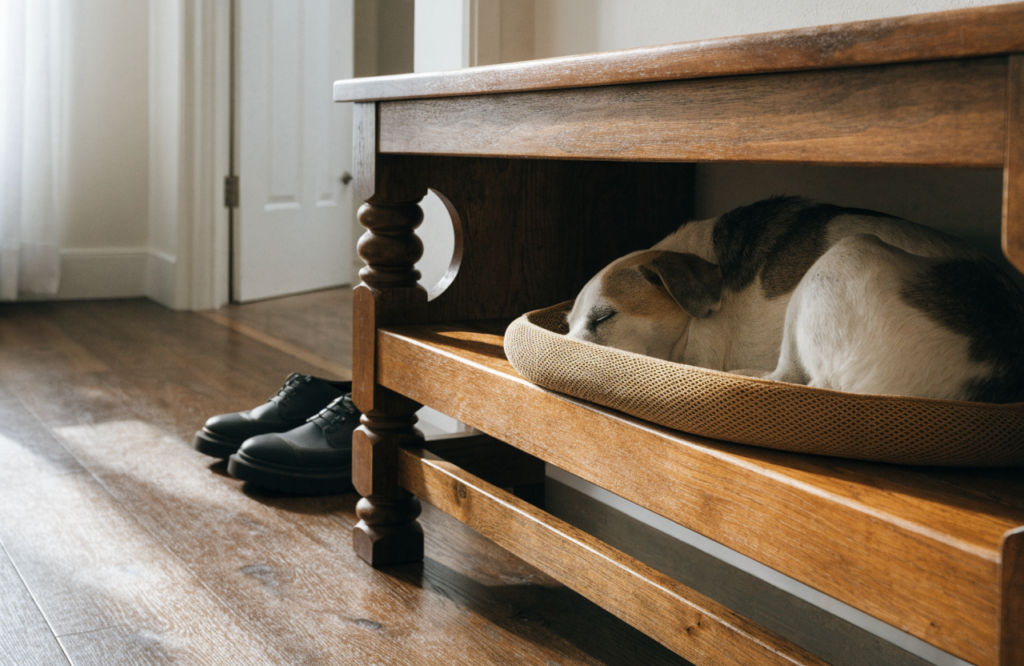
A standard dining or entry bench often has 12 to 16 inches of clearance and a stretcher bar that blocks a full-length bed. If the bar is structural, do not remove it. Slide a low-profile bed into the open bay, or accept that only a small dog fits.
A floating bench mounted to studs can leave the floor clear, which makes the room look larger and the bed easier to pull out. The seat has to be lagged into framing, not drywall anchors, because people will sit on it and a dog may push off the wall getting up. Leave the underside open rather than boxing it into a cave with one narrow mouth. A dog who cannot turn around will back out awkwardly or stop using it.
DIY frames that show up in home projects are usually 2×4 boxes with a plywood top, foam, and fabric. That is enough for a light seat and a small or medium dog if the legs are blocked to the floor and the top is screwed, not just glued. It is not enough if you want two adults to sit or a large dog to lean into the frame. Hardwood or thicker stock, and legs that cannot rack, matter more than the stain color.
Match the bed to the floor. A mat with a non-slip bottom stays put when the dog circles. A raised cot under a bench can work on a cold mudroom floor, but it eats height. Removable, washable covers matter more than the cushion style, because this spot collects hair, grit from paws, and the occasional accident.
Problems that show up after the first week
Hair packs into the gap between the bed and the bench legs, and a vacuum hose often will not reach the back corner. A bed you can pull fully clear is easier to live with than a fitted cushion stapled into a cubby. If you build a front panel for looks, hinge it or leave it off.
Chewing usually starts on the nearest corner or the door latch, not the center of the cushion. Metal mesh and rounded edges hold up better than raw plywood in a crate bench. An open nook has fewer edges to mouth, which is one reason it is simpler for a gentle chewer.
Some dogs ignore a new under-bench bed because it is darker or smaller than the couch spot they already use. Move the familiar blanket into it, and put it where they already nap, rather than where the photo looked best. If they still sleep beside the bench, the bench is in the wrong place. Veterinarians in the Good Housekeeping piece noted that dogs vote with where they lie; relocating the bed beats insisting on the designed nook.
Do not use the under-bench spot as a timeout corner if you also want it to be the sleep place. The two jobs conflict. A crate bench used for short confinement should be introduced the same way as any crate: door open, meals nearby, then brief closed periods, not a first night locked in after a move.
Which setup fits your dog and room
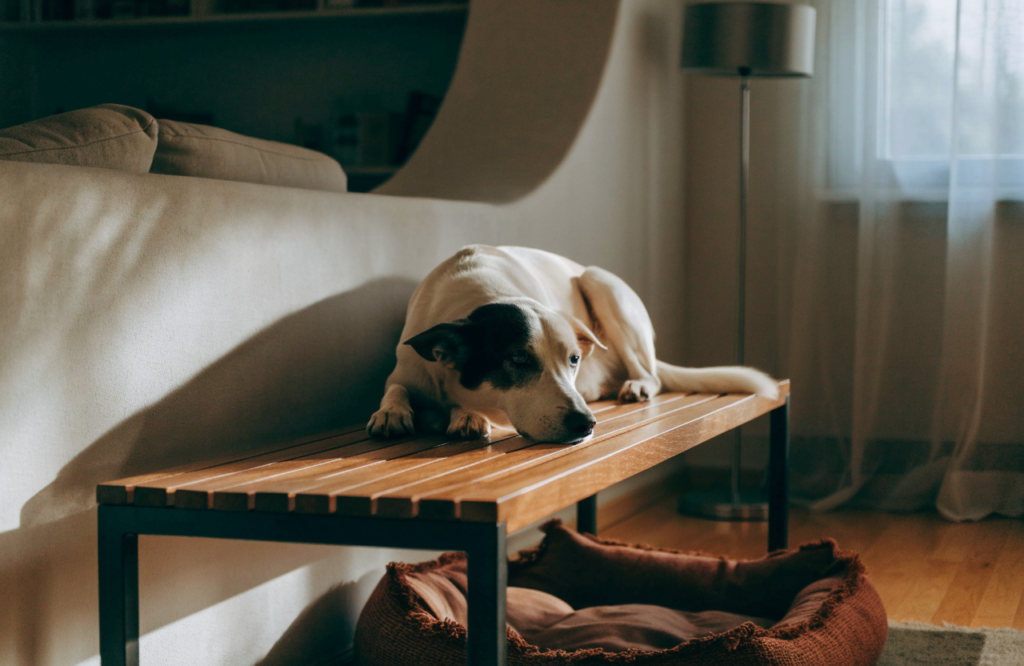
Use an open bed under a bench if your dog is small or medium, already settles without a door, and the bench can sit in a low-traffic corner with at least enough clear height to stand after the bed is in. Skip it for a large sprawler unless you are building a deeper, higher frame than a normal seat.
Use a furniture crate bench if you need a door, the dog likes a walled den, and the interior meets the stand-turn-stretch test with the bed inside. Confirm the seat rating if people will actually sit on it. Place it out of the main walkway even if the catalog photo is an entryway.
If the only available wall is beside the front door, keep a thin mat there for short waits and put the real bed in the living-room or bedroom corner. The bench can still hold shoes. It does not have to hold the dog’s night sleep.
Questions people ask after measuring
Will a dog sleep under a bench if they already have a bed? Often, if the new spot is quieter or more den-like than the old one, and the old blanket moves with them. If they keep choosing the floor beside the bench, the clearance or the traffic is wrong, not the dog.
How high does the bench need to be? High enough that the dog can sit with about 2 inches over the head after the bed thickness is subtracted, using the same clearance idea PetMD applies to crates. A number on a furniture listing is useless until you subtract the pad.
Is an entryway bench with a dog bed under it a bad idea? It is a weak primary bed. Veterinary advice published by Good Housekeeping flags front doors and busy walkways because noise keeps dogs alert. It can still work as a short-stay spot.
Can two dogs share one under-bench space? Only if each can lie extended without competing for the opening. A divided nook or two beds side by side fails less often than one long cushion.
What if the dog chews the bench? Switch to a metal-edged crate bench or an open nook with fewer raw corners, and do not leave them unsupervised in a particleboard unit they have already started to mouth.