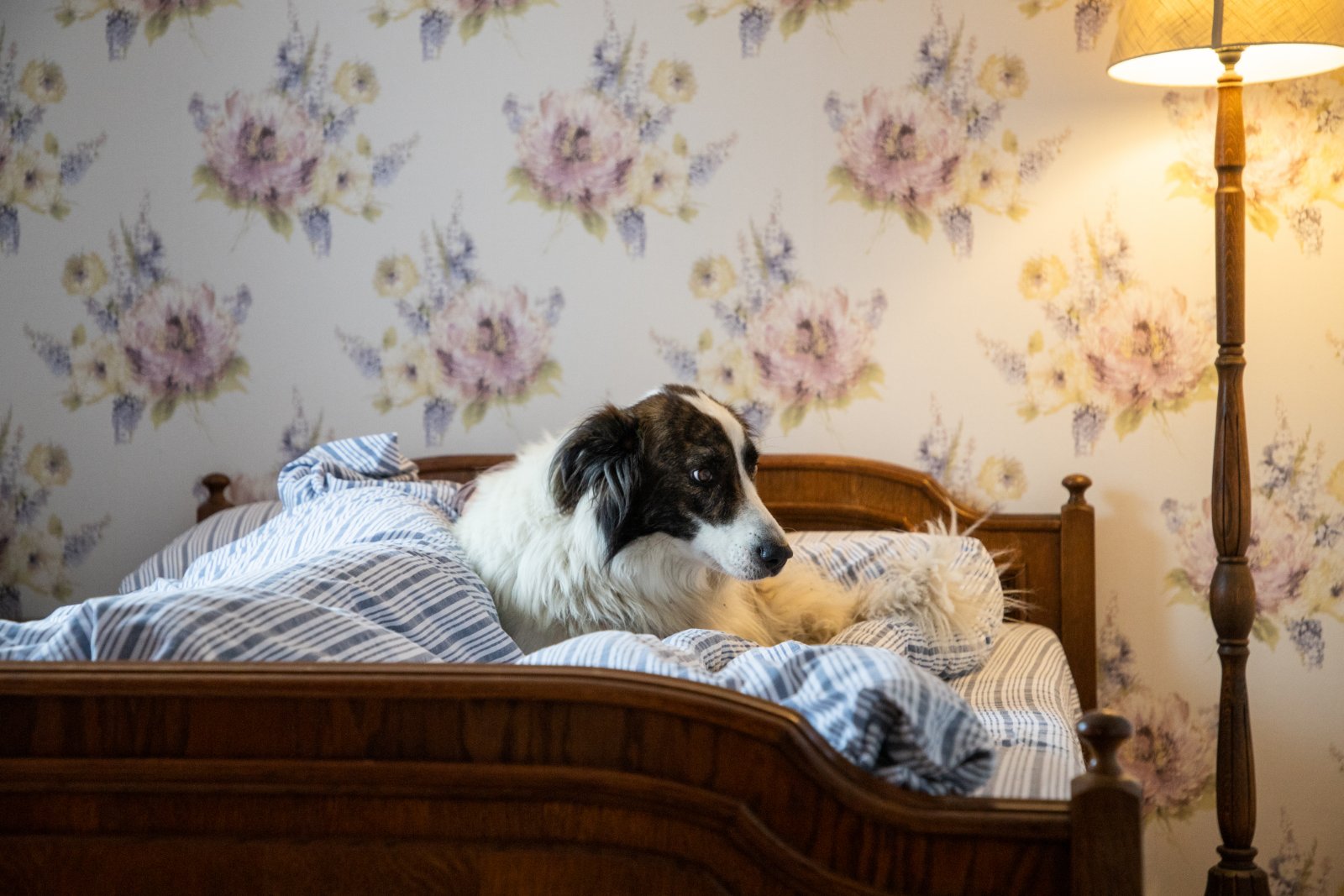

A bedroom dog bed works when it matches how the dog already sleeps and sits where that dog already settles. The useful ideas are less about matching your duvet and more about sleep style, floor space, and how often the cover will need washing. A curled-up small dog usually wants a nest. A sprawling Lab usually wants a flat mattress with room to stretch. A senior with stiff hips wants a low, firm bed they can step onto without jumping.
Placement follows the same logic. Veterinarians who advise on this say the bed should go where the dog already rests, not where it looks best in a photo, and that a corner near the people they live with beats a hallway or a spot by the door.
Start with how the dog sleeps, not the furniture
The bed type decides whether the dog uses it. Style labels on the box are secondary.
Curlers tuck nose to tail and often rest a chin on a raised edge. A donut or bolster bed gives them a wall to lean into. The tradeoff is usable space: bolsters eat the interior, so size up one level from what a flat mat would need, and check the sleeping surface in the specs, not the outer measurements.
Sprawlers sleep on their side with legs out. Raised edges waste the space they need. A rectangular mattress or low orthopedic pad is the better fit, and it should be long enough that the toes stay on the bed.
Burrowers push under blankets or into a hood. A cave or hooded bed suits that habit, especially in nervous dogs that want a den. The opening still has to be easy to enter and exit. A hood that traps a large head, or a bed so snug the dog cannot turn around, gets abandoned.
Hot sleepers, including thick-coated breeds and many flat-faced dogs, overheat on deep memory foam. A raised cot with mesh lets air move underneath. It is a poor choice for a dog that struggles to step up, and it offers little joint support.
Seniors and dogs with joint pain do better on dense foam they do not sink through, with a low front edge. Four inches of foam is a practical minimum for a medium dog; heavier dogs often need five to seven inches of a denser support layer. Egg-crate foam is cheaper and tends to compress sooner under weight. Marketing that only says “orthopedic” does not tell you density. If the brand will not publish foam weight per cubic foot, assume it is on the soft side.
Bedroom placements that stay out of the way
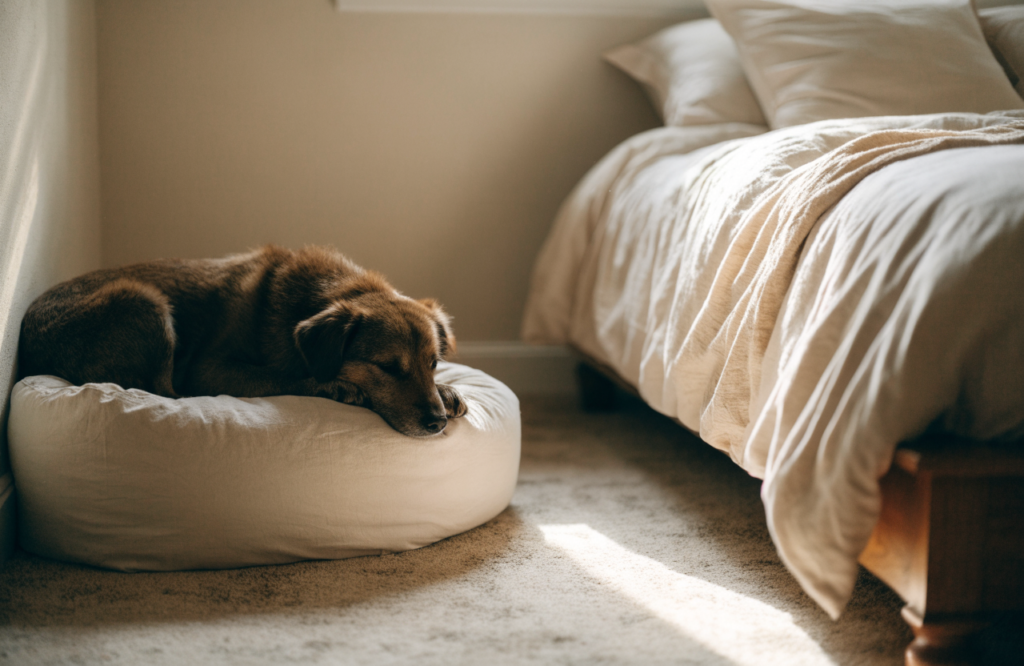
The bedroom changes the rules. The bed is a few feet from where you sleep, so noise, smell, tripping, and night access matter more than they do in a living room.
Beside your side of the bed. This is the default that works for most dogs who want to be near you without sharing the mattress. Put it against the wall or the nightstand, not in the path from the door to the bed. A non-slip base matters on hardwood and on rugs that shift.
In a quiet corner. Corners give a back wall and keep the bed out of the walkway. An L-shaped bolster can sit into a 90-degree angle if the room is tight. Avoid the corner directly under a drafty window or a heater vent; temperature swings are a common reason a dog abandons an otherwise good bed.
At the foot of the bed, only if the aisle is wide. A long flat mattress along the foot works for a sprawler when you will not kick it at 2 a.m. In a narrow room it becomes a trip hazard. If the foot of the bed is the only free wall, choose a low profile rather than a high bolster sofa.
Under a raised frame, with limits. A low pad slid under a platform bed can work for a small or anxious dog that likes a den, and it frees floor space. It fails when clearance is tight, the dog has to army-crawl, or arthritis makes getting out hard. Leave the opening unobstructed and do not use it as storage.
Inside an open crate. A crate pad in the bedroom gives a predictable den if the door stays open and the dog already accepts the crate. A thick foam insert can steal headroom in a standard crate; measure both before you buy.
Not in the doorway, and not in the hall outside. Traffic, voices, and the front door keep some dogs on alert instead of asleep. If the dog barks at every footstep, moving the bed a few feet off the path often helps more than a “calming” label on the fabric.
Dogs vote with where they lie down. If the new bed is ignored and the dog keeps sleeping on the rug next to it, move the bed to that rug.
Size it to the stretched dog, then to the room
Measure from the nose to the base of the tail while the dog is stretched out, not standing. Add about 6 to 12 inches (15 to 30 cm). Use the lower end for a tight curler and the higher end for a sprawler. That number is the minimum sleeping length.
Weight labels on product pages are a rough filter, not a fit guide. A long, lean dog and a stocky dog of the same weight need different lengths. Brand sizes also disagree: one company’s “large” can be rated for under 40 pounds while another’s large starts at 50.
| Dog | Typical weight | Practical sleeping surface | Notes for a bedroom |
|---|---|---|---|
| Toy and small | Under 25 lb (11 kg) | About 24 × 18 in and up | Donut or cave often fits a corner; avoid a bed so deep they cannot climb out |
| Medium | 25–50 lb (11–23 kg) | About 30 × 24 to 36 × 28 in | Bolster beds should be sized to the interior, not the outer edge |
| Large | 50–80 lb (23–36 kg) | About 40 × 30 in and up | Flat orthopedic mattress uses the foot-of-bed wall better than a high sofa |
| Giant | 90 lb (41 kg) and up | 48 in long and longer; check weight rating | Foam depth matters as much as length; budget pads flatten under this weight |
Round up if you are between sizes. A folded blanket can shrink a bed that feels too open. Nothing fixes one that is too short.
What matters because the bed lives where you sleep
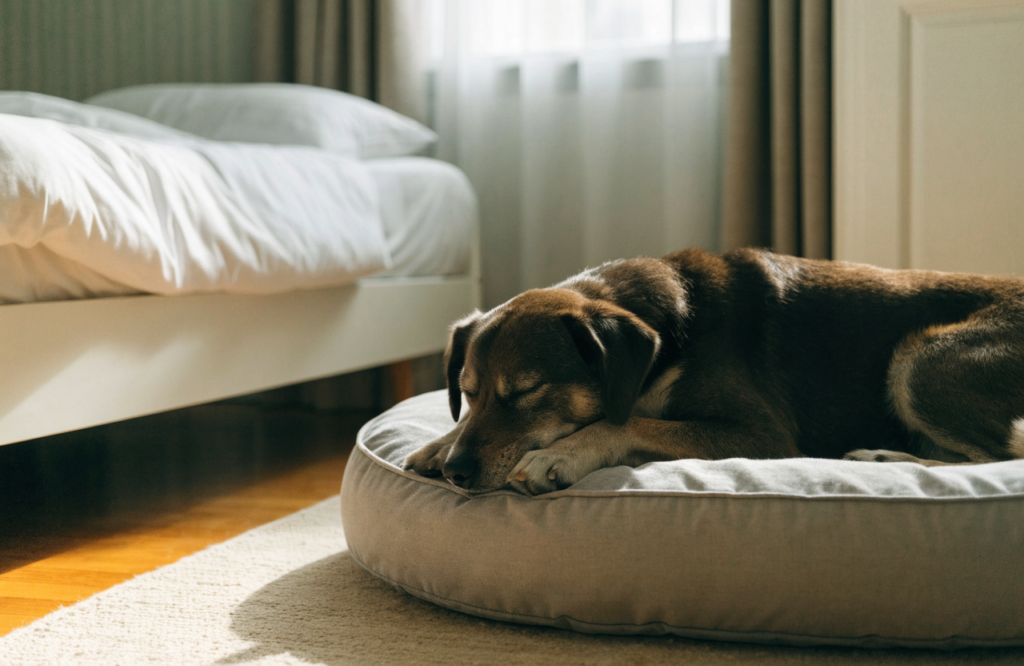
A bedroom bed needs a removable, machine-washable cover and a waterproof liner between cover and foam. Dog oils and damp fur are what make a bed smell; washing the cover on a schedule, often every one to two weeks if the dog sleeps there nightly, matters more than a scented spray. Foam itself is usually spot-clean only. If liquids reach the core, it is hard to dry fully and easy to mildew.
Faux fur looks soft and holds hair and dander. A tighter weave or performance fabric is easier to keep acceptable in a small room. A waterproof liner also protects the floor if the dog is older or not fully house-trained.
Heat is the other bedroom problem. Memory foam holds warmth. A thick-coated dog next to a warm human bed may prefer a cot or a gel-top pad in summer and a bolster only in winter. Two covers, swapped by season, is often simpler than one “all-year” bed.
Chewers need a different product. Plush bedroom beds are not chew-proof. A heavy chewer is safer on a tough canvas or ballistic cover, kept away from loose stuffing they can pull out overnight.
A floor bed versus sharing your mattress
A floor bed in the bedroom is the middle option between co-sleeping and shutting the dog out. It works well when both of you sleep through the night and the dog can get on and off their own bed without help.
Sharing the human bed is reasonable for many healthy adults with a relaxed, healthy dog, and a poor fit when it breaks sleep, worsens allergies, or means a stiff dog is jumping up and down. For people with dog allergies, keeping the dog out of the bedroom usually reduces symptoms more than keeping them off the pillow while they stay in the room. Anyone with a weakened immune system should ask their own doctor about close contact overnight.
If the dog is invited up, still keep a floor bed available so they can leave when they are too warm. For a dog with weak hind legs, a ramp or floor-level bedding is safer than repeated jumps; ask a vet before adding stairs if the dog is post-surgery or very unsteady.
Ideas that look intentional without wasting the bed
A few setups earn their space:
- A low orthopedic mattress in a neutral cover, set on a washable rug beside the bed, reads as part of the room and is the easiest to launder.
- A donut in a corner nook, with a water bowl on a mat outside the sleep zone, suits a small anxious dog.
- A bench or window seat with a fitted pad only works if the height is low enough to step onto. Pretty furniture that requires a jump is a bad bed for an older dog.
- A cave bed tucked beside a dresser gives a den without building anything. Leave the front clear.
Built-in nightstand beds and custom joinery are optional. They save floor space only if the interior is actually large enough and the cushion can be removed for washing. If the cavity is sized to the furniture rather than the dog, it becomes a decorative box the dog ignores.
Mistakes that make a good bed unused
Buying for the photo instead of the sleep style is the main one. A cave for a sprawler, or a cot for a senior who cannot step up, fails even if the fabric matches the curtains.
Sizing to the outer dimension of a bolster bed is the second. The dog ends up half off the mattress and back on the rug.
Putting the bed in the traffic lane, under a draft, or in full afternoon sun is the third. Dogs leave beds that are in the way or the wrong temperature.
Skipping the liner is the fourth, especially in a carpeted bedroom. One accident in unprotected foam usually means replacing the bed.
Expecting one bed to solve separation anxiety, night barking, or joint disease is the fifth. The bed can make the resting spot better. It does not replace training, a vet visit, or a closed door when the bedroom needs to stay quiet.
Frequently asked questions
Where should a dog bed go in a small bedroom? Against a wall on your side of the bed, or in the corner farthest from the door. Keep the path from the door to your bed clear. A low flat bed takes less visual and physical space than a high-sided sofa bed.
Do I need an orthopedic bed if my dog is young? Not always. A young, healthy dog of small or medium size is usually fine on a supportive bolster or mattress with a washable cover. Orthopedic foam is more useful for seniors, heavy breeds, and dogs with known joint pain, because cheap fill compresses under weight.
How often should a bedroom dog bed be washed? Wash the cover every one to two weeks with daily use, sooner if it smells or the dog has allergies or skin trouble. Vacuum or lint-roll between washes. Dry the cover fully before it goes back on the foam.
Can a dog bed go under the bed? Only with enough clearance for easy entry and exit, and only for a dog that likes enclosed spaces. Skip it for seniors, dogs in recovery, and any setup that forces them to crawl.
What if my dog ignores the new bed? Move it to the spot they already choose, add a familiar blanket, and leave it there without forcing them on. If they only sleep on your bed, a floor bed beside you is still worth having for hot nights and for guests who do not want a dog on the mattress.