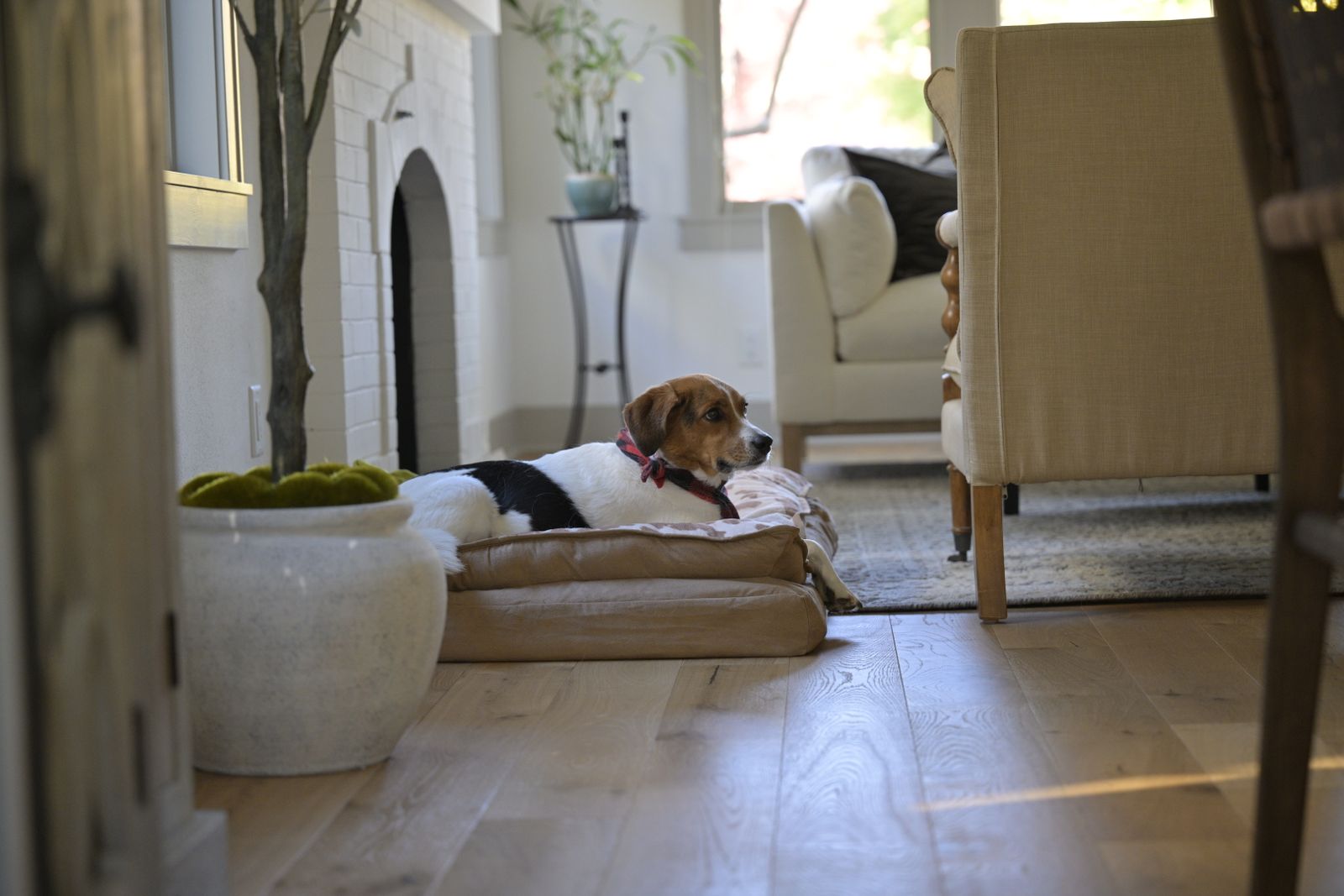

A living-room dog bed works when it sits where the dog already wants to be, fits how that dog sleeps, and uses the same materials and lines as the furniture around it. The useful ideas are not miniature versions of a human sofa for every house. They are placements and bed types that keep the dog in the room without blocking the path between the sofa, the door, and the television. Style only holds if the bed is large enough, low enough to enter, and covered in something you can actually wash.
Start with the spot the dog already chooses
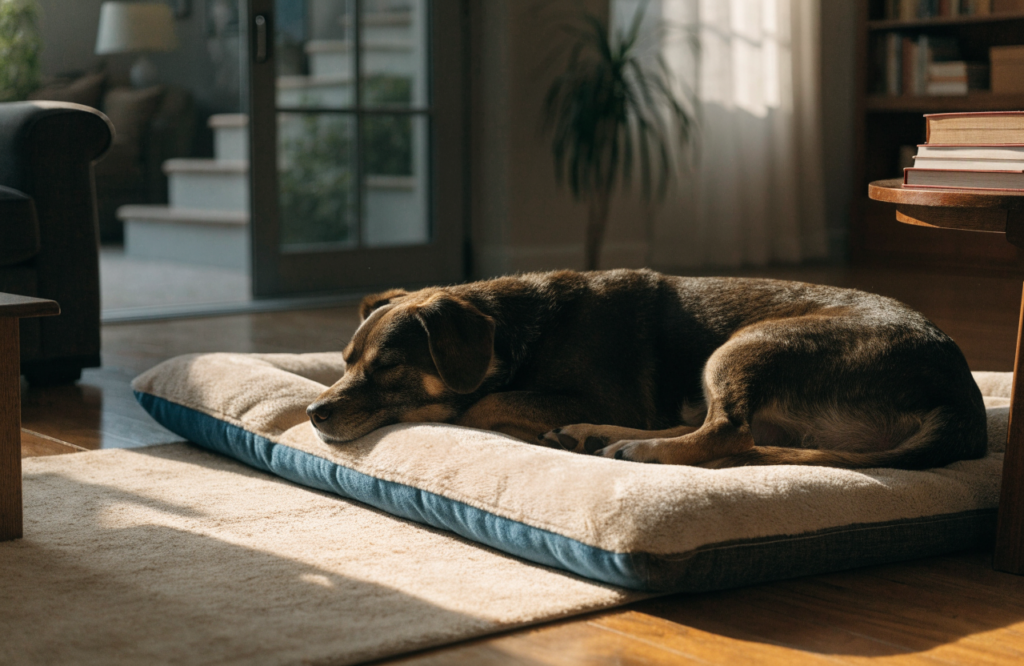
Veterinarians who advise on sleep placement generally point to a corner of the room where people spend time, with easy entry and exit and no feeling of being trapped. The same guidance warns against hallways, front doors, and busy walkways, because constant foot traffic keeps a dog alert instead of settled. Dogs also vote with their bodies: a bed moved a short distance into the corner they already nap in is more likely to be used than a prettier bed placed where it photographs well.
Watch the room for a few evenings before you buy. Note where the dog lies when people sit down, where they retreat when the room gets loud, and whether they stretch, curl, or try to get under furniture. That pattern decides the idea. A social dog that watches the sofa wants a bed beside seating. A dog that disappears under the coffee table wants a den, not an open mattress in the middle of the rug.
Temperature is part of placement. Drafts from exterior doors, floor vents, and leaky windows interrupt sleep. So does a bed pressed against a radiator or parked in hard afternoon sun, especially for thick-coated or flat-faced dogs. A sunny patch can be a good daytime spot if the dog can leave it; it is a poor only bed if the room overheats.
Low, rectangular cushions work in a living room when they sit clear of the main walkway and match the floor and upholstery rather than introducing a new color story.
Match the bed to the way the dog sleeps
Buying for the room first is the usual reason a living-room bed gets ignored. Shape should follow sleep style.
| How the dog sleeps | Bed that usually fits | Living-room caution |
|---|---|---|
| Curled tight | Bolster, donut, or nest | High walls eat floor space; check the inner diameter, not the outer one |
| Stretched on the side | Flat rectangular mattress | Needs length plus a stretch margin, or hips hang off |
| On the back, legs up | Firm, open mattress | Soft bolsters get in the way |
| Burrowed under a blanket | Cave or hooded bed | Can look bulky; place it in a corner so the hood faces the wall |
| Half on, half off | The current bed is too small | A larger flat pad fixes this faster than a prettier cover |
Seniors and dogs with joint pain usually do better on a supportive foam mattress with a low step-in than on a deep plush nest they have to climb into. Puppies and dogs that still chew need a cover you can replace, not a loose boucle loop they can pull. Anxious dogs often prefer a bolster they can lean on, but only if the opening still lets them see the room.
Dog bed ideas that fit real living-room layouts
A sofa-side bed in the same palette
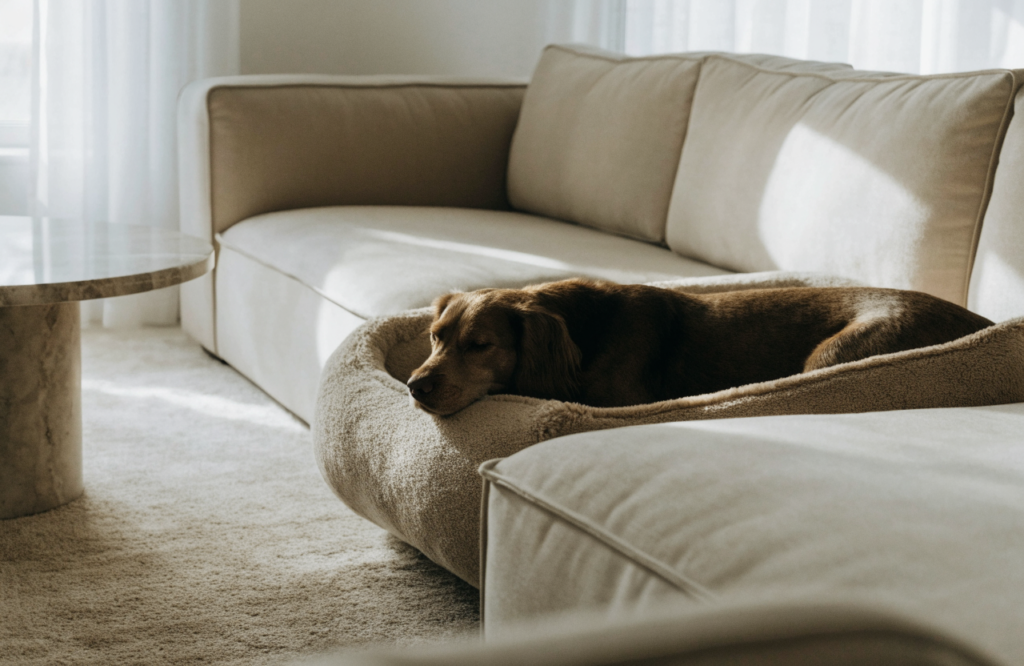
The most reliable living-room idea is a low bed tucked against the sofa, on the side people actually sit. It keeps the dog in the conversation without giving them the cushions. Choose a cover close to the sofa fabric or the rug: oatmeal, charcoal, warm gray, or the same wood tone as the legs. A second blanket in a throw already used on the sofa makes the bed read as part of the seating group.
Leave enough clear floor that someone can walk past the coffee table without stepping over the dog. If the only gap is the main path from the kitchen, this idea fails even if the colors match.
An unused corner that is not a corridor
Corners work because they give a wall on two sides and stay out of traffic. A curved wooden frame or a simple rectangular pad can turn that dead space into a defined spot. The corner has to be a real corner, not the triangle where the hallway meets the living room. If people cut through it to reach a door, the dog will not settle there.
Under a console, bench, or open coffee table
A cubby under a console or an open coffee table hides the bed and gives den-loving dogs a roof. It only works if the interior is large enough for the dog to turn around and the lip is low enough to step over. Measure the opening, then the dog’s height at the shoulders and the length from nose to the base of the tail. A tight cubby that looked clever in a photo becomes a bed the dog refuses, or one they cannot exit quickly.
Storage around the cubby is useful for spare covers and toys, but keep food and water bowls out of the sleeping nook. Eating and sleeping in the same tight space makes the area harder to keep clean.
A window bench with a bed inside one bay
A built-in bench under a window can hold a cushion in one open bay and baskets in the others. The bed feels architectural instead of added. Two limits matter. Afternoon sun can overheat the bay, so the dog needs another option in summer. A drafty sill does the opposite in winter. A removable cushion with a waterproof liner underneath is what makes the built-in practical; a fixed upholstered pad in that spot is difficult to clean once muddy paws arrive.
Crate furniture used as a side table
If the dog already rests in a crate, a wood or metal crate designed as an end table or console keeps the crate in the living room without looking like equipment left out. The top can hold a lamp or books. Ventilation has to stay open, the interior needs a real mattress, and the crate has to be large enough for the dog to stand, turn, and lie stretched. A furniture shell does not fix a crate that is too small.
Crate furniture earns its place when the dog already uses a crate and the piece is sized for standing and turning, not just for the top surface to hold a lamp.
This idea is a poor fit for dogs who panic in crates, and for households that only wanted a prettier bed. A crate is a different object from a bolster pad. Treat it as optional housing, not as decor with a door.
An elevated wood frame for mid-century rooms
A low walnut or oak platform with tapered legs can match mid-century seating and lift the mattress off a cold floor. It fails when the dog chews legs, when the height makes entry hard for an older dog, or when hair collects underneath and never gets vacuumed. A non-slip pad on the platform matters, or the mattress walks off the frame.
A miniature sofa only if the dog leans
Bolstered dog sofas give a back and arms to lean on, which some dogs use the way people use a couch. They also take more visual weight than a flat pad and collect hair in the corners. They suit a living room that already has soft, upholstered furniture. In a sparse room they become the loudest object on the floor. Check the inner sleeping length, not the outer frame, and confirm the cover unzips fully.
A rug-defined floor cushion
In a small room, the least bulky idea is a firm floor cushion placed on the existing rug, aligned with the sofa rather than floating in the center. The rug does the visual work of making the spot intentional. This is often the right first try before built-ins or crate tables, because you can move it to the corner the dog actually uses.
Pair the bed with the room instead of buying a statement piece
A bed disappears when three things agree: height, material, and color.
- Keep it lower than the sofa seat so it reads as a floor layer, not a second chair.
- Repeat a material already in the room. Wood frames belong with wood tables. Woven baskets belong with natural-fiber rugs. Smooth performance fabric belongs with a sofa that is also wiped down often.
- Stay inside the palette. A cream bed next to a cream sofa needs less explaining than a bright pattern that matches nothing else.
- Skip loose name plaques, dangling tags, and trims a dog can chew off. Those details photograph well and fail in daily use.
Pattern is fine if the rug or pillows already use it. A single zebra print or monogram in an otherwise quiet room makes the bed the focal point, which is the opposite of what most people want when guests arrive.
Choose materials for washing, not for the product photo
Living-room beds take hair, crumbs, outdoor dirt, and the occasional accident.
- A removable, machine-washable cover is the baseline. If the cover cannot come off, the bed will migrate to a back room within a month.
- A waterproof liner between cover and foam protects the fill. Foam that stays damp smells and breaks down.
- Performance weave, canvas, and tight cotton blends survive claws better than loose boucle. Boucle looks like current upholstery and snags when a dog digs.
- Leather-look vinyl wipes clean and can crack or peel at the bolsters. It is a surface choice, not a forever frame.
- Raised mesh or a thinner cooling pad helps heavy-coated dogs who overheat on deep memory foam. It looks less “furnished,” so pair it with a simple wood tray or a matching floor pillow if the room is formal.
- Chewers need fewer exposed seams and no shredded-foam fill they can excavate. A destroyed bed in the middle of the living room is a worse design problem than a plain one.
Wash the cover on a regular schedule, more often if the dog comes in from wet grass. Air the foam when the cover is off so it does not hold odor between washes.
Size the bed before you fall for the shape
Measure the dog in the posture they actually sleep in. Length runs from the tip of the nose to the base of the tail, not the tail tip. Width is the widest point across the shoulders or the full sprawl. Add roughly 15 to 25 cm (about 6 to 10 inches) so they can turn without hanging off. Sprawlers need the larger margin. Curlers can live with less, but a slightly large bed is easier to fix with a folded blanket than a small one is to fix at all.
As a rough floor check, many sizing guides start near these minimums: about 60 by 45 cm for a small dog, 80 by 60 cm for a medium dog, 100 by 75 cm for a large dog, and 120 by 90 cm or more for a giant breed. Treat those as floors, not targets. A Labrador who sleeps stretched out will outgrow a “large” labeled for a dog that curls.
Foam depth is the other number. Supportive beds for medium and large dogs are commonly sold around 10 cm (4 inches) or deeper. Thin bargain foam flattens and teaches the dog that the bare rug is better. For seniors, low entry matters more than a tall bolster wall.
Placement rules that keep the idea working
- Put the bed near people, not in storage view of them. A spot behind the sofa only works if the dog already chooses it.
- Keep a clear exit. A bed jammed between a plant, a basket, and the sofa arm feels cornered.
- Leave the main walking line open. If guests have to step over the dog to reach a seat, the bed will be moved every time someone visits, and the dog will stop trusting the spot.
- Do not place it against electrical outlets or cord runs.
- In a multi-pet house, a second bed reduces guarding. If a cat routinely takes the dog’s bed and that causes tension, the beds need enough separation that one animal is not displaced every evening.
- Offer two beds only if the dog splits the day between a sunny lookout and a quieter corner. Two identical beds in random places usually means one is ignored.
Mistakes that make a good idea look temporary
The bed is too small, so the dog sleeps beside it and the living room gains two sleep zones instead of one. The cover cannot be washed, so the bed is banished before a guest arrives. The cubby was sized to the furniture, not the dog. The elevated frame is too high for an older dog, who then sleeps on the hard floor in front of it. The only bed sits in the path to the kitchen. A beautiful boucle cover is the first thing a digging dog unravels.
A related limit: a living-room bed does not replace training if the dog is not allowed on the sofa. Dogs who have always used the couch will keep testing it. The bed has to be more comfortable and closer than the alternative, not merely better looking.
Questions people ask after they pick a spot
Can the dog bed go in front of the fireplace? Only if the fire is cold or screened and the bed is far enough back that the dog cannot reach the hearth, tools, or a hot glass front. A fireplace is a heat source and a traffic magnet. Many dogs like it for a nap and still need a second, quieter bed for the rest of the day.
Is a furniture crate better than a regular bed? Only if the dog already settles in a crate and the furniture piece meets crate-size needs, with ventilation and a mattress. For a dog who just needs a nap spot beside the sofa, a crate is extra hardware.
What if the dog only sleeps on the couch? Move a bed to the exact floor spot beside the cushion they claim, use a cover that smells like their current blanket, and make the couch less available if that is the rule. A bed across the room will not compete with the sofa seat.
How often should the cover be washed? Often enough that the living room does not smell like a dog bed. Weekly or every other week is a practical rhythm for a bed in the main room, sooner after wet walks or accidents. Dry the liner and foam fully before the cover goes back on.
Do two dogs need two beds? Usually yes, even if they sometimes pile together. One shared bed becomes a dispute when one dog wants it and the other is already in it. Matching covers keep two beds from looking like a pair of leftovers.