

A double dog bed only works if both dogs can lie down, turn, and stretch without one of them being pushed off the edge. The right size is not “large plus large.” It depends on whether they sleep pressed together or side by side, and on the longer dog’s stretched length plus enough extra surface that neither hangs off. Two medium dogs who already pile up can share a well-sized bed. Two large sprawlers, or any pair that guards sleeping space, usually do better with separate beds. The rest of the decision is foam that will not collapse under combined weight, a cover you can actually wash, and floor space you have already measured.
Decide Whether Your Dogs Should Share a Bed
Watch them for a few nights before you buy. The pattern they already choose is a better guide than breed labels or a product photo of two dogs curled in the middle of an oversized cushion.
Shared beds work when dogs already choose to sleep together
A double dog bed is a reasonable buy when both dogs voluntarily sleep in contact: back to back, draped over each other, or piled in the same corner. Bonded pairs, littermates, and many small-to-medium dogs fall into this group. They are using one surface because they want to, not because there is nowhere else to go.
In that case, one generous bed can be simpler than two. It uses less floor space, there is only one cover to wash, and it matches a routine they have already settled on. Even then, keep a spare bed or a folded blanket available. Illness, recovery from surgery, or a heatwave can make shared sleeping a bad idea for a few days, and it is easier to separate dogs if a second surface already exists.
Separate beds are safer when space is contested
Two beds are the better default if one dog regularly displaces the other, stiffens when the other approaches the bed, or leaves as soon as the second dog climbs on. Resource guarding around sleep is a reason to stop sharing, not a reason to buy a bigger cushion. A dog that has to defend its resting spot does not rest well.
Separate beds also fit mixed needs more cleanly:
- One dog is older, sore, or startles easily and needs uninterrupted sleep.
- One runs hot and the other burrows.
- One sprawls on its side and the other curls into a tight ball.
- The dogs are newly introduced and have not chosen to sleep together yet.
If you are unsure, start with two beds placed near each other. Dogs that want to share often end up on one anyway. Splitting a contested bed later is harder than merging two peaceful ones.
How to Size a Double Dog Bed

Size labels are not standardized. A “jumbo” from one brand can be smaller than an “XL” from another, and some listings quote the outer frame rather than the sleeping surface. Ignore the label until you have measurements of your own dogs and of the interior of the bed.
Measure each dog from the tip of the nose to the base of the tail while they are lying in the position they actually use at night, not while they are standing. Add the width across the shoulders or hips in that same position. For a single dog, the usual working rule is that length plus about 6 to 12 inches (15 to 30 cm), so they can turn without hanging off. Shared beds need a second calculation on top of that.
Cuddlers who sleep pressed together
Length should still be based on the longer dog, plus roughly 8 to 10 inches. Width is the pair’s combined width when they are already lying against each other, plus another 8 to 10 inches. Overlapping bodies do not need two full footprints. A bed sized this way is often smaller than people expect, and it is the setup most likely to be used rather than abandoned.
Dogs who touch but keep personal space
Add about 30 to 40 percent to the bed you would buy for the larger dog alone. Two 60-pound Labs that sprawl side by side are often in giant-bed territory, around the mid-50-inch by mid-40-inch range, not a standard extra-large. Guides aimed at two large dogs commonly treat about 48 by 35 inches as a minimum and 52 by 40 inches or larger as the more comfortable target, but those figures only help after you have measured the pair lying down.
One large dog and one small dog
Size to the larger dog and add roughly 25 to 30 percent. The small dog will usually find a corner or a hip to lean on. The large dog is the one that ends up on the floor if the bed is short.
| How they sleep | Length | Width | Practical note |
|---|---|---|---|
| Pressed together | Longer dog + 8–10 in | Combined width as they lie + 8–10 in | Most efficient use of space |
| Side by side with a gap | Longer dog + 10–12 in | About 30–40% more than the larger dog’s bed | Often a giant size for two large breeds |
| One big, one small | Larger dog + 8–12 in | Larger dog’s width + 25–30% | Small dog adapts; large dog does not |
| Unsure or tense | Do not force one bed | Two beds, each sized to one dog | Easier to merge later than to split a fight |
If you are between two sizes, take the larger one. A blanket can make extra space cozier. Nothing fixes a bed that is too small except replacing it.
Bed Styles That Share Well
Shape matters almost as much as dimensions, because one dog can claim the only “good” spot on the wrong style.
Flat orthopedic mattresses
A rectangular mattress with no walls is the easiest style to share. Either dog can lie in any direction, there is no corner to monopolize, and sprawlers can extend their legs. This is the usual choice for two large dogs. Look for a low front edge if either dog is older or stiff. PDSA notes that memory-foam beds are kind to joints and suggests letting a dog choose between an enclosed bed and a flat mattress rather than assuming one style fits every sleeper. A bed is not a treatment for arthritis. Stiffness, reluctance to jump, or trouble rising is a reason to talk to a vet, not only to shop for foam.
Bolster and sofa beds
Raised edges suit curlers and dogs that like to rest their head or back against something. They share less well. One dog often takes the bolstered corner and leaves the other on the open side or on the floor. A sofa-style bed with bolsters on three sides and an open front is a compromise: the open edge makes entry easier and gives the second dog a way in. Full donut beds are a poor default for two dogs unless both are small and already sleep in a heap.
Elevated beds
A chew-resistant elevated bed with a taut sleeping surface can work for heavy chewers and for dogs that run warm, because air moves underneath. Sharing still depends on the frame size. Two large dogs need a giant elevated bed, and the surface has less “give” than foam, so it is a weaker match for a senior with sore joints unless your vet has already steered you toward a firm surface.
Cooling beds
Two dogs raise the temperature of a shared bed. Gel mats, raised mesh, and breathable covers help in warm rooms, especially for thick-coated breeds. Cooling surfaces are often thinner, so they are a poor sole bed for a heavy or arthritic dog. Many owners use a cooling mat in summer and a thicker orthopedic bed the rest of the year.
What Has to Hold Up Under Two Dogs
Two dogs are harder on a bed than one dog of the same total weight, because the load is concentrated and the cover takes twice the dirt, hair, and digging.
Foam is the part that fails first. Polyfill and thin egg-crate pads flatten under two medium or large dogs, sometimes within weeks. Retailer size guides commonly suggest around 4 inches of foam for a medium dog, 5 to 6 inches for a large dog, and deeper foam again for giants. Welfare charities do not publish a universal foam depth or density standard, so treat those numbers as a durability check, not a medical specification. Press the center of a display bed if you can. If your hand hits the floor easily, two dogs will bottom out.
Other features that matter more in a shared bed:
- A removable, machine-washable cover, ideally with a second cover so the bed is not bare on wash day.
- A waterproof liner between cover and foam. Two dogs mean more drool, wet paws, and the occasional accident. Foam that gets wet usually has to be replaced.
- A non-slip base. A large bed that creeps across a hard floor becomes a trip hazard, and slippery floors are already a problem for arthritic dogs.
- A zipper that is covered or tucked, so it is not the first thing a bored dog finds.
- A stated weight capacity at or above the combined weight of both dogs. If the listing does not give one, assume the bed was designed for a single sleeper.
Chewers are a separate problem. No fabric bed is chew-proof if a dog is left alone with it and already destroys bedding. A raised chew-resistant bed, or a bed used only when you are in the room, is more realistic than a “tough” cover claim.
Where to Put a Double Dog Bed
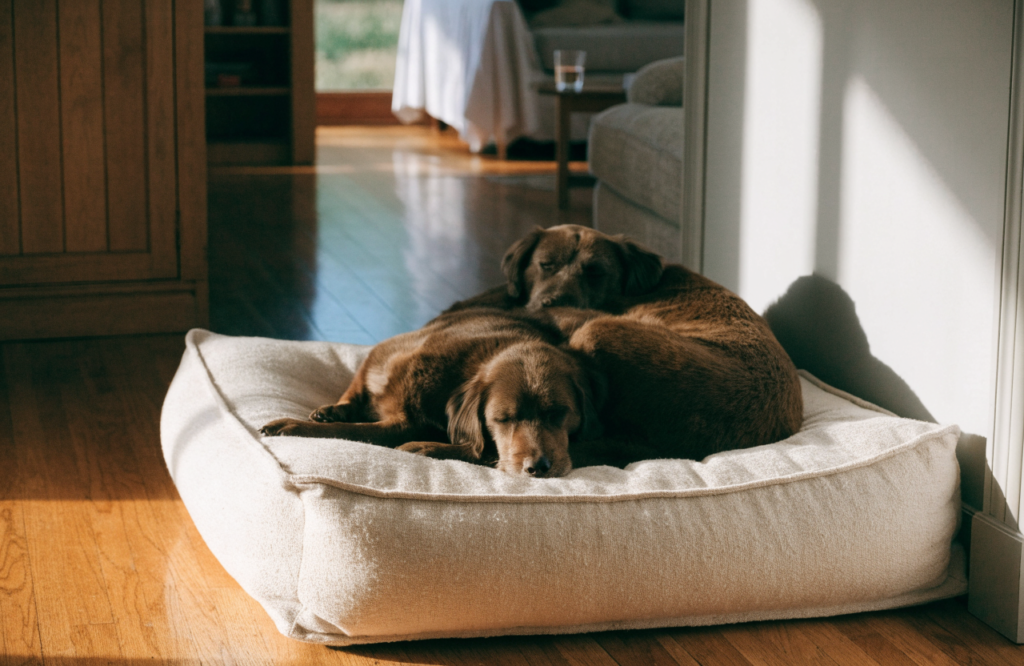
Measure the floor before you measure the dogs. A bed around 52 by 40 inches needs a clear corner, not a gap between the sofa and the coffee table. Leave enough room to walk past it. Pushing a shared bed into a tight alcove can make the inner dog feel trapped and gives the outer dog an easy way to block the exit.
Place it out of drafts and away from the main traffic path through the room. Dogs that startle will not settle on a bed people step over. A neutral spot, not one dog’s usual crate corner, reduces the chance that the bed is treated as private property. If you use crates at night, a double bed is a daytime resting surface, not a replacement for separate overnight spaces.
Problems Owners Run Into
Most failed double dog beds fail for a short list of reasons.
The bed is wide enough in the product photo and too narrow once both dogs stretch. One ends up on the floor within a week, and the owner assumes the dogs “don’t like beds.” Re-measure them side by side before replacing the style.
One dog hogs the bolster or the center. A flat mattress removes the premium spot. If hogging continues on a flat bed large enough for both, that is a relationship issue, and two beds are the fix.
The foam collapses in the middle. Two dogs then compete for the firmer edges. Replacing the cover will not repair a crushed core. This is the main reason a cheap extra-large bed is often more expensive than a thicker one.
The cover cannot be washed, or the zipper fails after two cycles. With two dogs, spot-cleaning is not enough. Check the care label for machine washing and for whether the liner is separate.
One dog chews the corner when left alone. Supervise early use, remove the bed when you leave if chewing has already started, and do not treat a destroyed bed as a sizing problem.
They sleep together in winter and abandon the bed in summer. That is often heat, not rejection. A cooling mat or moving the bed off a sunny floor solves it without a second full-size purchase.
Frequently Asked Questions
Do two dogs need a special “double” bed?
No. Most shared setups are simply an extra-large or giant bed with enough interior surface for both dogs. The useful question is the sleeping area in inches or centimeters, not whether the brand uses the word double.
What size double dog bed fits two large dogs?
Plan on at least about 48 by 35 inches, and often 52 by 40 inches or more, if both dogs are in the 70-to-100-pound range and do not sleep piled on top of each other. Measure them lying side by side. Weight charts alone undersize sprawlers.
Can a senior dog share with a younger dog?
Only if the younger dog does not climb on, paw, or displace the older one, and the bed is easy to enter. A low-sided orthopedic mattress is usually kinder than a high bolster. PDSA advises a choice of comfortable beds for arthritic dogs and treats the bed as one part of care, alongside weight, suitable exercise, and veterinary treatment.
Is one double dog bed cheaper than two beds?
Often at the checkout, not always over a year. A shared bed needs tougher foam and sees heavier soiling. Two simpler beds can outlast one undersized giant bed that both dogs abandon. Buy the shared bed because they already sleep together, not because it looks like the cheaper option.
Should puppies share a bed?
A shared bed is fine for puppies that already pile up, sized for the adult dimensions if you do not want to replace it in six months. They still need the option of separate rest, especially during house-training and bitey play, when one puppy needs a break the other will not give.