

An indestructible dog bed is a marketing label, not a material science category. The beds that last are the ones that give a determined chewer almost nothing to grab: a metal frame, fabric locked inside the rails, and no loose stuffing to gut. Plush covers and “heavy-duty” labels fail for a simple reason. Dogs start at edges, seams, and zippers, then pull fill out because the shredding itself is rewarding.
That distinction matters if you have already replaced two or three beds. A tougher cover can slow a moderate chewer. A dog that destroys a bed in a day usually needs a different design, plus a plan for why the chewing is happening. Chewing is normal canine behavior. The ASPCA notes that puppies chew while teething and exploring, and that adult dogs chew from boredom, restlessness, or mild anxiety. A bed cannot fix separation stress, but the wrong bed can turn a normal nap spot into a foreign-body risk if foam or polyfill is swallowed.
Why standard “tough” beds still come apart
Most destroyed beds fail in the same order.
Dogs grab a corner, a piping edge, or a loose bolster first. Once a thread opens, the cover splits along the seam even if the fabric itself is strong. Reviewers of canvas beds, including heavy cotton-duck styles, repeatedly find that the cloth outlasts the stitching. A zipper is the same kind of handle: easy to pinch, easy to work open.
Loose fill is the second failure. Polyfill and shredded foam feel like a toy reward. Nesting and digging are also normal denning behavior, so a dog that “makes a nest” can open a bed without ever meaning to chew it to pieces. Once a dog learns that beds come apart, the habit often continues on the next soft bed.
The practical test is not the word on the hangtag. It is whether your dog can get a mouthful of fabric, and whether success produces a pile of stuffing.
Match the bed to how your dog actually destroys it
Edge chewers and power chewers
These dogs bite corners, drag the bed, and work one spot until it opens. They need a frame that covers every rail and corner, with the sleeping surface captured inside a channel rather than wrapped over the tube. Kuranda’s chew-proof design does this on purpose: cording is fixed into the fabric edge, the fabric sits in a channel in the rail, and corner brackets leave no loose lip. The company recommends an aluminum frame over PVC because determined chewers can leave tooth marks in plastic. K9 Ballistics uses a similar idea on its armored elevated beds, with an aluminum frame over the edges and ballistic fabric pulled tight so there is little slack to bite.
Dogs that gut the bed for the filling
Remove the filling. A taut sling — ballistic nylon, heavy vinyl, or a commercial canvas — over a metal cot takes away the reward. Elevated cots used in shelters and kennels, including Kuranda beds in circulation since the late 1980s, are built on that principle. A solid foam pad inside a tough cover is the next-best option if your dog needs cushioning. Avoid bead fill, polyfill, and any mattress that spills once the cover is nicked.
Diggers and scratchers
Digging is often nesting, not aggression. Claws punch small holes, then the holes spread. Ripstop weave limits that spread because a heavier thread grid stops a tear from running. Open outdoor mesh, often sold as Textilene, ventilates well but is a weaker choice for diggers. Kuranda’s one-year chew-proof warranty covers the frame and its Cordura, ballistic, and heavy-duty vinyl surfaces, and explicitly excludes outdoor mesh because digging can damage it.
Damage that only happens when you leave
If the bed is intact while you are home and wrecked when you return, the bed is not the whole problem. The ASPCA distinguishes ordinary chewing from separation-related chewing, which is usually worst when the dog is alone and may come with pacing, vocalizing, or house soiling. A chew-resistant cot still helps, because it removes a dangerous outlet. It does not treat the stress. That pattern is a reason to talk to a veterinarian or a qualified behavior professional, not a reason to buy a softer bed and hope.
What the materials actually do
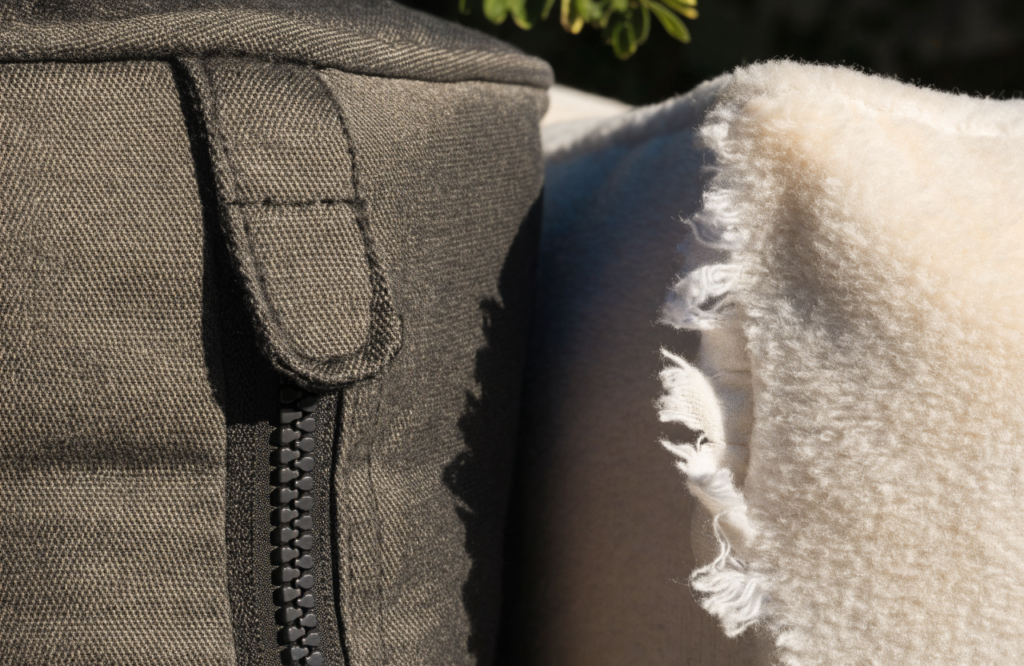
Ballistic nylon is a dense nylon weave originally used for durable goods and gear. It resists puncture and abrasion better than fleece, microfiber, or ordinary polyester. Cordura is a related heavy nylon, commonly specified at 1000 denier or higher for chew-resistant covers. Denier is just a measure of fiber thickness; a higher number usually means a tougher cloth, but only if the seams match it. Ripstop adds a grid so a claw hole does not become a tear. Heavy vinyl or PVC-coated canvas is hard to bite through and easy to hose off; it is less cozy and can feel cold or slick.
None of these fabrics is bite-proof against every dog. Manufacturers who sell to this market say the same thing in different words: a persistent power chewer can eventually damage even ballistic cloth. The honest goal is a bed that fails slowly, fails without spilling fill, and is backed by a replacement policy.
Steel-framed budget cots with a tight polyester or mesh sling — Frisco and Coolaroo are common examples — are a reasonable step up from a plush bed for moderate chewers. They are not equivalent to an aluminum cot with the fabric locked into the rail. Screws can loosen, and wrapped edges can still be chewed.
Which style fits which dog
| Style | Best for | Weak point | Comfort tradeoff |
|---|---|---|---|
| Aluminum elevated cot, fabric in the frame | Dogs that destroy beds in days | Mesh versions can be clawed; some dogs refuse the sling at first | Cool and supportive, not orthopedic |
| Armored cot with a thin padded center | Heavy chewers who need a little give | Padding is another layer a dog can target | Better for bony dogs than a bare sling |
| Solid-foam crate pad in ballistic or Cordura | Crate sleepers, moderate chewers, seniors | Zippers and cover edges | Real joint support if the foam is dense |
| Canvas bolster or pillow bed | Nesting dogs that mouth but do not gut | Seams and bolsters | Most familiar “dog bed” shape |
| Plush or polyfill bed | Dogs with no chewing history | Everything | Highest cozy factor, lowest survival |
For a dog that has already eaten a bed, start in the top row. Add cushioning only after the dog treats the tough bed as furniture rather than prey. Whole Dog Journal’s chew-proof roundup reached a similar conclusion: aluminum-framed ballistic beds are the closest thing to chew-proof currently sold, and a chew warranty is part of the buying criteria, not a slogan.
Size, support, and the warranty that is worth reading

Measure the dog sprawled, not standing. A bed that is only as long as the body from nose to tail base is too small for a side sleeper, and a tight bed gives a digger a reason to scratch. Elevated cots should list a weight rating; many aluminum models are rated around 150 to 250 pounds, which is about frame strength, not a promise about teeth.
Orthopedic need and chew resistance pull in opposite directions. A senior dog with stiff joints will not love a bare mesh cot. Practical compromises that do not hand the dog a stuffed toy:
- Use the aluminum cot as the unsupervised bed, and offer a solid-foam pad only when you are in the room.
- Choose a crate pad with a dense, single-piece foam core and a ballistic cover, not a pillow stuffed with shreds.
- Look for a padded armored cot only if the pad is thin, fixed, and covered by the same warranty as the sling.
Read the warranty by product, not by brand homepage. Kuranda’s chew-proof warranty is one year on frame integrity and on Cordura, ballistic, and heavy-duty vinyl, including digging and scratching. It is one free replacement per part, it excludes cosmetic damage, and outdoor mesh is not covered. Claims generally need photos rather than a return shipment. K9 Ballistics publishes a one-year chew-proof warranty on many beds, with a one-time replacement of the cover or the whole bed depending on the model; some armored product pages still state a 120-day chew-proof replacement. Either way, it is a one-time remedy, not a lifetime promise. A warranty that replaces the cover only is weak if your dog eats foam. A warranty that requires you to mail a shredded, soiled bed back is slower than one that accepts photos.
Price follows construction. Simple steel cots are often the cheapest durable option. Aluminum armored beds from specialist makers commonly sit in the low-to-mid hundreds of dollars. That is still cheaper than replacing a $60 plush bed every month, and cheaper than an emergency visit if stuffing is swallowed.
Habits that keep the next bed alive
A resistant bed works better if the dog has a legal thing to chew. The ASPCA recommends chew items matched to the dog’s size and chew style, and warns against products the dog can break into large swallowable pieces. Rotate those chews so the bed is not the most interesting object in the room.
For puppies, intensified teething chewing usually eases after adult teeth are in, often by about six months, if the puppy has appropriate outlets. Adult chewing that continues is more often boredom or a learned game. Short daily training, a real walk, and a food puzzle before you leave reduce the idle time that gets spent on the bed.
Do not punish a dog for a bed you found destroyed hours later. The dog will not connect the scolding to the chewing. Remove the remains, give the tough bed, and reward lying on it calmly. Some owners withhold soft beds until the destructive phase passes, then return a normal bed as a privilege. That is reasonable for a young dog. It is a poor plan for an arthritic dog that needs padding now.
Bitter sprays sometimes discourage mouthing. They do not stop a dog that is gutting a bed for the filling, and they wash off. Treat them as a supplement, not the strategy.
If the bed is already shredded
Take the wreckage away immediately. Loose foam, polyfill, and stuffing beads are not digestible. A small amount relative to the dog’s size may pass, but larger amounts can cause choking or an intestinal blockage. Contact a veterinarian if your dog ate bedding and then vomits repeatedly, becomes lethargic, refuses food or water, strains without producing stool, or seems painful in the abdomen. Do not wait out those signs because the pieces “might pass.”
Until you have a replacement that cannot spill fill, a folded blanket you can supervise, or nothing but the floor, is safer than another polyfill bed left overnight.
Frequently asked questions
Is any dog bed actually indestructible? No. Aluminum frames come closest, because a dog cannot chew through the rail. Fabric, even ballistic nylon, can eventually be punctured by a relentless chewer. Shop for a design with no loose edges and a written replacement policy.
Are raised beds comfortable enough to sleep on? Many dogs take to a taut cot immediately because it is cool and off the floor. Others need a few days, or a thin pad added only while you are home. Senior dogs with joint disease usually need solid foam for long sleeps; use the cot when you cannot supervise.
What fabric should I avoid? Fleece, faux fur, microfiber, and ordinary cotton covers. Also avoid any bed whose “tough” claim depends on a zipper and single-needle seams. Open outdoor mesh is fine for heat, poor for diggers.
Do chew-proof beds work for puppies? They remove the dangerous toy. They do not stop teething. Pair a sling cot with supervised chew toys, and expect the worst phase to ease after adult teeth erupt if the puppy is exercised and not left with soft goods.
Can I put a blanket on a chew-proof cot? Only if your dog ignores blankets. A blanket on a Kuranda-style bed recreates the exact object you just removed. If the dog shreds blankets, skip them.