

An office dog bed fails when the size on the label does not fit the clear floor beside or under the desk. Adult dogs spend as much as half the day asleep and about 30 percent awake but resting, according to the American Kennel Club’s overview of canine sleep, so the spot next to a workstation takes a large share of those hours. A bed bought for looks often blocks the chair, leaves the dog hanging off one edge, or cannot be washed after a week of hair and drool. Measure the dog stretched out and the open floor first; foam and bolsters only help once that fit is right.
Size the sleeping surface to the dog and the desk
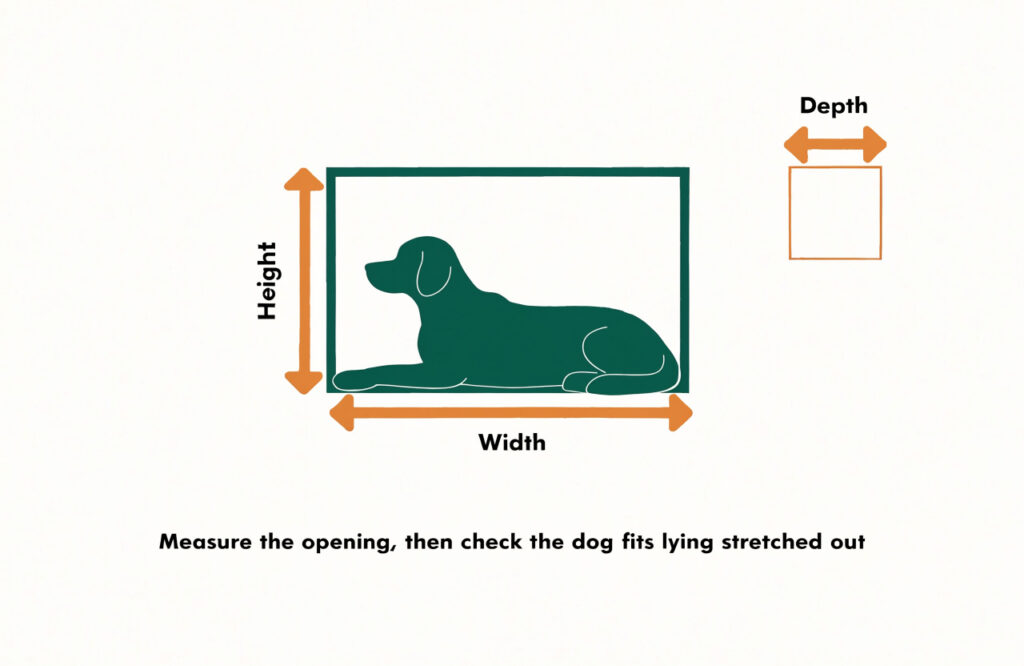
The reliable method is to measure the dog, not the breed chart. Have the dog lie on their side, fully stretched, and measure from the tip of the nose to the base of the tail. Add 6 to 12 inches (about 15 to 30 cm) for the minimum bed length. Sprawlers, who sleep with legs extended, need the higher end of that range. Curlers, who sleep in a ball, can often use a bed closer to the diameter of that curl, especially if the bed has a raised edge.
Weight bands are only a shortcut. Seller guides commonly map dogs under 25 lb to small beds around 18 by 24 inches up to 24 by 30 inches, 25 to 50 lb dogs to medium beds around 24 by 30 up to 30 by 36 inches, and 50 to 75 lb dogs to large beds around 30 by 36 up to 36 by 42 inches. Dogs over 75 lb usually need extra-large or giant beds, often 42 inches or longer. Those ranges overlap, and a long, light sighthound will not fit a bed sized only by pounds.
Two office-specific traps sit on top of that rule.
Bolsters shrink the usable area. A bed labeled 36 by 42 inches with raised sides may offer only about 32 by 38 inches of flat sleeping surface. Check interior dimensions, not the outer footprint. In a tight office, that difference decides whether the dog can stretch or has to curl against a wall of fabric.
The desk sets a second size limit. Measure the clear rectangle that remains after the chair is pulled in: width between the desk legs, depth from the modesty panel or wall to the front edge of the desk, and height from floor to the underside of the desktop. A thick bolster bed that looks right on a product page can sit too high for a dog to enter without scraping their back, or too wide for the chair to roll. Small and medium dogs often fit an under-desk nook. A Labrador or larger dog usually needs the bed beside the desk or in a corner, not under it, unless the desk is unusually deep and open.
If you are between sizes and the floor allows it, size up. The common reason a dog ignores a new bed is that it is too small to lie in naturally. The exception is a small curler who feels lost in a huge open pad; for that dog, a snug round bed is often better than a giant rectangle.
Match the shape to nap style, not to product photos
Office naps are shorter and more interrupted than overnight sleep. The bed has to be easy to get into, easy to leave for a walk or a doorbell, and supportive enough that the dog does not abandon it for the tile.
| Nap style | What the dog does | Office-friendly bed | Skip if |
|---|---|---|---|
| Curler | Sleeps in a ball, chin on an edge | Round or donut bed, bolster on three sides | The room is hot and the faux fur cannot be removed |
| Sprawler | Legs fully extended | Flat orthopedic mat or low sofa bed | Bolsters eat the only floor space you have |
| Den seeker | Wants a roof or a wall at their back | Bolster bed in a corner, or an open crate with a pad | The dog overheats or panics in enclosed beds |
| Floor preferrer | Chooses tile or wood | Thin cooling mat, not a deep plush bed | You needed the bed only to stop them lying in a walkway |
Donut and bolster beds are popular in office roundups because the raised rim gives a visual boundary and a place to rest the head. That helps anxious dogs and curl-sleepers in a busy room. It is a poor default for a dog who sprawls, overheats, or has to step over a high rim with stiff joints.
“Orthopedic” is a marketing word, not a regulated standard. What matters is foam thickness and density relative to the dog’s weight. Practical seller guidance suggests about 3 inches of foam for dogs under 25 lb, 4 inches for 25 to 50 lb, and 5 to 7 inches or more for large and giant dogs, because a thin pad compresses to the floor under a heavy chest and hips. Solid memory foam or a dense base with a softer top layer holds shape longer than a cheap shredded fill. Egg-crate foam can feel cushioned at first and still bottom out under a 70 lb dog. The AKC shop’s orthopedic lounge beds use a 7-inch convoluted pad on some models, while other AKC orthopedic beds use about 3 inches plus batting — a useful reminder that the label alone does not tell you the support.
Orthopedic foam is worth it for seniors, large breeds, and dogs with known joint pain who spend the workday on the bed. A young, healthy small dog who mostly curls for an hour at a time can do well on a simpler washable cushion. Low entry matters more than plush height for older dogs: a 10-inch sofa bed can be hard to climb onto between meetings.
Put the bed where the dog already settles
Dogs in home offices often reject a bed in the “correct” corner and use it only after it moves under the desk. That is not stubbornness. Many dogs want to see you, have a wall or desktop at their back, and stay out of the walkway. Watch where they already lie for a few days before you commit to a spot.
Three placements cover most offices:
- Under the desk. Best for small and medium dogs who want contact and a den. Clear cables into a sleeve or raceway first. A chew on a loose charger is a more expensive problem than a cheap bed. Leave enough room that your feet and the chair base are not constantly displacing the dog.
- Beside the desk, against a wall or cabinet. Best for larger dogs and for anyone who needs full legroom. The dog can still see you. Keep the bed out of the path to the door so coworkers or family are not stepping over it on every call.
- A quiet corner with a sightline. Best for dogs who startle at hallway traffic. Avoid the spot directly on a vent, next to a drafty exterior door, or in full afternoon sun. A bed that is too hot or too cold gets abandoned for the bare floor.
A non-slip bottom matters on wood, laminate, and tile. Beds migrate when a dog circles to lie down, and a sliding bed ends up in the chair’s path. On carpet, grip matters less than a cover that does not pill into the pile.
Shared items help the bed become the default spot: a familiar blanket, one chew, and a water bowl just outside the bed rather than in it. Do not add a pile of toys. The office bed is a rest place. A play pile teaches the dog that the bed is for wrestling, which is the opposite of what you want during a call.
Cleaning is a weekly job in an office, not an occasional one
Bedroom beds can go longer between washes. An office bed collects hair, drool, outdoor dirt from lunch walks, and occasional accidents, in a room you also use for calls and food. The features that matter are boring and non-negotiable.
- A cover that zips off and goes in the washing machine.
- A waterproof liner between cover and foam, so a spill does not reach the core.
- A foam insert that can be spot-cleaned and aired. Foam should not go through a wash cycle. It holds water, collapses, and can mildew while it dries.
- A color and fabric that do not show every hair if the office is shared. Dark gray and textured weaves hide more than white faux fur.
Wash the cover every one to two weeks in normal use, and sooner after mud or an accident. Air the foam the same day if anything soaked through. In a workplace, a second cover is the practical upgrade: you can swap it at lunch and wash the dirty one at home, instead of leaving a bare foam slab in the office.
Certifications are narrower than the labels suggest. CertiPUR-US applies to flexible polyurethane foam — emissions and certain chemical limits — not to the cover, zipper, or glue. OEKO-TEX Standard 100 applies to textiles, not the foam core. A useful office bed can have one, both, or neither. If someone in the room is sensitive to off-gassing, air a new foam bed in another room for a day or two before it moves next to the desk. Dogs notice strong chemical smells more than people do, and a new-bed odor is a common reason they refuse to lie down.
A home office and a shared workplace are different problems
At home, the constraints are space, chair clearance, and whether the dog will settle. In a company office, add other people, cleaning staff, and policy.
Personal pets are allowed only if the employer says so. A dog bed does not create that permission. Colleagues with allergies or a fear of dogs need a workable layout, not a bed parked in a shared aisle. Hair, dander, and smell travel farther from a plush donut than from a low mat with a washable cover. If the dog comes in only some days, a bed that folds, has a carrying handle, or lives in a closet is more realistic than a 40-pound sofa.
Service dogs are a separate category. Under the ADA’s service-animal guidance, a service animal is a dog trained to perform a task directly related to a person’s disability. Emotional support or comfort alone is not that task, and businesses open to the public generally must allow service dogs even when they ban pets. Employment is handled differently. The Equal Employment Opportunity Commission administers the ADA at work, and a service dog in the workplace is requested as a reasonable accommodation rather than as an automatic public-access right, as summarized by the Great Plains ADA Center. A defined bed still helps: it gives the dog a down-stay spot that is not underfoot, which matters in a meeting room or open office. It does not replace the accommodation process.
For a service dog or a calm office dog, a low, firm, easy-clean mat often beats a deep cuddler bed. The dog is resting between tasks, not nesting for the night, and a low profile is easier to step around.
If the dog ignores the bed, change the setup before you replace it
A refused bed is usually the wrong size, the wrong place, or too new-smelling. A few checks sort that out faster than buying a second one.
- Move it to the spot the dog already uses, even if that is under the desk. A week of voluntary naps there beats a month of staring at a bed in the “right” corner.
- Feed a chew or scatter a few treats on the bed at the start of the work block, then ignore the dog. Attention for pacing teaches pacing.
- Keep the first sessions short. A settled 20 minutes is a success. Do not drag the dog onto the bed.
- Rule out heat. Faux-fur donut beds are warm. A dog who pants and then moves to the tile needs a cooler surface, not more encouragement.
- If the dog chews the edges, switch to a tougher mat or an open crate with a pad, and give a legal chew. Replacing the same plush bed repeats the same failure.
No bed fixes an under-exercised dog at 2 p.m. A working breed who has not had a real walk will get up, sigh, and interrupt calls no matter how good the foam is. The bed is the place to settle after exercise, not a substitute for it.
Which bed fits the room you actually have

Choose a round bolster or donut if the dog curls, the floor patch is small, and the room stays cool enough for plush. Choose a flat orthopedic mat if the dog sprawls, is large or older, or the bed has to slide beside a chair without blocking it. Choose a low, washable crate pad if the setting is a shared office, the dog is a service dog on duty, or you need to carry the bed home. In every case, confirm three measurements before you order: nose-to-tail length plus 6 to 12 inches, interior sleeping surface after bolsters, and the clear floor once the chair is in working position. If those three match, the dog has a fair chance of using the bed on day one. If they do not, a better cover will not save it.
Questions people ask before they buy
How big should an office dog bed be? Long enough for the dog to lie in their normal nap position, plus several inches of spare room, and small enough that the chair still moves. Measure the dog stretched out and add 6 to 12 inches, then check that the interior of the bed — not the outer label — fits the open floor.
Should the bed go under the desk? Only if the dog fits with clearance and you want them that close. Many dogs prefer it because it feels enclosed and keeps you in sight. Larger dogs, and anyone who needs the footwell for posture, do better with the bed beside the desk against a wall.
Is memory foam worth it for daytime naps? For heavy, senior, or sore dogs, yes, because thin fill collapses under them and they end up on the floor anyway. For a small, healthy curler, a simpler washable bed is enough. Look at foam depth and a waterproof liner, not the word orthopedic.
Can the whole bed go in the washing machine? The cover can. The foam should not. A waterproof liner is what keeps a spilled water bowl or a wet walk from turning into a foam replacement.
Can I bring a dog bed to work if pets are not allowed? A pet policy is up to the employer. A service dog is requested as a workplace accommodation under the employment side of the ADA, which is not the same rule as public-access service-dog rules. The bed itself does not change either rule; it only gives an approved dog a defined place to rest.