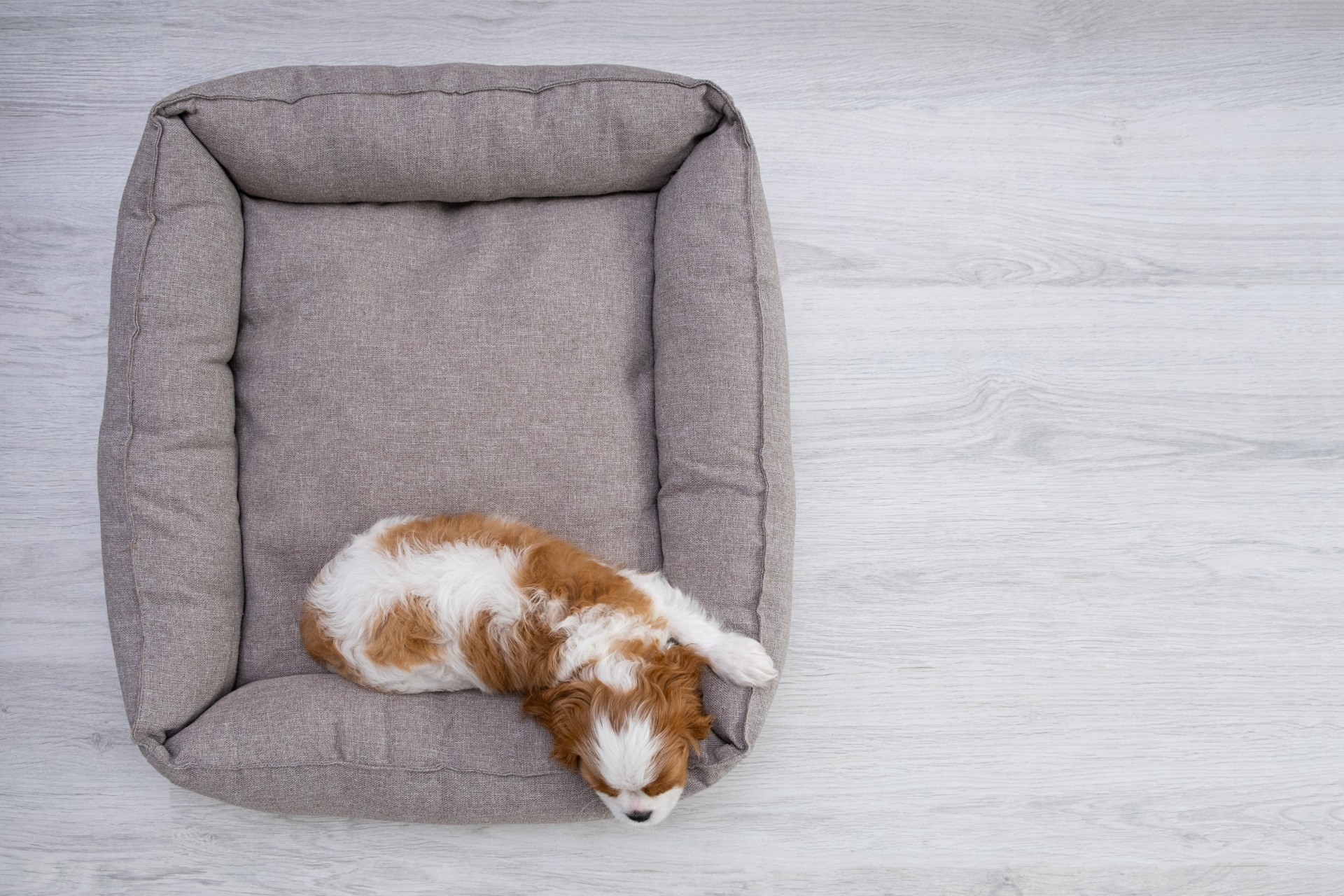

A useful DIY big dog bed is a solid foam slab, cut to the dog’s stretched-out length plus room to shift, wrapped in a waterproof liner and a removable washable cover. That combination is what keeps a 70- to 120-pound dog off the floor. A sack of old pillows or polyfill looks plush on day one and compresses into a flat mat within weeks, which is why so many homemade beds get abandoned. Size the sleeping surface to the dog, pick foam that does not bottom out, and make the cover easy to wash. The frame, if you add one, is optional.
Commercial extra-large beds often run well over $100 because the foam has to be thick and dense. Building one yourself mainly saves money when you can source a foam offcut, a crib or twin mattress topper, or a foam supplier’s remnant, and when you want a size stores do not stock.
Measure the dog before you cut anything

Breed charts are a rough starting point, not a cutting list. A lean German Shepherd and a stocky Labrador of the same weight need different widths, and a dog that sleeps stretched out needs more length than one that curls.
Measure while the dog is lying on its side, relaxed:
- Length: nose to the base of the tail, where the tail meets the body. Do not include the tail tip.
- Width: from the backbone across to the front paws, or shoulder to shoulder if the dog sprawls on its chest.
- Add a buffer: 6 to 12 inches on length, and enough width that elbows and hocks are not hanging off. Sprawlers need the larger end of that range.
A dog that measures 40 inches nose to tail base usually needs a sleeping surface around 46 to 52 inches long. Giant breeds often land near 48 by 36 inches or larger. If the bed will sit inside a crate, the inner crate floor is the hard limit, not the dog’s preferred sprawl.
Weight bands are only a cross-check. Dogs around 50 to 75 pounds often fit a large bed in the mid-30s by low-40s inches. Dogs over 100 pounds commonly need a giant size, closer to 48 inches or more on the long side.
Choose support before you choose a style
The cover is what you see. The fill is what the dog feels after a month.
Solid foam outperforms loose fill for heavy dogs. Polyester fiberfill and shredded foam shift under a concentrated load. Hips and shoulders sink to the floor while the edges stay puffy. A solid slab spreads weight and keeps a consistent thickness. Shredded memory foam is still shredded: the pieces migrate, so the “memory foam” label does not deliver the same pressure relief as a continuous slab.
Thickness has to match weight. A practical range used by foam suppliers and orthopedic-bed guides:
| Dog weight | Useful foam thickness | Why |
|---|---|---|
| About 50–80 lb | 4–5 inches | Thinner foam bottoms out under chest and hips |
| About 80–100 lb | 5–6 inches | Extra depth before the floor is felt |
| Over 100 lb, or a dog with stiff joints | 6–7 inches or a two-layer stack | Weight is concentrated on elbows and hips |
Density matters as much as thickness. Soft, low-density foam can be 6 inches tall and still collapse. When buying foam, look for a stated density, not only the word “orthopedic,” which is unregulated. Support polyurethane in the higher furniture grades, or memory foam around 3 to 5 pounds per cubic foot, holds shape longer than bargain 1 to 1.5 pound foam. CertiPUR-US certification is one of the few independent checks that the foam was tested for certain chemicals and durability. Press the center with your palm: it should compress and rebound, not punch through to the table.
A two-layer stack works well when you cannot find one thick slab: a firmer high-density base, then a thinner comfort layer on top. Glue the layers with a foam-safe spray adhesive so they do not skate apart inside the cover.
Memory foam holds heat. Double-coated breeds and dogs that already seek tile may overheat on a thick memory-foam top. A high-density polyurethane slab, or a raised bed with airflow underneath, is the better default for those dogs.
Three builds, and when each one is worth it
Foam slab with a zip cover is the best default. It gives real joint support, fits a crate or a corner, and the cover can be washed without destroying the foam. Sewing is helpful but not required if you use a duvet cover, a mattress encasement, or a no-sew hem.
Bolster or box bed adds a raised rim some dogs lean against. The rim is usually a fabric tube stuffed with fiberfill or foam pipe insulation. It looks finished, but the bolsters take abuse from chewing and digging, and the center still needs a solid slab or the dog bottoms out in the middle.
Raised wood or PVC frame lifts the dog off cold or dirty floors and can make standing up easier for a stiff older dog. The frame does not replace the cushion. A bare plywood platform is hard on elbows. Outdoor versions need materials that tolerate weather: exterior screws, a finish labeled safe once cured, and a cushion you can bring inside.
Build the foam-core bed
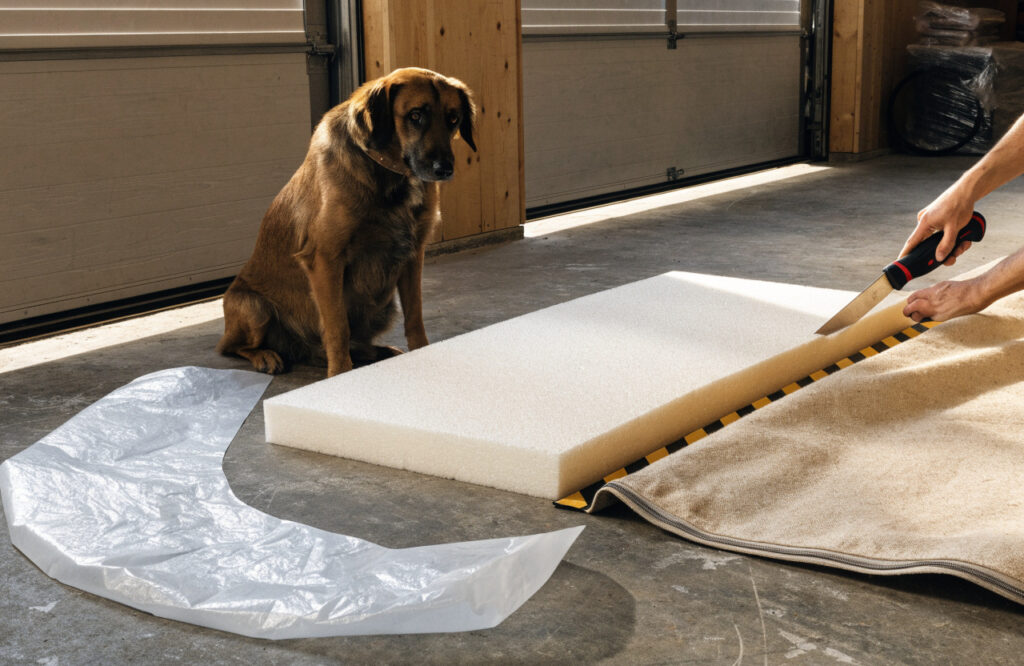
This is the version most large-dog households should start with.
- Cut the foam to the measured size. An electric carving knife or a long serrated bread knife cuts foam cleaner than scissors. Cut outdoors or in a garage. Support the slab so it does not tear. If you are using a crib mattress or a firm twin topper, confirm it is foam, not an innerspring, and that it is thick enough for the dog’s weight.
- Add a waterproof barrier before the pretty cover. A polyurethane or TPU mattress protector, or a dedicated pet-bed liner, goes around the foam. Urine and drool that reach open-cell foam stay there. Washing the outer cover will not remove that smell. Do not machine-wash the foam. Agitation breaks the cell structure, and a waterlogged slab can damage a washer.
- Make or adapt the outer cover. For a simple envelope, cut two panels the size of the foam plus seam allowance, and a gusset strip as wide as the foam thickness plus seam allowance. Sew three sides, insert a heavy zipper on the fourth, and box the corners so the cover is not a floppy sack. Canvas, denim, outdoor upholstery fabric, or a tight cotton duck survives nails better than thin fleece. Fleece feels soft and pills and tears quickly under a digger.
- If you do not sew, a zippered duvet cover or a crib-mattress encasement in a close size works. Tuck excess fabric under the bed or stitch a simple channel so the foam cannot walk out. A non-slip rug pad underneath stops the bed migrating across hardwood.
- Close the zipper fully and check that the dog can lie stretched without the cover pulling tight. A drum-tight cover makes the foam feel harder and stresses the zipper.
Bolster add-on, if you want one: sew a long tube about 6 to 8 inches in diameter, stuff it firmly, and stitch or button it to three sides of the cover so it can be removed for washing. Leave the front open if the dog is older and steps rather than jumps in.
Build a simple raised frame
A basic indoor frame is a rectangle of 2×2 or 2×4 lumber with a plywood deck, raised 4 to 8 inches. Size the interior to the cushion, not the other way around.
- Cut two long rails and two short rails to the outer dimensions of the foam, plus the thickness of the lumber if the foam sits inside the frame.
- Join the corners with wood glue and 2.5-inch screws, predrilled so the ends do not split. Pocket holes work if you already have a jig. They are not required.
- Screw a 1/2-inch or 3/4-inch plywood deck to the underside of the rails, or set cleats inside the frame and drop the plywood in so the cushion is recessed.
- Add four legs of equal length if you want it off the floor. Felt pads protect hard floors.
- Sand, then finish with a paint or clear coat that is fully cured before the dog uses it. Unfinished softwood absorbs drool and is harder to clean.
- Drop the covered foam on top. Do not staple the cover to the wood if you want to wash it.
PVC pipe with side-outlet elbows is a reasonable outdoor alternative because it does not rot, but the fabric sling sags under a heavy dog unless the span is short or you add a solid deck. A sagging sling is not joint support.
Fabric, zippers, and washing
Large dogs destroy cheap closures. Use a jacket-weight or upholstery zipper, set at least 3/8 inch in from the edge, and double-stitch seams. A zipper on the long side is easier to wrestle a thick slab through than one on the short side.
Wash the cover every one to two weeks, more often if the dog is oily, sheds heavily, or has accidents. Zip it closed before washing so the teeth do not catch other laundry. Air-dry if the fabric allows. Spot-clean the liner and foam with an enzyme cleaner, blot, and dry completely before the cover goes back on. Foam that stays damp grows odor even if the cover smells fine.
Replace the foam when a palm press leaves a dent that does not rebound in a few seconds, or when odor survives cleaning. High-density foam often lasts a few years under a large dog. Polyfill often needs replacing inside a year.
Mistakes that make a homemade bed fail
- Stuffing it with pillows or old blankets and calling it done. Fine for a small dog that naps. A 90-pound dog compresses that fill and sleeps on the floor through a layer of fabric.
- Sizing to the curled-up measurement. The dog lies down, cannot stretch, and moves to the couch.
- Skipping the liner. One accident ruins the foam. The cover can be perfect and the bed still smells.
- Using a thin decorative foam. Craft-store 1-inch or 2-inch sheets are for seating pads, not a Great Dane.
- Exposed staples, nails, or rough plywood edges. Cover or sand anything the dog can lie against.
- Machine-washing the foam to “refresh” it. That is how supportive foam becomes crumbly foam.
- A bed with no non-slip bottom on hard floors. The dog stands up, the bed shoots backward, and they stop using it.
What you actually spend
A thrift-store polyfill bed can be made for the cost of two pieces of fabric and stuffing, sometimes under $20. It will not support a heavy adult dog for long. A foam-core bed is the fair comparison with a store orthopedic bed.
Foam is the expensive line. A thick high-density slab in a giant size can cost as much as a mid-range commercial bed unless you find a remnant, a cut-down mattress topper, or a foam shop offcut. The cover is comparatively cheap: a couple of yards of canvas or a ready-made zip cover. A wood frame adds lumber, screws, and an afternoon. The DIY advantage is custom dimensions, a replaceable cover, and the option to swap only the foam when it wears out instead of throwing away the whole bed.
If a local foam price is close to a finished bed with a good zipper and liner, buying the finished bed is the rational choice. Build when the size is odd, the dog destroys covers and you want a tough fabric, or you already have suitable foam.
Questions people ask after they start
Can a crib mattress work as a big dog bed? A firm foam crib mattress is a common shortcut and is often thick enough for a large dog. Cover it with a waterproof encasement and a washable outer layer. Skip it if the mattress is badly compressed or has an innerspring core.
How thick should the bed be for a dog with hip stiffness? Use the thicker end of the range for that weight, preferably a firm base under a comfort layer, and keep the entry low or open at the front so the dog does not have to hop in. A raised frame helps only if the dog can still step up easily. Too high is as bad as too soft.
What fabric survives digging? Tight canvas, denim, or outdoor upholstery fabric. Avoid loose fleece and thin microsuede if the dog scratches a nest before lying down. A second cheap cover for rotation is more useful than one delicate cover.
Is outdoor use different? Yes. Use a raised deck so the cushion is not sitting in water, bring the foam inside when it rains, and do not rely on a standard memory-foam slab outside. Open-cell foam holds water. Exterior wood needs a cured finish and corrosion-resistant fasteners.
How do I stop the dog chewing the edges? A chewed corner is a habit problem as much as a materials problem. Bitter spray is inconsistent. More reliable fixes are a tougher fabric, keeping the bed away from unsupervised chewing periods, and replacing a frayed edge before the foam is exposed. Once foam is visible, many dogs keep pulling it out.