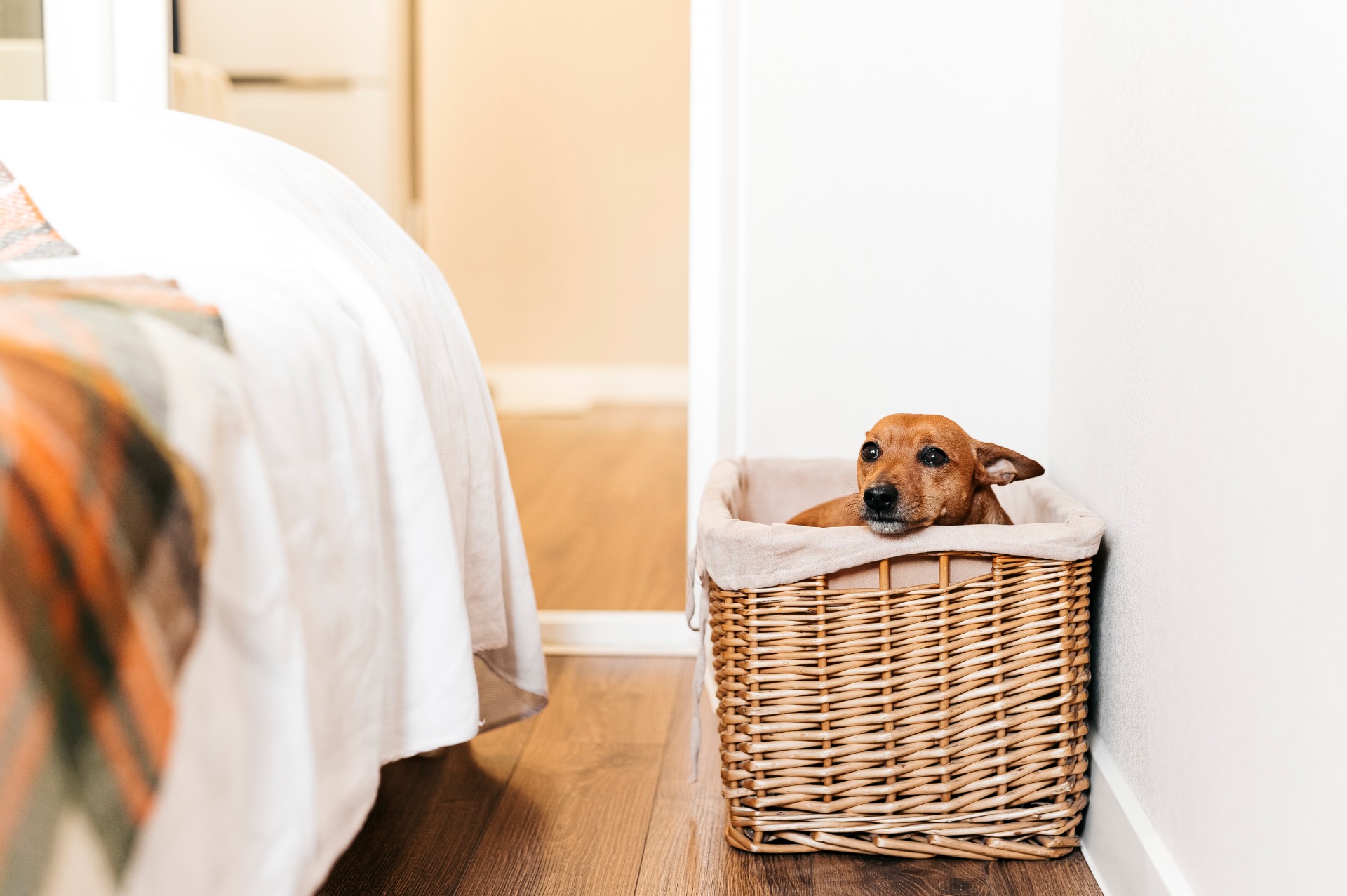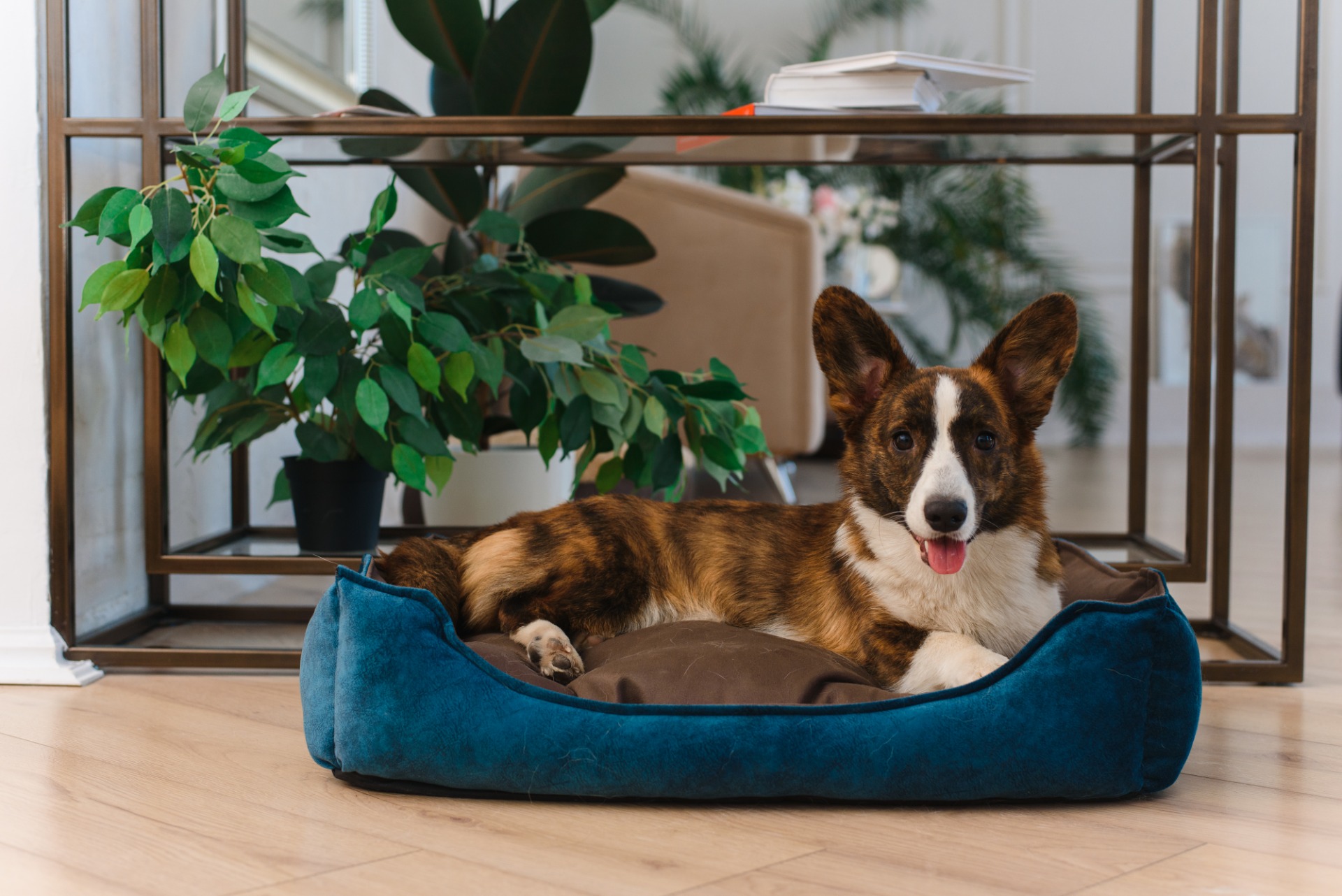

A standard kitchen toe kick is only about 3.5 inches high, so a dog bed will not fit in the recess under a finished base cabinet. The spot people mean is an open bay where a cabinet box was left out, the knee space under an island overhang, or the gap under a desk. Dogs often want that den because it is close to people and out of the walkway, but the opening has to clear the dog’s back plus the bed’s thickness, and it has to sit off the path you use while carrying hot pans.
The toe kick is not a sleeping spot
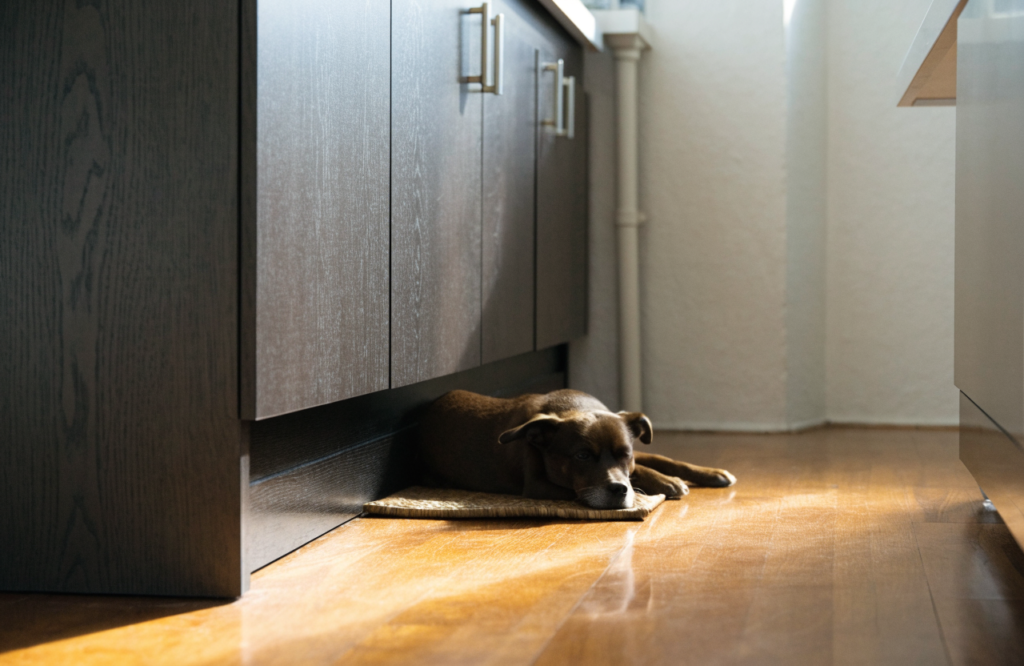
The recessed panel at the bottom of a base cabinet exists so you can stand close to the counter without stubbing your toes. Kitchen Cabinet Kings puts the usual size at 3.5 inches high and 3 inches deep. That height is part of a 34.5-inch base cabinet; add a typical 1.5-inch countertop and the work surface lands at 36 inches. A 3.5-inch gap clears a shoe. It does not clear a cushion, and it does not clear a dog.
ADA-style kitchens are the exception that still does not solve the bed problem. The same guide notes an accessible toe kick of at least 9 inches high and 6 inches deep, under a lower 34-inch counter, so a wheelchair footrest can slide in. Nine inches is still too short for any dog bed a dog can actually enter.
If the only space “under the counter” is that recessed strip, the bed belongs beside the run, not inside it. Raising the cabinets to invent a taller kick also raises the counter, which throws off dishwasher and range alignment unless the whole stack is redesigned.
Three openings that can hold a bed
An omitted base cabinet. Designers leave a gap in the cabinet run, run the countertop over it, and set a cushion on the floor. Houzz’s renovation roundup shows this in kitchens, mudrooms, and laundry rooms: a den under the worktop, sometimes framed so two small dogs share it, sometimes screened for airflow when the nook doubles as a crate. Laundry tile is a practical floor because spills wipe up. The kitchen version mainly stops you tripping over the dog while you cook.
An island or peninsula overhang. The working side of an island is usually a full 24-inch cabinet. The seating side is shallower, often 12 to 18 inches of structure plus overhang, which is where a bed can slide under the stools. That only works if the dog is not under someone’s feet every time a stool moves.
A desk or vanity knee space. This is the renter version. Clearance is whatever the desk frame allows, often less than a kitchen bay, so it suits dogs that curl rather than stand. The same rules apply: measure the lowest rail, not the desktop.
A cabinet brand’s own how-to, Kaboodle’s pet-nook guide, treats the open gap as the bed and a separate pull-out as the feeding station. Their smaller module is sized around a bed of roughly 500 by 580 mm, which is a small dog or a cat, not a Labrador.
Measure height, then depth, then width
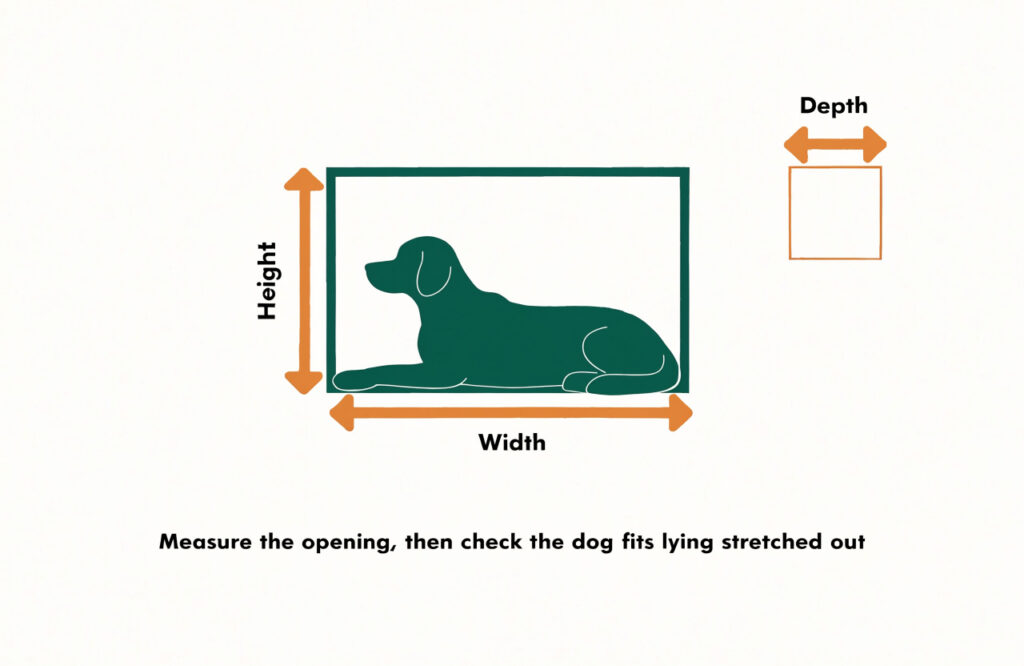
Height fails first. In a full open bay the underside of a 34.5-inch cabinet box is the ceiling, but only if nothing else hangs down: a support rail, a drawer stack on either side, a finished panel, or the countertop substrate. Subtract the bed. A 4-inch orthopedic cushion drops the usable opening by that amount. The dog still needs to walk in without scraping the spine. A bolster wall steals more height than a flat mat, which is why a pretty couch-style bed is often the wrong shape here.
Depth is the next limit. Standard US base cabinets are 24 inches deep at the box and about 25 to 26 inches once the countertop overhang is included, so the floor space under the worktop is a shallow rectangle, not a room. UK and Australian kitchen units are commonly 600 mm deep, which is why a few makers sell “kitchen” beds at 60 cm deep. The Big Dog Bed Company K120 listing is 120 by 60 by 10 cm, with a 90 by 60 cm sibling, explicitly so the cushion can sit alongside unit runs. Ten centimeters is about 4 inches of foam. That is useful support, and it is also 4 inches you no longer have above the dog.
Width should follow how the dog sleeps, not the cabinet label. Dogster’s sizing advice, reviewed by veterinarian Dr. Marta Vidal-Abarca, is to measure the dog’s length and add about a foot, then size up if you are between beds. A curled dog can live in a shorter bay. A sprawler who hangs off the end will abandon it.
| Opening | Typical clear size | Who it fits | What usually fails |
|---|---|---|---|
| Toe kick | About 3.5 in high | Nobody | Bed and dog both too tall |
| Cabinet-module nook | Roughly 20 by 23 in floor, full cabinet height | Small dog or cat | Medium dog cannot turn |
| Open bay under a 24 in counter | About 24–26 in deep, width you leave out | Small to medium if they can stretch | Thick bolster, no exit path |
| Island seating overhang | Often under 18 in of cover | Dog that lies flat | Stools, feet, kicked bowls |
| Desk knee space | Set by the lowest rail | Curlers, small and medium | Standing up, chair collision |
Keep the bed out of heat and out of the aisle
The appealing place is next to the person cooking. That is also where the oven door swings, the dishwasher vents warm air, and a dropped knife or a boiling pot has the least room to miss. Put the bay at the end of a run, in the mudroom side of the kitchen, or on the quiet face of an island, not beside the range. If the nook is enclosed, copy the crate versions in the Houzz examples and leave a vented opening. A sealed cabinet with the door removed still needs air, and the cut edges need to be sanded or capped so the dog is not leaning on raw particleboard.
Aisle width is the other hard limit. A bed that sticks past the cabinet face steals the path two people need to pass. If the only way to fit the cushion is to leave it halfway in the walkway, the counter is the wrong home for it. Water bowls belong outside the bay or in a pull-out, not on a cord routed under the dog. Heated pads add a chewable cord and a burn risk in a spot that also gets wet; a kitchen nook is a poor place for one.
Choose a bed that can take grease, tile, and washing
Kitchen floors are hard, and the air above them carries oil. A plush donut looks cozy and then holds smell. Prioritize a removable, machine-washable cover and a waterproof liner between cover and foam, which is the combination Dogster’s guide treats as the practical default. The kitchen-specific cushion mentioned above uses a waterproof, urine-resistant upholstery fabric, a removable cover washed at 30°C, and no tumble drying. That last point matters: high heat breaks down a lot of waterproof membranes.
Support has to fit the gap. Memory foam or a dense orthopedic core helps larger and older dogs, and Dogster flags a low entrance for dogs that struggle to step over a wall. Under a counter, “low entrance” usually means no entrance wall at all. A flat mat with a non-slip bottom beats a bolster that eats the opening and slides on tile every time the dog turns. If the dog chews, a kitchen bed is a bad first project. Grease smells and food crumbs make chewing more likely, and a destroyed foam slab under a cabinet is miserable to extract.
Color is not only decor. A cover close to the cabinet finish disappears; a white sherpa next to a frying pan does not stay white. Plan on washing the cover more often than a bedroom bed, and keep a second cover if the dog has accidents.
Built-in bay or a bed you can pull out
A built-in nook looks finished and stays with the house. It is also harder to vacuum, and the cushion has to come all the way out for a real wash. A freestanding bed in an open gap does the same job for a renter: no saw, no commitment, and you can move it when the dishwasher cycle is loud. Converting an existing cabinet by taking the door off only works if the interior is tall enough after the shelf is removed, the toe kick is cut back or the dog can step over it, and there is no plumbing or electrical in the box. Check that before you cut.
Feeding and sleeping should stay separate. A bowl station that slides out at chest height is a different project from a bed. Combining them in one tight bay puts water next to foam and puts the dog in the aisle at mealtime.
Why the dog ignores a perfectly fitted nook
Some dogs treat any overhead cover as a den and move in the same day. Others will not enter a dark box, especially if the only entrance faces a busy fridge. Trial the bed on the floor in that exact spot for a week before you build around it. If the dog only uses it when you are standing there, the draw is you, not the architecture, and a desk bed may be the better match.
Noise is the other rejection. A dishwasher, a spinning washer, or a kick on the island panel can make an otherwise correct gap unusable. So can a bed that is long enough on paper but too narrow for the dog to turn without backing out. If the dog backs out and sleeps in the aisle, the opening is the problem, not the training.
Questions people ask after measuring
Can I slide a bed into the toe kick if I buy a very thin mat? No. At about 3.5 inches, the recess is foot space, not a cave. A mat that thin also has no support, and the dog still cannot get in.
Will a large dog fit under a normal counter? Only in a true open bay, and only if the dog can lie down and turn in the depth you have, usually about 24 inches before the overhang. Many large dogs need more floor length than a single cabinet module. They can use the space as a shaded resting spot if the entrance is wide, but they will not stretch the way they do on an open floor.
Is the kitchen a good idea if my dog begs? A tucked bed can reduce tripping, which is why the built-in versions exist. It does not reduce begging. If the dog already camps at the stove, a bed there rewards that post. A mudroom or laundry bay a few steps away keeps the dog near the action without putting them under the pan.
Do I need a special kitchen dog bed? You need the right depth, a washable cover, and a liner. A product sold as a kitchen bed is mostly a cushion cut to unit depth, not a different species of foam. Any flat bed that matches your measured opening will do the same job.
Which setup fits your room
Use an open bay if you are already changing the cabinets, the dog is small or medium, and you can keep the bed fully behind the cabinet face. Use the island overhang only if stools will not land on the dog and the dishwasher is not on that side. Use a desk nook if the dog’s real demand is to be at your feet and the kitchen gap is just the toe kick. Skip the counter entirely when the only space is that 3.5-inch recess, the bay would sit beside the range, or the cushion has to spill into the aisle to be long enough. In those rooms a corner mat on a non-slip pad, washed often, is the more honest fix.