
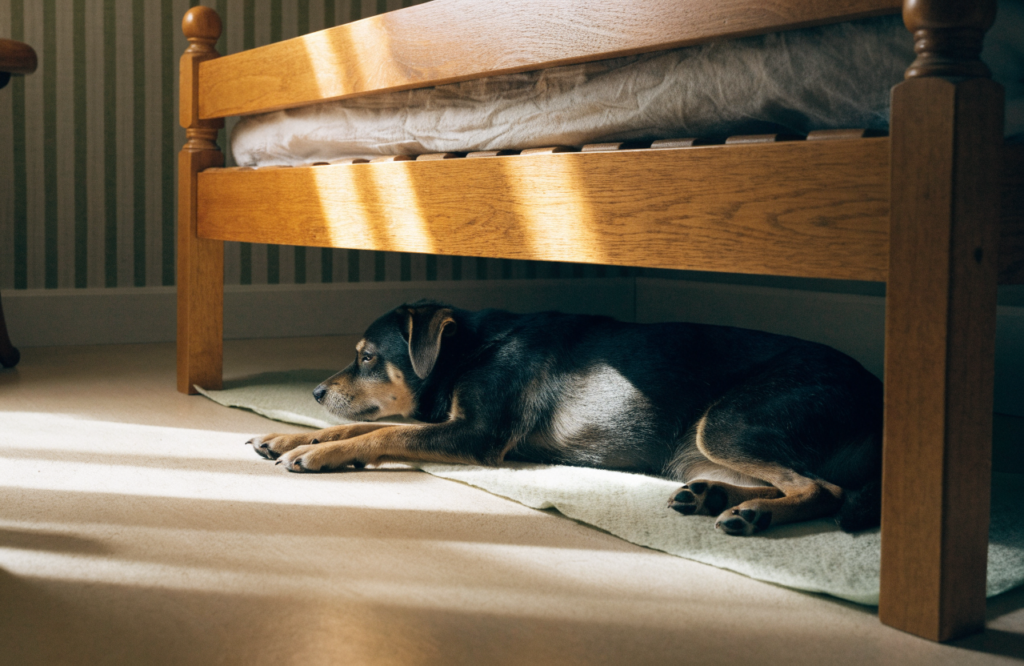
A bed with a dog bed underneath works only when the frame leaves a clear, open gap tall enough for the dog and the cushion together. Most failures come from buying a “pet-friendly” frame or sliding a thick bed under a standard platform and discovering the dog cannot stand, turn, or get out without scraping the slats.
The setup is simple in concept: raise the mattress on an open frame, then place a low dog bed in the space below so the dog stays in the room without taking the floor. It suits dogs that already choose the underside of furniture. It is a poor fit for dogs that need a closed crate, for very large dogs under a low frame, and for seniors who cannot crouch to enter.
What the under-bed space has to provide
The useful measurement is not the listed frame height. It is the open gap from the floor to the underside of the slats or platform, minus anything that crosses that gap.
A workable dog space needs three things at once:
- Vertical clearance after the dog bed is in place, so the dog is not forced to crawl on its elbows.
- A floor area long enough for the dog to lie fully stretched, and wide enough to turn around.
- At least one open side with no center support bar, drawer, or footboard rail blocking the path.
A queen mattress is about 60 by 80 inches, which looks generous on paper. Under the bed, that footprint is often cut in half by a center beam, storage drawers, or a low rail. Measure the empty rectangle the dog can actually occupy, not the mattress size.
Why some dogs already sleep under the bed
Many dogs treat the space under a bed as a den: lower light, a ceiling close overhead, and walls on more than one side. Ancestral canids used small sheltered spots to rest, and a lot of pet dogs still prefer that feeling to an open cushion in the middle of the room. Being directly under the person also keeps the dog near a familiar scent without sharing the mattress.
Temperature is the other common reason. The floor under a bed is often cooler in warm weather and less drafty than an open corner. Whole Dog Journal notes that under-bed sleeping can also be simple quiet, a cooler nap spot, or a response to noise such as storms. A new habit of hiding there, especially with appetite loss, limping, or reluctance to come out, is a reason to check with a vet rather than assume the dog has found a favorite bed.
An intentional dog bed underneath does not create that preference. It only makes an existing preference cleaner and safer. Dogs that want to be on the mattress usually keep trying to get up, no matter how nice the nook is.
Measure the dog before you measure the frame

Start with the dog, not the furniture listing.
- Measure standing height from the floor to the top of the head or ears while the dog is square on all four feet.
- Measure length from nose to the base of the tail while the dog is stretched on its side, then add a few inches so the cushion is not exactly body-length.
- Note shoulder height. The entry opening should be at least about three-quarters of that height, or the dog will scrape on the way in.
- Add the thickness of the dog bed you plan to use. A 4-inch orthopedic cushion under a 12-inch frame leaves about 8 inches of air. That is enough for many small dogs and too tight for a beagle that wants to sit up.
Practical clearance targets, after the cushion is in place:
| Dog size | Open height above the cushion | Floor area to aim for |
|---|---|---|
| Under about 20 lb, curl-up sleepers | 8–12 inches | Enough to turn; often 24–30 inches long |
| About 20–50 lb | 12–16 inches | Roughly 30–36 inches wide, full stretch length |
| Over about 50 lb | 16–22 inches | 40 inches or more in at least one direction |
These are working ranges used by frame guides, not breed rules. A tall, narrow dog such as a greyhound needs more height than a stocky dog of the same weight. A French bulldog may fit a 10-inch gap and still struggle if the opening is narrow. If the dog already sleeps under your current bed, measure that gap and copy it rather than guessing.
Frame types that leave a real dog space
Open metal or wood frames on legs. The most reliable everyday option. Look for 14–20 inches of clearance, side rails that do not drop to the floor, and a center support that is either absent or high enough to walk under. A standard metal platform with 6–8 inch legs is usually too low once a cushion is added.
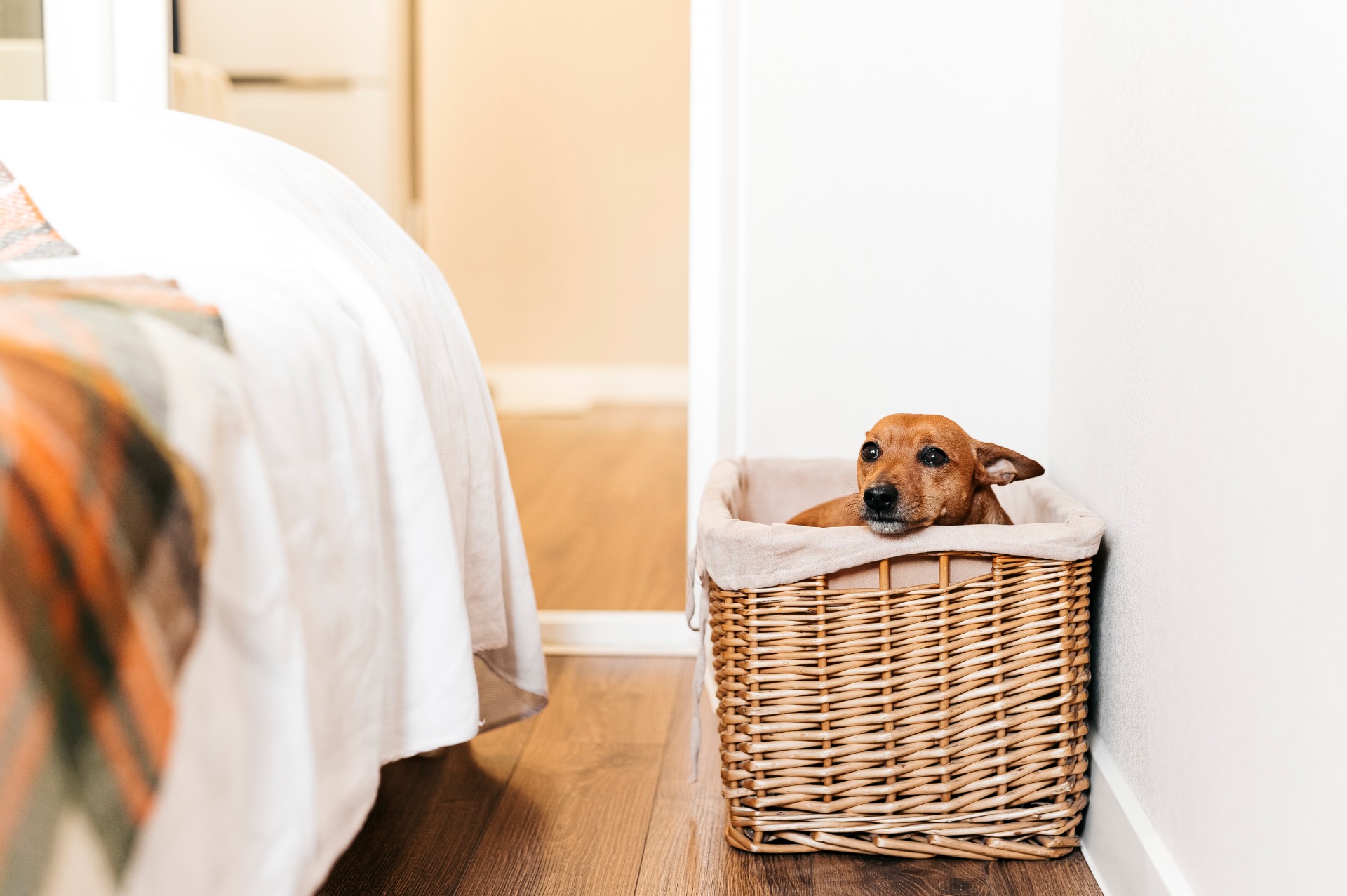
Pet-nook platform beds. Some upholstered frames are built with arched openings along the side or foot specifically for a cat or small dog. Retail listings often describe the nook as suited to cats and small dogs, and they rarely publish the interior height. Ask for the floor-to-slat measurement before buying. An arch that looks wide in a photo can still be only 8–10 inches tall.
Loft and bunk frames. These leave the most floor space and work for larger dogs, but the mattress ends up high. Anyone who shares the room has to climb, and the dog loses the “right next to you” feeling if the gap is several feet. Better in a studio or a room where the dog uses the space during the day as well as at night.
Trundle or pull-out beds. A trundle on casters can hold a large cushion and rolls out for cleaning. It fails if the trundle is meant for a twin mattress and sits too high to slide under, or if the dog has to wait for a person to pull it out. Fixed open space is simpler for a dog that comes and goes at night.
Bed risers on a frame you already own. Plastic or wood risers add 3–8 inches. They are a reasonable test before replacing the bed, provided every leg is supported, the frame is not wobbly, and the risers are rated for the combined weight of the frame, mattress, and people. They will not fix a center bar or a storage drawer.
Frames that usually do not work: platform beds a few inches off the floor, captain’s beds with drawers on three sides, and any frame whose only opening is a narrow gap at the foot. Storage and a dog nook compete for the same volume. You can have drawers on one side and an open dog entry on the other, but not both across the whole footprint.
The dog bed has to be thinner than the gap
Choose the cushion after the clearance is known.
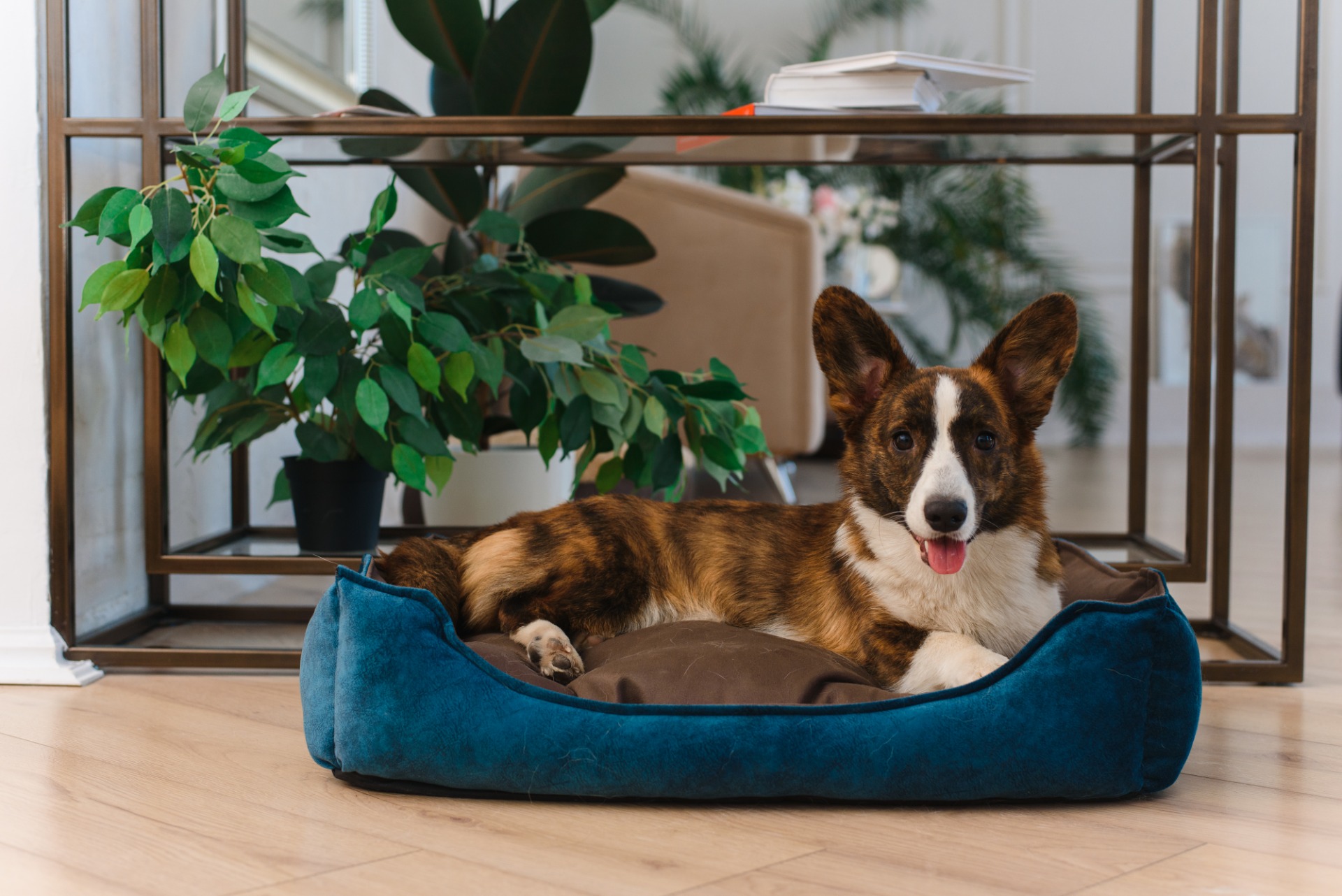
- Height matters more than brand. A 3–4 inch bolster-free pad preserves headroom. A 8–10 inch “sofa” dog bed will erase the gap on most bedroom frames.
- The cover should come off and wash. Under-bed dust, hair, and the occasional accident collect there faster than on an open floor bed.
- A non-slip bottom matters because the dog will push off the pad when turning. A pad that slides into the center support is a nightly nuisance.
- Skip tall bolsters and hoods unless the measured gap still clears them. A cave bed can work for an anxious small dog, but only if the hood does not touch the slats.
- Match length to the stretched dog, not to the “large” label. A 36-by-28-inch pad is a common starting point for a medium dog; a Lab-sized dog usually needs something closer to 40 inches or longer.
Orthopedic foam is worth it for older dogs only if the remaining air space still lets them stand to exit. A joint-friendly pad that forces a crawl is not joint-friendly.
Safety and day-to-day limits
An under-bed nook is a resting spot, not a crate. It will not contain a dog that should be confined, and it should not be the only exit route from the room. Keep one long side or the foot fully open.
Check the underside before the first night. Exposed bolts, sharp slat ends, loose center wires, and lifted staples are at dog-eye level. Sand or cap anything the dog can rub against. If the frame uses a metal grid, confirm the dog cannot catch a collar or harness on it. Many people remove the collar at night for this reason.
Heat builds under some upholstered platforms. If the room runs warm, a breathable pad on a hard floor is better than a thick memory-foam bed in a fully skirted frame. The opposite problem is a cold, dusty floor in winter. A washable mat solves the dust; a low fleece layer solves the cold without stealing height.
Older dogs and dogs with back or hip trouble are the group most likely to get stuck. If the dog has to drop its chest to enter, or hesitates on the way out, the gap is too low. Raising the frame or moving the bed beside the bed, not under it, is the better fix.
A sudden preference for hiding under the bed, especially during storms or fireworks, can be fear rather than comfort. Noise fears often worsen if the only response is to leave the dog in the hiding spot. A planned nook is fine for a dog that relaxes there. It is not a treatment for panic.
Setting one up with the bed you already have
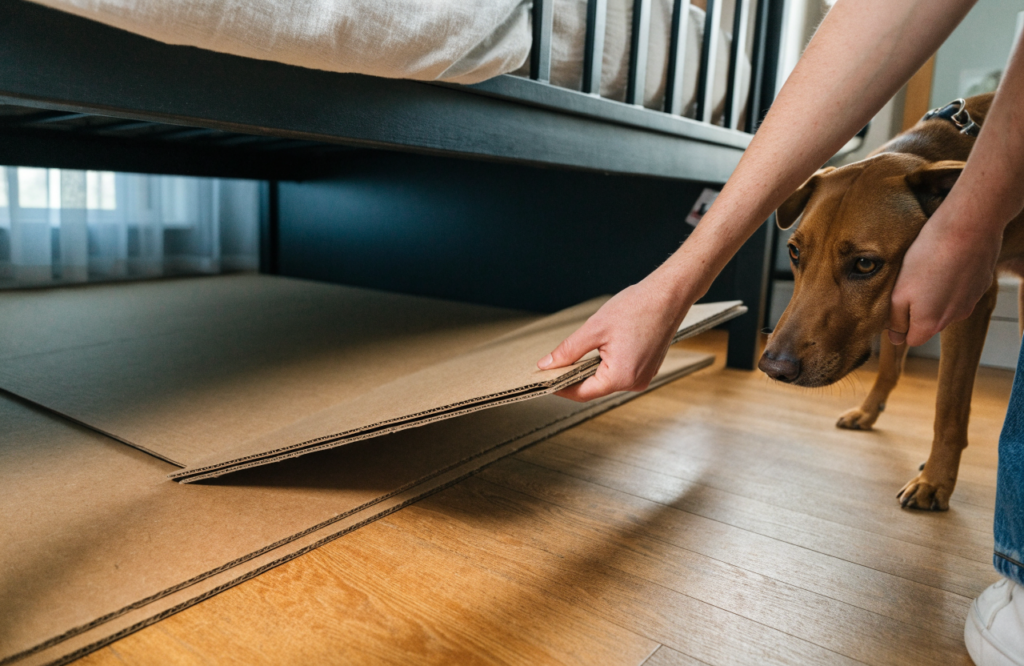
- Empty the under-bed area and measure the open height at the entry and at the center. Use the smaller number.
- Slide a flat cardboard template the size of the dog bed underneath. If it catches on a bar, the real bed will too.
- Add risers only if all legs can take them and the frame stays stable when you sit on the edge. Recheck the height.
- Put the dog bed in place during the day, not at bedtime. Let the dog investigate. A treat on the pad is enough for many dogs that already like the space. Dragging a dog under the frame teaches the opposite of what you want.
- Watch one entry and one exit. If the back scrapes, stop and raise the frame or switch to a thinner pad.
- Vacuum the zone weekly and wash the cover on the same schedule as your sheets. Hair packed into the slats is the main reason these setups get abandoned.
If the current frame cannot clear the dog plus a 3-inch pad, replacing the frame is more reliable than stacking risers on a storage bed.
Mistakes that make the nook unusable
- Trusting the product photo. Arched openings are often styled for cats and small dogs and never list interior height.
- Ignoring the center support. A queen frame can have a bar exactly where the dog needs to lie.
- Buying the dog bed first. A thick orthopedic bed is the usual reason a “perfect” frame ends up too tight.
- Skirting the bed. A bed skirt looks finished and blocks the entry, traps heat, and hides mess until it smells.
- Using the nook as storage plus a bed. Bins, shoes, and suitcases turn the space into an obstacle course and a chew risk.
- Assuming every dog wants it. A dog that sleeps on the mattress or against the door will not move under the bed because the frame is pet-friendly.
Frequently asked questions
How much clearance does a large dog need under the bed? Plan on 18 inches or more of open frame height before the cushion, so 14–16 inches remain after a modest pad. The dog also needs a stretch length, often 40 inches or more, with no bar through the middle. Many standard bedroom frames never reach that.
Can I use bed risers instead of a new frame? Yes, as a test, if every leg is supported and the risers are rated for the loaded bed. Risers add height only. They do not remove drawers or a low center rail.
Is an under-bed dog bed the same as a crate? No. It is an open resting spot. It will not keep a dog from roaming, chewing, or leaving the room, and it should not replace a crate for dogs that need confinement.
What if my dog only goes under the bed during storms? That pattern is often noise fear, not a request for a nicer bed. A covered nook can be one calm option, but escalating storm or firework fear is worth a conversation with a veterinarian rather than a furniture change alone.
Do pet-nook platform beds work for medium dogs? Only if the published or measured interior height clears the dog and the pad. Many of these frames are marketed for cats and small dogs. Get the floor-to-slat number before treating one as a medium-dog solution.