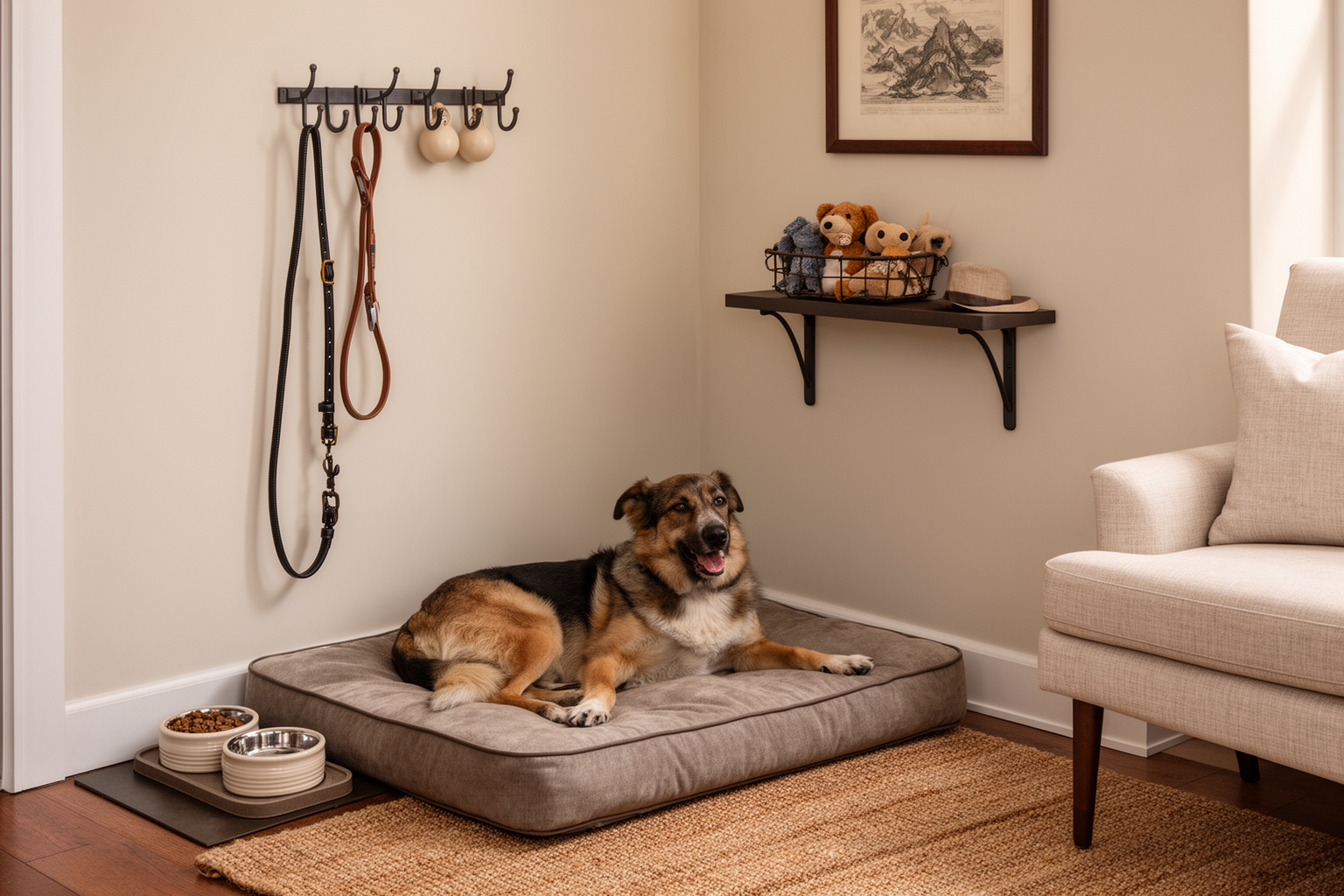

A dog bed area is not just the cushion you buy. It is the sleeping surface your dog can actually use, plus enough clear floor around it that they can get on and off without stepping into a walkway. Most dogs need a bed about 6 to 12 inches longer than their stretched body, and a spot that is quiet, dry, and still close to the household. Size the bed to the dog. Place the area where they already choose to rest.
Start with the Usable Sleeping Surface, Not the Label
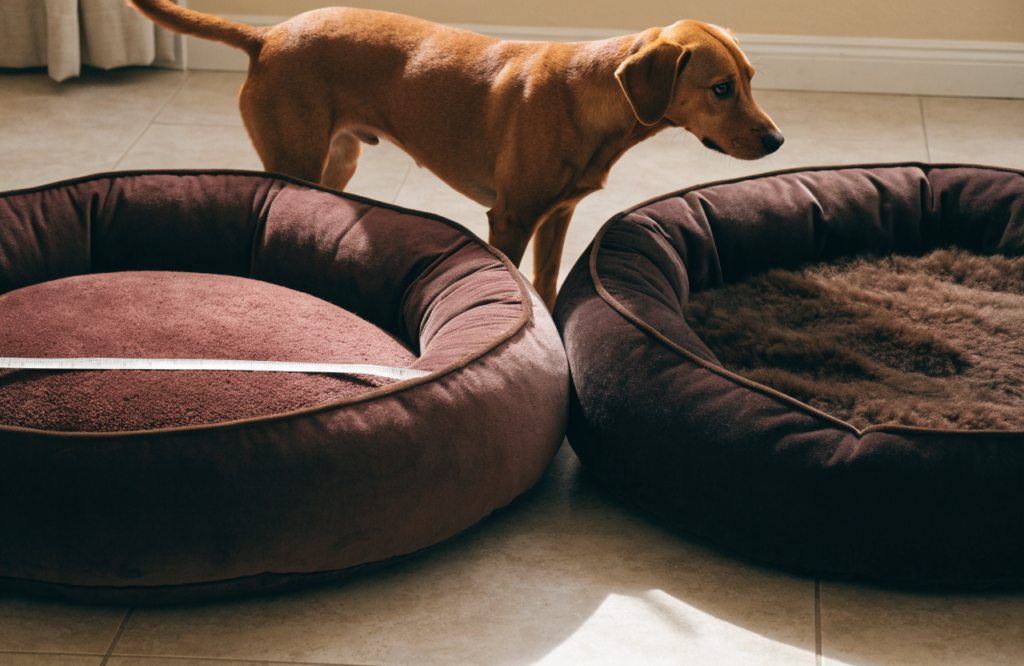
Retail sizes such as “large” or “XL” are not standard. Two beds with the same label can differ by several inches, and a bolster or donut bed gives up several inches of that footprint to raised sides. The number that matters is the flat area the dog can lie on.
Measure while the dog is relaxed and lying down, not standing. A standing dog is shorter than a dog that has fully stretched.
- Measure from the tip of the nose to the base of the tail, where the tail meets the body. Do not include the tail.
- Add 6 inches if the dog sleeps curled, or 10 to 12 inches if they sprawl with legs extended. That is the minimum bed length.
- Measure width at the widest point while they are on their side, from the back to the outstretched paws, and add about 4 to 6 inches so hips and elbows are not hanging off.
- For a round or nest bed, measure the diameter of the curl and add a few inches. Nose-to-tail length matters less for a dog that always balls up.
A 38-inch stretched dog that sprawls needs roughly 48 to 50 inches of sleeping length. The same dog that always curls may be comfortable on a shorter bed with a raised rim. When you are between sizes, the slightly larger bed is usually the safer buy, unless the dog is anxious and treats a very open surface as exposed.
Weight charts are only a starting point. Body length and sleep position override them. A long, light sighthound can outgrow a “medium” bed that would suit a stockier dog of the same weight.
| Typical weight | Usual bed label | Common outer dimensions | What usually changes the pick |
|---|---|---|---|
| Under 25 lb | Small | about 18 × 24 to 24 × 30 in | Curlers can stay at the small end |
| 25–50 lb | Medium | about 24 × 30 to 30 × 36 in | Sprawlers often need the next size |
| 50–75 lb | Large | about 30 × 36 to 36 × 42 in | Check shoulder width on barrel-chested dogs |
| 75–100 lb | X-large | about 36 × 42 to 42 × 48 in | Size up if they sleep on their side |
| Over 100 lb | Giant | 48 × 54 in or larger | Confirm the room can hold the footprint |
These bands are practical ranges used by bed makers, not a breed standard. A Labrador that stretches often needs the upper end of large or a true XL. A French bulldog that curls may be fine in a medium even if a weight chart points higher.
Sleeping Style Changes the Area More Than Breed Does
Watch the dog for a few nights before you buy. The position they hold for most of the night is the one to design for.
Curlers tuck nose to tail and often prefer a snug nest with a rim. A bed much larger than the curl can feel less secure. Sprawlers need a rectangle, not walls. Bolsters that look cozy on a product photo steal the width their legs need. Side sleepers need enough width to roll without dropping a hip off the edge. Chin-resters use the rim as a pillow, so bolster height matters more than extra floor space. Burrowers want something they can crawl under; extra open area does not replace a cover or hood.
A bed that is too small gets abandoned because limbs hang off. A bed that is far too open can also be ignored by a dog that wants a boundary at their back. The useful middle is stretch room without a vast empty center.
The Floor Area Is Larger Than the Mattress
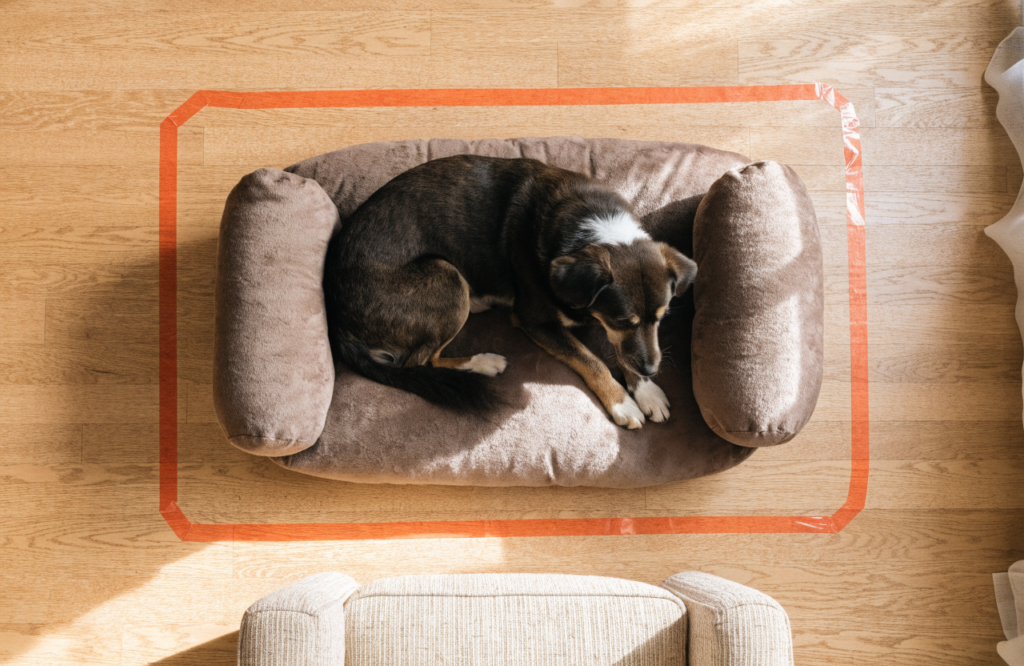
The dog bed area in the room is the outer footprint plus clearance.
Bolster, sofa-style, and donut beds are the common trap. A listed 36 × 42 inch bolster bed may only offer about 32 × 38 inches of sleeping surface once the walls are subtracted. Read interior dimensions, not just the outer size. On a flat mat, interior and exterior are almost the same, which is why mats are the better fit in a tight corner.
Around the bed, leave enough room that:
- The dog can step on and off without a running start.
- A person can pass without stepping over the dog. A main path between sofa and kitchen is a poor place for this.
- Drawers, doors, and crate doors still open.
- Nothing forces a senior dog to jump down from a raised platform.
A couple of inches of gap beside furniture is not enough if the dog has to shuffle sideways to lie down. If the only available patch is smaller than the stretched measurement, a flat mat against a wall is a better fit than a thick bolster that will not actually fit.
Crate beds are the exception to “size up.” The pad should match the crate floor so it lies flat and does not bunch against the walls. Measure the crate interior, not the dog.
Where That Area Should Sit
Welfare guidance is consistent on the conditions, even when the room changes. A dog needs a place that is comfortable, dry, draught-free, clean, and quiet enough to rest without being disturbed. Veterinarians tend to add a second condition: the spot should still feel connected to the household.
A corner of the room where people actually spend time — living room or bedroom — is the placement vets most often recommend, with easy access in and out so the dog never feels boxed in. Dogs also “vote” with where they already nap. If they keep sleeping beside the bed, or in one particular corner, moving the bed to that spot usually works better than insisting on a place that is convenient for the furniture.
What that looks like in practice:
- Living room. A corner with a wall or sofa behind the dog, and a view of the room, but off the path between seats and the doorway. Behind a sofa or beside a bookcase often works. Directly in front of the television, or in the lane to the kitchen, does not.
- Bedroom. Useful if you want the dog nearby overnight, and practical for older dogs that may need you during the night. Keep the bed off the swing of the door and out of early direct sun if that wakes them. A dog with poor bladder control is a reason to use a washable cover, not a reason to hide the bed in another room.
- Kitchen or utility room. Hard floors are easier to clean, and a door to the yard can help late-night trips outside. These rooms are also cold and busy. A bed here suits a dog that is content alone more than a dog that shadows people all evening.
- Home office. Worth a second bed if you work from home for long stretches. One bed cannot be in the right place for both daytime and night.
Avoid the foot of the stairs, hallway wind tunnels, the front door, and any raised surface the dog has to jump from. Constant foot traffic keeps many dogs on alert instead of asleep. Drafts from exterior doors, windows, and vents make an otherwise good bed feel wrong. So does a heater, fireplace, or strong afternoon sun in warm weather. Laundry rooms and garages are usually too loud, too isolated, or both.
Protect the Floor Without Shrinking the Area
The bed should sit on a stable, cleanable surface. Hard floors get cold and can slide a light bed; a low-pile rug or mat a few inches larger than the bed stops that and catches hair. Do not put a thick rug under an already deep orthopedic bed if a senior dog then has to climb onto it. Washable covers matter more in the living room than in a quiet bedroom, because that is where spills and muddy paws land.
Outdoor or patio spots need a different setup: a bed that can get wet, drains, and dries, placed out of standing water. A house bed taken outside is rarely the right object for that area.
One Area Is Often Not Enough
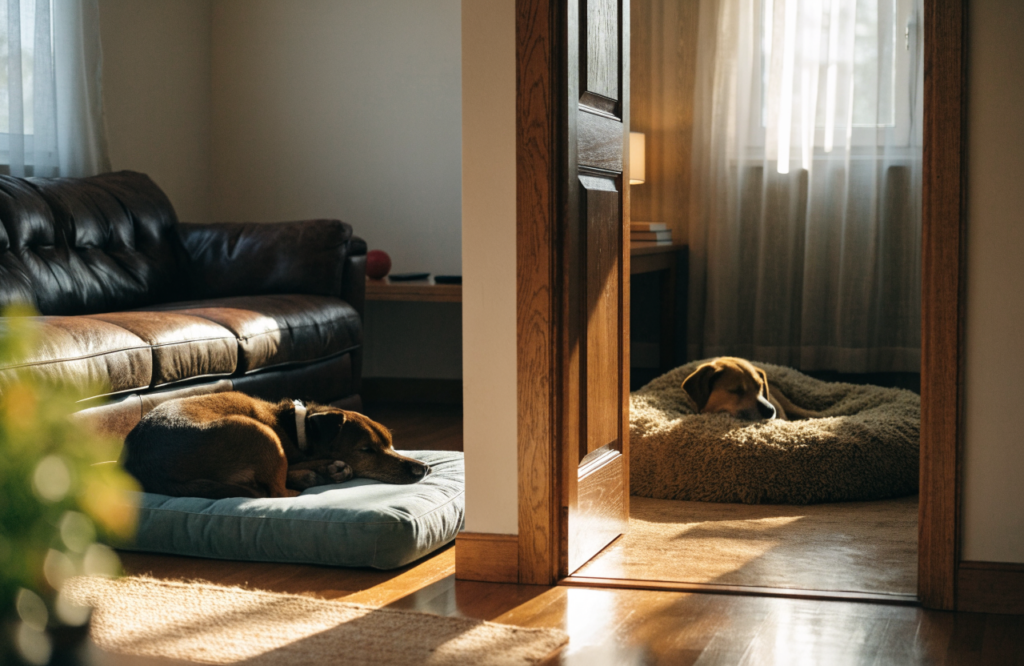
Dogs rest in short bouts through the day and a longer stretch at night. A single bed in a spare room fails for many dogs because it cuts them off from the people they track. A common workable setup is one bed in the evening room and one in the bedroom, with a third only if someone is in a home office all day. Moving the same bed around every few days removes the stable cue. Pick the spots, then leave them there.
Puppies need a bed they will outgrow, so a washable mat sized for the next few months is more sensible than a giant bed “for later.” Two dogs sharing one bed need the combined sprawl, not the size of the larger dog alone, unless they reliably sleep stacked. Seniors usually need a lower entry, a firmer supportive surface, and no jump down. Extra length helps them turn without struggling.
Mistakes That Make a Correctly Sized Bed Fail
- Buying by weight label and never measuring the dog or the corner.
- Using the outer size of a bolster bed as if it were all sleep space.
- Putting the bed where it bothers you least — a back hallway, a closet, a cold utility room — rather than where the dog already lies.
- Parking it in the traffic lane, then wondering why they will not settle.
- Choosing a high lounge bed for an older dog that has to jump off.
- Treating “ignored the bed” as a preference for the floor, before testing a move of a few feet to their actual nap spot.
If the dog still chooses bare floor after the size and the place are right, temperature is the next check. Some dogs simply run warm and want a cool surface. A thinner mat in the same area often gets used when a deep plush bed does not.
Questions People Ask After Measuring
Is a bigger dog bed always better? No. Slightly larger than the stretched body is the usual goal. A much larger open bed can feel insecure to a dog that curls, and it may not fit the only good corner in the room.
Should the bed go in the bedroom or the living room? Whichever room matches when you want them settled, and where they already try to sleep. Many households use both, rather than forcing one location to cover day and night.
How do I know the area is too small? Legs, hips, or head hang off during normal sleep, they cannot turn without standing up, or they have to cross a walkway every time they get in. Any one of those means the footprint is wrong, even if the product label matched their weight.
What if they only sleep on the sofa? Check placement and access before assuming the bed is rejected. A bed with a wall at the back, in the same room, at floor level, is the fair test. Sofas are a separate training choice, not proof that no floor area will work.