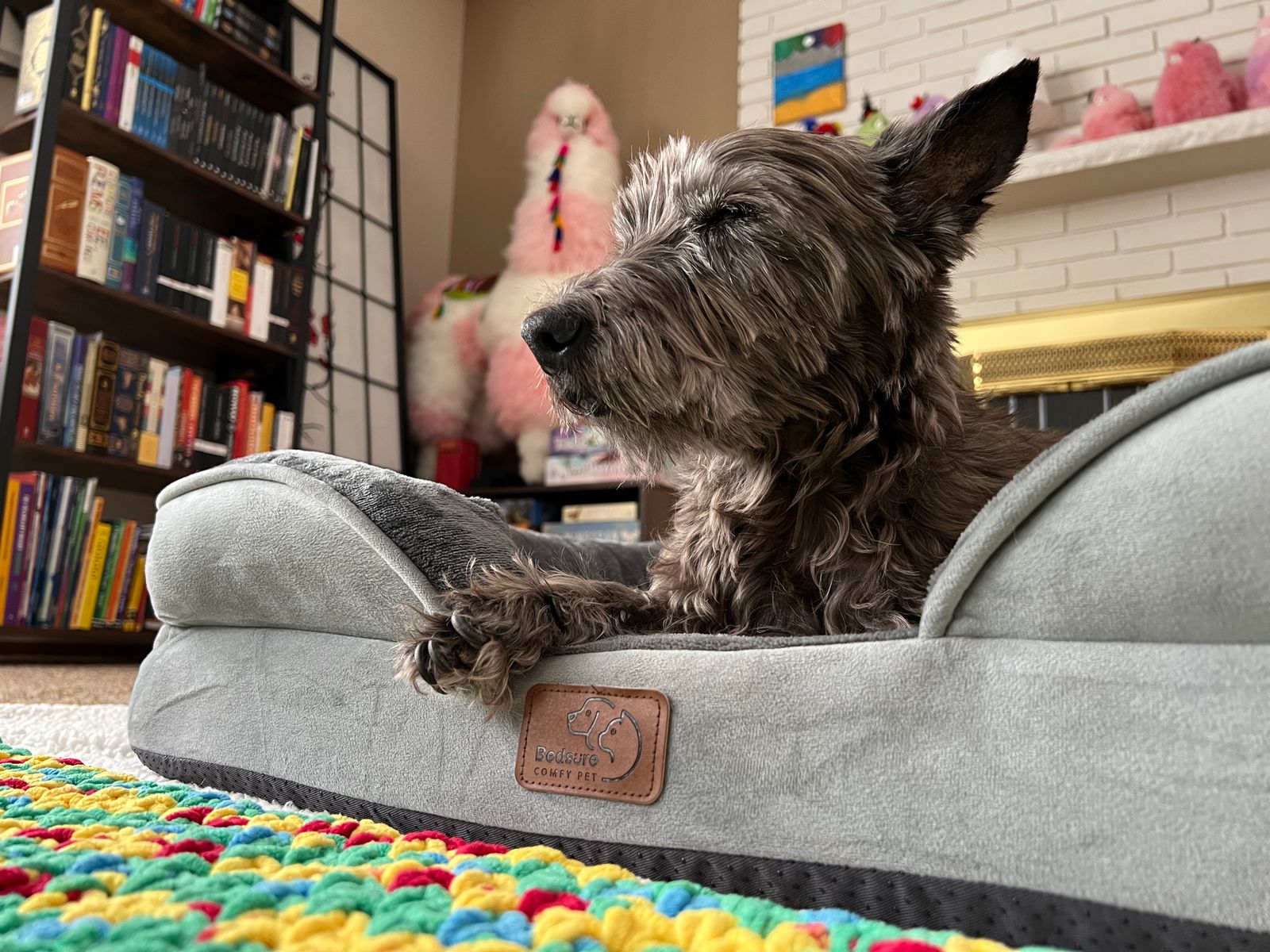

A corner dog bed is a wedge, quarter-circle, or L-shaped bed built to sit in a 90-degree corner, usually with raised sides along the two walls. It is worth buying when the unused corner is where your dog already rests, and when the usable sleeping surface is still large enough for how that dog actually lies down. It is a poor substitute for a full mattress if the dog sprawls, has stiff joints, or needs more floor area than the corner can give.
The shape solves a room problem first and a sleep problem second. Two walls already give a back and a side. A bed that follows those walls keeps the walkway clear and gives leaners and curlers something to press against. That only works if the foam supports the dog’s weight and the front edge is easy to step over.
When a corner dog bed matches the dog
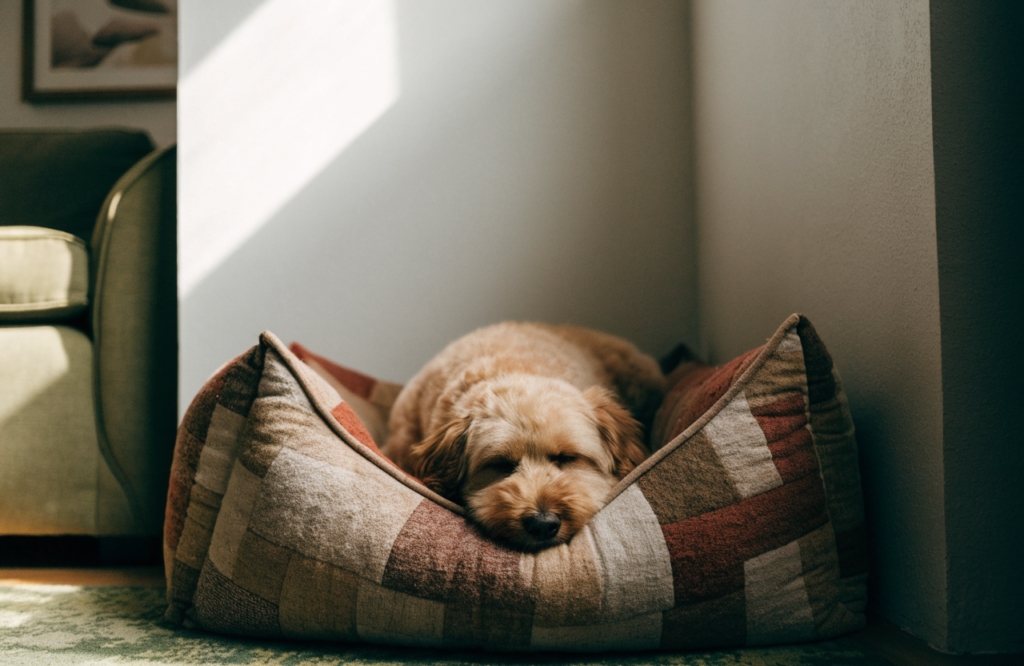
Dogs that curl, tuck against furniture, or rest their head on a raised edge are the clearest fit. Enclosed sides echo the denning habit many dogs still show: a bounded spot with something solid behind them, rather than an open pad in the middle of the room. Curl sleepers also lose less heat than dogs stretched on their side, so a bolstered corner can feel warmer without adding a heavy blanket.
The same shape is less useful for a dog that sleeps fully extended, on its back, or half off every bed it owns. A triangle forces the longest stretch onto the diagonal front edge. If the hips or elbows hang off that edge, the joint is unsupported for hours. Guides on bed sizing consistently treat a too-small surface as the worse error, especially for large breeds and older dogs, because hanging limbs get no foam under them.
Space is the other real reason to choose this shape. In a small apartment, a rectangular bed often blocks a path or sits in the middle of the only clear floor. A corner bed uses floor that is hard to furnish. That advantage disappears if the corner is a draft line, next to a radiator, or in a hallway the dog will not settle in.
Corner dog bed styles and what each one is for
Most products fall into four groups. The label matters less than the sleeping surface and the entry height.
Wedge and triangle beds
These have two straight sides that meet at a right angle and a curved or straight front. Bolsters usually run along the walls. They are the most space-efficient option and suit small and medium curlers. The usable middle is smaller than the listed side length suggests, because the bolsters and the taper both eat area.
L-shaped sofa beds
An L-shaped bed uses the corner but keeps a longer rectangular sleeping pad, with bolsters on the back and one side. It wastes a little more floor than a pure wedge and gives sprawlers more room to extend one way. It also looks more like furniture, which is why it shows up in living rooms. The open front is usually lower, which helps dogs that struggle to climb.
Orthopedic corner beds
“Orthopedic” describes the job, not a single material. A useful version has a dense foam core, often memory foam or a firm base under a softer top, thick enough that a medium or large dog does not press through to the floor. Fiber-fill bolsters can still be fine for a headrest. Fiber-fill as the whole mattress usually flattens. Seniors, dogs over roughly 50 pounds, and dogs with arthritis, hip dysplasia, or stiffness after sleep are the ones who gain the most from that denser core. A young, light, healthy dog can be comfortable on a simpler cushion.
Flat corner cushions
A low wedge pad with no walls is mainly a floor protector and a place marker. It saves space and is easy to wash, but it does not create a nest. It can be the right call for a hot sleeper who rejects bolsters, or as a second bed, not as the only bed for a dog that wants to lean.
| Style | Best for | Watch-out |
|---|---|---|
| Triangle with two bolsters | Curlers, small rooms, head-resters | Usable area shrinks fast once bolsters are in place |
| L-shaped sofa | Dogs that both lean and stretch | Takes more floor than a wedge |
| Orthopedic foam corner | Seniors, heavy dogs, joint discomfort | High bolsters can block an easy exit |
| Flat corner cushion | Hot sleepers, spare bed, easy washing | Little security or support |
How to size a corner dog bed without guessing

Listed sizes are often the length along each wall, not the clear sleeping pad. A “36-inch” corner bed may give a large dog far less than 36 inches of flat foam once the bolsters and the taper are counted.
Measure the dog, then the corner
Measure from nose to the base of the tail while the dog is in its usual sleeping pose, not while standing. For a curler, also note the diameter of the curl. For a stretcher, measure fully extended. Add about 8 to 12 inches for a curler and more, closer to 6 to 12 inches beyond the stretched length, if the dog extends its legs. Custom corner-cushion makers use that same idea: wall length roughly equals body length plus 8 to 12 inches, with thicker foam (about 4 to 5 inches) for older or heavier pets.
Then measure the corner itself. Check both walls for baseboards, outlets, door swing, and furniture that stops the bed from sitting flush. A bed that cannot reach the corner leaves a gap the dog will not use and a lip that catches paws.
Account for bolsters and usable surface
Subtract the bolster width from the listed side length before you decide the bed is big enough. If each bolster is 4 to 6 inches, a medium dog can lose a meaningful share of the pad. The front diagonal must still clear the hips. If you only have a side length, picture a quarter-circle: area is much smaller than a rectangle of the same side length. When a brand will not state inner dimensions, size up or choose the L-shape.
Too big is a smaller problem on a flat pad than on a nest. A very large wedge can feel less secure to a small anxious dog, and the empty foam becomes a landing spot for toys and dust. For seniors, extra room to shift at night matters more than a tight fit, as long as the front edge stays low.
Support, covers, and the features that matter after week one
Foam depth is the first check after size. About 3.5 to 4 inches is a common minimum on better corner beds; large dogs do better with a thicker, denser core so shoulders and hips do not bottom out. Memory foam contours and can feel warmer. A firmer high-density base is easier to push up from. Dogs that struggle to stand do better when the edge is stable and not so soft that paws sink as they rise.
The cover should come off. Look for a zipper that actually clears the corners, a waterproof liner between cover and foam, and a fabric that survives washing without the bolsters collapsing. Puppies, incontinent seniors, and heavy shedders make the liner non-negotiable. The foam itself should not go in the machine.
A non-slip base matters more in a corner than it looks. On hardwood or tile, dogs often launch forward off the open edge, and the bed walks out of the corner. A rubberized bottom or a cut-to-fit rug pad underneath fixes most of that. Corner grippers can work if the bed base is flat. Skip anything that could peel up and be chewed.
Other practical checks: bolster fill that is sewn into channels so it does not migrate, a low front if the dog is older, and chew-resistant fabric if the dog mouths edges. Cooling gel or mesh helps dogs that abandon beds in summer. A dark plush cover in a sunny corner will do the opposite.
Where to put it so the dog uses it
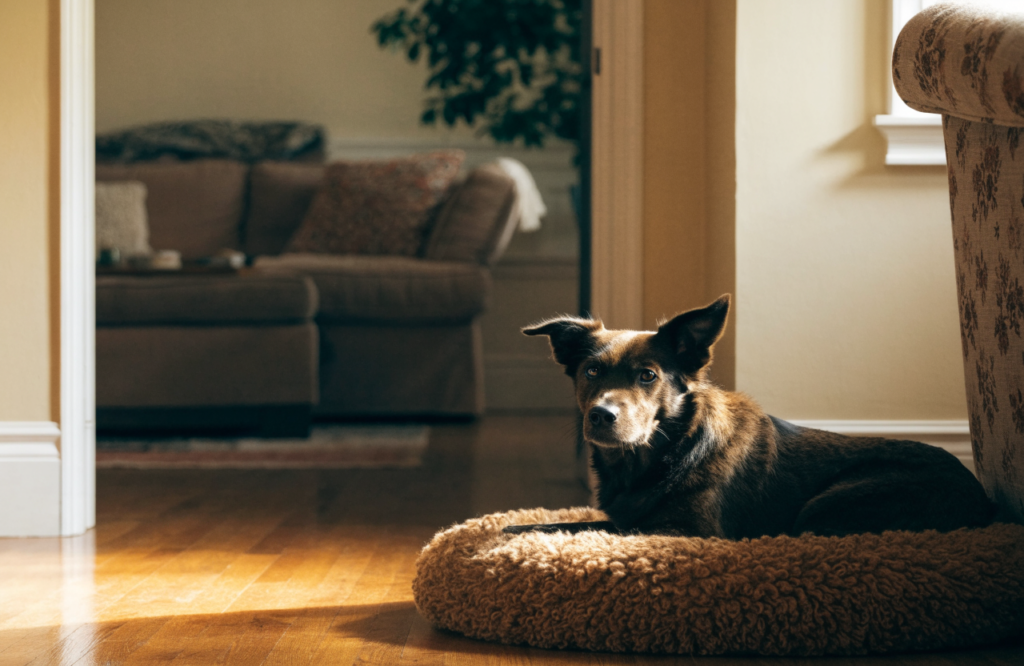
Place it in a corner the dog already chooses, not the corner that looks tidy. Dogs that want a view of the room may ignore a bed tucked behind a door. Dogs that want a wall at their back will ignore a bed in the center even if it is more expensive.
Check the floor-level climate. Corners can be drafty along exterior walls, and they can also trap heat beside a radiator or vent. A gap of several inches from a heat source is safer than a bed pressed against it. Keep the open edge out of the main walkway so people are not stepping over the dog and the dog is not startled every time someone passes.
If the dog will not try the bed, the corner may be the problem rather than the product. Moving the same bed to the wall the dog already sleeps against is a better test than buying a second style immediately.
Problems owners run into
The bed looks the right size in the listing and is too small once assembled. Inner dimensions were never published, and the bolsters took the margin you added for the dog’s legs.
The bed slides. A corner does not anchor a light bed. Weight and a grip layer do.
The dog lies in the corner and ignores the foam. Some dogs want the wall, not the cushion. A lower pad, or a bed with one bolster removed, sometimes works better than a high-sided wedge.
The dog chews the bolster corners. Raised edges are easy to mouth. A heavy chewer often does better on a simple durable mattress than on a shaped sofa bed.
Stiff dogs stop using it. Tall bolsters and a soft front edge make getting in and out harder. For arthritis or hip pain, a low orthopedic mattress against the wall can beat a classic corner sofa. Bedding can improve comfort, but sudden stiffness, limping, or trouble rising needs a veterinary check, not a new cover.
The corner smells damp or the cover never fully dries. Wash the cover, not the foam, and dry it fully before zipping it back on. A waterproof liner only helps if the foam never gets wet in the first place.
When a regular bed is the better choice
Choose a rectangular orthopedic mattress if the dog stretches, weighs enough to collapse thin foam, or needs a low step-in more than a nest. Put that mattress in the corner if you still want the space savings. The walls do part of the bolster’s job.
Choose a round bolster or donut only for a confirmed curler who already sleeps in a ball and is not a senior with mobility limits. Choose an elevated cot for hot sleepers and dogs that like airflow, accepting that most cots are rectangular and will not fill a corner cleanly.
A corner dog bed is the right product when three things line up: the dog leans or curls, the inner pad still fits that pose with the legs supported, and the corner is a place the dog will actually stay. If any one of those fails, the shape is mostly furniture.
FAQ
Do corner dog beds work for large dogs? Only if the inner diagonal and side lengths clear a stretched or curled large dog after bolsters are subtracted, and the foam is thick and dense enough not to bottom out. Many wedges are sized for small and medium dogs. An L-shaped orthopedic bed is usually the fairer large-dog version.
Are they calming? They can feel more secure to dogs that already rest against walls, because two sides are bounded. They do not treat anxiety by themselves. A dog that paces, pants, or avoids rest needs the cause addressed, not a different outline of foam.
How thick should the foam be? Around 4 inches is a practical floor for medium dogs. Heavier and older dogs need a denser core, sometimes thicker, so hips and elbows stay on foam rather than on the floor. Thin fiber fill is a cushion, not joint support.
Can two dogs share one? Only if they already share space calmly and the bed’s usable area fits both bodies at once. Most corner beds are sized for one dog. A second bed, or a long rectangular bed along one wall, crowds them less.
How do you wash one? Remove the cover and wash it on the cycle the label allows, usually gentle and cool or warm. Wipe the liner. Keep the foam dry. Dry the cover completely before reassembly so the corners do not hold damp and odor.