

A dog bed frame is the structure that holds the sleeping surface off the floor. It is not the cushion itself. Most products fall into two groups: a cot-style elevated frame with a taut fabric or mesh surface, and a furniture-style platform that supports a separate mattress or bolster bed. The right choice depends on your dog’s weight, mobility, chewing habits, and whether the bed lives indoors, on a patio, or both.
The frame only works if the dog can get on and off easily, lie fully on the surface, and not destroy the edges. A good-looking frame that is too small, too high, or too soft under load is the most common reason these beds get abandoned.
The two kinds of dog bed frames

Cot-style frames use PVC, aluminum, or steel tubing with a fabric panel stretched inside the rails. Brands such as Kuranda have sold this design for decades. The surface is firm and slightly giving, air moves underneath, and there is no foam to flatten or smell. Kuranda rates its standard PVC frames for dogs up to 100 pounds and its aluminum frames up to 250 pounds. Aluminum is the usual recommendation for heavy chewers because the fabric is held in a channel inside the frame rather than wrapped over the outside edge.
Furniture-style frames look more like a low daybed or pet sofa. Wood, rubberwood, or a metal-and-wood mix forms a deck or slatted base, and a cushion sits on top. These are the beds that show up in living-room photos. They can take a washable orthopedic pad, a bolster, or a bed you already own. They do not cool as well as an open cot, and the cushion still needs replacing when it compresses.
A third, less common type is a bedside platform that matches the height of a human mattress so a dog can sleep level with the bed. That is a space and co-sleeping solution, not a general dog bed.
| Frame type | Best for | Weak point |
|---|---|---|
| PVC or resin cot | Indoor/outdoor use, dogs under about 100 lb, easy cleaning | Moderate chew resistance; dark frames can warp in direct sun |
| Aluminum cot | Heavy dogs, determined chewers, outdoor use | Firmer surface, less “nest” feel |
| Wood or metal platform | Matching home furniture, using your own cushion | Cushion still flattens; slats can let a thin pad sag |
| Bedside extender | Dogs that sleep next to the human bed | Fixed height must match the mattress; takes floor space |
When a frame helps, and when it does not
Elevation solves a few specific problems. A cold or damp floor pulls heat from the body. Dirt, grass, and patio grit stay under the bed instead of in the sleeping surface. Air moving under a mesh panel keeps thick-coated dogs cooler than a solid foam bed in a warm room. A taut surface also spreads weight more evenly than a cheap bed that has already bottomed out.
That even support is not the same as pressure relief. A bare cot does not mold around hips and elbows the way dense memory foam does. Dogs with osteoarthritis, hip dysplasia, or elbow pain usually sleep better on a thick orthopedic pad. Veterinary guidance for arthritic dogs favors soft, padded bedding and non-slip floors. A low cot can still be a second bed for warm afternoons, but it should not replace cushioned support if rising and lying down already hurt.
Short-legged dogs, very stiff seniors, and dogs recovering from surgery often do better on a floor-level bed or a platform only a few inches high. The airflow benefit is not worth a daily jump.
Size the sleeping surface, not the label

“Medium” and “large” are not standard. Measure the dog lying on their side, nose to the base of the tail, not to the tip of the tail. Add about 6 inches for a dog that curls, and 8 to 12 inches for a dog that sprawls. Then check the usable surface inside the rails, not the outer frame.
A rough starting map:
- Under 25 pounds, body length to 18 inches: about 24 by 18 to 28 by 20 inches
- 25 to 50 pounds, 18 to 26 inches long: about 30 by 24 to 36 by 28 inches
- 50 to 75 pounds, 26 to 34 inches long: about 38 by 30 to 44 by 34 inches
- Over 75 pounds, or any dog longer than 34 inches: 46 by 36 inches and up
If the dog falls between sizes, take the larger frame. Limbs hanging off the edge get no support. Weight capacity is a separate check. A frame rated for 70 pounds is not a large-dog bed. Heavy dogs also load one corner when they step on, so the rating should leave room above their actual weight. On a platform frame, confirm the cushion is at least as long as the measured sprawl. A roomy frame with a short pad still leaves hips unsupported.
Height is a mobility decision
Cot legs are often about 5 to 7 inches. Furniture platforms vary more; some sit near 8 to 10 inches once the cushion is on. Lower is safer for seniors, dachshunds, French bulldogs, and any dog that hesitates before stepping up. A dog that has to jump, scramble, or brace is telling you the frame is too high.
Test the idea before you commit if you can: watch the dog step onto a low ottoman or a folded blanket stack of similar height. If they pause or slip, choose a floor bed or the lowest available legs. Non-slip feet matter on hardwood and tile. Large dogs can walk a light frame across the room when they climb on.
Materials, chew resistance, and weather
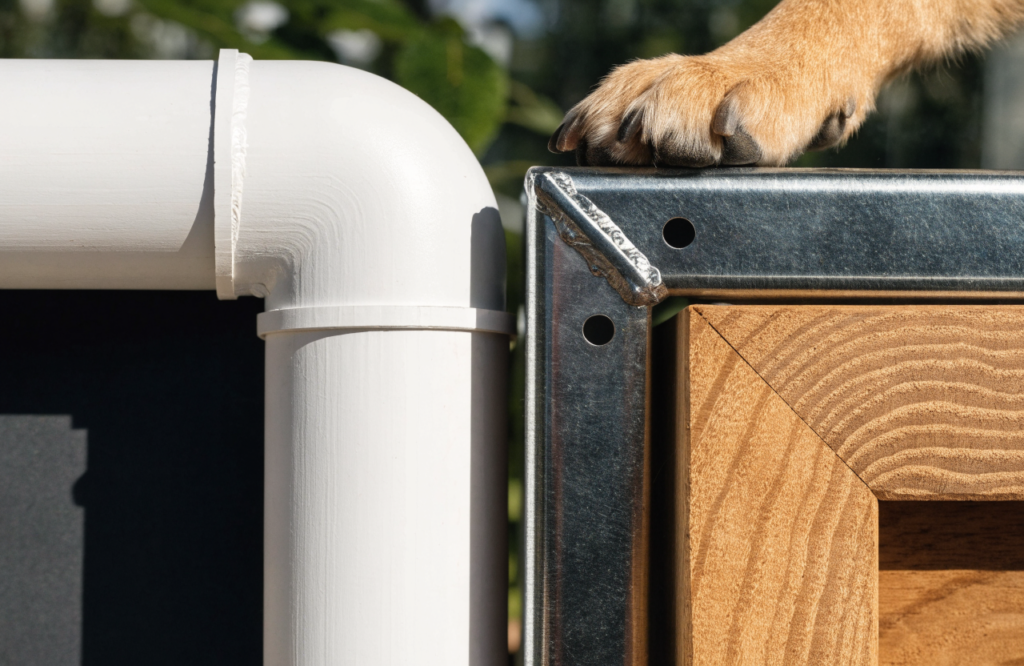
PVC and furniture-grade resin frames are light, rust-proof, and fine for most indoor dogs and for patios if the color is light. Dark PVC left in direct sun can heat and warp; Kuranda recommends its darker walnut frames for indoor use only and the lighter almond frames for indoor or outdoor use. Aluminum does not rust and handles heavier dogs and harder chewing. Steel cots are common and inexpensive, but thin tubing can bend, and bare steel heats up in sun faster than aluminum.
Wood frames should be solid stock or a thick plywood deck, not a thin veneer over wide gaps. Slats more than about 3 inches apart let a soft cushion sag between them. Sand edges smooth. Outdoor wood needs a finish that can handle moisture; unfinished softwood on a covered porch will still swell and check over time.
Chew resistance is mostly about edges. Fabric wrapped over the outside of a tube is an invitation. A panel locked inside the frame, rounded corners, and no loose piping last longer. No fabric bed is truly indestructible. A dog that shreds beds for sport will eventually work on corners, feet, or the cushion cover. For those dogs, aluminum with a protected panel is the practical ceiling, not a wood sofa frame.
What to check on the product page
Ignore lifestyle photos and look for these:
- Usable length and width, listed in inches, not only a size name
- Weight rating above the dog’s weight, with stiffer long rails on the biggest sizes
- How the fabric or cushion attaches, and whether a replacement cover or panel is sold separately
- Entry height with the sleeping surface in place
- Rubber or felt feet, and whether the frame rocks when weight shifts to one side
- Washable cushion cover, or a surface you can hose or wipe
- Indoor-only versus outdoor rating, including UV notes on dark plastic
A platform frame is only as good as the pad you put on it. For a dog over about 50 pounds, look for several inches of dense foam so hips do not hit the deck. Thin “decorative” cushions look finished and flatten in a few months.
Buying versus building
A simple wooden platform is a reasonable first woodworking project: four legs, a rectangular rail, and slats or a plywood deck sized to a cushion you already own. Plans built from 2×2 legs and 1x boards are common, and the critical details are pilot holes so the wood does not split, brackets at the leg joints for a heavy dog, and pads on the feet. Size the deck to the cushion, not the other way around.
Buy instead of build if the dog chews, the bed will live outside, or you need a known weight rating. A well-made aluminum cot with replaceable parts usually costs less time and lasts longer than a homemade frame that loosens at the corners.
Mistakes that make the frame fail
Measuring the dog while curled up produces a bed they only fit in one position. Treating the weight rating as the only fit check ignores width, fabric sag, and step height. Putting a senior with sore hips on a tall, taut cot makes getting up harder, not easier. Using a dark plastic frame in full sun, or any frame next to a heater or fireplace, can warp plastic and overheat metal. Skipping floor protection lets the frame drift and scratch. And a beautiful wood frame with a thin pad is still a thin bed.
If the dog ignores the frame for a week, check size and height before assuming they “don’t like beds.” Many dogs reject a surface they cannot stretch out on or step onto without effort.
Frequently asked questions
Is a dog bed frame better than a regular dog bed? Only for the job it is built for. A cot frame wins on airflow, cleaning, and outdoor use. A cushioned floor bed or a platform with a real orthopedic pad wins for joint pain and dogs that like to nest.
Can an old dog use an elevated frame? Yes, if the step is low, the surface is stable, and the dog already moves without obvious pain. If rising from the floor is already hard, a thick floor bed with a non-slip bottom is usually the safer main bed. A low cot can stay as a cool daytime option.
What size frame does a large dog need? Measure nose to tail base on their side and add 8 to 12 inches. Many Labs and Goldens need at least a 40- to 44-inch usable length. Confirm the weight rating; “large” frames rated near 50 to 70 pounds are undersized for a 80-pound dog.
Will a frame stop chewing? It reduces the easy targets. Protected fabric channels and metal rails survive longer than piping and foam corners. A determined chewer can still damage feet, connectors, and any loose cushion.
Do I need a frame if I already have a good cushion? Only if you want the cushion off a cold floor, easier cleaning underneath, or a lower step than the human bed. A flat platform with a lip or straps to keep the pad from sliding is enough. The cushion still has to be the right thickness for the dog’s weight.