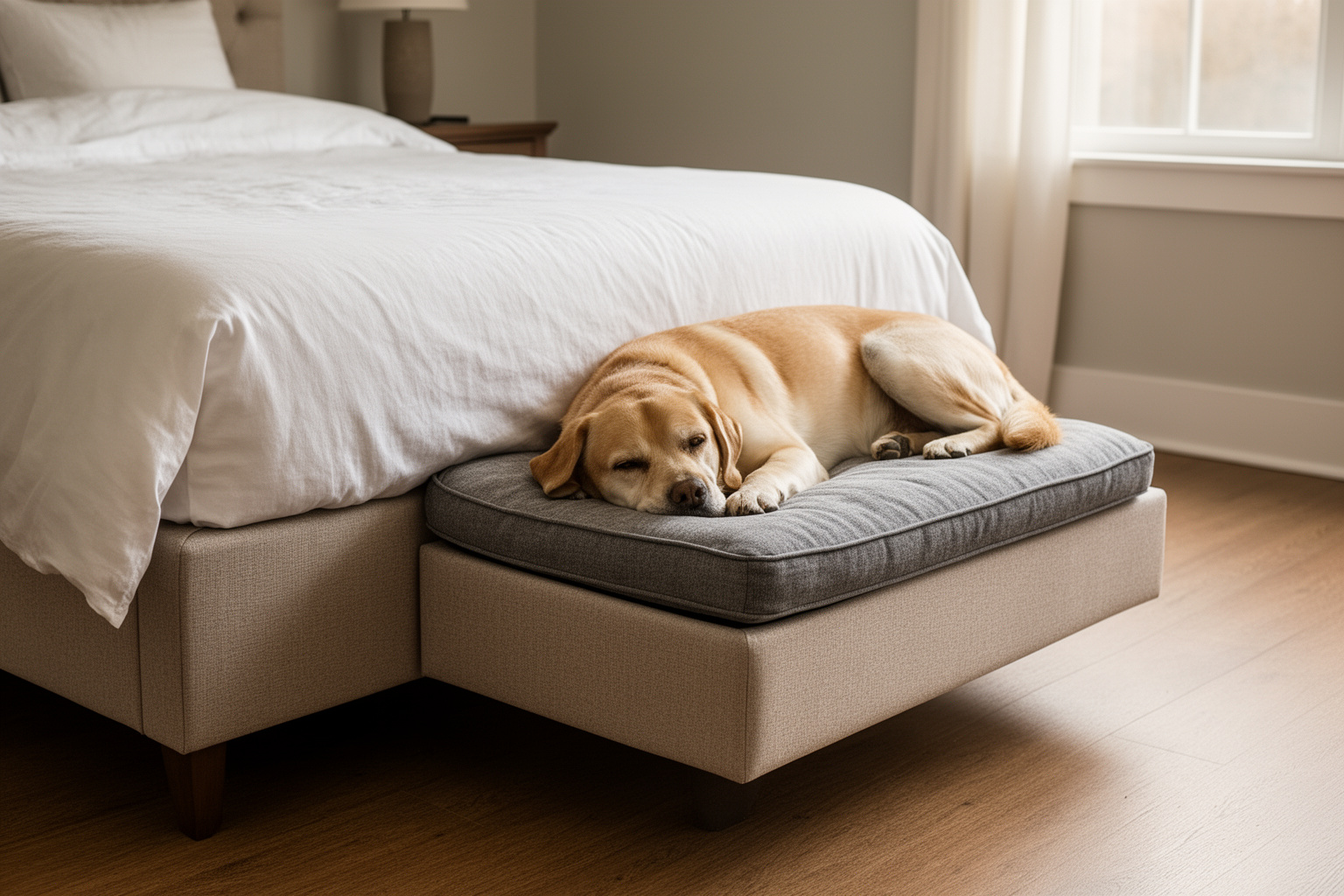

A bed extension for a dog is a raised platform or attached sleeper placed at the foot or side of your bed so the dog can stay at mattress height without taking over the mattress. It works when the surface is level with yours, stable under the dog’s weight, and close enough that the dog still feels near you. A floor cushion or an unanchored bench usually fails those three tests.
People search for this after the dog has already won the bed. A larger mattress rarely fixes it. Extra space often becomes extra room for the dog to stretch across your legs. An extension creates a separate zone at the same height, which is the detail that matters more than the brand name.
What a bed extension for a dog actually is
The useful versions are not ordinary dog beds pushed against the frame. They are structures meant to sit flush with the top of the mattress.
Two commercial styles cover most of the market.
Mattress extenders are platforms that add roughly 25 to 26 inches to the length of the bed, sized to the width of a twin, full, queen, or king. A common metal frame sits about 14 inches off the floor. Foam goes on top of that frame, and the foam thickness is what brings the sleeping surface up to your mattress. Wooden versions do the same job as furniture, sometimes with a step or bench. These are aimed at medium and large dogs that sprawl.
Bedside sleepers attach or stand at the side of the bed. Many are built for dogs under about 40 pounds and cats. Adjustable legs are often rated for a floor-to-mattress height of roughly 17 to 26 inches, with a rail on the open sides and straps that pull the unit against the bed. The open side faces you so the dog can be reached without sharing the sheet.
DIY versions sit between those two. Owners build a wood platform at the foot, matched to mattress height, and add carpeted stairs for dogs that should not jump. A reported Labrador build used boards, brackets, and cushions for about $100 in materials, with the boards set slightly below mattress level so the padding finished flush.
When an extension helps, and when it will not
An extension is a space tool, not a training tool. It helps in a few specific situations.
- The dog already sleeps on the bed and crowds you, but will stay put if the new surface is level and next to you.
- A senior dog or a dog with joint pain wants to be up with you but should not jump a tall mattress every night.
- Two people and one large dog cannot all fit a queen without someone sleeping on the edge.
- You want the dog close for reassurance, but off the duvet because of shedding, dirt, or light sleepers.
It is a weak fix if the dog’s real goal is body contact. Plenty of owners report that a king still ends with the dog in the middle. A chest or bench already flush with the mattress often gets ignored for the same reason. If your dog only settles when touching you, an extension at the foot may become an expensive shelf.
It is also the wrong product if the problem is separation anxiety that needs behavior work, or if someone in the bed has severe allergies. Keeping the dog in the room but off the mattress can reduce dander on the sheets. It does not remove the dog from the room.
A small 2017 study of 40 dog owners wearing activity monitors found sleep was less efficient when the dog was on the bed than when the dog was in the room but off it. Limited later work has found owners often do not notice the disruptions. An extension is a reasonable middle step if you want to test “close, but not on the mattress” without moving the dog to another room.
Foot-of-bed platform or side sleeper
Placement decides whether the product fits the room and the dog.
| Decision | Foot platform / mattress extender | Side sleeper |
|---|---|---|
| Best dog size | Medium to large, dogs that stretch | Small and medium, often listed under 40 lb |
| Space it uses | About 25 inches beyond the foot of the bed | Width of a nightstand zone beside the bed |
| Access for you | Dog is at your feet; harder to reach without sitting up | Dog is at arm’s reach |
| Footboard | Often blocked or left with a gap | Usually irrelevant |
| Mobility help | Needs a step or ramp if the bed is tall | Rails can contain a small dog; ramp still useful for seniors |
| Stability risk | Frame can walk when a heavy dog jumps on | Gap between bed and sleeper if straps loosen |
Choose the foot if the dog already sleeps at your feet and the room has clearance past the bed. Choose the side if you want to touch the dog, the dog is small, or a footboard, window, or closet blocks the end of the bed.
A footboard is a frequent reason end extenders fail. The platform cannot sit flush, so a gap opens between mattress and extension. Paws drop into that gap. Measure before you buy. If the footboard is fixed and you cannot remove it, a side sleeper or a freestanding platform set beside the bed is the practical route.
Match the height before you match the color
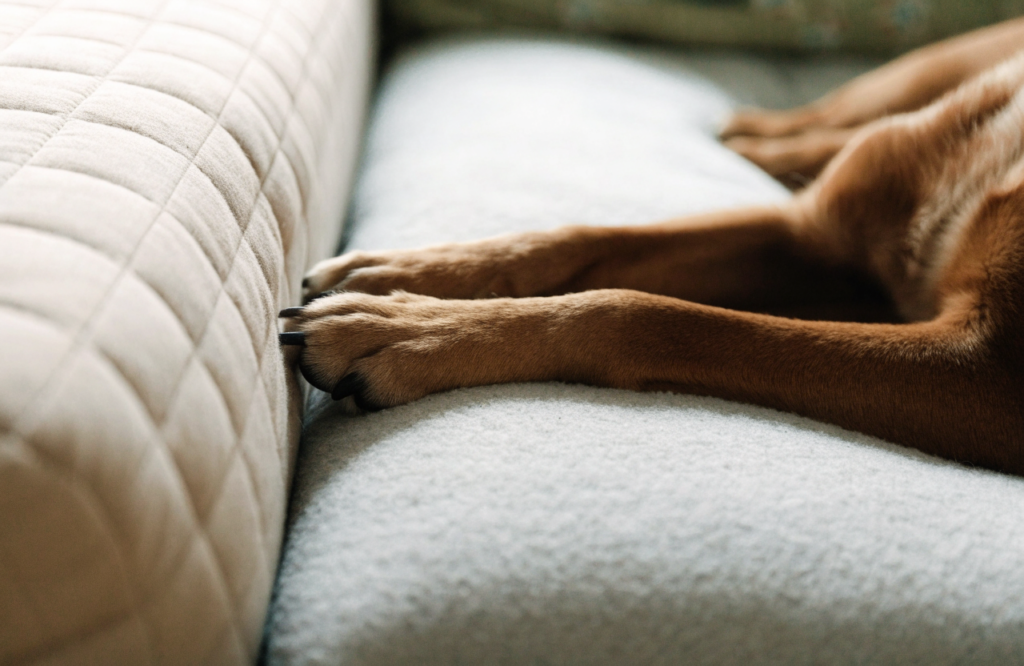
Height is the detail that decides whether the dog uses the extension. A lip of even an inch is enough for many dogs to abandon the new surface and climb back onto the mattress. A drop is worse: it becomes a place to catch a paw.
Measure three numbers.
- Floor to the top of the mattress, with the bedding you actually sleep on. A thick topper changes the number.
- Mattress thickness alone, if the product clamps to the mattress rather than standing on the floor.
- Clearance at the foot or side: doorway swing, nightstand, radiator, and how much walkway you still need.
On a typical metal extender, the frame is fixed at about 14 inches. You choose foam height so frame plus foam equals your mattress height. A 10-inch foam topper on a 14-inch frame lands near 24 inches. If your bed is 22 inches, that kit will sit proud of the mattress. Listings that sell the foam without the frame leave you with a mattress and nothing to put it on.
Side sleepers with telescoping legs are more forgiving, but the range is still limited. A product rated for 17 to 26 inches will not solve a very low platform bed or a tall storage bed outside that window. Some note that a mattress about 8 to 12 inches thick gives the flushest fit because the front bar is fixed.
Check the fit after a week. Foam compresses, and straps loosen. Recheck that the surfaces still meet and that no gap has opened.
Size the sleeping surface to the dog, not the bed label

King, queen, and twin labels on extenders describe your mattress width, not how much room the dog gets. A common king kit is about 76 inches wide and 26 inches deep. That is a long, relatively narrow shelf. A Great Dane can lie across it. A dog that sleeps curled may be fine. A dog that sleeps stretched nose-to-tail needs the length of that stretch, plus a few inches, on the dimension it actually uses.
Listed weight limits vary and are easy to overread. One king metal-frame listing recommends about 50 pounds. Owners of much heavier dogs have used similar frames, and some of those owners tied the extender to the bed frame because two large dogs jumping on it shifted the unit. Treat the listed limit as a starting point. If you have a heavy dog, look for a stated load rating, a rigid frame, and a way to anchor it. Do not assume a particle-board nightstand or an ottoman will do the same job.
For seniors and dogs with back or joint disease, the extension only helps if getting on and off is also easy. A flush platform still requires a step or ramp if the bed is high. Jumping down is often harder on shoulders and wrists than jumping up. Raised rails help a small or anxious dog feel contained. They can also block a large dog that needs to step off sideways.
Stability, gaps, and the setups that fail at 2 a.m.
Most bad outcomes are mechanical.
- An ottoman or bench looks right until the dog lands on it. On hard floors it walks away from the bed and opens a gap.
- Grip patches on the underside of the foam keep the cushion from sliding on the frame. They do not keep the frame from sliding on the floor. Non-slip pads under the legs, or straps to the bed frame, are what stop the walk.
- A height mismatch sends the dog back to your mattress. If the extension is harder than your pillow-top, the same thing happens. Medium-firm polyurethane is common on commercial kits. It will not feel like a plush mattress.
- Open sides without a rail are a fall risk for toy dogs, puppies, and seniors. Very small dogs can also be rolled on if they stay on the human mattress. A contained side sleeper is the safer version of “nearby” for them.
- Footboard gaps and gaps from loose straps are the main entrapment points. The same rule used for bedside infant sleepers applies here in spirit: the two surfaces should meet, and the joint should be rechecked after the bed is used.
Commercial kits in this category are commonly priced from the mid-hundreds for a metal frame plus foam, with wooden furniture-style versions higher. A simple DIY platform can cost less if you already have the tools and can match height precisely. The expensive failure mode is a correct-looking product that the dog refuses, or a frame that shifts under a jumping dog. Returning a custom foam size is often restricted, so measure twice.
How to introduce it so the dog has a reason to stay
Place the extension before bedtime, not as a surprise at lights-out. Rub a worn T-shirt on the surface so it smells like the bed the dog already likes. Feed a chew or a stuffed food toy on the extension for a few evenings while you are in the room. If the dog starts there and migrates onto you, calmly return them a couple of times early in the night, then stop turning it into a contest. Some dogs need several nights. Some never prefer it.
If the dog has always slept on the bed and you remove that option on night one, expect protest. A partial step works better for many households: the extension is available, the dog may still come up for a settle, and you move them across once they are drowsy. That only works if the crossing is level. A step down will feel like exile.
Keep nails trimmed. Cover the extension with a washable, waterproof-lined cover. Dog beds collect dander, outdoor dirt, and the occasional accident, and a foam core that gets soaked is difficult to save.
What to check before you buy
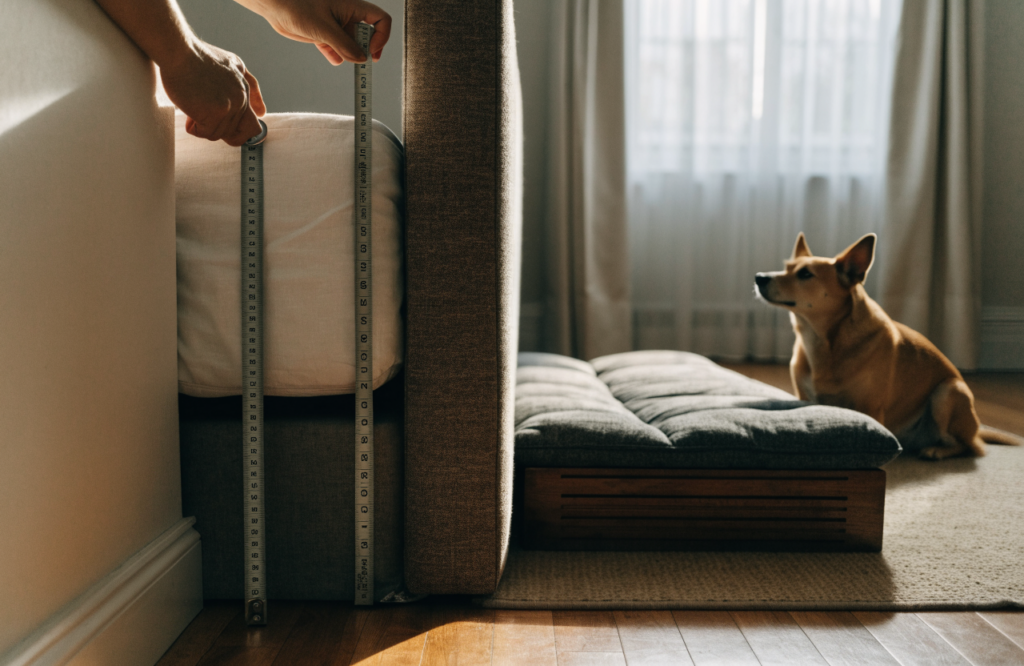
Use this as the decision list, in order.
- Floor-to-mattress height, and whether the product’s range actually hits it.
- Foot clearance or side clearance, including doors.
- Footboard or frame rails that would force a gap.
- Dog’s stretched length and weight against the product’s stated limits.
- A step or ramp if the dog is senior, small, or recovering from injury.
- A real anchor: straps, a tie to the frame, or a base that does not walk.
- A washable cover and a foam firmness you can live with if the dog rejects a hard surface.
- Whether the dog wants proximity or contact. Proximity can be solved with an extension. Contact usually cannot.
Renters should avoid anything that screws into the bed frame or the wall. A freestanding, strap-anchored unit is the reversible option. Homeowners who want a permanent look can build a platform to the exact mattress height and add stairs. Either way, the flush joint matters more than the finish.
Frequently asked questions
Will a bed extension stop my dog from kicking me?
Only if the dog stays on it. Owners who match the height and put the extension where the dog already likes to lie often get their legs back. Owners whose dogs insist on sleeping against a person usually do not. Watch where the dog settles in the first hour. That predicts the night better than the product photo.
Can I use it with a platform bed or an adjustable base?
Platform beds can be too low for fixed 14-inch frames unless the foam is thin, and thin foam is a poor match for a thick mattress. Adjustable bases move. A platform strapped or butted against a base that rises will open a gap or bind. A freestanding side sleeper with adjustable legs is the safer match, and only inside its stated height range.
Is this safe for a puppy or a very small dog?
A raised open platform is a fall risk. Use rails, a contained side sleeper, and a step. Do not rely on the dog “knowing” the edge in the dark. Puppies that are still being housetrained are also a reason to keep a waterproof layer on any foam you care about.
Do I still need stairs if the extension is flush?
Flush means the dog can walk from your mattress onto the extension. It does not mean the dog can get down from that height in the morning. Seniors, short-legged breeds, and dogs with back pain still need a ramp or steps to the floor.
Can two dogs share one extension?
A king-width foot extender can hold more than one small or medium dog if they already share space calmly. Two large dogs jumping onto a light metal frame is the scenario where owners report the unit shifting and end up tying it to the bed. Size the frame for the combined weight and for how they get on, not just for how they sleep.