
A dog bed for the end of the bed only works if it solves two problems at once: the dog has a place they will actually stay, and you can still walk past the foot of the bed, make the bed, and sleep. That usually means one of three setups — a low bed on the floor at the foot of the mattress, a defined bed on top of the mattress so the dog stops migrating toward the pillows, or a bench-style piece that looks like bedroom furniture and still gives the dog a usable sleeping surface. The right choice depends less on the product label and more on walkway width, mattress height, and whether your dog curls, sprawls, or needs help getting up.
Most failed purchases come from measuring the wrong thing. People size the bed to the dog’s weight, then discover the gap at the foot of the room is only 18 inches deep, or that a “large” bolster bed has a flat sleeping area closer to a medium. Start with the space, then size the sleeping surface to how the dog actually lies down.
Decide where the bed goes before you shop
The phrase covers three different jobs. Buying for the wrong one is the usual reason a bed ends up unused in a closet.
On the floor at the foot of the mattress
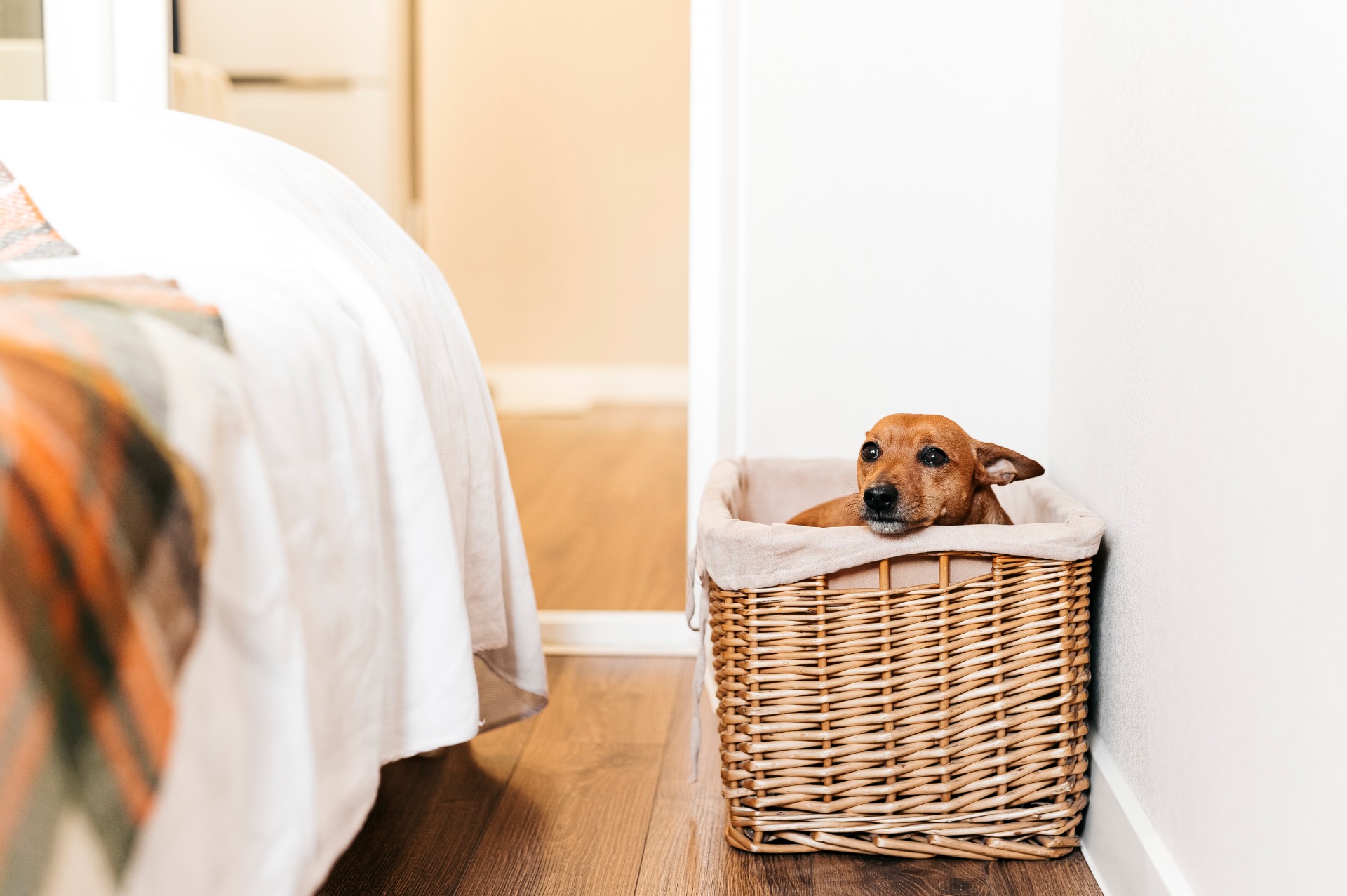
This is the most useful default. The dog stays in the room, close enough to see and hear you, without taking half the mattress. A rectangular orthopedic mat or a low bolster bed works here if the walkway can absorb the depth.
It fails when the bed is so deep that you have to sidestep it every morning, or so light that it slides across hardwood every time the dog turns. A non-slip base matters more in this spot than in a corner of the living room, because the bed sits in a traffic path.
On the mattress itself
Some dogs already sleep on the bed and crowd the sleeper by migrating from the foot toward the middle of the night. A bolster or nest-style bed placed at the foot can give them a boundary. Trainers who work with co-sleeping households sometimes suggest a designated bed on the mattress for small dogs, partly so they are not in the path of a person rolling over, and partly because very small dogs, puppies, and seniors can fall or get trapped in bedding.
A bed on the mattress only works if three things are true. The dog can get on and off safely. The bed stays put — a slick cover on a slick duvet will migrate. And the remaining mattress is still enough for the people sleeping there. On a full or queen, a medium bolster bed can eat the foot of the bed. On a king, the same bed often fits without a fight.
As an end-of-bed bench the dog can use
Furniture sold as an end-of-bed bench, storage ottoman, or crate bench is a different object from a dog bed. Seat height on many of these pieces lands around 17 to 21 inches. That can be a useful step for a dog who already jumps onto the human bed, or a sleeping surface for a small dog if you add a thin mat. It is a poor primary bed for a senior or a large sprawler unless the top is wide, firm, and low enough to step onto.
Crate-style benches with a padded lid are built for a dog to go inside, not to sleep on the cushion. Check the interior height and the door opening before treating one as a bedroom den. A storage ottoman with a tufted lid is not a dog bed until you put a washable, non-slip mat on it — and even then, the dog may slide off a curved or button-tufted surface.
Under the frame
A bed under the foot of the frame only works if the dog can stand, turn, and lie down without scraping the slats. Measure the clear height from floor to the lowest rail, then subtract the thickness of the dog bed. A 4-inch orthopedic mat under a 12-inch clearance leaves about 8 inches of headroom, which is tight for anything but a small, low dog. Center support bars and storage drawers often block the one spot that looked open in a photo.
Measure the walkway before you measure the dog
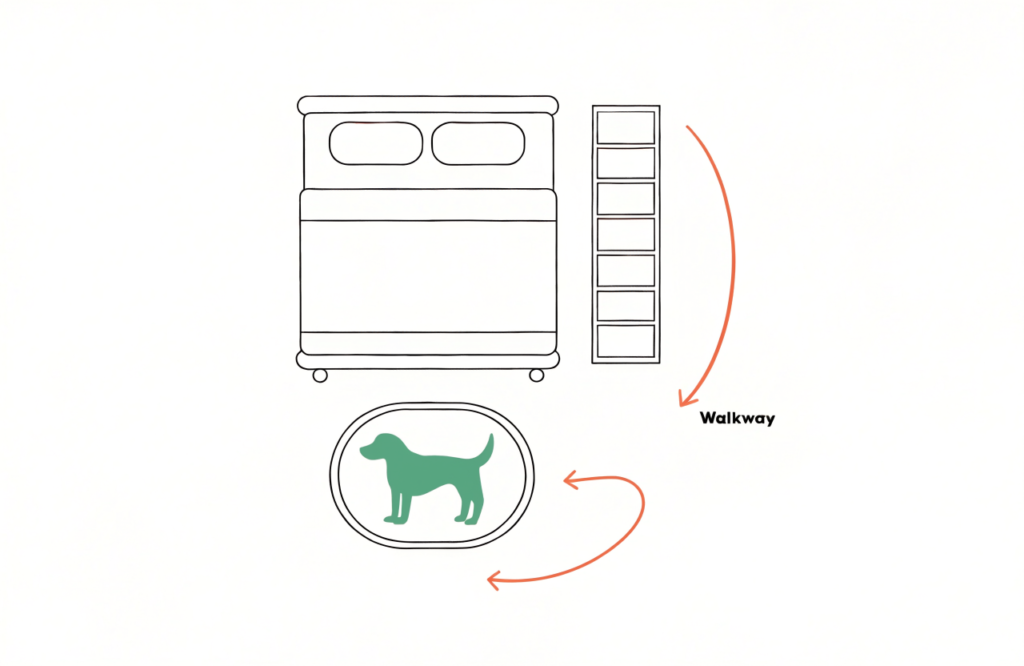
Standard mattress widths are a useful starting point: a twin is 38 inches, a full 54, a queen 60, a king 76, and a California king 72. The frame and footboard can add a few inches. The number that actually decides the purchase is the clear floor from the foot of the frame to the nearest wall, door swing, or dresser.
Bedroom-bench guidance from furniture buyers is a reasonable proxy. A bench is usually kept narrower than the mattress, often around two-thirds to three-quarters of the bed width, so the sides stay open. Anything under about 22 inches of depth from footboard to the opposite obstruction leaves little room, and you are in the slim-bench category whether you wanted to be or not. A typical large dog bed is 30 to 36 inches deep. That depth is comfortable for a Labrador and awkward in a small primary bedroom.
Leave a path you can walk in the dark. If the only route to the bathroom runs along the foot of the bed, a bolsters-on-all-sides bed becomes a trip hazard. A flat mat, or a bolster bed with the open side facing the room, is easier to step around.
| Bed size | Mattress width | Practical bench or bed width | Depth that still leaves a path |
|---|---|---|---|
| Full | 54 in | About 40–48 in | Under 20 in is tight; 14–18 in is safer |
| Queen | 60 in | About 45–52 in | 18–22 in if the room is shallow |
| King | 76 in | About 55–66 in | More forgiving; still measure the door swing |
Width can run across the foot of the bed. Depth is what steals the walkway. A 48-by-30-inch bed turned the long way can look balanced against a queen and still block the room. Turned the short way, it may fit the path and be too narrow for a sprawler.
Size the sleeping surface to the dog, not the label

Weight charts are a rough filter. The measurement that predicts whether the dog stays on the bed is length in a real sleeping position.
Measure from the tip of the nose to the base of the tail — not the tip of the tail — while the dog is lying down. Add about 6 inches for a dog who curls and stays tucked, and 10 to 12 inches for a dog who stretches flat. Guides from bed makers land in that same range, often 6 to 12 inches or 15 to 30 centimeters. If you are between sizes, size up. A slightly large bed can be made cozier with a folded blanket. A short bed cannot be fixed.
Width matters for side sleepers. Measure from the spine to the outstretched paws and leave room to roll. Older dogs shift more through the night, so a bed that fits them exactly at 8 p.m. is often too small by midnight.
Bolster beds shrink the usable area. Raised sides are part of the outer dimension. A bed marketed as 36 inches long may have only 28 to 30 inches of flat interior once the bolsters are counted. Size a bolster bed from the interior sleeping surface, and go up one size from what you would buy in a flat mat if the listing does not publish interior numbers.
Curlers can use a round or three-sided nest close to the diameter of the circle they make, plus a little margin. Sprawlers need a rectangle with at least one low or open side. A deep donut that looks secure in a product photo will be rejected by a dog who sleeps like a starfish.
Match the style to the sleeper and the room
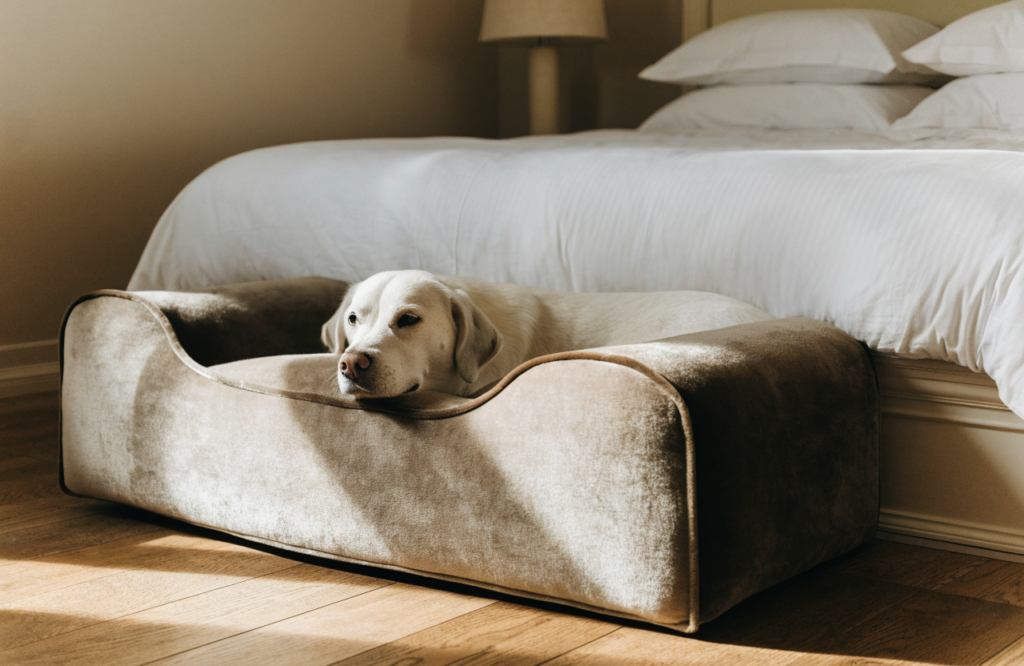
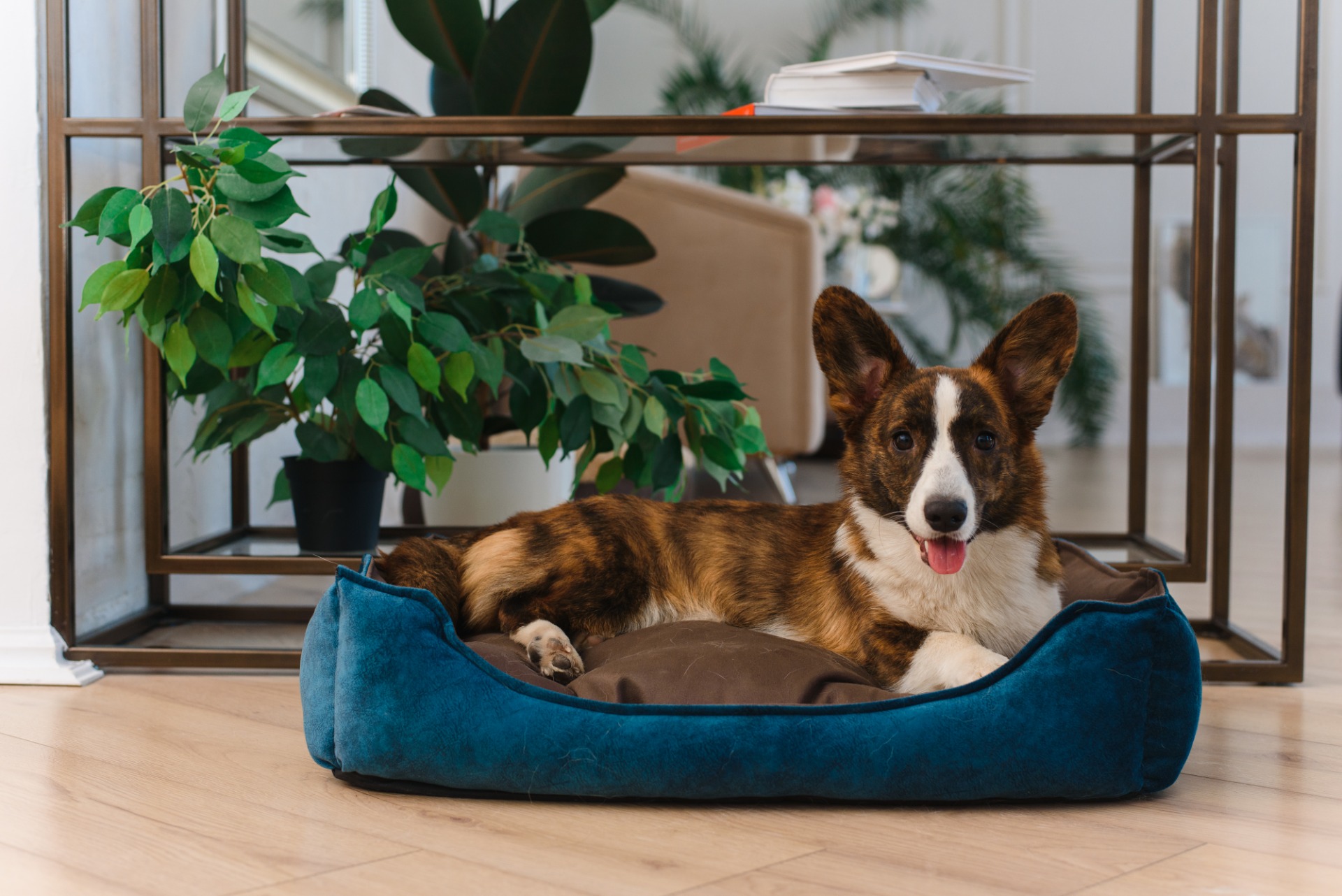
A bolster on one long side, or on three sides with a low front, is the most practical end-of-bed shape. The raised edge gives a chin rest and a visual boundary. The open side lets a stiff dog step in without climbing a wall. Full surround bolsters suit anxious curlers in a corner. At the foot of a bed they often just get in the way.
Flat orthopedic mats suit sprawlers, hot sleepers, and dogs who already have a favorite blanket they drag onto the bed. They also slide under a bench or partly under a frame more easily than a sofa-style bed. The tradeoff is less of a “this is your spot” edge, so some dogs treat them as optional.
Foam depth is the support question, not the word “orthopedic” on the label. Veterinary guidance for dogs with arthritis or hip pain favors thick, supportive padding on a solid surface, with easy entry, rather than a soft human mattress they have to climb onto. A common practical threshold in buying guides is about 4 inches of resilient foam for a medium dog and more for a heavy dog, with density high enough that the bed does not pancake in a few months. Egg-crate foam can relieve pressure points. Very soft memory foam that lets a heavy dog sink to the floor does not.
Elevated cots keep a dog off a cold or drafty floor and can suit a healthy dog who runs warm. They are a weaker choice for a senior who has to step up, and the mesh is less of a defined “place” at the foot of a bed, where you also want the bed to stay visually quiet.
Height is a joint question, not a style question
A human bed is often around 24 inches to the top of the mattress, and thicker mattresses sit higher. Small dogs have short legs. Veterinarians have pointed out that a jump down from a height several times a dog’s leg length is a real injury risk, especially for dachshunds, corgis, and other long-backed breeds, and for any dog with existing joint disease. VCA Animal Hospitals notes that dogs with musculoskeletal problems may struggle to climb onto a bed, and that aging joints are often better served by comfortable padding low to the ground.
If the dog already sleeps on the human bed and you want to keep that, a ramp or wide steps at the foot can lower the impact. Steps need treads deep enough for the whole paw, and a non-slip surface. Ramps need a gentle angle, which means length — a steep ramp in a short walkway is harder on the shoulders than a single low step. Many dogs refuse both until they are lured with treats over several days. A floor bed at the foot removes the jump entirely, which is the simpler fix for a senior who is starting to hesitate.
A bench used as a halfway step should be stable under the dog’s full weight plus a landing, not a lightweight storage cube. If the bench slides, the dog will stop trusting it.
Materials that survive a bedroom
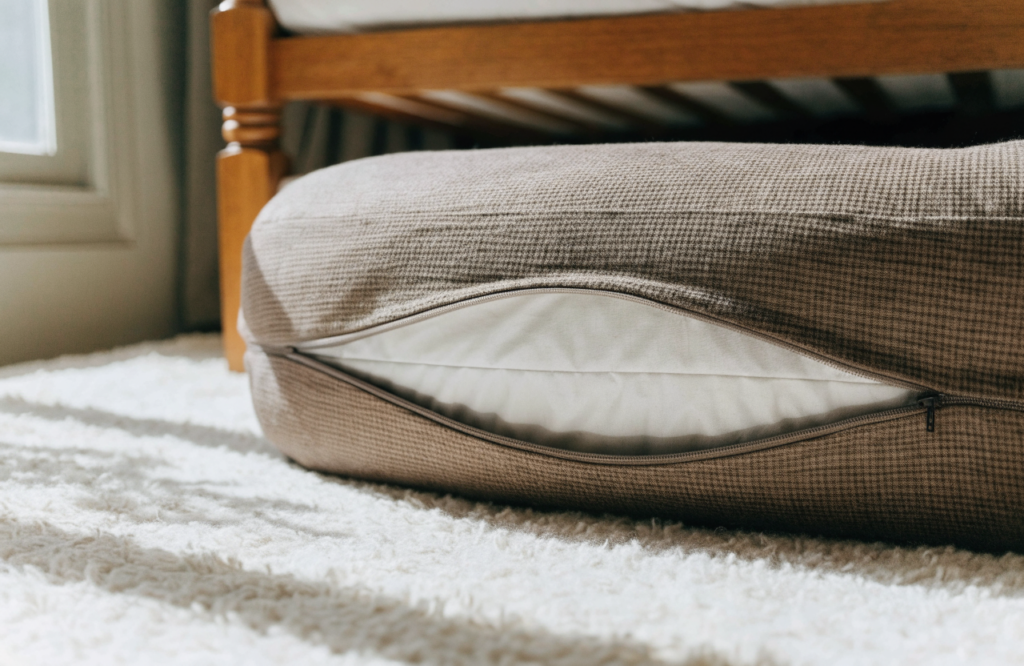
The foot of the bed collects hair, dust, and the occasional accident. Prioritize a removable cover you can machine wash, and a waterproof liner between the cover and the foam. A water-resistant outer fabric is not the same thing. Liquid that reaches memory foam usually means the bed is finished.
A non-slip bottom, or a separate rug pad under the bed, keeps it from creeping into the walkway. On carpet, rubber dots are often enough. On hardwood or a slick rug, they are not.
Color is the last decision. A mid-tone cover hides hair better than white and shows less lint than black. Match it to the duvet or the bench if the bed will be visible from the doorway. Avoid loose decorative piping if the dog chews edges. A heavy chewer will destroy a plush bolster long before the foam wears out. Canvas or a tighter weave lasts longer, at the cost of the nest feeling some dogs want.
Mistakes that make the setup fail
Buying from the weight chart alone. A 40-pound French bulldog and a 40-pound whippet need different lengths and different entry heights.
Trusting the outer dimension of a bolster bed. If the listing does not give the interior sleeping area, assume the bolsters steal several inches on each raised side.
Choosing a tall-walled bed for a stiff dog. High bolsters feel secure to a young curler and like a hurdle to a senior. A low front edge is the detail that decides nightly use.
Ignoring the door. A bed that fits when the door is open can block the door from closing, or catch the door every morning.
Putting a bed on the mattress with no reason for the dog to stay in it. A flat mat at the foot, with the rest of the bed still available, often loses. A bolster with a clear edge, plus a short routine of treating only in that bed for a week, gives the spot a job.
Using a storage bench lid as the bed. Button tufting, slippery faux leather, and a lid that lifts when the dog stands up are all reasons the dog will end up on the rug beside it.
If the dog will not stay in the new bed
Proximity usually beats luxury. A modest bed at the foot of your bed will outperform a expensive bed in another room for a dog who wants to be near you. Move an unwashed blanket or a T-shirt that already smells like the household onto the new bed for the first few nights. Feed a chew or a stuffed food toy only in that spot, and do not relocate the bed while the habit is forming.
Some dogs run hot and will sleep on the bare floor next to the bed no matter what you buy. That is a preference, not a failed purchase. A cooling mat or a flat orthopedic pad still gives joints a surface when they want it, without forcing a nest they reject.
If the goal is to stop the dog sleeping on the human bed, the floor bed has to be ready before you close the mattress off. Blocking access with no alternative in the same room is what sends many dogs onto the couch or into the doorway.
Questions people ask after measuring
Can a small dog use a bed meant for a larger dog at the foot of the bed?
Yes, if they can step in and the extra space does not make the bed feel insecure. A large flat mat is fine for a small sprawler. A large donut can feel too open. You can tighten a big bed with a blanket. You cannot stretch a small one.
Do I need a waterproof liner if my dog is house-trained?
It is still worth having. Older dogs leak when they lie down for long stretches, and a bedroom bed is harder to replace than a living-room bed once foam is soaked. The liner should sit under the washable cover, not as the only surface the dog feels.
Is an end-of-bed bench better than a regular dog bed?
Only if you also need a place to sit while putting on shoes, or a step up to the mattress. As a sleeper, a purpose-built dog bed with a washable cover and a flat or low-entry surface is usually the better night’s rest. The bench can sit beside or just beyond that bed if the walkway allows both.
How wide should the bed be compared with a queen or king?
Wide enough for the dog’s stretched length, and narrow enough that you still have a path. Against a queen, many households land around 42 to 52 inches of bed or bench width. Against a king, 50 to 60 inches still looks intentional without spanning the whole frame. Depth should be the number you refuse to compromise, not width.
Should a senior dog’s bed be on the floor or on the mattress?
On the floor, unless they can use a stable ramp or steps without hesitation and you are willing to keep that ramp in place every night. Low entry and firm support matter more than a spot on the duvet. A human mattress feels soft and does not replace an orthopedic surface for sore joints.