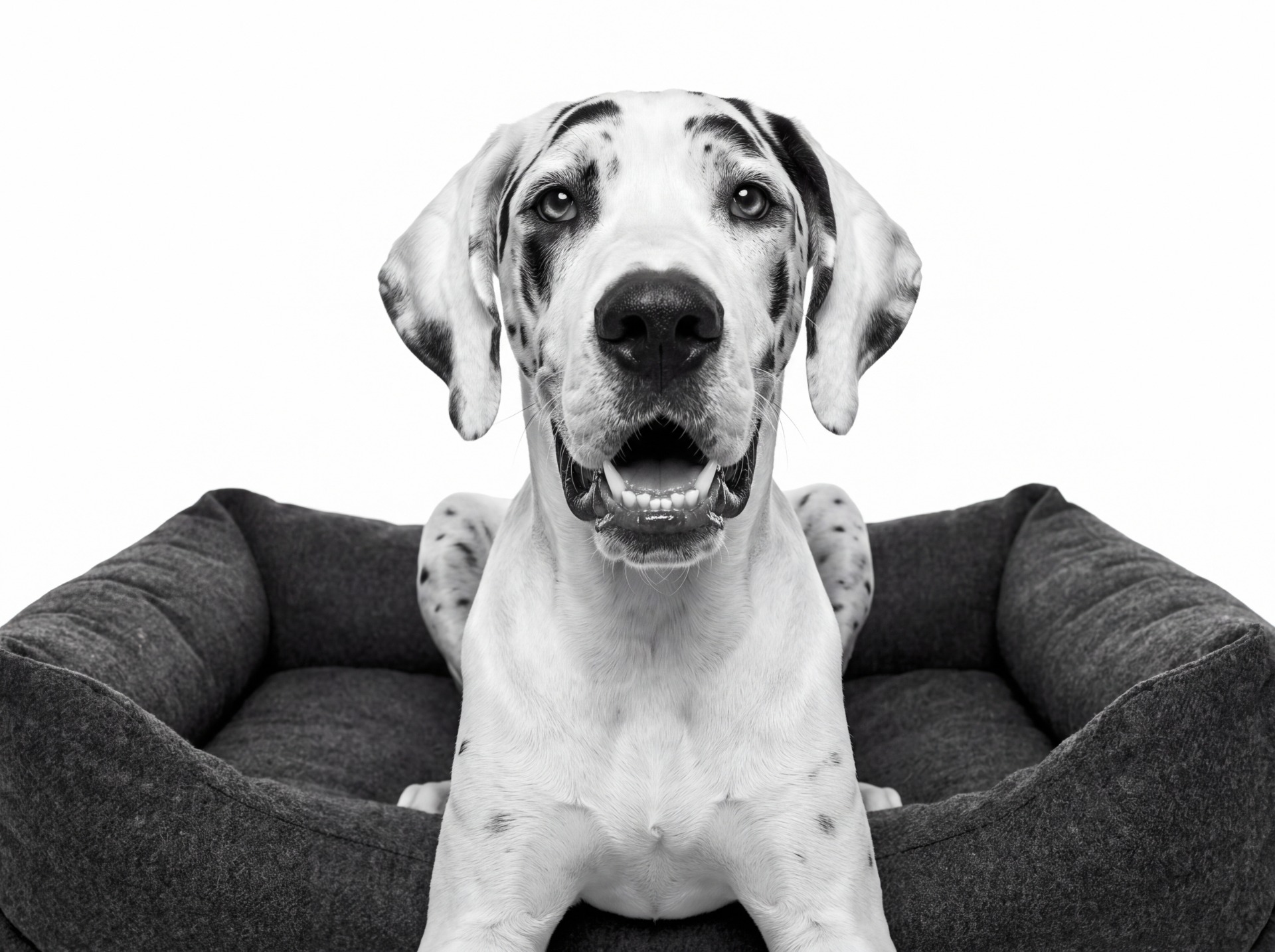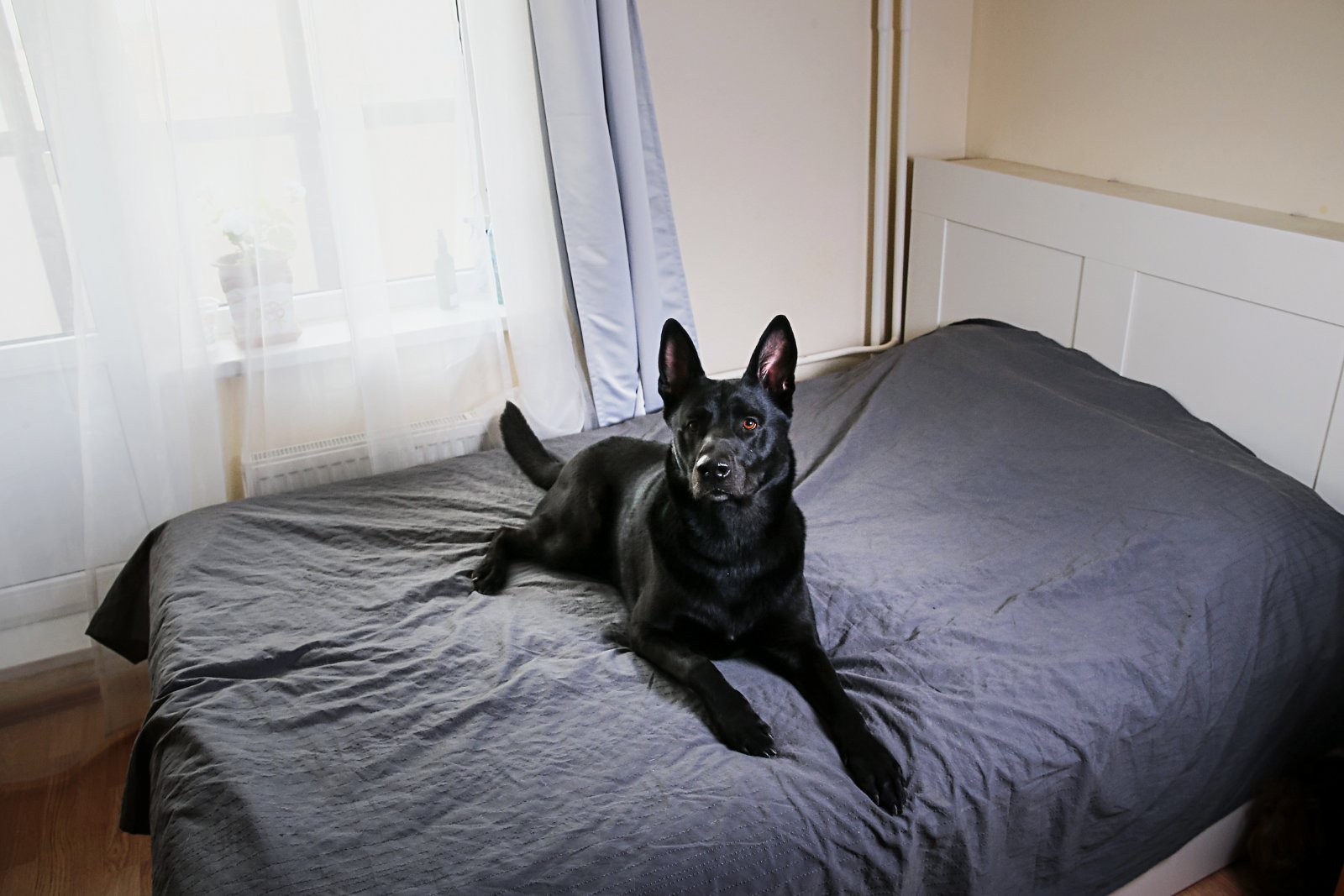

A big dog bed only works if two things are true at the same time: the sleeping surface is long enough for a full stretch, and the core is thick and dense enough that a 70- to 150-pound dog does not sink through to the floor. Most products labeled “large” or even “XL” are built for dogs in the 50- to 70-pound range. Put a Labrador, German Shepherd, or Great Dane on that bed and the foam compresses within weeks. The dog is then sleeping on a thin shell over hard flooring, which is the opposite of joint support.
Size labels are marketing. The useful measurements are your dog’s stretched length, the bed’s interior sleeping area, and the foam depth under the hip.
Measure the dog before you trust the label

Lie the dog in the position they actually use at night, not the one they hold for a photo. Stretch them nose to the base of the tail and note that length. Add 6 to 12 inches so they can turn and shift without hanging off the edge. Sprawlers and dogs that paddle in their sleep need the high end of that range. Curlers can live with a little less length, but large dogs often stretch in their sleep even if they start curled, so a bed that only fits the curl is still too small.
Width matters for dogs that sleep on their side with legs extended. Shoulder-to-shoulder, plus room for the elbows, is a better check than weight alone. A lean 80-pound sighthound and a stocky 80-pound Rottweiler do not need the same footprint.
Then compare those numbers to the interior sleeping surface, not the outer dimensions. Bolster beds publish a larger number because the raised rim is included. A bed listed as 48 by 36 inches can leave a usable center closer to 40 by 28 once the walls are counted. If the listing does not separate interior from exterior, assume the usable area is smaller than the headline size.
When a dog falls between two sizes, take the larger one. A folded blanket can make an oversized bed cozier. Nothing fixes a bed the dog cannot fully lie on.
What “big” actually means in inches
Retail size names are not standardized. These ranges are practical starting points based on weight and typical body length, not brand labels.
| Dog | Typical weight | Minimum sleeping surface | Foam depth to look for |
|---|---|---|---|
| Large (Lab, Golden, Boxer, Husky) | 50–75 lb | About 40 × 30 in | 4–5 in of solid foam |
| Extra-large (German Shepherd, large Lab, Rottweiler) | 75–100 lb | About 48 × 36 in | 5–6 in |
| Giant (Great Dane, Mastiff, Newfoundland, Irish Wolfhound, Saint Bernard) | Over 100 lb | 52 × 40 in or larger; long breeds need 54–60 in of length | 6–7 in or more |
Great Danes and Irish Wolfhounds are length problems first. Mastiffs and Newfoundlands are weight problems first. A bed that is long enough for a Dane can still bottom out under a 160-pound Mastiff if the foam is thin. The reverse is also true: thick foam on a short mattress leaves the hind end on the floor.
Crate pads are a separate measurement. The pad has to fit the crate floor, not just the dog. A 54-inch crate common for giant breeds will not accept a bed whose outer size is listed as 55 inches.
Foam that does not collapse under the hip
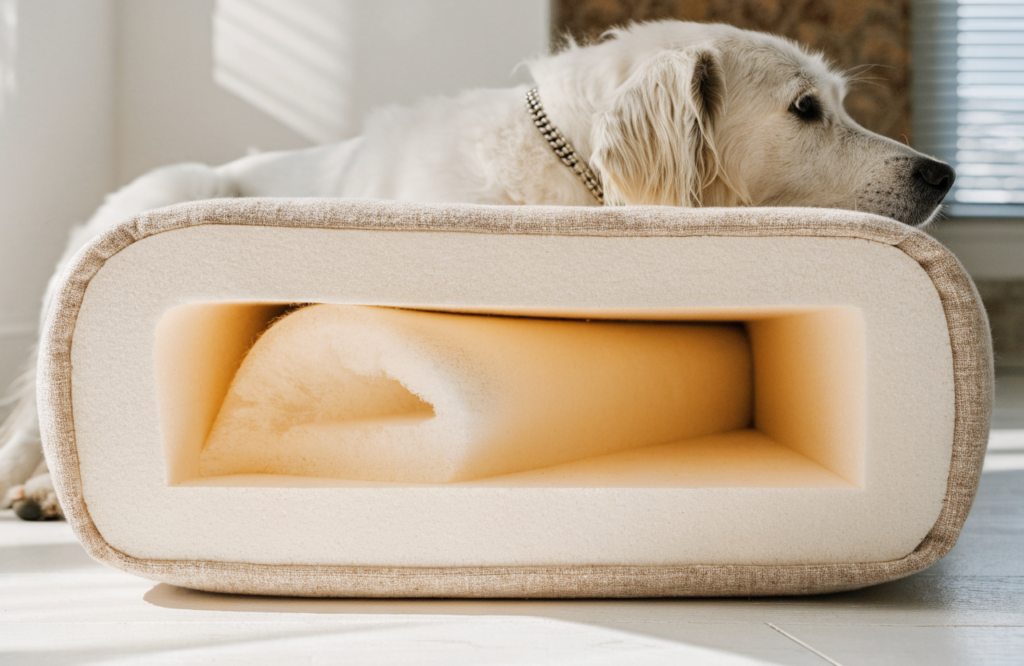
“Orthopedic” is not a regulated term. A bag of shredded foam with that word on the tag will feel plush in the store and pack down under a heavy dog within weeks. What holds a large dog up is a solid slab of high-density foam, sometimes topped with a thinner memory-foam layer, not polyfill and not chopped foam.
Depth is the number most listings actually publish, so use it:
- Under about 50 pounds, 3 to 4 inches can be enough.
- From 50 to 75 pounds, look for at least 4 to 5 inches.
- From 75 to 100 pounds, 5 to 6 inches is the practical floor.
- Over 100 pounds, 6 to 7 inches of dense foam is what keeps the dog off the floor after the top layer compresses.
Density predicts how fast foam flattens, but most dog-bed makers do not print pounds per cubic foot. Treat a missing density number as a reason to read the warranty instead. A warranty that only covers stitching defects does not protect you from sag. A warranty that names a flattening threshold, or that runs for several years against loss of shape, is a stronger signal that the foam was built for weight.
A simple check, in a store or on a return window: press the heel of your hand or a fist into the center as hard as you can. If you feel the floor, the dog’s hip will too.
Memory foam contours and can ease pressure on elbows and hips, but it also traps heat and can be hard for a stiff dog to push up from if it is very soft. A firmer high-density base with a thinner comfort layer often gives heavy dogs a stable surface to stand from. Gel-infused tops help hot sleepers; they do not replace thickness.
Match the shape to how the dog sleeps
Sleep style decides the silhouette more than breed charts do.
Bolster or nest beds suit dogs that lean into a wall, rest their head on a raised edge, or like a den-like boundary. Veterinary behavior work on shelter dogs has noted that many dogs prefer to sleep with their back against something. The tradeoff is entry. A tall bolster is a step a senior or dysplastic dog may not want to climb. Look for a low front opening if mobility is already limited.
Flat mattress-style beds suit sprawlers. The whole surface is usable, entry is level with the floor or only a few inches up, and there is no rim to hang a leg over. These are usually the better choice for giant breeds and for dogs that stretch fully on their side.
Elevated cots use a fabric sling or a chew-resistant surface on a frame, so air moves underneath. They suit hot climates, thick coats, and dogs that run warm on foam. Quality frames are rated for well over 100 pounds; cheap ones bend. A cot does not give the same pressure relief as a thick foam slab, so it is a poor sole bed for a dog with sore hips unless you add a pad the frame can carry.
Crate pads should be heavy enough that the dog cannot flip them, waterproof at the core, and sized to the crate floor. Light pads become digging toys. A full mattress that does not fit the crate is not a solution; it becomes an obstacle.
Covers and liners decide how long the foam lasts
Large dogs shed, drool, track dirt, and sometimes leak. A washable cover is the minimum. A waterproof liner between the cover and the foam is what keeps urine, drool, or a wet coat from soaking the core. Once foam is wet inside, it smells and breaks down, and no amount of surface cleaning fixes it.
Prefer a zipper that is covered by a flap. Exposed zippers are the first thing many dogs mouth. Machine-washable covers matter more for heavy shedders than stain-resistant marketing; hair has to come out in the wash, not sit in the fabric. Non-slip bottoms keep the bed from skating on hardwood when a big dog stands up.
Cooling covers and raised beds help double-coated breeds in summer. In winter, a washable blanket on top of the same supportive base is usually better than switching to a plush bed with no structure.
When the dog destroys beds
A foam bed is not a chew toy. Determined chewers will open ordinary covers and pull the fill out in days. Training and exercise still matter, but the product category changes: look for ballistic or ripstop nylon, reinforced seams, hidden zippers, and a stated chew warranty that says what happens if the cover is breached. Elevated aluminum-frame beds remove most of the material a dog can grab.
Those beds trade some cushion for survival. A young power chewer is often better on a tough cot until the habit eases, then moved to a thick orthopedic bed. Spending on premium foam before the chewing stops usually means replacing both.
Seniors and dogs with sore joints
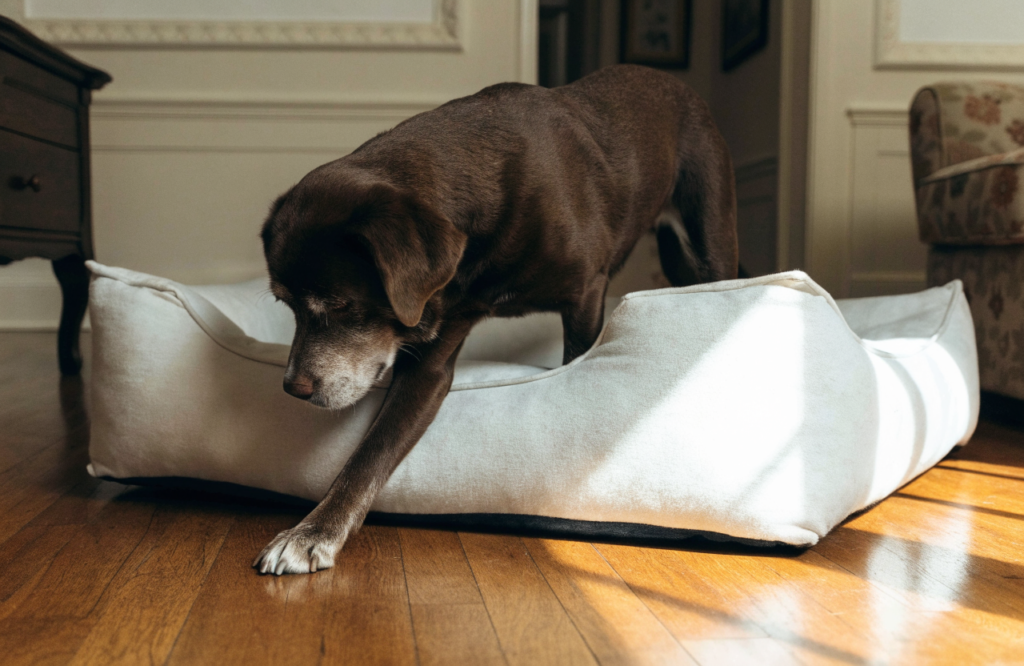
Large and giant breeds are more prone to hip dysplasia, elbow disease, and arthritis than small dogs. A bed does not treat those conditions. It can reduce the hours spent on a hard surface.
For a stiff dog, three details matter more than a soft top: foam that does not bottom out under the hip, a low entry so the dog does not have to hop, and a stable surface to push off from. Very soft memory foam can make standing harder. Place the bed on a non-slip floor, away from drafts, and keep water close so the dog is not crossing the house on sore joints for every drink.
Hard floors are the worst default. Even a basic solid pad is better than tile for a dog with hip pain. Replace the bed when the center stays compressed after the dog gets up; a flattened orthopedic bed has already stopped doing its job.
Mistakes that make a big dog bed fail early
- Buying by the word “XL” instead of interior inches and foam depth.
- Choosing shredded fill because it feels softer in the listing photo.
- Ignoring sleep style and getting a high bolster for a dog that only sprawls, or a flat pad for a dog that only rests with a head on a rim.
- Skipping the waterproof liner and then throwing out a soaked foam core.
- Putting a chew-grade dog on a plush bed and treating destruction as a defect.
- Sizing a crate pad to the dog instead of the crate.
- Assuming a cooling cot replaces support for an arthritic giant breed.
Price tracks foam quality more reliably than it tracks looks. A mid-price bed with 4 inches of egg-crate foam can be reasonable for a young, healthy 60-pound dog and a poor buy for a 110-pound senior. The expensive failure mode is a thick bed that is still too short.
A buying checklist
- Measure nose to tail base while stretched, then add 6 to 12 inches.
- Match that length to the interior sleeping surface.
- Confirm solid foam depth for the dog’s weight, not a shredded fill.
- Press the center. If you feel the floor, move on.
- Pick bolster, flat, or elevated based on how this dog sleeps and how easily they stand.
- Require a removable washable cover and a waterproof liner.
- For chewers, switch to a reinforced or elevated bed until the habit is under control.
- Read what the warranty actually covers: shape loss, or only seams.
Frequently asked questions
Is a human mattress a reasonable big dog bed? A firm guest mattress or a thick foam topper on a low platform can work if it is protected by a waterproof encasement and the dog can get on and off without jumping. It takes more floor space and is harder to wash than a dog bed with a removable cover. It is a practical option when commercial giant sizes still come up short.
Do two large dogs need one shared bed? Only if the interior surface fits both stretched bodies at once. Most “shared” setups are one dog on the bed and one on the floor by morning. Two correctly sized beds usually work better than one oversized bed they compete for.
How often should a big dog bed be replaced? When the hip spot no longer rebounds, when the cover cannot be cleaned, or when the dog starts avoiding it. Quality solid foam can last several years. Thin or shredded beds under dogs over 70 pounds often flatten in months.
Are cooling beds better for big dogs? They help dogs that overheat on foam, especially thick-coated breeds in warm rooms. Cooling gel or an elevated frame does not replace support. A hot, sore dog needs airflow and a surface that still holds the joints up.