A dog bed mat sold for a “36-inch crate” is cut for the outside frame, not the tray the dog actually lies on. Pads that match the label often bunch in the corners, and that fold is what many dogs dig at first. The useful version of this product is a low, rectangular sleeping surface—crate, car, or floor—whose footprint matches the space and whose fill matches how long the dog stays on it.
Retailers use “mat,” “pad,” and “crate bed” for the same rectangle. Animals Matter’s crate-pad guide draws a practical line: a mat is a thin floor cover for a dog that runs warm or only naps; a pad has a supportive core and is what most dogs need if they sleep in the crate overnight; a crate bed adds bolsters and only works if the crate still has room to turn. In listings those names overlap. What matters is thickness, fill, and whether the cover comes off.
That overlap also hides a different product. Absorbent entry mats catch mud at the door. They are not sleeping surfaces, and a sleeping mat will not stop a wet dog from tracking water across the hall. Buy for the job.
Size the mat to the floor it sits on
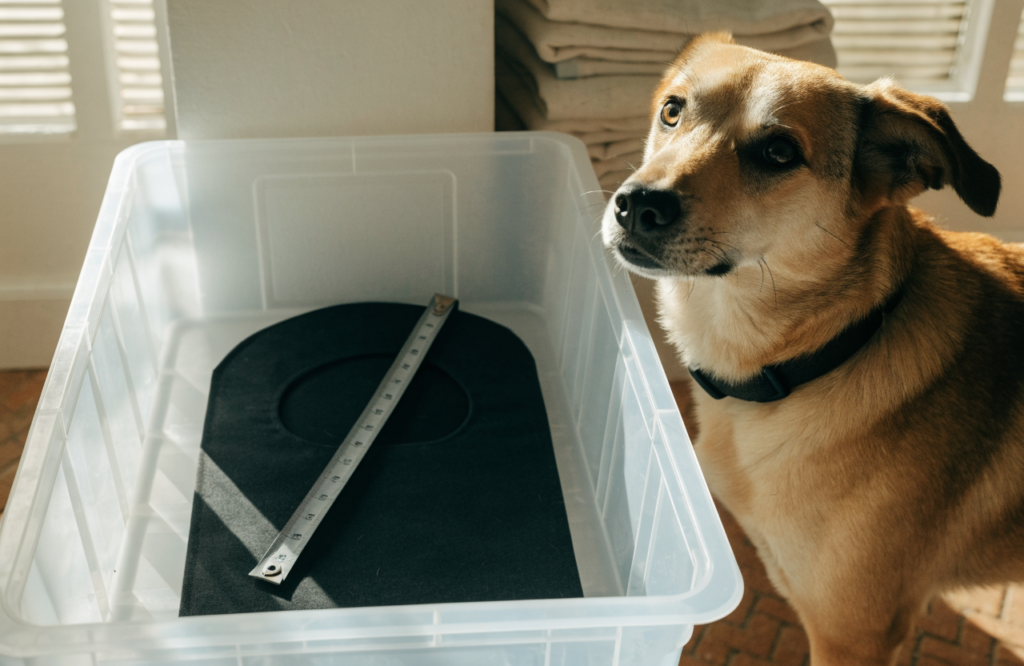
For a crate, measure the inside of the tray at its narrowest points, including any lip or divider. The number on the box is the outer frame. Published charts from pad makers land in the same neighborhood: a 24-inch crate usually takes about 18 by 24 inches, a 30-inch about 21 to 22 by 30, a 36-inch about 24 by 36, a 42-inch about 26 to 28 by 42, a 48-inch about 30 by 48, and a 54-inch about 37 by 54. Molly Mutt’s crate-pad size guide uses that pattern, and Animals Matter’s own pads follow the same crate lengths at 18 by 24, 22 by 30, 24 by 36, and 26 by 42. Widths still vary by crate brand, so check both dimensions before ordering.
If you are between sizes, go slightly smaller. A pad an inch or two short lies flat. A pad that is long rides up the walls, leaves a gap under the fold, and gives a bored dog a corner to chew. The dog should still be able to lie on a side with the legs on the pad, not hanging onto the plastic.
Thickness steals height. A 3-inch pad in a crate sized with little spare headroom can leave a tall dog ducking. The dog still needs to stand, turn, and sit without the ears brushing the top. If the only pad thick enough for a senior dog kills that clearance, the fix is a larger crate, not a thinner pad and sore elbows.
Outside a crate, measure the dog, not the furniture. Nose to the base of the tail in the position they actually sleep, then add several inches so a stretch does not push the hips onto the floor. Weight charts are a rough filter only. A long, light sighthound and a stocky bulldog of the same pounds need different rectangles.
Match the fill to how long the dog stays down
Loose fiber fill feels soft in the store and flattens under a medium or large dog within weeks. Solid foam and egg-crate foam keep a shape longer, which is why crate-pad comparisons keep coming back to a real core instead of stuffing. A layered pad—a softer top over a denser base—cushions the hard tray without the whole thing bottoming out. Animals Matter describes that idea as support mattering more than loft: the crate floor is rigid, so a thin pretty cover does less for joints than a pad that does not collapse.
Thickness has a ceiling on a mat. Many crate pads sit around 2 to 3.5 inches. That is enough to stop direct contact with plastic or tile for a healthy adult, and egg-crate foam in that range is a common “orthopedic” claim on crate mats. It is not the same as a full memory-foam bed of 4 inches or more, which has room for a firm base plus a contouring layer and is easier for a heavy, arthritic dog to rise from. If the dog is stiff getting up, avoids the crate, or has a diagnosed joint problem, a low mat is a floor barrier, not a treatment. A veterinarian is the right person to say whether the dog needs a deeper bed, a ramp, or something else entirely.
Cooling mats are a third category, and they are easy to confuse with supportive pads. Pressure-activated gel mats feel cooler when the dog lies down because the gel takes up body heat, then warm toward room temperature. NBC Select’s cooling-bed roundup notes that The Green Pet Shop’s mat, recommended there by a trainer, recharges after about 15 to 20 minutes unused and can stay cool for up to three hours depending on conditions. That model is listed at 23.6 by 35 inches with an 80-pound weight limit, and it is wipe-clean, not machine-washable. The same piece of reporting is clear that these mats are not supportive. Gel-infused foam beds cool less dramatically but hold a dog up. Neither replaces shade and water on a hot day.
Self-warming mats are the opposite tradeoff: a reflective layer that returns body heat, with no cord. Useful for a short-coated dog in a cold crate or car, pointless for a thick-coated dog that already seeks tile.
When a soft mat is the wrong object
Chewing is the failure mode product photos skip. On owner forums, Labs, Malinois, and huskies shred crate pads while left alone, and the worry is not the ruined cover—it is foam or gel in the stomach. A few patterns show up repeatedly. Fiber-fill and faux-fur covers are easier to open than a solid foam slab in a tight weave. Beds left in the crate all day get destroyed more often than bedding offered only at night. Elevated cots, with no stuffing to pull, survive dogs that ruin every mattress. Brands such as K9 Ballistics sell chew-resistant crate pads with tie-down points; owners of determined chewers cite those more often than plush “indestructible” listings.
Until the habit fades, the safer setup is an empty crate or a bare pad you can see, not a plush mat behind a closed door. Supervise any new bed. If the dog punctures a gel cooling mat, retire it. Makers call the gel non-toxic, but a torn mat is still a foreign-body risk, and patching it does not put the seal back.
Puppies in house training have a different problem. A thick bed that soaks an accident has to come out of rotation, and owners on puppy boards end up swapping to a thin mat or towel they can change in a minute. A waterproof liner under a removable cover is what keeps the foam out of that cycle. Seniors who leak at night need the same liner; softness without a barrier just hides the mess inside the pad.
Dogs that curl and lean sometimes ignore a flat mat and settle only when there is a bolster to push against. A bolstered crate bed works if the crate is large enough that the raised edge does not block turning. If it is not, a folded blanket on the mat gives a nest without a permanent rim. The AKC’s blanket guide notes that an extra layer helps short-coated and stiff senior dogs, and that a blanket is easier to wash and pack than the bed under it.
Features that decide whether you still use it in a month
A zipper that actually releases the cover matters more than the fabric on top. If the cover does not come off, every accident or shed season means replacing the whole mat. Machine-wash the cover cold and skip high dryer heat, which melts waterproof films and shrinks fleece. Spot-clean the foam core and let it dry fully before the cover goes back on; a sealed liner cannot be thrown in the washer.
Look for that liner if the mat lives in a crate, a car, or under a dog that drools. Non-skid backing matters on hard floors and in a wire crate, where a sliding pad bunches the same way an oversized one does. Corner straps or ties are worth it in a crate the dog circles in. Hidden zippers and reinforced edges last longer around a light chewer than quilted seams that offer a thread to pull.
Care is dull and decisive. Shake out hair before washing. Do not soak foam. Replace the mat when the core stays compressed after the dog gets up, or when the liner cracks. A flat pad is no longer doing the job the crate floor required.
Price is a weak guide. Petmate’s SnooZZy kennel mats, sold for crates, cars, and loose use around the house, run from about $13 for a simple quilted pad to about $45 for a faux-sheepskin bolster style. A $40 plush pad with no zipper will cost more over a year than a simpler foam pad whose cover survives the washing machine.
Where a mat earns a place, and where it does not
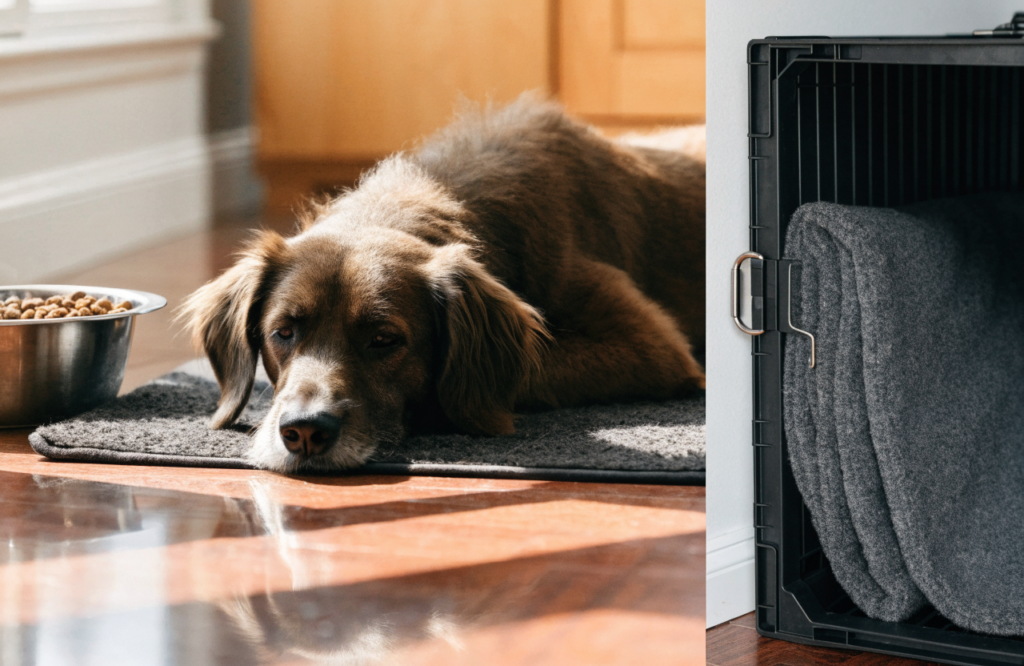
In a crate, the mat’s job is to cover a hard tray so elbows and hocks are not on bare plastic for hours. Owners of young, active dogs sometimes notice fur worn off the elbows after weeks on an empty pan; a pad is the direct response, provided the dog will not eat it. For daytime crating of a chewer, skip it. For overnight sleep of a calm adult, a 2- to 3-inch foam pad with a washable cover is the usual fit.
In a car, a low mat with a waterproof back protects the seat and gives the dog a defined spot. It should not be thick enough to raise the dog into the window line or loose enough to slide under braking. Kennel-mat makers, including Petmate, market the same pads for road trips for that reason.
On a floor at home, a mat is a portable bed for a dog that already sleeps flat, a summer cooling layer on top of a winter bed, or a spare for guests. It will not stop a dog from claiming the couch, and it is the wrong tool at the door. Hot dogs often prefer tile; forcing a thick foam mat on them in July just means an unused rectangle in the corner. Offer the cooling mat beside the regular bed and let the dog choose.
Which mat to buy for this dog
Choose a thin, waterproof, easy-swap pad if the dog is a puppy still having accidents or a chewer you cannot supervise. Choose a 2- to 3-inch foam or egg-crate pad with a removable cover if a healthy adult sleeps in the crate or the car. Choose a deeper orthopedic bed, not a mat, if the dog is heavy, stiff, or slow to rise and the crate can spare the height—or move the deep bed outside the crate. Choose a pressure-activated cooling mat only as a seasonal add-on for a dog that seeks cold floors, and only if that dog does not chew. In every case, buy to the measured floor, a little short rather than a little long.
Questions owners ask after the first pad fails
Why does my dog dig at the new mat? Usually the pad is long, so a corner stands up, or the fill is loose and fun to scratch. Refit it so it lies flat, strap the corners if the crate allows, and take it out when you cannot watch a dog that already shreds bedding.
Can I put a dog bed mat in the washing machine? Wash the cover if it unzips. The foam core is spot-clean only. A mat with no removable cover can sometimes be washed on gentle, but waterproof layers and glued foam often separate after a few cycles.
Is a cooling mat safe to leave out all day? Only if the dog does not chew and the room is not the dog’s only heat plan. Gel mats are a comfort surface. A puncture means the mat is done, even if the maker calls the filling non-toxic.
Do I need a mat if my dog prefers the floor? Not for comfort. Some dogs, especially thick-coated ones, sleep colder on purpose. A mat is for the crate tray, the car seat, or a joint that should not meet bare plastic for long stretches—not for overriding a dog that is already comfortable.