Dog stairs for a bed only work if the top step meets the mattress and each rise is short enough for that dog’s legs. Most standard beds sit about 20 to 30 inches from the floor to the top of the mattress, pillow top included. A unit that stops several inches short simply replaces one jump with a smaller one. The useful choice is not the tallest staircase in a product photo. It is the one whose height, step rise, width, and weight rating match the bed and the dog, and that stays put when the dog lands on the first step.
Jumping off a mattress loads joints and, in long-backed breeds, the spine. Stairs cut that drop, but they still ask the dog to flex hips, knees, elbows, and back on every step. For some dogs that trade-off is fine. For others a ramp, or a lower sleeping spot, is the safer route.
When bed stairs help, and when a ramp is safer
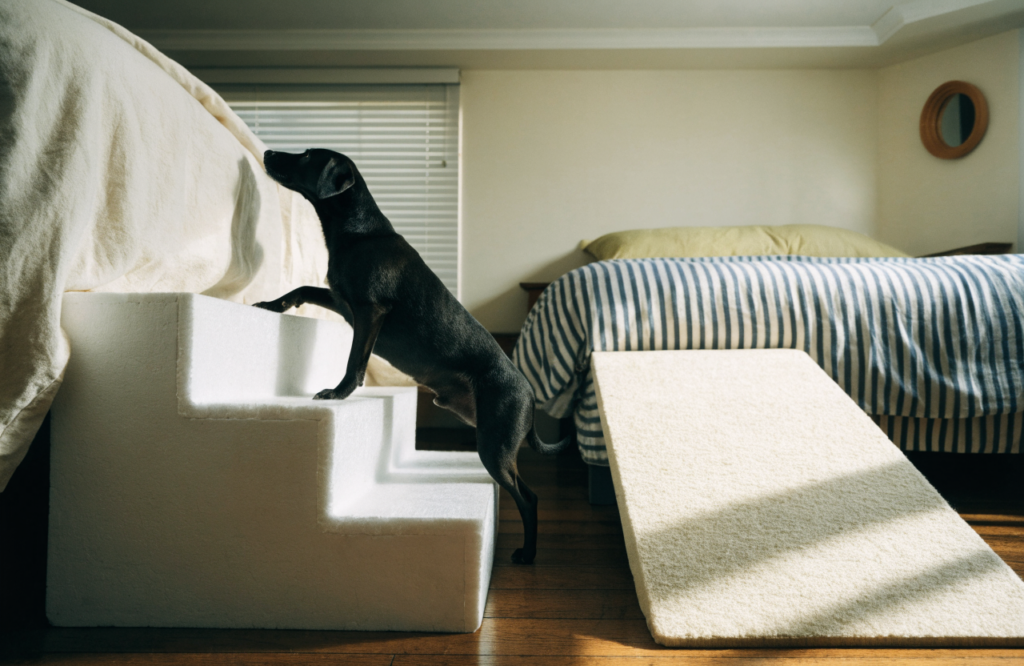
Stairs are a space-saving way to close the gap between floor and mattress. They usually need only 1.5 to 3 feet of floor depth. A ramp long enough for a gentle slope to a 24-inch bed often needs 5 to 6 feet. In a small bedroom, that footprint difference decides the purchase before joint theory does.
Veterinary guidance treats the two options differently. Stairs still require the dog to step up, which loads legs and joints. A ramp lets the dog walk a mild incline with less impact. Small, coordinated dogs generally do well on stairs. Medium and large dogs, and any dog with arthritis or an existing joint or back problem, are usually better served by a ramp.
Dogs that usually do well on stairs
Stairs are a reasonable fit when the dog is still placing each paw confidently, the bed is not extremely high, and the room cannot take a long ramp. A young or middle-aged small dog that already uses household stairs is the clearest case. Mild stiffness in an otherwise steady dog can also work if the rises are low and the treads are deep.
Dogs that should start with a ramp
A ramp is the better first discussion if the dog has arthritis, hip dysplasia, hind-leg weakness, poor balance, or a back condition such as intervertebral disc disease (IVDD). That last group includes many dachshunds, corgis, and French bulldogs. Going down is often the harder direction: the forward pitch compresses the spine more than climbing does. PetMD notes that ramps add little impact compared with stairs, and recommends them over stairs when arthritis or a pre-existing joint or back condition is already present. If the dog is recovering from orthopedic or spinal surgery, follow the veterinarian’s restriction rather than a product label. Some recovery plans ban stairs entirely.
If a properly sloped ramp will not fit, the practical alternatives are a lower bed, a dog bed on the floor, or a lift harness for the trips you still allow. A steep ramp is not a compromise. It is a slide.
Measure the bed before you look at step count
Measure from the floor straight up to the top of the mattress, including any topper. Do not stop at the frame or box spring. That single number is the height the stairs have to serve.
The top step should land at the mattress edge, or within about one normal step of it. A gap of several inches puts the jump back in. A unit taller than the mattress forces an awkward step down onto the bed or a hyperextended last stride. If you are between sizes, a slightly taller set with the correct rise is usually safer than a short set that reintroduces a leap, as long as the top step does not sit well above the mattress.
Step count is a poor shopping filter on its own. A “3-step” model might top out near 17 inches. A “5-step” model might reach the low 30s. Read the listed total height, then divide by the number of steps to estimate the rise.
Typical matches, not rules:
- Low platform beds and many sofa seats, about 14 to 18 inches: often a 2- or 3-step unit.
- Common beds, about 20 to 25 inches: often 3 to 5 steps, depending on rise.
- Tall or pillow-top beds, about 26 to 30 inches: often 4 to 6 steps, or a ramp if the dog’s joints will not tolerate that many rises.
High beds are where foam units run out of height and wood or plastic frames show up. Confirm the spec. “High bed” in a title is not a measurement.
Match the rise, tread, and width to the dog
Rise is the vertical gap between steps. It matters more than the color of the cover. Commercial bed stairs commonly use rises around 4 to 7 inches. About 7 inches is a typical figure sold for medium and large dogs. Short-legged, senior, and stiff dogs do better toward the low end of that range, or below it. A 7-inch rise that a young Lab tolerates can be a haul for a dachshund, a toy breed, or an arthritic spaniel.
Tread depth should let the dog place its feet without hanging off the nosing. Deep treads, roughly 10 inches or more, give small dogs room to stand and larger dogs room to commit to the step. Narrow treads are a frequent reason long-bodied dogs climb partway and then refuse. Width matters the same way: a staircase barely wider than the dog’s chest feels unstable, especially on the way down, when the dog cannot see its hind feet the way a person can.
Side bolsters or a slight curve can help a hesitant dog stay centered. They do not fix a rise that is too tall.
Foam, plastic, or wood: what holds up next to a bed
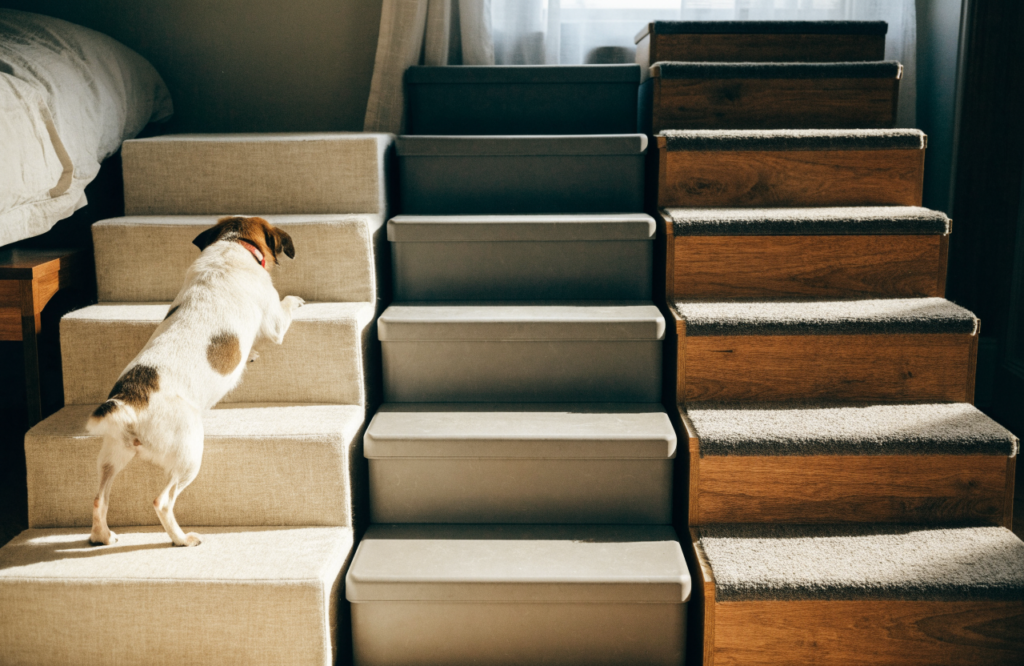
Foam is the default bedroom product because it is quiet, light, and softer on landing. High-density foam (often sold around 30D to 35D) resists collapsing better than soft craft foam. Removable, washable covers matter once the stairs live in the path from yard to bed. The weakness is capacity and stability. Budget foam is often rated somewhere in the 50- to 150-pound range, and a rating is a static claim. A dog coming down with momentum loads the front edge harder than a dog standing still. Soft foam that compresses and rocks teaches the dog not to trust the route after one bad step.
Plastic and wood frames usually hold more weight and slide less if they have real rubber feet, not a printed texture. They are harder underfoot and noisier. Carpet or a grippy tread fixes some of that. Hollow plastic that skates across hardwood is a common refusal trigger: owners report dogs avoiding plastic or slick wood until a towel, rubber shelf liner, or foam unit gives them traction.
A practical capacity check is to stay well under the stated limit, on the order of 25 percent if the dog is athletic or the stairs are foam. A 70-pound dog does not belong on a unit rated to 70 pounds. Giant breeds generally need a rigid frame, not a light foam stack.
Non-slip has two jobs. The underside must grip the floor so the unit does not walk away on the first step. The treads must grip paws, including at night when the dog is half asleep. Rubber feet and a textured cover do more than a “non-slip” sentence in the listing.
Place the stairs and teach the route
Put the stairs where the dog already tries to get up, usually the side or the foot, tight against the mattress so there is no gap to jump. On hard floors, add a rug under the base if the feet still creep. On thick carpet, a light unit can rock; a heavier frame is more predictable.
Most dogs need a short training sequence, not a single demonstration.
- Leave the stairs in place and reward any investigation, with the dog on a leash if it tends to leap past them.
- Lure one step at a time with a treat on the tread, then a treat on the bed. Keep sessions short.
- Practice the way down before the dog invents a jump off the far side. Down is where slips and back strain show up.
- Fade the treats once the dog uses the route without prompting. Glow tape on the nosings helps dogs that misjudge steps in the dark.
Some dogs refuse for weeks. Slippery treads, a unit that shifts, steps that are too narrow for a long body, or a rise that feels like a hop are the usual reasons, not stubbornness. If the dog has already slipped, expect a longer rebuild. One bad landing can undo several calm sessions.
Problems that make dogs refuse bed stairs
- The top step stops short of the mattress, so the dog still has to jump.
- The rise is fine for a person and too tall for that dog’s legs.
- The unit slides on wood or tile the moment weight hits the first step.
- Plastic or worn carpet is slick, especially on the way down.
- Foam compresses under a dog near the weight limit and feels unstable.
- Treads are too narrow for a long-backed breed, so the hind feet miss the step.
- The ramp alternative that was tried was short and steep, so the dog slid and now distrusts both.
- The dog is painful. Hesitation, a changed gait, or crying when lifted is a veterinary question, not a training problem.
A dog that jumps over the stairs has usually decided the stairs are less reliable than the jump. Fix stability and traction before adding more treats.
Frequently asked questions
How tall should dog stairs be for a bed?
As tall as the mattress surface, measured from the floor to the top of the mattress, with the top step meeting that edge or sitting within one easy step of it. Step count does not answer the question. Total height and rise do.
Are foam stairs better than wood?
For a small or medium dog in a bedroom, dense foam is often quieter and kinder on landing. For a heavy dog, or any floor where light stairs skate, a wood or rigid plastic frame with rubber feet is more stable. Neither material fixes a rise that is too steep.
Can senior dogs use bed stairs?
Many can, if the rises are low, the treads are deep, and the unit does not move. Dogs with clear arthritis, weakness, or back disease are usually better on a ramp, which avoids repeated joint flexion. PetMD’s guidance is to involve a veterinarian when mobility is already limited, and to expect an adjustment period.
What if my dog still will not use them?
Check for slide, slick treads, a gap at the mattress, and steps too narrow for the dog’s length. Cover slick plastic, weigh or brace a light unit, and retrain one step at a time. If the dog is also reluctant to jump onto the couch or climb household stairs, have a veterinarian check joints and spine before you keep shopping.