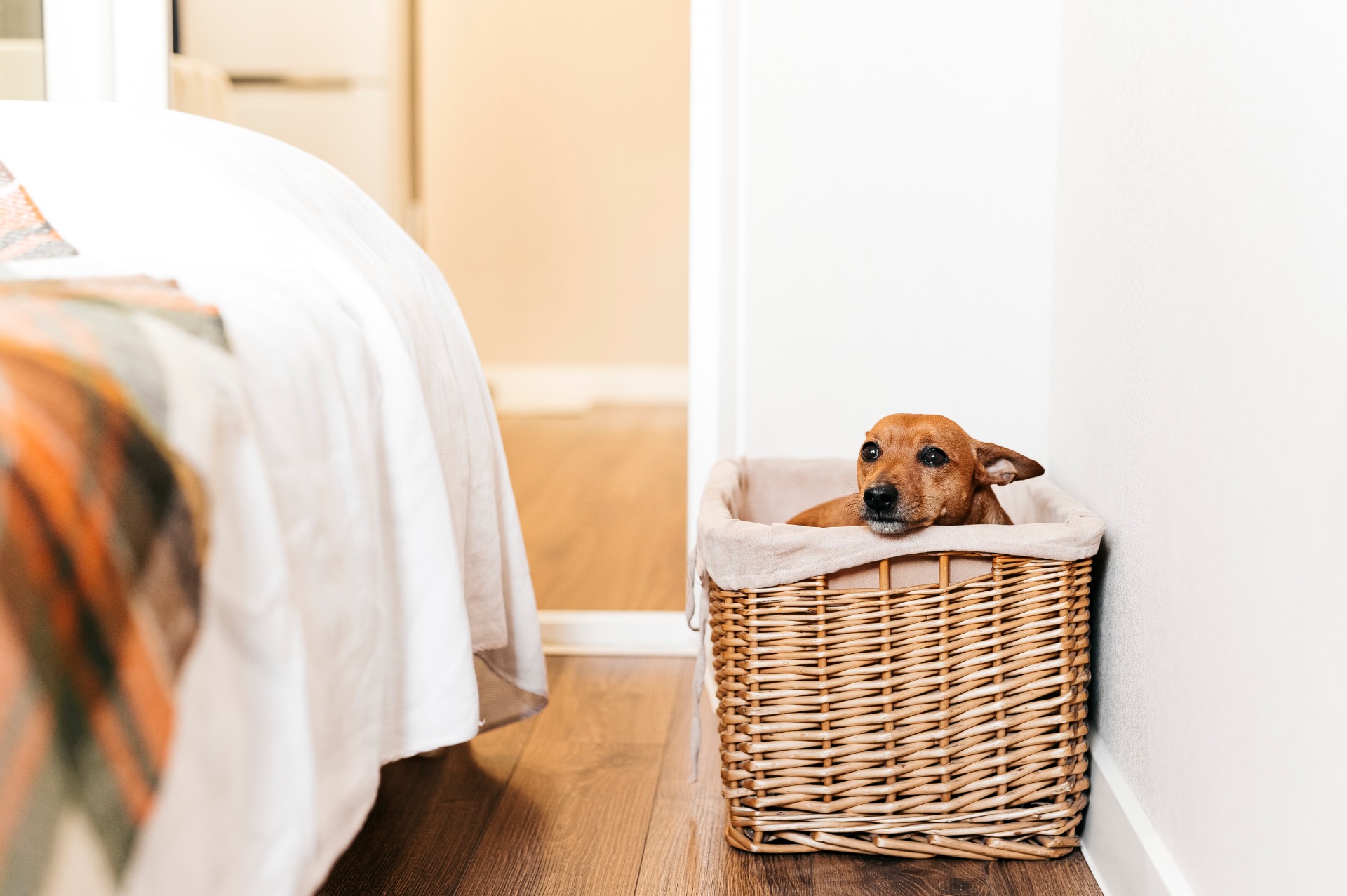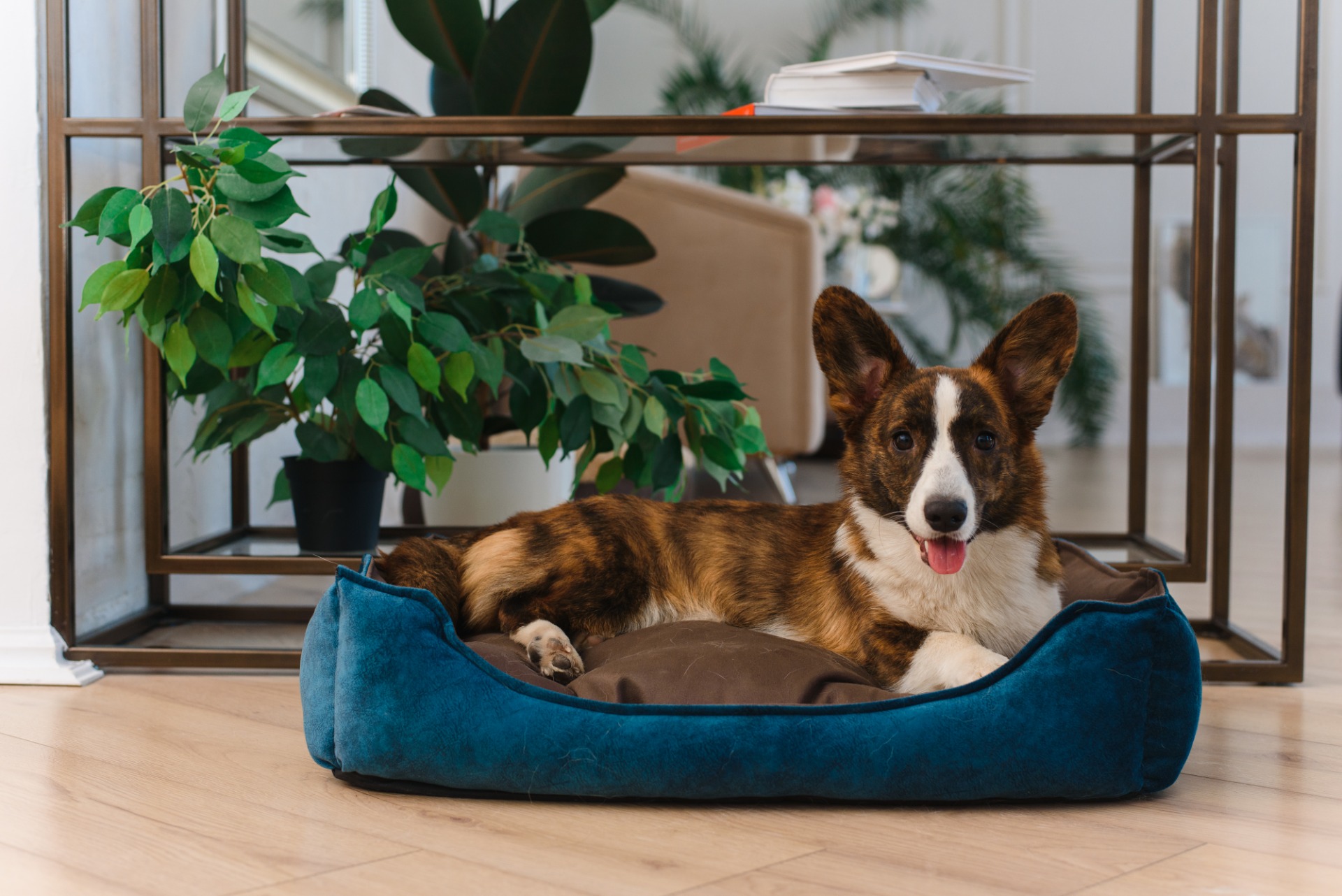

A dog couch bed is a raised-edge bed with an open front, built so a dog can step in and lean the way they would on a sofa. It is the right choice for dogs that prop their head or back against something, and a poor one for dogs that only sleep stretched flat, or for seniors who cannot clear a tall lip. The useful decision is not the silhouette on the product photo. It is whether the interior is long enough, the base stays firm under this dog’s weight, and the front is low enough to use every day.
Most rejected dog beds fail on one of those three points. The couch shape only helps if the dog already likes an edge to settle against.
What counts as a dog couch bed
Reviewers generally split raised-edge beds into two close relatives. A bolster bed wraps a cushioned wall around all four sides. A couch bed, sometimes sold as a sofa bed, keeps that wall on three sides and leaves the front open so the dog can get in and out without stepping over a barrier. Wirecutter uses that distinction: couch beds are bolster beds with one side left open.
That open side is the whole point of the category. Dogs that lean, curl into a corner, or rest their chin on a ridge often settle faster with something to push against. Dogs that sprawl on their side, or that already have sore hips, often do better on a flat mattress with no walls at all. A furniture-like outline in the living room is a bonus, not the reason the bed works.
There is a second product hiding under the same search. Soft sofa beds are foam or fiber cushions in a washable cover. Framed dog couches are miniature sofas: a wood or metal base, short legs, upholstered arms, and a seat cushion. They look more like furniture and usually cost more. They also clean differently, and the weight rating on the frame matters in a way a soft bed never has to worry about.
Soft sofa beds and framed couches are not interchangeable

A soft dog couch bed sits on the floor. The “arms” are stuffed bolsters. The seat is a foam slab, egg-crate foam, shredded foam, or loose polyester fill. Entry height is whatever the front bolster is. These beds are the practical default for most houses: lighter, easier to wash, and available in sizes that actually fit a Labrador.
A framed dog couch is a piece of pet furniture. Legs lift the seat a few inches off the floor. The arms are structured, not just stuffed. Covers on the seat often unzip; the arms and back often do not. Owners of older dogs sometimes prefer these because the seat is still low enough to step onto, while a full-size human sofa has become a jump. A Costco La-Z-Boy-style dog couch, for example, is commonly described as roughly 3.5 feet wide, with a stated limit around 50 pounds — enough for a border collie, tight for a golden retriever. Read the limit on the specific model. Listings and boxes do not always match.
Choose the soft bed when cleaning, size range, and joint support are the priority. Choose the framed couch when the goal is a low seat that looks like furniture and the dog is within the frame’s weight rating. Do not buy a framed couch expecting the whole thing to go in the washing machine.
| Soft sofa bed | Framed dog couch | |
|---|---|---|
| Best for | Leaners, daily washing, large dogs | Dogs that want a low “people sofa” look |
| Support | Depends entirely on the core | Seat cushion plus a rigid base |
| Cleaning | Cover should fully unzip; liner protects the core | Seat cover often washes; arms usually wipe only |
| Failure mode | Fill flattens or foam gets soaked | Frame flex, arm fabric wear, undersized seat |
| Typical spend | Often under $150 for a solid large bed | Commonly $150–300, sometimes well above |
Retail guides often place the broader category somewhere between about $80 and $300, with the largest orthopedic soft beds and branded framed couches at the top of that range or past it.
Match the shape to how your dog settles
Watch the dog for a week before you buy. The pose they choose on the floor or on your sofa is more useful than the breed label.
Dogs that curl and tuck their back against a wall usually like a three-sided couch bed. The bolsters give them a boundary. Anxious dogs often use that same boundary as a windbreak; a higher back can help, as long as the front stays open.
Dogs that sleep with their chin hooked over the arm of your couch are the clearest fit. They are already asking for a bolster. A soft, rounded arm is easier on the neck than a hard square edge.
Dogs that starfish, belly-up or fully on one side, need length more than walls. A couch bed can still work if the interior is long enough that the legs are not hanging off the front. If every sleep ends with the spine pressed into a bolster, a flat orthopedic mattress is the better buy.
Two dogs change the math. Size the bed to the larger dog’s stretched length, then add room, or accept that they will trade off. A couch bed built for one medium dog becomes a wrestling ring once a second dog arrives.
Size the interior, not the number on the box
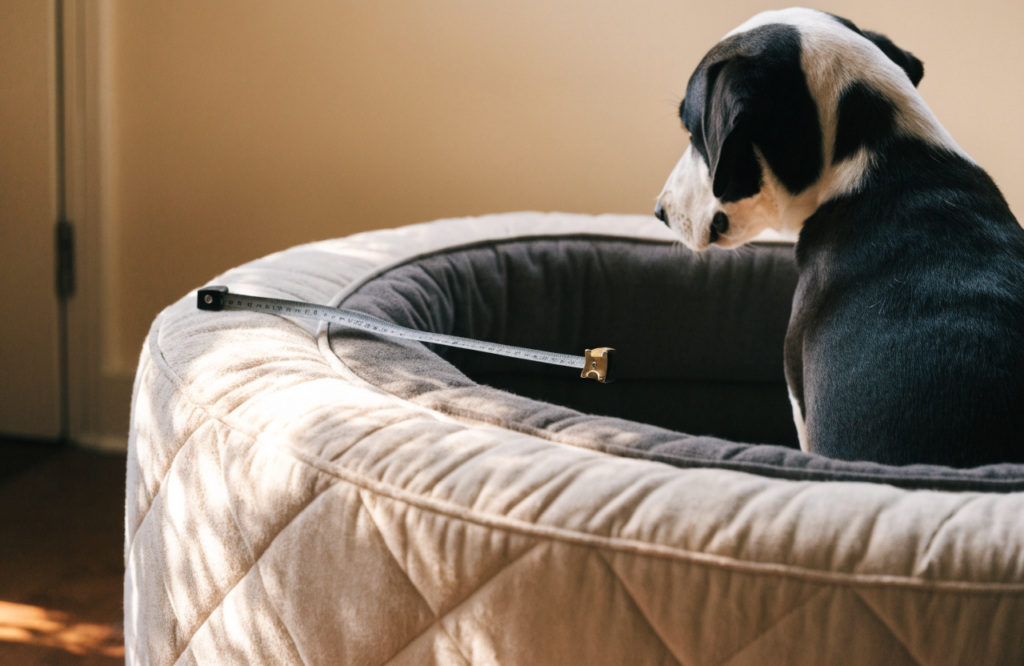
The most expensive mistake in this category is buying the outer dimension. Bolsters eat the sleeping surface. A bed sold as 36 inches can leave only about 28 to 30 inches of flat interior once the walls are in place. Guides that focus on bolstered beds treat that as the default trap, and recommend sizing up one level from the flat mat you would otherwise buy.
Measure the dog, not the breed chart.
- Have the dog lie on their side, nose to the base of the tail, legs extended. That length is the minimum interior.
- Add 6 to 12 inches (about 15 to 30 cm) so they can shift without a hip on the floor.
- For a sprawler, also measure across the body at the widest point and compare that to the interior width.
- Read the product’s interior or sleeping-surface dimensions. If the listing only gives the outside, assume the bolsters steal several inches on each raised side.
- When you are between sizes, take the larger one. A blanket can fill extra space. Nothing fixes a bed that is too short.
Weight bands are only a starting point. A 50-pound French bulldog and a 50-pound whippet do not need the same bed. A practical interior guide:
| Dog | Stretched body length | Interior to aim for |
|---|---|---|
| Toy and small (under 25 lb) | Up to about 18 in | 24–30 in long |
| Medium (25–50 lb) | About 18–26 in | 30–36 in long |
| Large (50–75 lb) | About 26–34 in | 36–44 in long |
| XL (75–100 lb) | About 34–42 in | 44–50 in long |
| Giant (over 100 lb) | 42 in and up | 52 in and up, and a base that will not bottom out |
Giant dogs are where couch beds often fail quietly. A three-sided bolster on a thin core feels fine for a month, then the hips reach the floor. If the dog is over about 100 pounds, prioritize foam thickness and a stated weight capacity over the couch look.
Support is a construction detail, not a marketing word
“Orthopedic” is not a regulated term for dog beds. Veterinarians consulted by Wirecutter have been blunt about this: there is no specific product category called orthopedic bedding. What matters for a dog with arthritis is a surface that is easy to enter, that supports the joints, and that does not create pressure points at bony areas such as elbows and hips. Dogs without joint disease are at much lower risk from pressure points, so a softer bed is not automatically a mistake.
The core is where couch beds diverge.
- A solid foam slab gives an even surface and holds shape if it is thick enough for the dog. Memory foam contours, then recovers slowly. It also holds heat, which heavy-coated dogs often dislike.
- Egg-crate foam is lighter and more breathable. The peaks compress under a heavy dog, so it is a weaker choice for large seniors.
- Shredded foam can feel plush at first, then migrate toward the bolsters and leave a hollow under the hips.
- Loose polyester fill is the usual reason a bed labeled supportive is flat within weeks. Press the center in the store, or read whether the base is a removable slab. If the middle collapses and stays collapsed, it is stuffing, not support.
For a medium or large dog, look for a foam base you can identify as a single piece, with a removable cover. CertiPUR-US is a useful certification when a brand claims the foam has been tested for certain chemicals; it is not proof the bed is the right thickness. Four inches is a reasonable floor for a medium dog. Large and giant dogs need more, or they feel the floor. There is no universal inch count that survives every weight.
A simple check before you commit: press the center with your palm. It should give, then push back, without your hand hitting the bottom. On a bed you already own, look for a permanent body-shaped trench after a few weeks. That trench is the bed telling you the core is wrong for this dog.
Entry height decides whether an older dog will use it
A couch bed with a tall front bolster recreates the problem you were trying to solve. Veterinarians advising on beds for arthritic dogs emphasize low entry: a dog that has to lift and flex a sore hip to get in will stop trying, then sleep on the hard floor beside a perfectly good bed.
Prefer a three-sided design with a clearly lowered front. Some brands cut the front bolster down to a few inches. That is the version to buy for a senior, a post-surgery dog, or a breed with a long back and short legs. A four-sided bolster can still suit a young, sound dog that likes to burrow. It is the wrong default for a wobbly one.
Framed couches need the same test. Measure from the floor to the top of the seat cushion, not to the frame. If the dog hesitates at your sofa, they will hesitate at a mini sofa with the same step.
Non-slip bottoms matter more on hard floors than buyers expect. A light sofa bed walks across the room every time the dog gets up. A rubberized base, or a rug underneath, fixes it.
Cleaning fails at the liner, not the zipper
A washable cover is not a waterproof bed. Many covers have a light water-resistant finish that weakens after a few washes. Urine, drool, and wet paws then reach the foam. Foam that has absorbed urine rarely comes back: it holds odor, and you replace the bed rather than the cover.
What actually protects the core is a separate waterproof liner, usually a membrane around the foam, plus a cover that comes off completely. Zippers that stop halfway, or bolsters stitched shut, make the bed look washable and then mildew at the seam. Check three things on the listing:
- The cover unzips on every panel you are expected to wash.
- A liner or waterproof barrier sits between the cover and the foam, including around the zipper.
- The care label allows a normal machine cycle, not “spot clean only,” if you have a puppy or an incontinent senior.
Keep a spare cover if the dog is messy. The bed is useless while the only cover is in the dryer. Foam itself should be spot-cleaned and air-dried. Do not put the core in the machine.
New incontinence is not automatically “just aging.” If a previously dry dog is wetting the bed, that is a veterinary question. The liner only manages the mess.
Fabric, chewing, and how long the shape lasts
Microsuede and velvet-like polyester are common because they hide fur and feel soft. They also snag if a dog digs. A tighter weave, canvas, or a performance upholstery fabric resists claws better and feels less plush. Leatherette on framed couches wipes clean and shows scratches. Neither is a good idea for a determined chewer.
If the dog already destroys beds, a couch bed is often the wrong category. Loose bolsters are easy to grab and shake. A chew-resistant elevated cot, or a flat bed with a tough cover, fails less dramatically. No sofa bed is chew-proof once the stuffing is exposed.
Bolster fill collapses on a different schedule from the base. A year in, the arms can look deflated even if the foam seat is fine. Brands that use a higher-loft fill and a cover you can restuff last longer in the room. If the listing does not say the bolsters are removable, assume you cannot fix a flat arm.
Heat is the other quiet rejection. Memory foam under a sherpa cover is a winter bed. Double-coated breeds and dogs in warm rooms often abandon it for the tile. A cooler woven cover, or egg-crate foam, is the better match for those dogs even if the product photo looks less luxurious.
Where it belongs, and when to cover your own sofa instead
A dog couch bed works best where the dog already rests: beside the human sofa, in a corner they have claimed, or in a bedroom if they sleep near you. Placing it in a spare room because it matches the rug is a common way to buy a bed the dog never uses.
It does not automatically keep a dog off your furniture. Some dogs treat it as a second sofa and still prefer yours. If the real problem is a destroyed human couch, a fitted, non-slip sofa cover is often the cheaper fix, with a dog bed as the alternative place rather than the replacement. Use the dog bed as an invitation, not as a rule the dog has not agreed to.
Multi-level homes add one constraint. A heavy foam sofa bed is awkward to carry upstairs. If the dog sleeps in more than one room, two simpler beds usually beat one expensive couch bed that lives in the wrong place.
Mistakes that get the bed ignored
- Buying the outer size and discovering the interior is a trench between bolsters.
- Choosing a four-sided or high-front bed for a dog that already struggles to climb the couch.
- Trusting “orthopedic” on a loose-fill bed.
- Skipping the liner, then throwing the foam out after one accident.
- Picking sherpa and memory foam for a husky in a warm climate.
- Setting the bed up in a new room and expecting the dog to follow it.
- Using a framed 50-pound couch for a 70-pound dog because the photo looked sturdy.
Give a new bed a fair test in a spot the dog already likes, with a familiar blanket on it for the first few nights. A dog that circles once and leaves is often reporting size, heat, or entry height, not a bad personality.
Frequently asked questions
Is a dog couch bed better than a donut bed? Only if the dog leans rather than burrows. Donut and cuddler beds wrap a small dog in a ring and suit curlers. Couch beds give a larger flat interior and an open front, which medium and large dogs can actually lie down in.
Can two dogs share one? Yes, if the interior fits the larger dog stretched out with room left over. If they resource-guard sleeping spots, two beds side by side cause fewer arguments than one bolster they both want to own.
How long should it last? A identifiable foam core with a replaceable cover often stays useful for a few years with one dog. Loose fill and thin egg-crate under a large dog can flatten in months. The frame on a mini couch can outlast the upholstery; the seat cover is the part you should be able to replace.
Do puppies need one? A puppy needs a washable bed with a real liner more than a couch shape. They also chew bolsters. A simple waterproof bed is the better first purchase, with a couch bed once the chewing phase has passed and you know how they like to sleep.