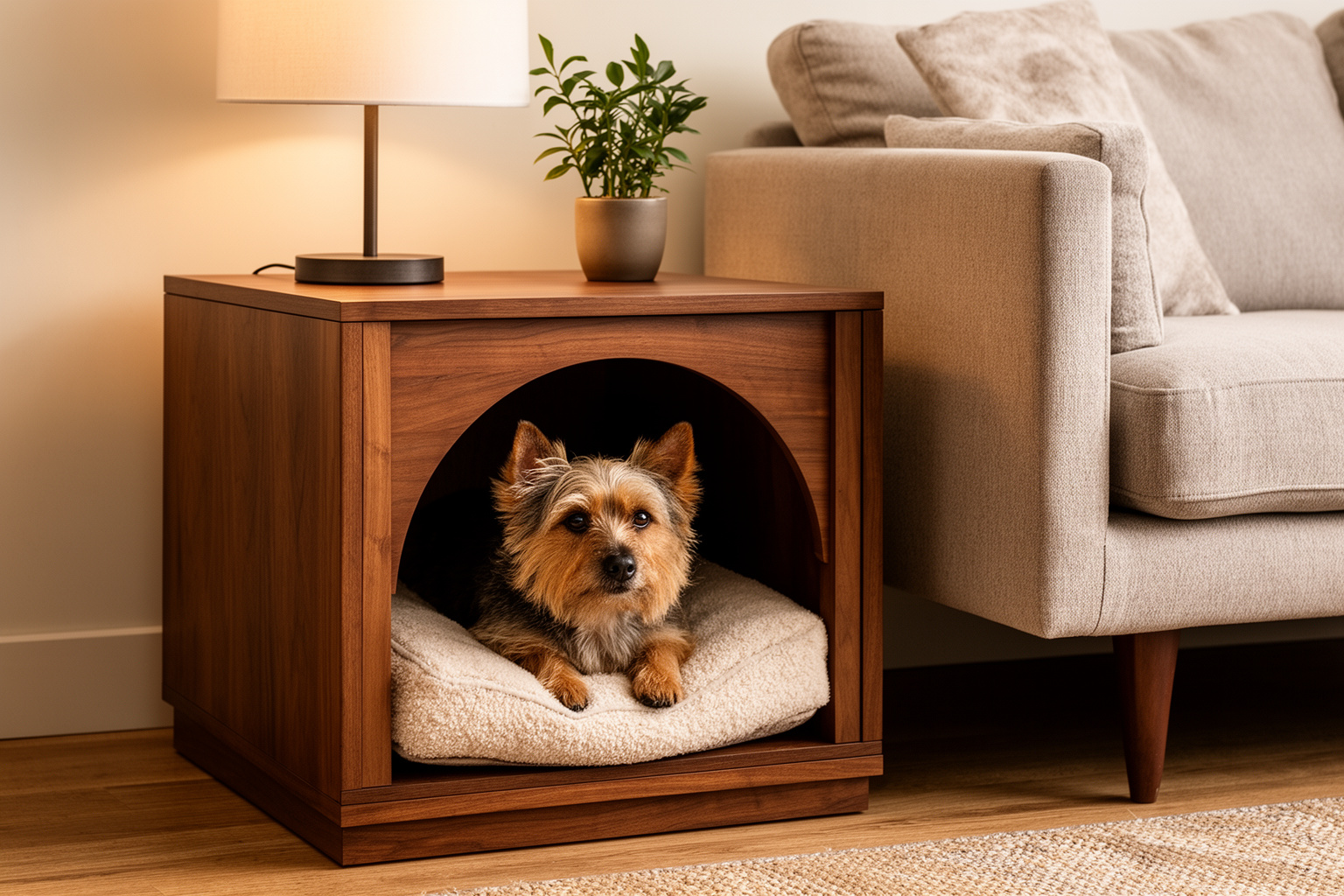

An end table dog bed is a side table with a resting space built into the base, so the dog can stay next to the sofa or bed without a separate crate taking up the floor. Most commercial versions fit small and medium dogs. The useful ones are sized to the dog’s actual sleeping posture, not just a listed weight, and the top is treated as a real surface for a lamp or books only if the manufacturer states a load rating.
The category splits into three designs that solve different problems: an open bed under a tabletop, a furniture-style crate with a door, and a covered hideaway that happens to have a flat top. Buying the wrong one is the usual reason these pieces sit unused.
What an end table dog bed is for
People usually want one of three things: a place for the dog beside the seating area, a crate that does not look like a wire pen in the living room, or a way to reclaim floor space in a small apartment.
An open end table bed does the first job well. The dog can walk in and out, watch the room, and still be out of the walkway. A lockable furniture crate does the second job, but only for a dog that already rests calmly in a crate. A covered igloo-style piece, such as a faux-rattan end table bed around 25 inches square, suits a small dog that prefers a den.
None of these replace a heavy-duty escape crate. Wood and particleboard frames are furniture first. A dog that chews table legs or tests latches will damage them, and many models are sold for indoor dogs under about 30 to 50 pounds.
Open bed, crate furniture, or covered hideaway
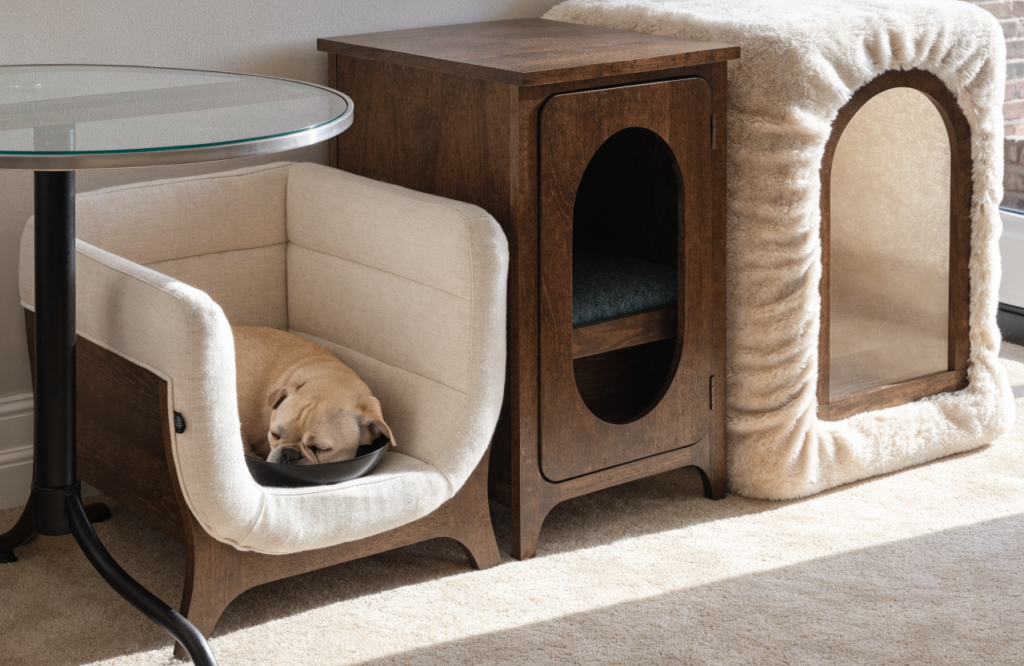
Match the opening to how the dog already rests.
Open three-sided beds leave the front, and sometimes a side, clear. Listings such as the ALBAD open dog bed end table describe a piece about 30.7 inches long, 22 inches wide, and 28.5 inches high, with a washable cushion and a stated limit around 50 pounds. The open entry is easier for older dogs and for dogs that dislike being enclosed. The tradeoff is that it will not contain a dog, and the bed is visible, so hair and a rumpled cushion stay in the room.
Furniture-style crates put a wire or mesh door under a wood or engineered-wood top. Some add a drawer, a pull-out tray, or a charging station. A Lowes listing for a particleboard-and-steel side-table kennel gives an interior around 24 by 16.5 inches and a dog limit of 30 pounds. Larger furniture crates exist, but the exterior grows quickly: a piece long enough for a Labrador-sized dog starts to look like a media console, not an end table. Doors matter. A front door works when the table sits in open floor space. A side door is better when the table is pushed against a sofa arm and a front door would face the wall.
Covered beds with a usable top are closer to a cave than a crate. The Refined Canine Igloo-style end table bed, sold as a 25-by-25-inch piece with a washable cushion, is aimed at small dogs. Dogs that burrow often prefer this. Dogs that overheat, or that want to see the room, often do not.
If the goal is house-training a puppy, skip furniture crates. Most cannot take a divider panel, and a too-large interior gives a puppy room to soil one end and sleep in the other. Wire crates with a divider are the simpler training tool. Furniture comes later, once the dog already chooses the crate.
How to size the interior, not the listing photo
Weight limits are a starting point, not a fit. A 35-pound dog that sleeps curled may be fine in a space a 25-pound sprawler rejects. Owners who buy a coffee-table or end-table bed that is visually cute and then find the dog sleeping on top of it are usually looking at a space the dog cannot stretch in.
Measure three things while the dog is relaxed:
- Length from nose to the base of the tail, plus 3 to 4 inches.
- Height from the floor to the top of the head while standing, or to the shoulder if the dog only curls. The opening should clear the shoulders without a duck.
- Width across the body when lying on the side, plus a few inches so the dog is not pressed against both walls.
The dog should be able to stand without crouching, turn around, and lie flat. That is the same standard used for ordinary crates. Interior dimensions matter more than exterior ones. A thick frame and a drawer can shrink the usable bed by several inches on every side.
As a rough planning range, not a product guarantee: many small-dog furniture pieces land around 24 to 30 inches of interior length and 18 to 22 inches of width. Medium furniture crates often run 30 to 36 inches long. Anything marketed as an end table and longer than about 40 inches is really a sideboard. If the listing only gives outside measurements, assume the bed is smaller and ask for the interior before buying.
Also check the entry. A lip that holds the cushion in place can be an obstacle for a short-legged or arthritic dog. A bed floor more than a few inches off the ground has the same problem. Older dogs usually do better with a low, open entry than with a step up into a box.
What you can actually put on the top
These are side tables only up to the stated load. Some engineered-wood crate tables list a top capacity around 110 pounds. At least one larger furniture crate has been listed at 220 pounds, which is enough for a small television or a record player, not just a lamp. Many open bed tables never publish a number at all.
If the listing is silent, treat the top as light duty: a lamp, a book, a coaster. Do not assume it can take a person sitting on the edge, a large planter, or a leaning elbow every night. Particleboard and thin MDF soften if a water bowl spills and they hold screws less reliably than solid wood. Adjustable feet help on uneven floors, but they do not fix a flexible top.
Place the table where someone will not catch a hip on a projecting corner. Rounded edges are worth paying for in a tight path between sofa and chair.
Materials, chewing, and cleaning
Solid wood holds fasteners better and shrugs off minor moisture better than particleboard. It is still not chew-proof. A dog that mouths furniture will mark the rails, and a determined chewer can break a wooden slat. Metal mesh or steel tube frames resist gnawing better. Wide slat gaps look airy, but a paw or nose can get caught if the opening is in an awkward middle size. Very small gaps or clearly large openings are safer than a gap just big enough to trap a foot.
Cushions are a separate decision. Some wooden crates ship without one. A cushion that does not match the interior will slide, bunch, or block the door. Removable, machine-washable covers matter more here than on a floor bed, because the space is enclosed and odors sit in it. A waterproof liner under the cover protects foam from the occasional accident. Foam itself is rarely washable.
Hair collects in corners and on mesh. A pull-out tray is the feature that makes a crate-style table livable. Open beds are easier to vacuum but show every shed hair.
Where it belongs in the room
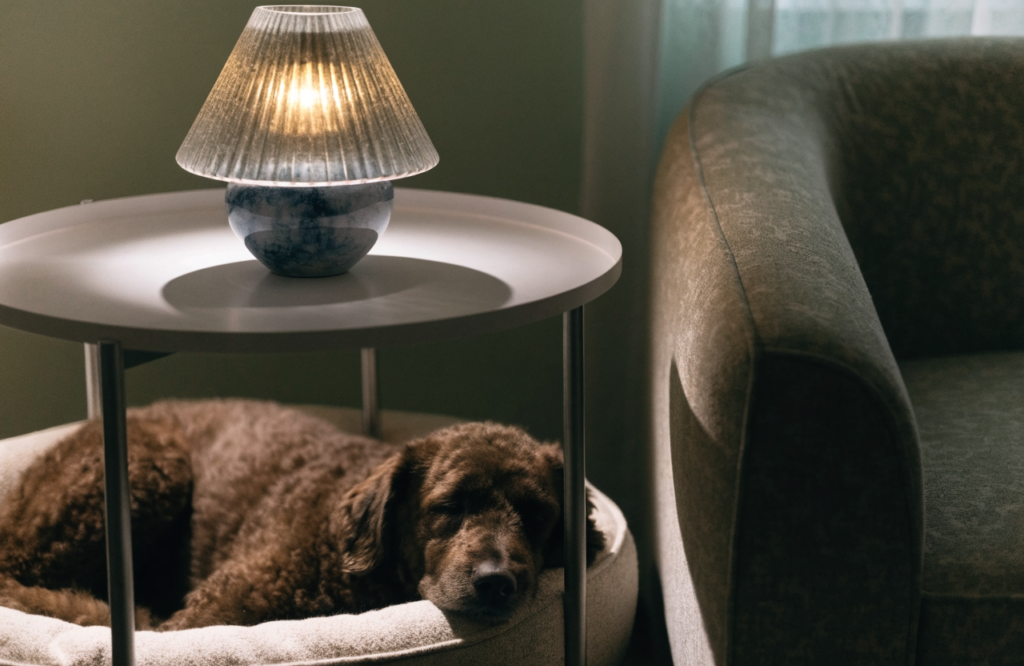
Standard sofa seat height is often in the high teens, and a usable end table usually lands somewhere around 22 to 26 inches so a seated person can reach a glass without leaning. That is a human measurement. The dog’s measurement is the opening and the floor clearance.
The best spot is beside the seat the dog already wants to be near, with the opening facing the room rather than a wall. Pushing the open side against upholststered furniture turns the bed into a dead end. Keep it off floor vents. A covered bed in a draft or a hot sun patch gets abandoned.
If the dog’s real preference is to be at human height, an end table bed on the floor will not satisfy that. Some small dogs end up with a bed on top of a table instead. That is a different product, and it needs a stable surface and a dog that can get down safely.
When a DIY conversion is the better route
Ready-made pieces cluster around small and medium dogs and a narrow set of finishes. A solid-wood end table with a lower shelf can become a bed if the shelf already clears the dog’s height and the frame is not thin particleboard. Thrift-store MDF tables are a poor base: they swell when wet and crumble if chewed.
A conversion still has to meet the same rules. The dog needs room to stand, turn, and lie down. Edges of any added metal panel should be covered so they cannot cut. Fasteners should sit below the surface the dog touches. Gaps should not trap a paw. Pet-safe finishes need to cure fully before the dog uses the space. A cushion or crate pad on the lower shelf is the actual bed. The table is only the frame.
DIY is worth it when you need an odd size, a finish that matches existing furniture, or a stronger top than budget crate tables offer. It is not worth it if the goal is a secure latch for a dog that must stay contained.
Why dogs skip them
The bed is too short for a stretch, so the dog sleeps on the rug in front of it. The opening faces a wall or a high-traffic path, so the space feels like a trap. The cushion is thin, slick, or strongly scented from the factory. The door was closed before the dog had any reason to go in on its own.
Introduce an open bed the way you would any new resting spot: put a familiar blanket inside, leave the approach clear, and do not block the exit. For a crate-style table, leave the door open, feed a meal or two just inside, and only close it after the dog is already napping there. A dog that has never liked crates will not like this one because it looks like a nightstand.
Frequently asked questions
Can a large dog use an end table dog bed? Usually no, if you still want it to function as an end table. Furniture long enough for a dog to stretch at 42 inches or more stops reading as a side table and starts reading as a cabinet. Large dogs are better served by a normal crate or a floor bed, with a separate end table.
Is it safe to leave a dog in a furniture crate while you are out? Only if the door and latch are secure, the dog is already crate-trained, the interior is the right size, and the dog does not chew wood or mesh. These pieces are a poor first crate for a puppy or a new rescue.
Do you need a separate cushion? Check the listing. Solid-wood crate tables often omit the pad. Open furniture beds and igloo-style tables more often include a washable cover. Measure the interior before ordering a replacement so the pad does not jam the door.
Will it hold a lamp? Only if you stay inside the published top capacity, when one exists. A table lamp is a reasonable load on most of these pieces. A person, a large TV, or a heavy stack of books is not, unless the maker lists a high capacity and the frame is metal-reinforced.