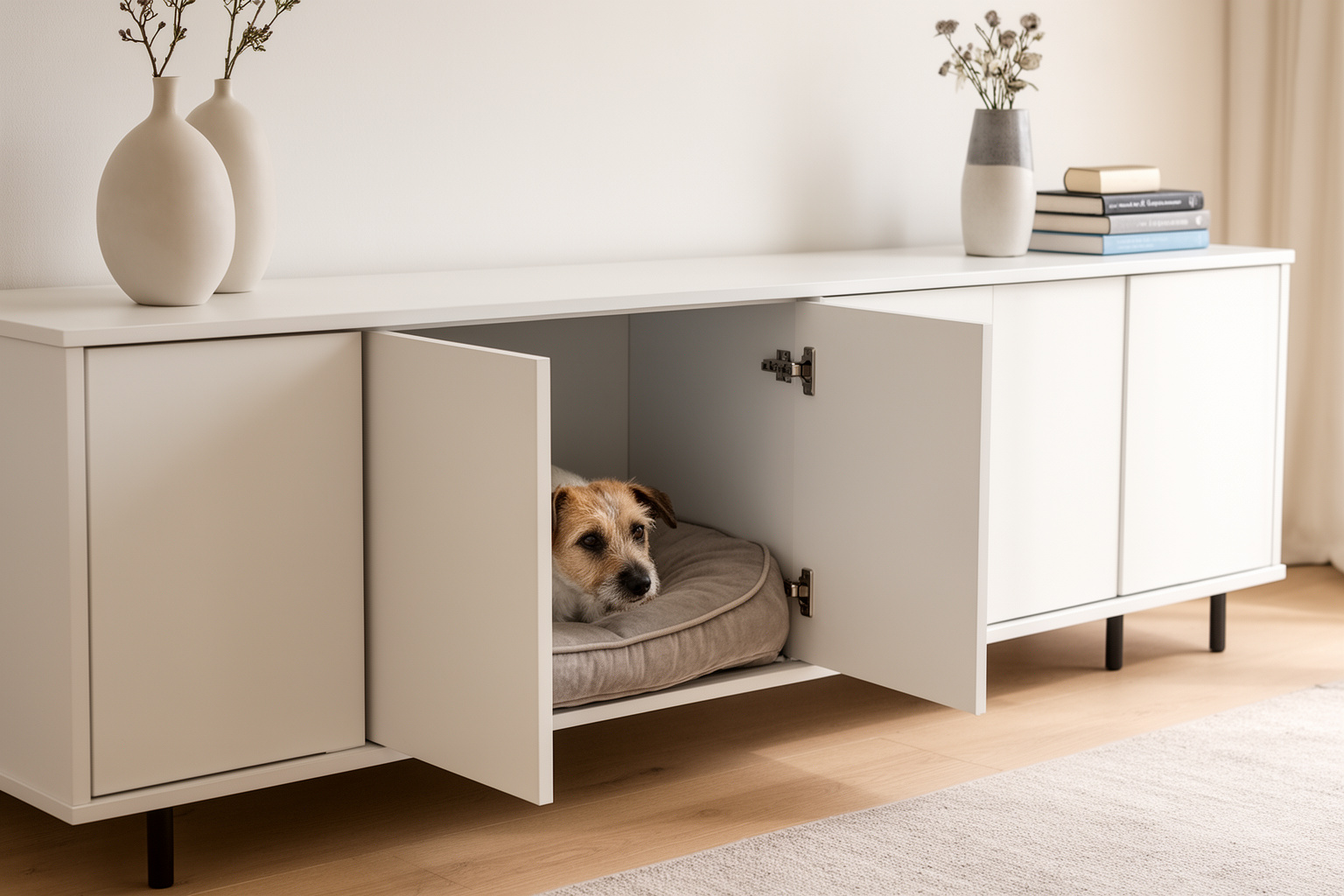

A hidden dog bed is a sleeping spot built into furniture or an unused part of the room, so the cushion is there when the dog wants it and mostly out of sight the rest of the time. Side tables with a den underneath, cabinet-style crates, under-bed nooks, wardrobe niches, and fold-away beds all belong in the category. The point is not to hide the dog. It is to give a dog a defined place without leaving a bolster and blanket in the middle of the floor.
That only works if the inside is sized to the dog, not to the photo. Wood panels, a thick cushion, and a door frame can take several inches off a piece that looks roomy from the living room. Enclosed furniture also holds heat and limits airflow. A good hidden dog bed is chosen for how the dog sleeps, how warm the room gets, and whether you need a real crate or just a den.
What counts as a hidden dog bed
The shared idea is a bed that reads as furniture or as empty architecture until you look for the dog. The formats are not interchangeable.
Open furniture dens. A side table, console, or bench with a clear space underneath and a fitted cushion. The dog can walk in and out. Nothing locks. This is the simplest version and the easiest to ventilate.
Furniture crates. A wooden cabinet or end table with a door, usually wire, acrylic, or a slatted panel, and a bed on the floor inside. These are crates that happen to have a flat top for a lamp. They are for confinement, not only for looks. Most ready-made versions are built for small and medium dogs; larger interiors exist, but they take real floor space.
Closed cabinets and wardrobe nooks. A door or panel hides the bed completely. Designers sometimes tuck a bed into the bottom of a built-in, under the stairs, or into the base of a desk. The look is the tidiest. The risk is also the highest if the opening is small and the walls are solid.
Fold-away beds. A Murphy-style panel drops down or a drawer rolls out to reveal a platform and cushion, then closes when the floor needs to stay clear. Useful in a studio. Useless if the dog is expected to stay in it while the panel is shut.
Under-bed and under-furniture nooks. A raised bed frame, a deep coffee table, or the gap beside a cabinet becomes the den. No new furniture is required. Clearance, dust, and cords are the constraints.
An ottoman is often listed with these products, but many are only storage or a footrest. If the dog is meant to sleep inside, the opening, the step-in height, and the air path matter more than the upholstery.
Match the format to the dog, not the room
Start with what the bed has to do.
If the dog already sleeps near people and only needs a boundary, an open side-table den or an under-bed nook is enough. The dog can leave when the spot gets warm. That exit matters. A covered bed is an optional retreat, not a treatment for anxiety, and it should not be the only resting place in the room.
If the dog must be contained while you cook, leave, or have guests, you need a crate, and the furniture has to function as one. The ASPCA’s crate guidance is the right minimum: the dog should be able to stand, turn around, and lie down without hitting the top or sides. A furniture shell does not change that. Crates are also a training tool with limits. The ASPCA advises against using a crate as a way to park a dog that is simply getting into trouble, and against long stretches for puppies. An adult dog should not be left crated for more than about four hours at a time without exercise on either side.
| Format | Best when | Weak when |
|---|---|---|
| Open side table or bench den | Dog wants to be near people and can come and go | You need a closed door for chewing or house-training |
| Furniture crate | You want a crate that looks like an end table | The dog is large, pants heavily, or hates confinement |
| Cabinet or wardrobe niche | The bed should vanish when guests are over | Ventilation is a single small hole, or the dog is a senior |
| Under-bed nook | The frame is already high enough | Cords, dust, or a low frame make entry awkward |
| Fold-away platform | Floor space is the scarce thing | The dog needs the bed available all day |
Seniors and short-legged dogs need a low threshold. A deep cabinet with a high lip, or a thick orthopedic pad stacked on a raised floor, turns an easy den into a climb. Brachycephalic dogs and thick-coated dogs are poor candidates for a solid box in a warm room. Offer them an open bed as well, and watch whether they stay in the furniture or abandon it.
Size the interior, then buy the furniture
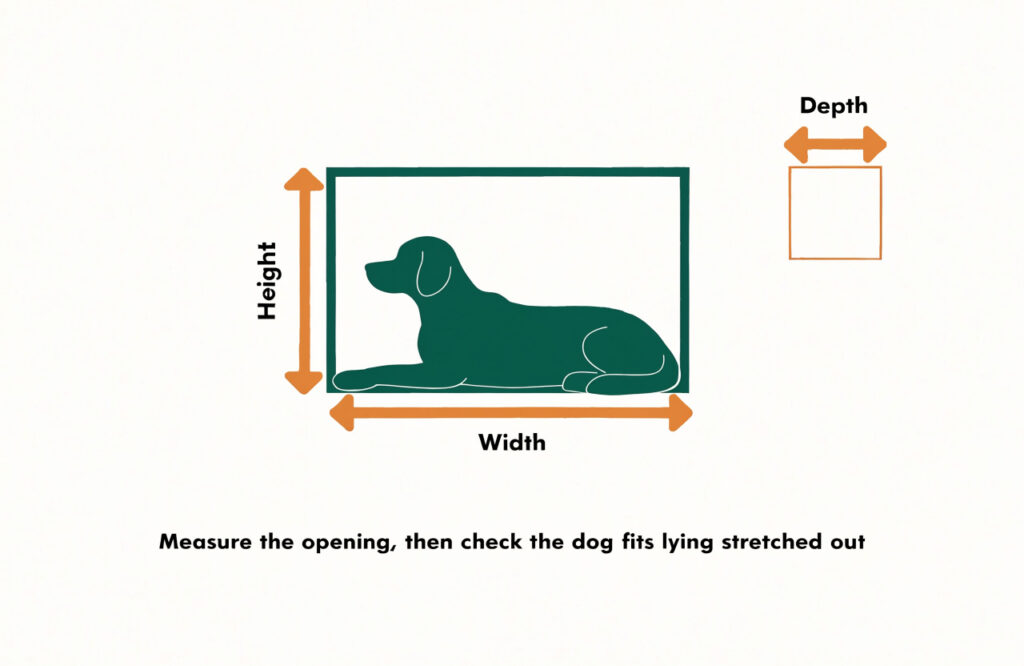
Exterior dimensions are what the product photo sells. Interior dimensions are what the dog sleeps in. Drawers, panel thickness, and the cushion all steal space. Compare your measurements to the usable floor inside, after the bed is in place.
Measure three things with the dog standing or lying naturally:
- Length from nose to the base of the tail.
- Height from the floor to the top of the head, ears included if they stand up.
- Width across the shoulders, or the full sprawl if the dog sleeps on its side.
For a crate, add a few inches of length — about 4 inches for a dog that curls, more like 6 for a dog that stretches — and enough height to stand without ducking. For a housetrained dog using an open den rather than a crate, extra length is fine and often better. The ASPCA notes that a too-large crate can undermine house-training because a puppy may soil one end and sleep at the other; once that habit is gone, more room is not a problem.
Check the door or opening separately. A roomy cabinet with a narrow cutout still fails if the shoulders have to squeeze through. If you are ordering online, ask for interior length, width, and height, and for the opening size. A “large” label is not a measurement.
Weight ratings on the tabletop are a separate number. A side table that holds a lamp may not hold a person sitting on the edge. If anyone will use the top as a seat, treat that as a furniture load, not a pet-bed feature.
Airflow and heat decide whether the dog will stay
A hooded or enclosed bed holds warmth because air cannot move freely around the body. That is pleasant in a cool bedroom and unpleasant next to a sunny window, a radiator, or in summer. Solid wood on three sides with one small entrance is the worst common version.
Prefer openings or vents on more than one side. Slats, a wire or mesh panel, or an open front plus a rear vent all help. Do not finish the look by draping a blanket over every opening. If a cover is useful for calming a dog in a wire crate, keep at least two sides clear.
Place the piece out of direct sun and away from heat sources. In warm weather, leave an open bed elsewhere in the same room so the dog can move. Panting, restlessness, or a dog that enters and immediately leaves is feedback about the setup, not a training failure.
Chewing changes the material choice. Rounded edges, a chew-resistant door, and a finish you would accept a dog mouthing are more important than a smooth paint color. Loose curtains used as a “hidden” front can become a tangle or a chew toy. A short, fixed panel is easier to keep safe than a long drape.
The cushion is the part you will actually maintain
The furniture is the shell. The bed inside is what the dog feels.
Use a cover that unzips and goes in the machine, plus a waterproof liner under it if the dog drools, sheds heavily, or has occasional accidents. A liner that cannot be removed turns every spill into a furniture problem. In a cabinet or under a bed, a hard floor with a removable mat is easier to wipe than carpet.
Thickness is a tradeoff. A deep foam pad helps an older dog and eats height and length inside a tight shell. Measure the interior with the cushion in it, not empty. If the pad buckles at the edges, it is too wide, and the dog will paw it into a ridge.
Odor builds faster in an enclosed space than on an open floor bed. A weekly cover wash and a wipe of the shell matter more here than they do for a bed in the middle of the room.
Buying versus building
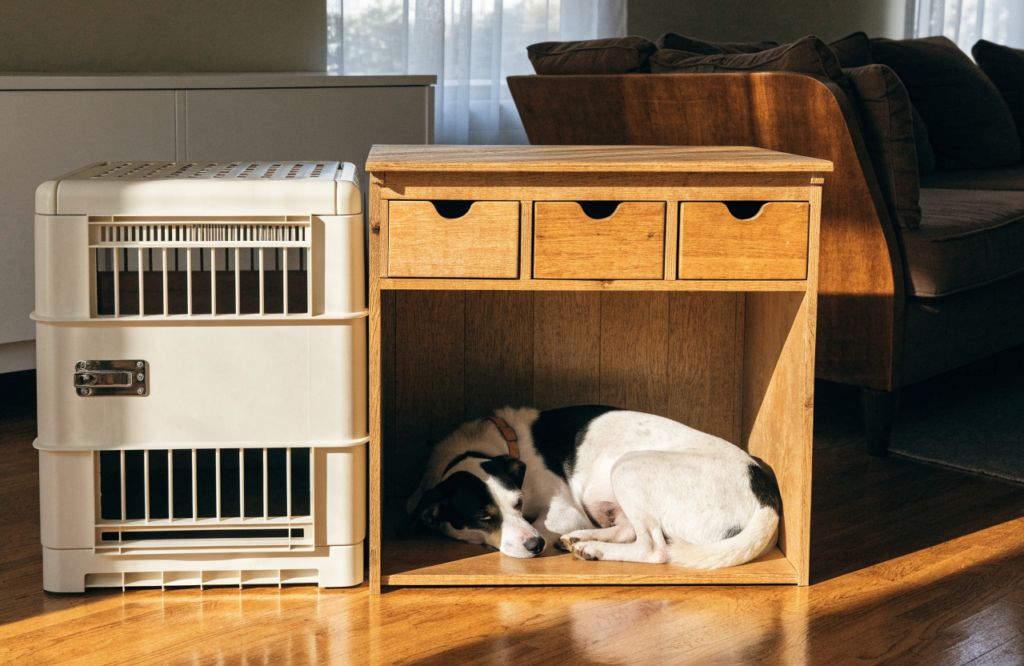
Ready-made side-table crates are the fastest route if a small or medium dog fits the published interior. Look for a flat top rated for what you will put on it, a washable cushion or a clear note that you must supply one, more than one ventilated side, and a door that latches without a gap a paw can work open. Adjustable feet help on uneven floors.
Building or adapting furniture makes sense when the dog is large, the gap you want to use already exists, or the ready-made sizes stop at medium. The useful constraints are simple:
- Decide the interior first, including the cushion, then build the shell around it.
- Keep a clear exit. If the piece is a den, the dog should leave without help.
- Cut ventilation into more than one face, and do not cover it later.
- Round edges the dog will brush past.
- Do not remove structural parts from an existing cabinet or bed frame without knowing what is holding the top up. A TV stand or dresser can become a den only after shelves and supports are planned, not after they are sawn out.
- If the dog chews, skip delicate veneers and anything with exposed foam.
Under-stair and wardrobe versions work when a carpenter sizes the opening to the dog and leaves a grated or slatted front. A locked solid door with no view and no airflow is a cupboard, not a bed.
Mistakes that make the furniture fail
Buying from the exterior photo. A 30-inch tabletop can hide a 20-inch floor once the walls and cushion are counted. The dog then sleeps curled against the door.
Treating every dog as a den dog. Some dogs use a covered spot immediately. Others want to see the room. Put the furniture where the dog already rests, leave the entrance open, and keep another bed available. Forcing a dog into a closed cabinet to “get used to it” teaches the opposite of what you want.
Blocking the only vent. A throw that makes the crate look like a cabinet also makes it a warm box.
A high lip for a stiff dog. The bed can be orthopedic and still be wrong if the dog has to hop to reach it. A low, firm pad beats a plush cave with a climb.
Cords and dust in an under-bed nook. Power strips, charging cables, and stored bags turn a free space into a hazard. Clear the volume the dog will actually use, not just the visible edge.
Using a pretty crate as all-day storage for the dog. Furniture does not change crate limits. A dog that is housetrained and settled should not live in the end table because the door looks better closed.
Questions people ask after they start looking
Is a hidden dog bed the same as a furniture crate? No. A hidden bed can be an open nook the dog enters by choice. A furniture crate has a door and is for containment. Buy the crate only if you need the door.
Will a large dog fit? Sometimes, in a custom cabinet, a high bed frame, or a long console. Most catalog side-table crates are aimed at small and medium dogs. Measure the interior against a sprawled length before assuming a “large” label will do.
How do you get a dog to use it? Place it where the dog already lies, put a familiar blanket on the cushion, and leave the entrance open. Feed a meal or offer a chew just inside, then let the dog leave. A closed door on the first day is unnecessary for a den and too much for a crate the dog has never entered. The ASPCA’s crate introduction — short, calm sessions with something worth staying for — applies if the piece is an actual crate.
Can a puppy live in one? Only with the same limits as any crate: short periods, a size that will still work as the puppy grows or a divider to shrink a larger interior, and no use as a substitute for supervision. An open furniture den is fine as a nap spot. It is not a pen.
Do you need an orthopedic pad inside? Only if the dog is older, stiff, or already more comfortable on a supportive bed than on a thin mat. A young, healthy dog does not need one, and a thick pad can make a small interior unusable.