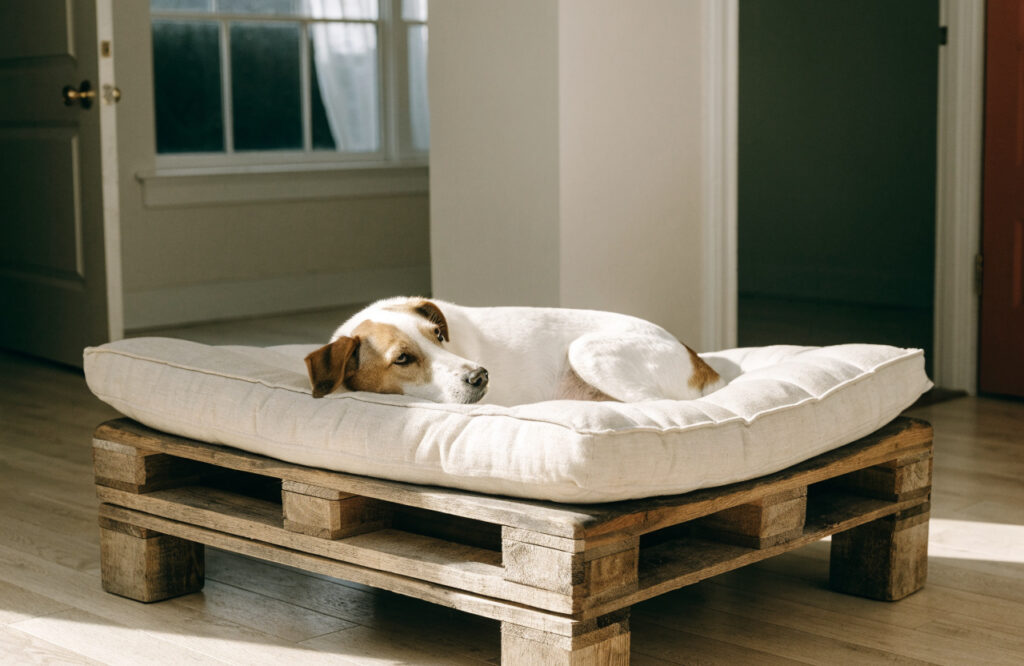
A pallet dog bed is a raised wooden frame, usually a whole shipping pallet or a cut section of one, with a cushion or folded bedding on top. It works when the pallet is heat-treated, structurally sound, and sanded smooth. The wood itself is not the bed. The cushion is. The pallet only lifts the dog off a cold or damp floor and gives the cushion a rigid base.
The build is simple if the pallet is already the right size. Most of the work is choosing wood that is safe to have in the house and finishing the surface so a dog cannot pick up a splinter or a nail.
When a pallet dog bed is the right project
A pallet bed earns its place in three situations.
The floor is hard, cold, or slightly damp, and a flat cushion keeps sliding. The open deck and the gap under the pallet let air move, so the bedding dries faster than a cushion sitting directly on concrete or tile.
The dog is medium or large and already has a cushion that needs a frame. A standard North American pallet is about 48 by 40 inches. A Euro pallet is 1200 by 800 mm, roughly 47 by 31.5 inches. Either footprint is enough for most dogs up to about 70 pounds to stretch out, and a large dog can use a full pallet as a lounging platform if the cushion covers the gaps.
You want the bed to stay put. A pallet weighs enough that a dog circling before it lies down will not shove the whole bed across the room the way a light foam bed often does.
It is a poor fit if the dog is a determined chewer. Pallet boards split, and swallowed splinters are a real problem. It is also a poor fit for a puppy still being housetrained on a washable pad that needs to come up every day, unless the cushion cover unzips and the wood is sealed. Senior dogs with weak joints do better on a thick foam mattress than on a thin blanket over slats. The raise helps them only if the top surface is continuous and firm.
How to choose a pallet that is safe around a dog
Shipping pallets are treated so they do not carry wood pests across borders. The treatment mark, set by the ISPM-15 standard, is the difference between a usable pallet and one that should stay outside.
Look for the IPPC wheat-stalk stamp on a block or stringer. The letters that matter are the treatment code.
| Stamp | What it means | Use for a dog bed? |
|---|---|---|
| HT | Heat-treated. Wood core held at least 56°C (133°F) for 30 minutes. No fumigant. | Yes, if the wood is clean |
| DH | Dielectric (microwave-style) heating. Also chemical-free. | Yes, if the wood is clean |
| MB | Fumigated with methyl bromide, a pesticide gas | No |
| SF | Fumigated with sulphuryl fluoride | No |
| No stamp, or stamp worn off | Treatment unknown | No |
HT does not mean the pallet is clean. Pallets sit on warehouse floors, in trucks, and under whatever was shipped on them. Reject any pallet with oil stains, chemical odor, mold, rot, insect holes, or paint you cannot identify. A dark spill is a reason to walk away, not a detail to sand off.
Pressure-treated decking lumber is a separate problem. Green or brown treated boards used for fences and outdoor structures are not shipping pallets, and they are not appropriate for a surface a dog may lick or chew.
Domestic pallets that never left the country sometimes carry no stamp at all. Those are not automatically safe. Without a mark, you cannot tell heat treatment from an older chemical process or from wood that simply was never treated. For a bed the dog will lie on every day, an unmarked pallet is not worth the guess.
Size the bed to the dog, not to the pallet

Measure the dog from nose to the base of the tail while it is stretched on its side, then add 4 to 6 inches. That length is the minimum useful sleeping surface. Width should let the dog roll without hanging a shoulder off the edge.
A full 48-by-40-inch pallet suits most medium and large dogs. A Euro pallet is narrower, so a broad-chested dog may prefer it turned long-ways, or two half-sections butted together. Small dogs do not need a full pallet. Cutting one in half, just past a center block, gives a footprint closer to a conventional small bed and leaves wood for a low side rail.
Height is already set by the pallet. A typical wooden pallet stands about 5.5 to 6.5 inches, and a Euro pallet is 144 mm. That lift is enough to get a cushion off a cold slab. It is not so high that a small or elderly dog struggles to step up, provided you do not add tall furniture legs on top of the blocks.
If you add side rails, keep them low, around 3 to 4 inches above the cushion. Taller rails look like a crate and make it harder for an older dog to get in. They also collect hair against the wood.
A simple build that leaves the pallet intact
Dismantling a pallet is the part that turns a short project into a long one. Nails are driven in at angles, boards split, and the stringers are full of holes. For a dog bed, an intact pallet is stronger and faster.
What you need:
- One HT pallet that has passed the inspection above
- Orbital sander, 80-grit then 120-grit paper
- Hammer, nail set, and a pair of pliers or end cutters
- Optional: four locking casters, exterior-grade screws, and corner braces if you add rails
- Cushion or mattress cut to the deck size
- Optional finish: food-grade mineral oil and pure beeswax
Work in this order.
- Strip the hardware. Walk every board. Sink or pull every nail, staple, and screw that sits proud of the surface. Check the underside and the gaps between deck boards. A nail you miss will find a paw.
- Scrub, then dry. Use hot water and a mild soap. Skip bleach mixes and solvent degreasers. Rinse and let the pallet dry fully, ideally for a day indoors, before sanding. Sanding wet wood raises the grain and hides the splinters you are trying to remove.
- Sand every surface a dog or a person will touch. Start at 80 grit on the top deck, the outer edges, and the ends of the boards. Finish at 120. Run a hand over the wood in both directions. If a finger catches, the dog’s skin will too. Do not stop at the top. Dogs push against the sides when they turn around.
- Decide on a finish. Bare sanded wood is usable indoors if it stays dry. A coat of food-grade mineral oil, followed by a beeswax and mineral oil blend once the oil has soaked in, slows water staining and makes hair easier to wipe off. It is not a hard film, so it will not peel into flakes a dog can eat. Avoid boiled linseed oil, which contains metal driers, and skip ordinary paint or polyurethane unless you can keep the dog off the bed until the finish is fully cured and no longer smells. Outdoor use needs a finish rated for weather, and the bed should still come inside when it rains.
- Add movement only if you need it. Locking casters on the four corner blocks make sense in a room you rearrange. Use screws long enough to bite the block, not so long they come through the top deck. Without a reason to roll the bed, leave the blocks as feet. They already keep the wood off the floor.
Side rails are optional. The usual method is to cut spare deck boards from a second pallet, sand them, and screw them to the outer stringers from the inside, or glue and brace them. A single low board on three sides is enough to stop a cushion sliding off. A full headboard is cosmetic.
What actually makes the bed comfortable
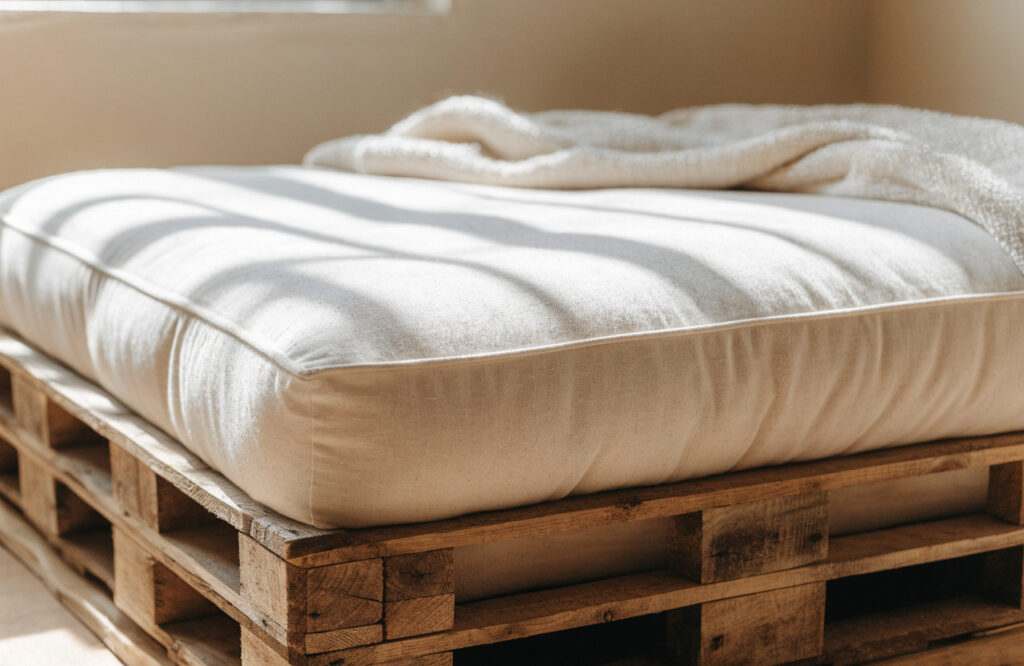
Gaps between pallet boards are usually about an inch. A thin blanket will sag into them. The dog feels the edges, and the blanket walks off the bed by morning.
Use a cushion at least 2 to 3 inches thick, and closer to 4 inches for a dog over about 50 pounds or any dog with stiff joints. High-density foam holds its shape on slats better than soft polyfill. A zip cover in a tight weave is easier to wash than a sewn-on pad. Cut the foam slightly under the deck size so the cover can tuck, or slightly over if you have low rails to contain it.
Euro-pallet cushions are sold at 120 by 80 cm because that footprint is standard. On a 48-by-40-inch pallet, a crib mattress, a custom-cut foam slab, or two smaller beds butted side by side all work. Two beds will separate unless a cover or a nonslip mat under them holds them together.
A rubber shelf liner or a piece of nonslip rug pad between wood and cushion stops the slow creep that makes dogs abandon the bed. Do not staple carpet directly to the deck unless you are prepared to replace it. Carpet holds hair and moisture against the wood, and roofing nails or staples work loose.
The space under the pallet is usable. A shallow bin fits between the blocks on many pallets and is a reasonable place for a spare cover or toys. It is a poor place for food, medication, or anything a dog can hook with a paw.
Problems that show up after the first week
The dog will not lie on it. Usually the surface is too hard, the cushion is sliding, or the bed is in a draft. Add thickness before you add blankets. A dog that liked a crate pad will often accept the same pad on the pallet once it stops moving.
Splinters appear after sanding. Pallet wood is soft and weathers open. Sand again, then oil. Check the end grain, which sheds slivers even when the faces feel smooth.
The bed rocks. One block is shorter, or the floor is uneven. A thin shim under the short block, screwed so it cannot kick out, is enough. Do not plane the other blocks down. You will only create a new rock.
Smell lingers after washing. That pallet absorbed something. Air it outside. If the odor remains after it is fully dry, do not bring it in. Odor is a useful reject test, not a problem to cover with finish.
Chewing starts at the corners. Corners and rail ends are the easy places to bite. Sand them round, and do not leave the bed as the only chew object in the room. A dog that is already destroying furniture will destroy this too. In that case a commercial bed with a chew-resistant frame is the safer spend.
Outdoor use stains the wood and grows mold underneath. A pallet on a patio needs airflow and a dry cushion. Bring the cushion in when it rains. A finish slows staining. It does not make the bed a dog house.
Frequently asked questions
Can the dog sleep on the bare pallet? No. The boards are spaced, the surface is hard, and even sanded wood is not a sleeping surface. The pallet is the frame.
Is kiln-dried the same as HT? No. Kiln-dried refers to moisture content for lumber stability. HT is a pest treatment with a time-and-temperature requirement and a stamp. A board can be kiln-dried and still not be an ISPM-15 pallet. Use the stamp.
Do I have to seal the wood? Not for a dry indoor bed that the dog does not chew. Sealing with mineral oil and beeswax is worth doing if drinks get spilled, if you wipe the frame down often, or if the bed sits on a porch part of the year.
Will a pallet bed help an arthritic dog? Only the cushion does that work. A raised frame helps if the dog struggles on a slippery floor or if the old bed sat in a cold corner. Pair the pallet with a thick, firm mattress, and keep the step-up low.
Where should it sit? Against a wall, out of the main walkway, on a floor you can sweep. The gap under the pallet collects hair. A wall on one side also gives the dog the enclosed feeling many of them want when they sleep.