
A dog bed bench is seating that also gives a dog a defined place to sleep, usually as an open nook under the seat, a cushioned cutout in the bench itself, or a crate hidden inside furniture. It works when the opening matches how the dog actually lies down and the seat still supports a person. It fails when the nook is a few inches too short, the cover cannot be washed, or the piece is asked to contain a dog that needs a real crate.
The four kinds of dog bed bench
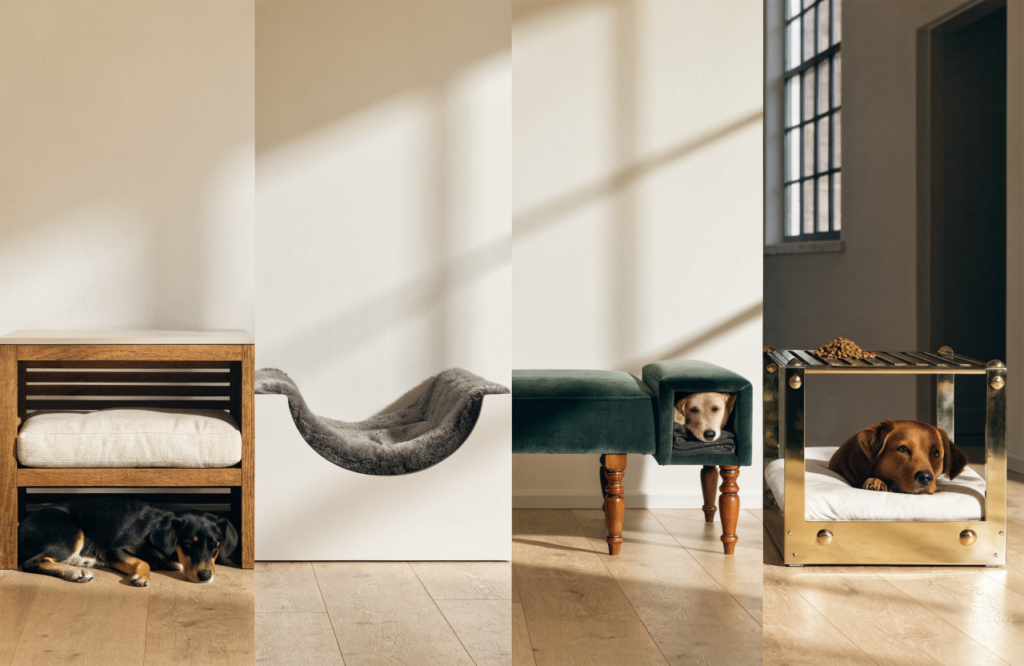
Retailers use the same phrase for products that do different jobs. Picking the wrong category is the usual reason these pieces get returned.
Open nook bench. A normal entryway, mudroom, or end-of-bed bench with an open cubby underneath or at one end. The dog walks in and out freely. A fitted cushion or orthopedic pad sits in the cubby. This is the most forgiving version for most homes, because the dog is never enclosed and you can swap the pad when it wears out.
Pet bed with a seat built over it. Products such as faux-leather pet bed benches put a cushioned cutout in the front or side of an ottoman-style seat. One widely sold version is about 38 inches wide, 18 inches deep, and 18 inches high, with a hinged top and a stated seat capacity around 250 pounds. The dog sleeps in the cutout; a person sits on the remaining surface. These suit small and some medium dogs. A Labrador will not fit the cutout on a piece that size.
Crate furniture bench. A wooden cabinet with a door, mesh or slatted sides, and a cushioned top. External footprints are often in the 47 to 56 inch range, with stated seat capacities commonly between about 220 and 300 pounds. This is furniture only if the interior still works as a crate: enough room to stand, turn, and lie down, airflow on more than one side, and a latch the dog cannot nudge open. A solid box with a pretty cushion on top is not a safe substitute for a wire or heavy-duty crate.
Raised sleeping bench. An outdoor or kennel platform, often phenolic-coated plywood on a treated frame, meant to lift a dog off cold or wet concrete. These are not living-room furniture. Chew strips along the edges and feet that keep the timber off the slab are what make them last in a run.
Match the style to the room, not the photo
An entryway or mudroom wants an open nook, wipeable surfaces, and a cushion you can pull out after a wet walk. Seat height in the 17 to 20 inch range is what adults can actually sit on to put shoes on. Depth of 18 to 24 inches is typical for a mudroom bench; a dog cubby often needs the deeper end of that range so the dog is not half in the hallway.
At the foot of a bed, width matters more than people expect. A bench that covers roughly most of the bed width looks intentional. A short ottoman in front of a king bed reads as leftover. If the bench is also the dog’s step up, the top needs a non-slip surface and the height should be a manageable fraction of the mattress height, not a second jump.
In a living room, an open nook or a low pet-bed bench keeps the dog in the room without a metal crate in the sightline. Enclosed crate furniture belongs where you can still see and hear the dog, not shoved against a wall that blocks the vents.
Outdoors, skip upholstered seats. A raised platform with a wipe-clean top handles weather. Fabric and foam do not.
Size the sleeping space before you size the bench
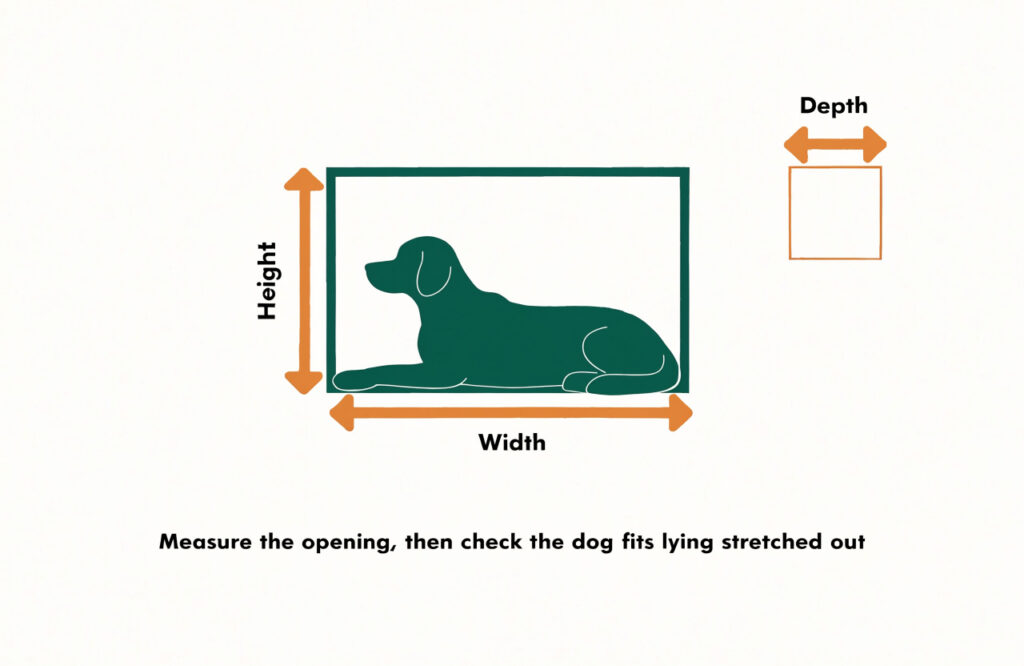
Measure the dog in the position they actually sleep in, not standing at a show stance.
- Length from nose to the base of the tail while stretched on their side.
- Width across the shoulders, or across the curled body if they always sleep in a ball.
- Height at the shoulders, plus head clearance if the nook has a top.
Add several inches to length and width so they can turn without hanging off the pad. A common working rule is about 6 to 10 inches extra on length. Round up if you are between sizes. A blanket can fill a slightly large nook. Nothing fixes a nook that is too short.
Then check the opening, not just the interior. The doorway should clear the shoulders with room to spare, and the threshold should be low enough that an older dog does not have to hop in. Senior dogs and short-legged breeds often refuse a nook with a high lip even when the interior looks generous.
For enclosed crate furniture, the same crate rule applies: the dog should stand without a crouched head, turn around, and lie fully down. Bigger is not automatically better if you are using it for short confinement, because some dogs will soil one end and sleep in the other. For an open sleeping nook, extra room is usually fine.
Human use still has to work. A seat at 17 to 20 inches is comfortable for most adults. Below about 16 inches, knees sit higher than hips. Confirm the stated weight rating covers the heaviest person who will sit there, and treat lightweight ottoman frames as closer to their limit than a hardwood bench with real joinery.
Materials that survive claws, mud, and sitting
| Material | Best for | Weak point |
|---|---|---|
| Solid wood frame, smooth finish | Open nooks, crate furniture | Water left in seams; claws on soft paint |
| Faux leather or leatherette | Pet-bed benches, muddy rooms | Punctures and peeling once the surface is broken |
| Performance fabric with a removable cover | Bedrooms, living rooms | Snags, and covers that are “spot clean only” |
| Metal frame with a wood or laminate top | High-traffic entries | Cold to the touch; can look industrial |
| Phenolic-coated plywood | Kennel and outdoor benches | Not a living-room material |
The cushion matters more than the frame for whether the dog stays. Look for a cover that unzips fully and can be machine washed, a waterproof liner under the foam, and foam deep enough that a heavier dog does not bottom out. Around 3 to 4 inches is a reasonable minimum for small and medium dogs; larger dogs and dogs with joint pain do better on a thicker orthopedic pad you can replace independently of the bench.
Avoid seagrass baskets, exposed foam bolsters, and loose throw pillows inside the nook. Those are the first things claws and teeth remove.
When a dog bed bench is the wrong purchase
A heavy chewer will dismantle wood corners, faux leather, and mesh doors. Elevated cot-style beds with a tight fabric over a metal frame, or a heavy-duty crate, hold up better than furniture in that case.
A dog that panics in small spaces will not settle in a closed crate bench just because the outside looks like a sideboard. An open nook is the fair test. If they will not enter that, the problem is not the finish.
Large and giant breeds often need more floor area than a standard bench cubby provides. A 38-inch pet bed bench is a small-dog product. For a dog over roughly 50 pounds, measure a real sleeping rectangle first and only buy a bench whose interior meets it.
Enclosed furniture also fails on ventilation. Slats or mesh on at least two sides, an unblocked door, and no thick cover draped over the vents are the minimum. Do not push the back tight to a wall if that is where the airflow is, and do not use the bench as unsupervised confinement unless the latch, the interior size, and the airflow would pass on a normal crate.
Setup that gets used
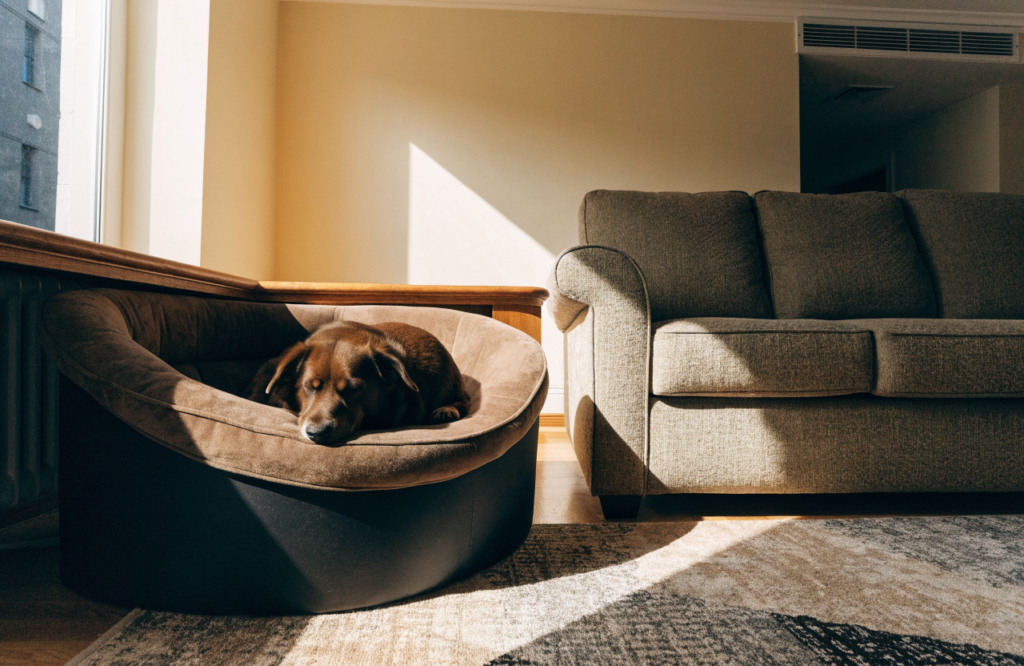
Place the bench where the dog already likes to be: near you, out of the main traffic line, away from heaters and drafty doors. A clear path of a couple of feet in front of the opening matters more than styling the top with pillows.
Put only the sleeping pad in the nook at first. Toys and blankets can come later if the dog does not treat them as something to drag out. For crate furniture, feed meals in the open unit and leave the door fixed open until the dog chooses it. Closing the door on day one to “make them use it” usually teaches them to avoid it.
In a mudroom, keep a towel and a washable pad within reach. Wet dogs plus fabric seats are how these benches start to smell. Wipe wood seams the same day water gets on them.
If the bench is also a step to the bed or sofa, add a non-slip topper and teach the route on leash before you expect the dog to invent it. Getting down is the harder impact. A low bench helps only if the remaining drop is small.
Problems that show up after the first month
The dog sleeps beside the bench, not in it. The opening is tight, the pad is thin, or the nook is darker and more enclosed than the dog wants. Lower the lip, swap in a thicker pad, or leave one side more open.
The seat sags or rocks. Lightweight frames and thin plywood lids show this once two people sit down. Check the rating before you buy, and look for a solid top and legs that bolt on rather than cam locks alone.
Fur and odor in the foam. If the cover does not fully remove, the foam is the bed. A waterproof liner and a second cover solve this more reliably than spot cleaning.
Claw marks on the front edge. A smooth finish or a replaceable edge strip holds up better than tufted fabric on the corner the dog launches from. Nail trims reduce the damage; they do not remove it.
The crate door becomes décor. If you need real confinement, the latch has to lock from outside and the dog should not be able to nose it open. Furniture latches are often weaker than crate latches.
Frequently asked questions
Can a storage bench replace a dog bed bench? Only if the dog has a clear cubby that is not also full of shoes. A lift-top ottoman is storage, not a bed, unless you add a separate open sleeping spot. Do not shut a dog inside a storage compartment.
Is an end-of-bed bench enough for a senior dog to reach the mattress? Sometimes, if the bench height splits the jump into two short steps and the top does not slide. Many seniors still need a ramp or wider steps. Measure the mattress height and compare it with the bench before treating the bench as mobility equipment.
Do these work for two dogs? Only with two openings or one long nook that lets each dog lie fully without sharing a single tight cutout. One small pet-bed bench is a one-dog product.
How often should the cover be washed? Weekly in a muddy season, every couple of weeks in a dry home, and immediately after an accident. That is why a removable cover is not optional.
Are outdoor sleeping benches safe in winter? A raised platform keeps the dog off wet concrete, which helps. It does not replace shelter, bedding appropriate to the temperature, or a dry kennel. Phenolic coatings wipe clean; they do not insulate.