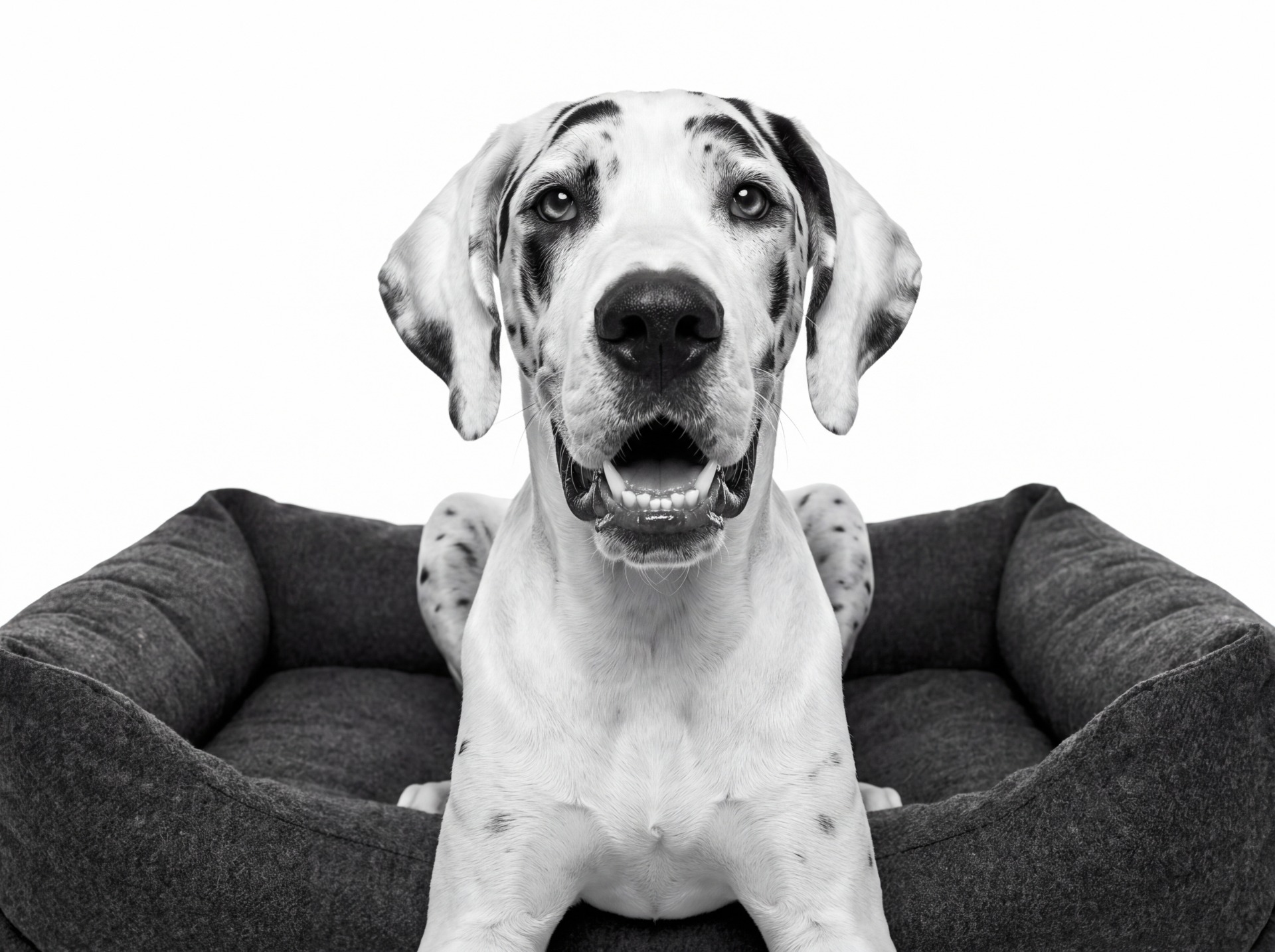
A round dog bed is the right shape when a dog circles, curls, and leans into an edge. The continuous raised rim — the feature that turns a round cushion into a donut, cuddler, or “calming” bed — gives a chin rest and a boundary on every side. It is not a better bed than a rectangle for every dog. Dogs that sleep stretched out lose usable floor to the bolster, seniors can struggle to step over a tall rim, and loose fiberfill flattens under anything heavier than a small dog. The useful choice is narrower: match the outline to how the dog actually sleeps, size by the inner sleeping circle rather than the outer diameter, and pick a fill that will still hold the dog up after months of daily use.
When a round dog bed matches the sleeper
Most dogs circle before they lie down. A round bed supports the dogs that then finish that circle as a ball: nose toward tail, back against something soft, head on a rim. The continuous bolster means there is no empty corner and no preferred side. That is the practical difference from a rectangular bolster bed, which only supports the head where the raised edge happens to be.
The shape also holds warmth. A curled dog radiates heat into a smaller pocket, and plush walls reflect some of that heat back. That is useful for small dogs, short-coated dogs, and cooler rooms. It is a drawback for thick-coated dogs and hot sleepers, who often abandon a deep faux-fur nest in summer.
A defined edge can help some restless dogs settle, because it gives them something to press against — the same reason many dogs choose a corner, a sofa crease, or the space under a chair. Marketing that calls every donut bed an anxiety treatment overreaches. Research on pressure garments in dogs is limited and mixed, and a bed is not a substitute for training or veterinary care when anxiety is severe. Treat the rim as comfort and a cue for rest, not as therapy.
When a rectangle is the better fit
Skip the round shape, or keep it as a second bed, if the dog usually sleeps on its side with legs extended. A sprawler needs length. The bolster that makes a round bed feel enclosed also steals sleeping surface: a bed sold as 36 inches across can have an inner circle several inches smaller once the wall thickness is subtracted.
Also look elsewhere if the dog has trouble rising, hip pain, or a long back that needs to stay straight. Low-entry orthopedic rectangles are easier to step onto and give the spine a flat line to lie along. A bed cannot treat arthritis. New stiffness, limping, or trouble getting up is a veterinary question, not a bedding question.
Size the inner circle, not the product label

Weight charts are a rough starting point and a common reason dogs ignore a new bed. Brands do not share one sizing standard. What matters is the usable inner diameter — the flat floor inside the rim — compared with the circle the dog makes when curled.
Measure while the dog is relaxed, not standing:
- Curl measurement: the distance across the dog when it is tucked nose to tail, or nose to the base of the tail if it will not hold a full curl.
- Side measurement: nose to the base of the tail while lying on its side, plus the width from back to outstretched paws. This catches the nights it stretches.
- Add about 4 to 6 inches (10 to 15 cm) to the curl measurement so the dog is not touching both walls at once. A bed so large that the rim never makes contact loses the nest effect; a bed so small that elbows hang over the bolster gets abandoned.
- Compare that figure with the maker’s inner sleeping area. Outer diameter includes the bolster and overstates the space the dog can use.
A product example shows how large the gap can be. One orthopedic round bed lists a small size at 74 cm outside and 48 cm inside — the wall takes roughly 13 cm off each side. A 20-inch curled dog in that bed would be cramped even though the outer number looks generous.
Approximate outer diameters, for orientation only:
| Dog weight | Typical outer diameter | What to verify |
|---|---|---|
| Under 10 lb (4.5 kg) | 20–26 in (50–66 cm) | Inner circle still fits a full curl; too big can feel drafty |
| 10–25 lb (4.5–11 kg) | About 30 in (76 cm) | Bolster not so tall that short legs cannot step over it |
| 25–50 lb (11–23 kg) | 36–40 in (91–102 cm) | Inner diameter, not the label “large” |
| Over 50 lb (23 kg) | 40 in (102 cm) and up | Whether a round bed this size exists with real foam support; many large dogs do better in a rectangle |
Long-legged or deep-chested dogs often need the next size up even when weight suggests otherwise. Two dogs sharing a bed need the larger dog’s stretched length, not the sum of two curls. When in doubt between sizes, go up — unless the dog is a tiny curler that only settles when the walls are close.
Fill decides whether the bed still works in six months
The raised rim is mostly polyester fiberfill. That is fine. The base is the part that fails.
Loose polyester fill is soft, light, and often fully washable. It also migrates and compresses. Under a medium or large dog it can become a thin pad within months, so the dog is effectively sleeping on the floor inside a fluffy ring. High-loft or siliconized fiber holds shape longer than cheap stuffing, but it is still a cushion, not joint support. It suits small dogs, light use, and dogs that mainly want to nest.
Shredded foam, or a blend of chopped foam and fiber, keeps more structure and conforms around hips without the sunk-in-place feel of a solid slab. It is the usual upgrade in mid-range donut beds. Solid memory foam or high-density orthopedic foam supports weight better and resists permanent dents, which matters for seniors, heavy dogs, and any dog with joint discomfort. Foam quality varies. Low-density foam marketed as orthopedic can flatten in a season. Look for a stated density — orthopedic-grade foam is commonly discussed around 3 lb per cubic foot (about 48 kg/m³) or higher — and a thickness of about 4 inches for a medium dog, more for a large one. Many listings omit density. If they do, treat “orthopedic” as a style name until the maker specifies the foam.
Memory foam holds heat. Gel-infused foam and egg-crate cuts breathe better but still need a cover the dog can tolerate in warm weather. Foam inserts should not be soaked or machine-washed; water breaks the structure down. A waterproof liner between cover and fill is what keeps accidents, drool, and wet paws off the foam.
Cover, rim, and base details that change daily use
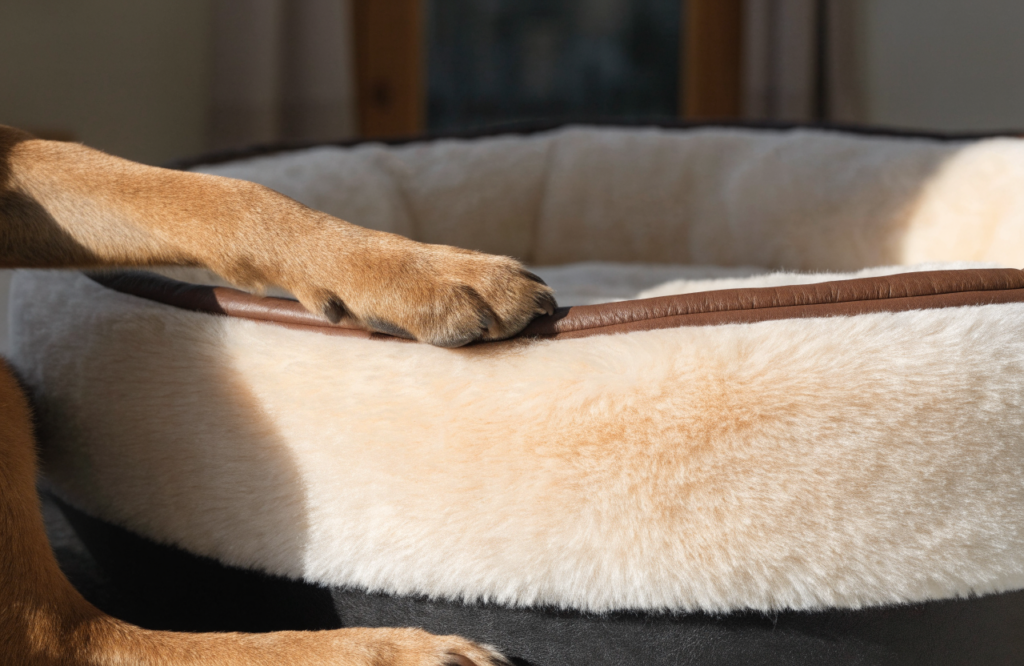
A removable, zippered cover is the feature that decides whether the bed stays in the house. Faux fur and sherpa feel nest-like and trap hair; they pill if washed hot. Canvas, ripstop, and ballistic nylon survive scratching and are easier to wipe, at the cost of softness. A heavier faux fur (sellers sometimes list grams per square meter) mats less than a thin pile. Check the care label before buying: some covers are machine-washable on cold and must be dried low, and waterproof coatings can crack under high heat.
Rim height is a tradeoff. A taller bolster gives more chin support and a stronger enclosed feeling. It also becomes a step. Short-legged, elderly, and post-surgery dogs need a low entry or a rim they can push through rather than climb. If the bolster collapses under the weight of the head, it is not support — it is decoration.
A non-slip base matters on hard floors. Raised beds slide when a dog jumps off, and a sliding bed teaches the dog not to trust it. For chewers and diggers, soft plush is a toy. Ballistic or canvas covers last longer, but no bed is chew-proof. A dog that guts bedding needs a different management plan, not a more expensive donut.
Raised or hooded round beds add den cover at the cost of heat and access. Useful for anxious curlers in a quiet corner; poor for dogs that overheat or need to be lifted in and out.
Round versus rectangular, by the job
| Decision | Round or donut bed | Rectangular bed |
|---|---|---|
| Best sleep style | Tight curl, chin on the rim, nesting | Side sleep, sprawl, frequent position changes |
| Head support | All the way around | Only where a bolster exists |
| Warmth | Higher, especially with plush walls | Lower and easier to cool |
| Joint support | Only if the base is real foam, and the rim is easy to cross | Easier to find in thick orthopedic foam with a low entry |
| Floor space | Circular footprint; corners of the room go unused | Fits against walls and inside many crates |
| Shared use | Works for two small curlers | Better when dogs stretch beside each other |
Many households end up with both: a round nest for evening curling and a flat orthopedic pad for daytime sprawling. One bed does not have to cover every position.
Mistakes that make the bed get ignored
- Buying by weight label alone. A 30-pound dog that sleeps stretched needs more inner length than a 30-pound dog that sleeps in a ball.
- Trusting the outer diameter. Always ask or check for the sleeping surface inside the wall.
- Choosing plush fiberfill for a senior or a heavy dog, then blaming the shape when the center goes flat.
- Putting a tall-rim bed in front of an older dog and expecting it to climb in. Place it where the dog already rests, and make the first entries easy.
- Washing the whole bed, foam included, because the cover did not unzip. That is how liners peel and foam collapses.
- Treating a new bed as a fix for separation anxiety. Use it as a calm resting place; get behavior help if the dog panics when left.
If the dog sniffs the bed and leaves, try a worn T-shirt or an unwashed blanket from the old bed on top for a few nights, and do not move the bed around the house while the dog is deciding.
Cleaning and when to replace it
Shake out hair, vacuum the seams, and wash only the cover unless the label says the insert is washable. Use a mild, fragrance-free detergent. Dry the cover completely before reassembling — damp fill grows odor. Spot-clean foam, then air it out. Do not soak it. A waterproof liner saves the insert from the occasional accident; repeated house soiling is a medical question, not a laundry one.
Replace the bed when the center stays compressed after fluffing, seams split, the liner cracks, or smell survives washing. Fiberfill beds reach that point sooner than a dense foam base. A cover can often be washed for the life of the insert; the insert is what determines replacement.
Questions buyers usually still have
Is a donut bed the same as a round dog bed? In product listings, yes. Donut, calming, cuddler, and marshmallow beds are round beds with a raised bolster. A plain round cushion without a rim is a different product and does not give the same head support or nest feeling.
Are round beds good for large dogs? Only if the inner diameter fits a curl and the base is supportive foam. Many large dogs sleep stretched and will hang off a round bed. For those dogs a rectangular orthopedic bed is the more honest match.
Do round beds help anxious dogs? Some dogs settle faster with a familiar edge to lean on, especially if the bed stays in a quiet spot and is introduced without pressure. That is not the same as treating anxiety. Severe distress needs a veterinarian or a qualified behavior plan.
Can a round bed go in a crate? Only if the crate floor is large enough for the outer diameter and the dog can still stand and turn. Most crates are rectangular, so a round bed wastes corner space and can block the door. A flat crate pad is usually the better fit.
How do I stop the bed from sliding and shedding everywhere? Choose a non-slip underside and a removable cover you can wash weekly during heavy shed season. A washable throw on top of a good base protects the main cover without hiding the rim the dog wants to lean on.