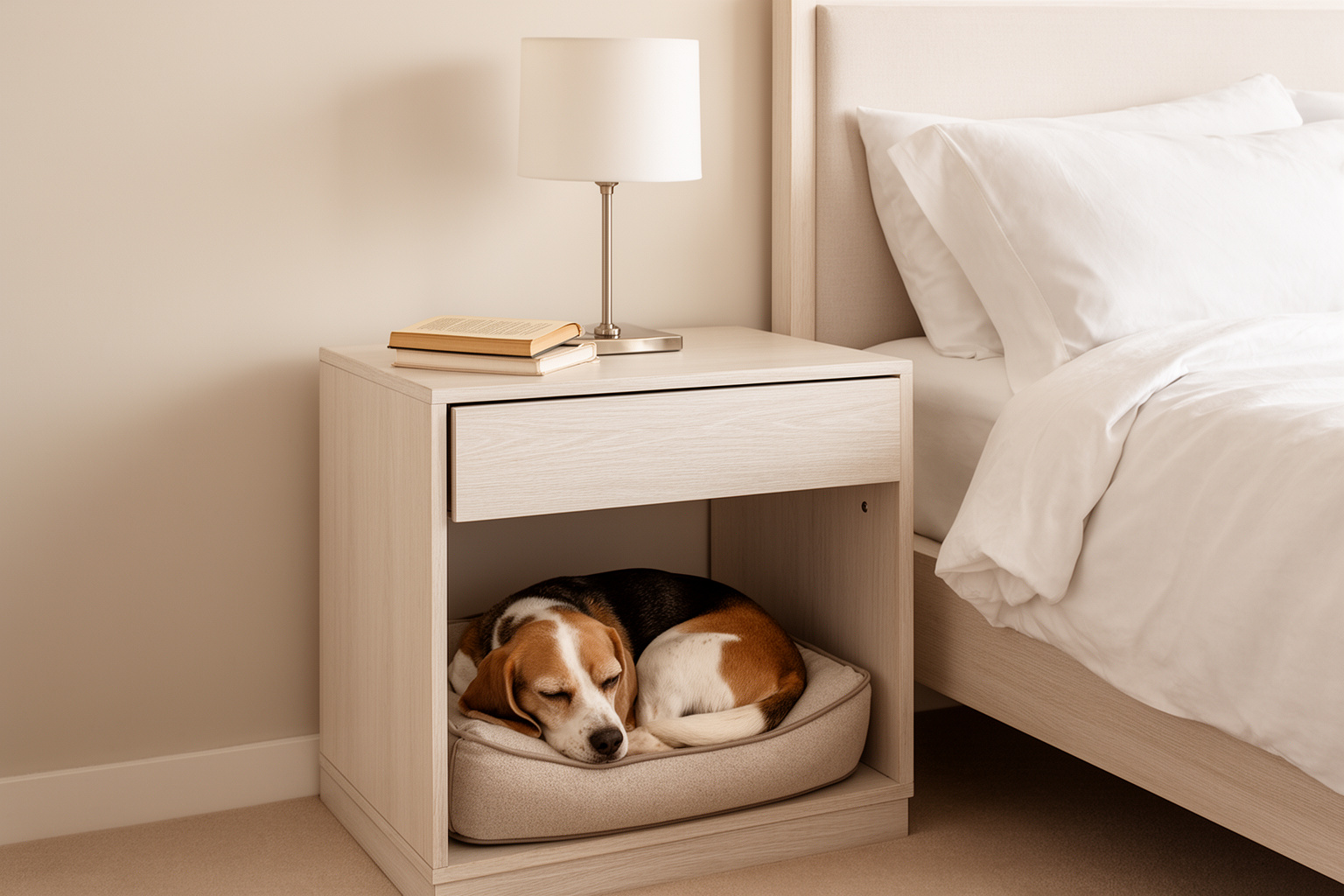

A dog bed nightstand is a bedside table with a sleeping space built into the lower half, so the dog rests beside the bed while the top still holds a lamp, phone, and glasses. Most retail versions fit small and medium dogs, not large ones, and the piece only works if two measurements line up: the interior bed with the dog’s sleeping length, and the tabletop with the top of the mattress.
Open models look like a nightstand with a cushioned shelf. Enclosed models are furniture-style crates with a flat top. A third option, often the better one, is an ordinary nightstand with a separate dog bed underneath it.
What the furniture is supposed to do
The appeal is proximity without sharing the mattress. The dog is close enough to hear and smell you, off the floor drafts, and out of the walkway. The room still has a place for a lamp.
That only holds if the piece is a real nightstand, not a pet bed with a thin board on top. A usable tabletop needs enough depth for a lamp base that will not tip, a flat edge you can reach without leaning off the mattress, and a stated weight limit for whatever sits on it. On the New Age Pet ECOFLEX nightstand dog bed, one widely sold open model, the maker lists the top and the middle shelf at about 20 pounds each and the bed area at about 50 pounds, with exterior dimensions around 22 by 30.7 by 27 inches. Those numbers are typical of the category, not an exception.
Mass-market versions usually run from under $100 to about $200. Furniture-store versions, including New Age Pet pieces sold through retailers such as Raymour & Flanigan, land higher, often in the $150 to $500 range depending on finish and seller. Designer crate furniture costs more again.
Open shelf, enclosed crate, or a normal nightstand with a bed under it
These are different products that get lumped under one search term.
Open nightstand with a cushion. Three sides are open or lightly railed, and a bolster pad sits on the lower shelf. Entry is easy, airflow is good, and an older dog does not have to step over a high lip. The dog can also leave whenever it wants, which is a feature if the goal is a nap spot and a problem if the goal is containment overnight. Listings for open end-table beds such as the ALBAD style often cite roughly 31 by 22 by 28 inches and a 50-pound pet rating.
Furniture-style crate. Wood or a wood-look shell, wire or slatted sides, and a door. The top is the nightstand. This is the right shape if the dog already crate-sleeps and you want the crate to disappear into the bedroom. It is the wrong shape for a dog that panics in small enclosed spaces, or for anyone who needs the dog to come and go during the night. Some models add a drawer or a charging strip on the top. Interior floor space is what matters, and many listings only publish the exterior.
Separate nightstand plus a dog bed. A standard nightstand with open space underneath, and a bed you already know the dog likes, solves the sizing problem that integrated furniture creates. You can replace a flattened cushion without replacing the table. You can also move the bed if the dog refuses the spot. The tradeoff is a less finished look, and the nightstand legs need enough clearance that the bed is not pinched.
| Setup | Best when | Weak when |
|---|---|---|
| Open cushioned shelf | Dog wants to see the room; easy in-and-out matters; dog is under ~50 lb | You need the dog contained; dog is a chewer |
| Enclosed crate nightstand | Dog already sleeps in a crate; you want doors and a cleaner silhouette | Dog dislikes confinement; interior is smaller than the photo suggests |
| Normal nightstand + separate bed | You want to match mattress height and bed size independently | You want one piece of furniture and a built-in look |
Size the sleeping space to the dog, not the product photo
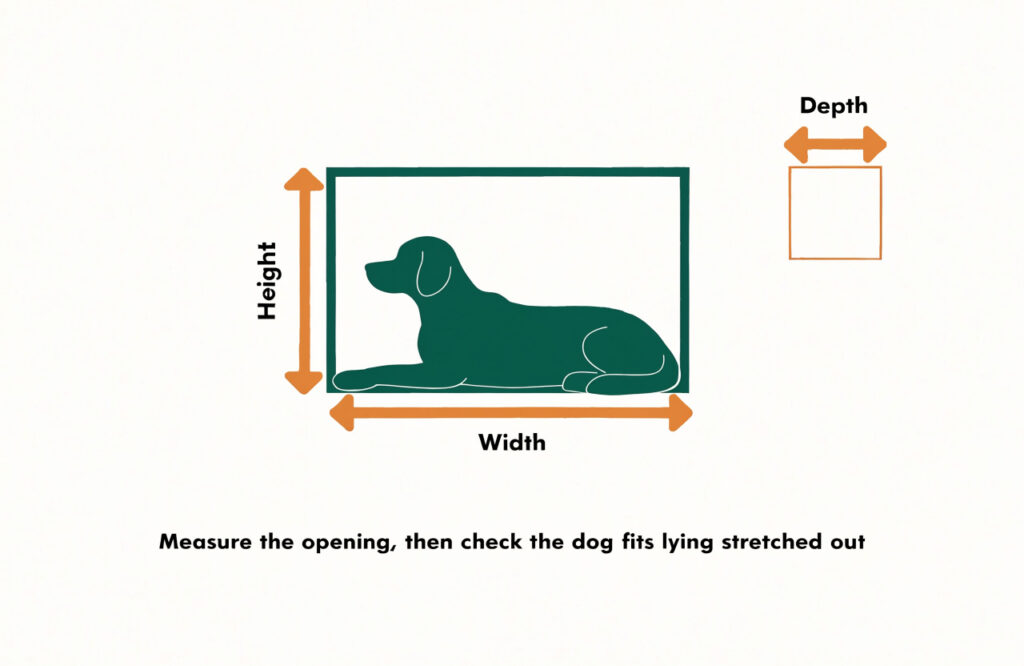
Weight ratings on these products are a load limit, not a fit guide. A 45-pound dog with a long back can overflow a bed that is “rated” to 50 pounds.
Measure the dog lying in the position they actually sleep in, from nose to the base of the tail, not the tail tip. Add about 6 inches if they curl, and 8 to 12 inches if they stretch. That number is the minimum interior length. Width should clear the shoulders with a few inches to spare. Then subtract the frame: rails, bolsters, and a thick cushion eat several inches that the exterior dimensions hide.
A common open model in this category has an exterior footprint near 31 by 22 inches. After rails and a bolster, the usable pad is often closer to a small or medium dog bed. That suits many Chihuahuas, Cavalier King Charles Spaniels, French Bulldogs, Cocker Spaniels, and compact mixed breeds. It does not suit a Labrador, a standard Poodle, or most dogs over 50 pounds who sleep stretched out. Product photos frequently use a small dog, or a dog that would not fit the listed size. If the listing does not publish interior length and width, assume the fit is tighter than the exterior and skip it unless you can measure a floor model.
Entry height matters as much as floor space for seniors and dogs with back or hip pain. A lip more than a few inches high, or a step the dog has to climb, is a reason to choose an open, low-entry design or a floor bed under a regular table. Stairs on some wooden models look helpful and still require the dog to commit to the climb every night.
Match the tabletop to the mattress, then check the floor plan
Standard mattress tops sit roughly in the mid-20-inch range once the foundation is included, which is why so many of these pieces are 24 to 28 inches tall. The useful test is specific to your bed.
Measure from the floor to the top of the mattress. The nightstand top should land at that height or up to about 2 inches above it, so a hand can find the lamp or phone without a sit-up. Much lower and the table is an end table, not a nightstand. Much higher and it blocks the pillow line and feels awkward to reach.
Also measure the floor gap beside the bed. A 31-inch-wide piece needs that much clear wall, plus room for the door of an enclosed model to swing, plus enough aisle that you are not stepping over the dog. Platform beds with a low frame can block the dog from tucking fully underneath the bed edge, so the nightstand has to sit fully beside the frame, not partly under it.
On the top, leave a lamp base at least a couple of inches in from the edge. A listed 20-pound top capacity, which is what Petco publishes for the ECOFLEX nightstand, rules out a heavy ceramic lamp plus a stack of books plus a full water glass. Put the glass on a coaster. Composite and particleboard tops stain when water sits on them.
Materials, cleaning, and what fails first
Frames in this category are usually a wood-plastic composite, particleboard with a veneer, metal tubing with a wood-look top, or solid wood on DIY and higher-end crate builds.
Composite such as New Age Pet’s ECOFLEX is sold as moisture-resistant and non-toxic, which is a real advantage over raw particleboard if a dog has an accident. It is still not chew-proof. The same brand’s product directions say indoor use only and not chew proof. Customer reviews on the ECOFLEX nightstand are mixed on durability: some dogs use it without trouble, and a visible share of buyers report cracking, flimsy joints, or parts failing in assembly. That pattern is common across inexpensive pet furniture, not unique to one listing. A one-year warranty on the composite shell is only useful if you keep the receipt and the damage is a material defect rather than chewing.
Particleboard is lighter and cheaper and swells if urine or a spilled bowl soaks an edge. Metal frames are stiffer under a jumping dog but can rack if the feet are not level. Solid wood holds up better and costs more; it still needs a finish that can be wiped.
The cushion is the part you will replace. Prefer a cover that unzips and is machine washable, and a pad you can remove entirely so the shelf can be wiped. Hand-wash-only covers, which some composite nightstands specify, get abandoned after the second accident. Foam in included pads is often thin. If the dog is middle-aged or has joint trouble, plan on swapping in a denser orthopedic pad cut to the interior, as long as the added height does not block the opening.
Nothing in the mass-market group should be treated as chew-proof. A dog that destroys beds needs a metal or aluminum elevated bed, or a crate with protected edges, not a cushioned nightstand.
When a dog bed nightstand is the wrong purchase
Skip the integrated piece if the dog is over 50 pounds and sleeps stretched out. The category barely makes beds large enough, and the tabletop becomes an awkward wide bench rather than a nightstand.
Skip it if the dog resource-guards the bed, or if you need a closed door for safety with other pets or children. An open shelf is not a crate.
Skip it for a persistent chewer, a dog that leaps onto furniture, or a bedroom where the nightstand has to hold a heavy lamp and a CPAP machine. The stated top limits on popular models are modest.
Skip it if the dog already refuses every bed except the couch. Moving the bed closer to you does not fix a preference for elevated human furniture. Some small dogs end up sleeping on the tabletop instead of in the cubby, which is unstable and knocks off the lamp.
A floor bed beside the bed, or a low ottoman the dog is allowed on, is the honest alternative in those cases.
Setting it up so the dog uses it
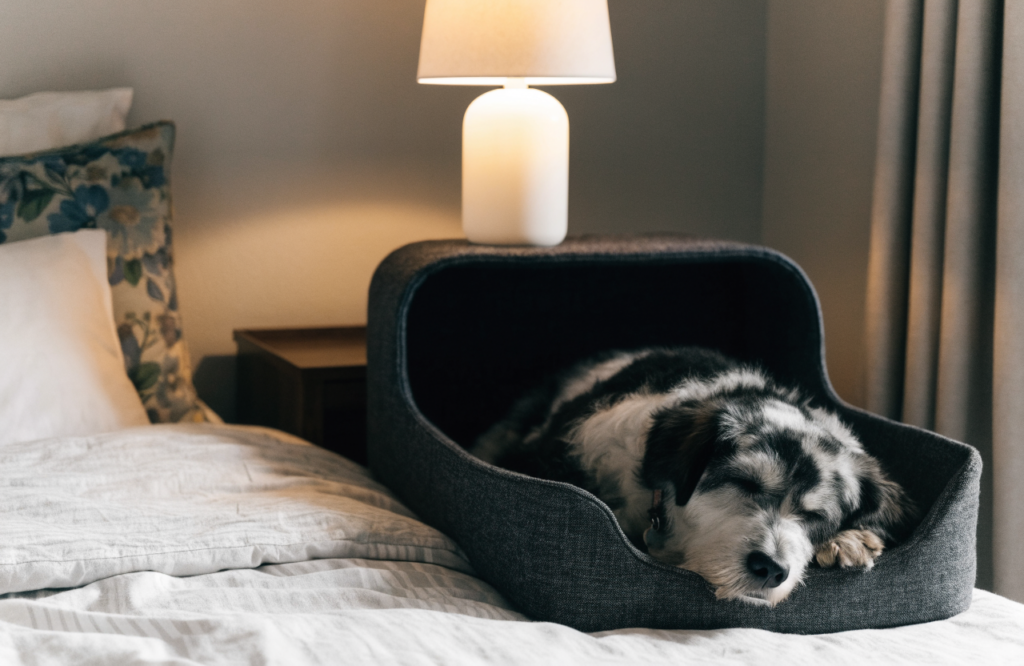
Place the nightstand on the side of the bed where you sleep, not the far side, if the point is company. Dogs settle faster next to the person they track.
Put the current bed or a worn T-shirt in the cubby for a few nights before you retire the old bed. Feed a chew or a stuffed food toy in the spot during the evening, then leave the dog alone in it. Forcing a dog in and closing a door on the first night teaches the opposite of what you want, unless this is already their crate and you are only changing the furniture around it.
Level the feet. A rock on the front corner is what makes lightweight frames creak and, over time, crack at the joints when a dog hops in. A rug under the piece keeps it from walking across hard floors.
Keep the top clear enough that a wagging tail or a shake after drinking cannot sweep a glass onto the cushion. Wash the cover on the schedule you already use for other dog beds, and sooner after any accident, because the enclosed lower shelf holds odor even when the frame itself does not absorb it.
Frequently asked questions
Can a large dog use a dog bed nightstand? Only if the interior, not the weight rating, fits a stretched-out body. Most sold-as-nightstand models are built for dogs under about 50 pounds. A large dog usually needs a furniture crate in a bigger end-table or bench size, or a normal nightstand with a large bed beside it.
Is the top safe for a lamp? Yes, if the lamp and everything else stay inside the listed top capacity and the base sits well in from the edge. On the ECOFLEX nightstand, that published top limit is about 20 pounds. A heavy lamp on a lightweight composite top is a tip risk, especially if the dog bumps the frame getting in.
Will the dog sleep in it? More often if they already like a covered or bolstered bed and the cubby is big enough to turn around in. Dogs that want to sprawl, or that only sleep on the human bed, often ignore it. Treat the first week as a trial, not a finished decision.
Open or enclosed? Open if the dog is older, anxious in crates, or you only want a voluntary nap spot. Enclosed if you already crate-train and need a door. The enclosed version is not automatically calmer. Some dogs rest better when they can see the room.
Are these chew-proof? No. Product directions on major composite models say they are not. A chewer will damage rails, cushions, and veneer. Choose a different bed style if chewing is the main problem.