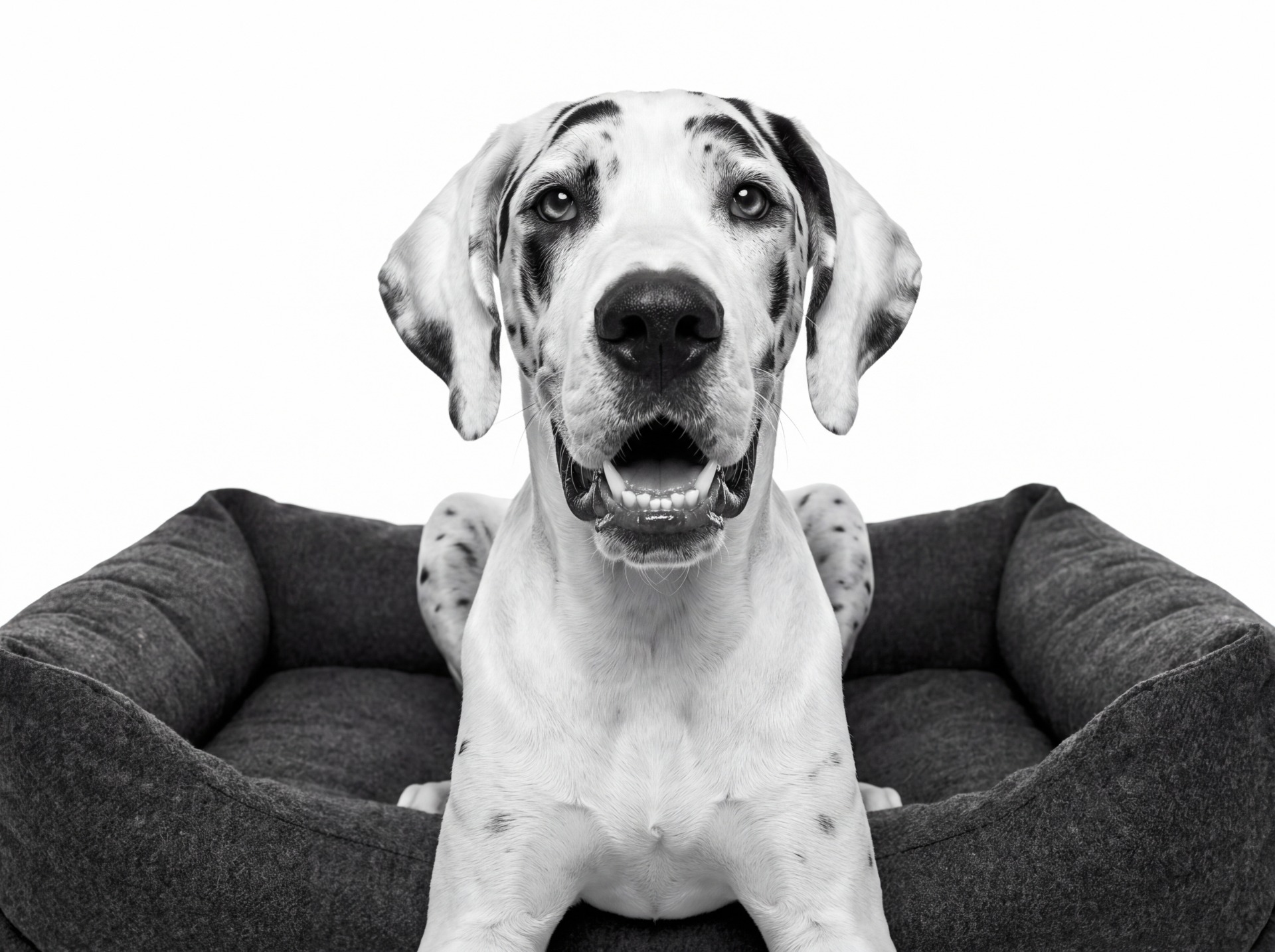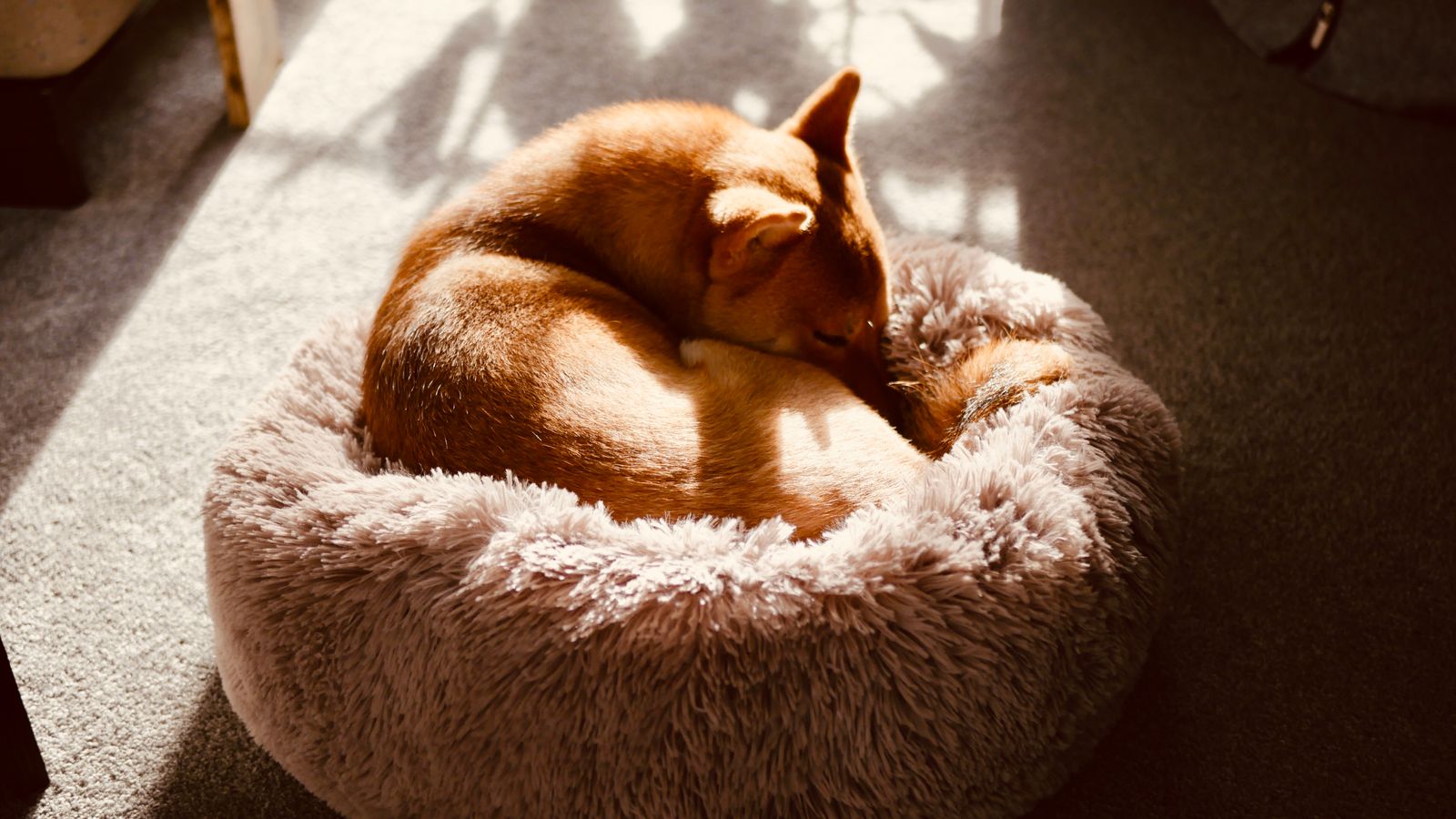

A donut dog bed is a round nest with a continuous raised rim and a softer center, built for dogs that sleep curled rather than stretched out. The rim gives them a place to rest their head and a wall to lean into. It is a good match for tight curlers, many small or short-legged dogs, and dogs that settle better when they feel enclosed. It is a poor match for sprawlers, heavy chewers, and dogs that need a firm orthopedic surface or an easy step-in edge.
The listing photo is the easy part to get wrong. Outer diameter includes the bolster, so the usable sleep area is much smaller than the number on the box. A bed that looks huge on the floor can still press a medium dog against the rim.
What a donut dog bed actually is
A donut dog bed, also sold as a cuddler, nest, or bagel bed, is a circular cushion with one unbroken bolster around a recessed middle. The dog curls into the dip and can park its chin on the wall from any side. Rectangular bolster beds do something similar, but only along one or two edges, and they leave an open side for stretching.
Most budget versions are stuffed with polyester fiber in both the rim and the center. Better ones keep a structured base — egg-crate foam or a thin foam slab — under a plush top, so the middle does not collapse into a pancake while the rim stays tall. Faux fur and sherpa are the common covers because they feel warm and nest-like. Corduroy and microsuede hold up better against claws and wash more cleanly, at the cost of that cloud look.
The “calming” label is a shape claim, not a medical one. The enclosed rim copies the way many dogs already sleep against a sofa, a wall, or another dog. That can help a restless dog settle. It does not treat separation anxiety, noise phobia, or pain.
Which dogs it suits, and which it does not
Sleep position matters more than breed or weight.
Tight curlers and smaller dogs
Dogs that tuck their nose toward their tail and stay in a ball are the core audience. Short-legged breeds often like the rim because they can rest a head on it without climbing. Toy and small dogs also keep the enclosed feeling if the bed is actually small. A Chihuahua in a 45-inch donut loses the nest and just has a round rug.
Cats use the same beds for the same reason. If a dog and cat share one, size it for the larger animal and accept that the smaller one may claim the rim.
Dogs that settle when they have a boundary
Some anxious or newly adopted dogs pace less once they have a defined edge to press against. A snug donut can work as one piece of a routine — same spot, low traffic, a familiar smell — not as the routine itself. If the dog already hides in laundry baskets or under blankets, a donut or a hooded cave bed is a reasonable test. If the dog wants to see the door and sprawl, the wall can feel like a trap.
Seniors who lean, with a limit
Older dogs often rest a head or a hip against a bolster. A soft rim can be comfortable for that. It is not a substitute for pressure-relieving foam. Most fiber-filled donuts compress under a large or arthritic dog, so elbows and hips still bottom out. Dogs that struggle to step over a high edge are better in a flat orthopedic bed or a bolster sofa with one open side. A stiff dog should not have to climb a wall to lie down.
When to skip a donut bed
- The dog sleeps on its side with legs extended. The round wall blocks that posture.
- The dog is a determined chewer. Torn faux fur and loose fiber fill are an ingestion risk, and almost no plush donut survives serious chewing.
- Joint disease is the main problem and the dog is medium or large. Look for a foam orthopedic bed first. A donut with a real foam base is a compromise, not the same thing.
- The dog is still in a heavy teething phase. A cheap, replaceable bed is safer until the chewing slows.
Size by the inner nest, not the outer diameter
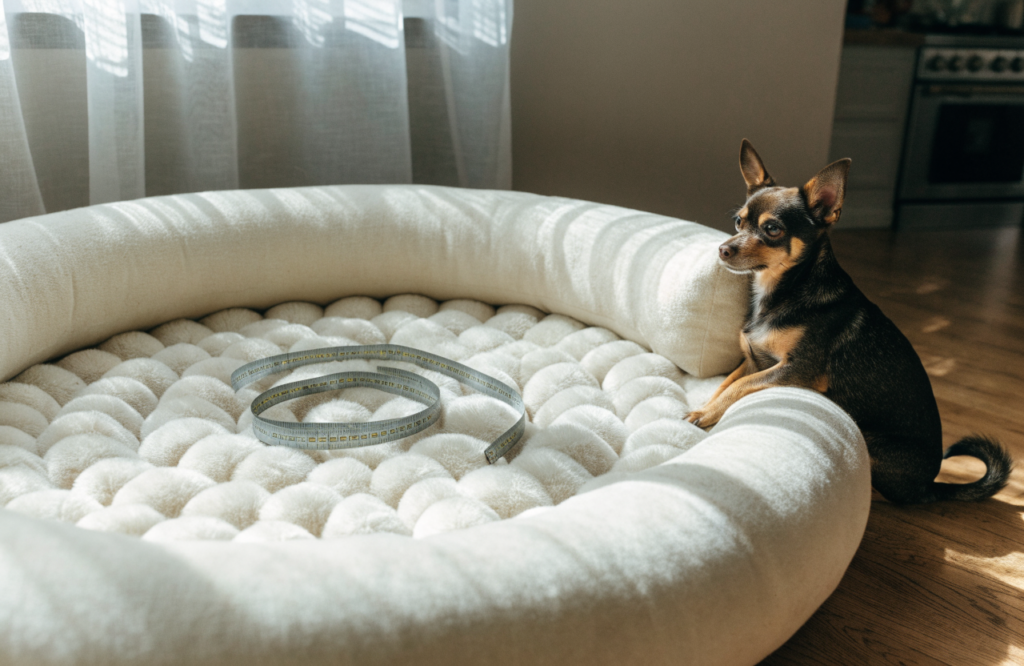
This is the mistake that sends most donut beds back. Brands advertise the outer diameter. The bolster eats a large share of that circle.
Published dimensions show how wide the gap is. One maker’s medium is 30 inches outside and only 12 inches inside; its large is 36 inches outside and 15 inches inside. Across brands, a “small” often lands around 20–24 inches outside with an inner cushion of roughly 7–13 inches, and a “large” can be anywhere from 30 to 40 inches outside.
How to measure
- Wait until the dog is curled in its usual nap posture, not standing.
- Measure from the nose to the base of the tail along the curve of the body.
- Measure across the shoulders at the widest point of that curl.
- Compare those numbers to the inner diameter if the brand lists it. If it only lists the outer diameter, assume the sleep area is several inches smaller on every side.
- Add a little room so the dog is not jammed against the fill. Guides commonly suggest roughly 15–20 percent, or a few inches, on top of the curled measurement. Brand charts do not agree, so the dog’s curl is the better number.
Weight charts are only a shortcut. A long, light dog such as a greyhound or dachshund can be “small” by pounds and still too long for a small nest. A compact, heavy dog can fit a size the weight chart calls too small.
The snug-versus-roomy tradeoff
For a calming effect, the rim should still touch the dog when it is curled. Too much empty center and the bed stops feeling enclosed. For comfort, the dog needs enough space to shift without being pinned. If the dog is between sizes, size up when it sometimes stretches, and stay with the smaller size only if it is a true ball-sleeper and the inner diameter still clears the nose-to-tail curl. A bed that is slightly roomy beats one the dog abandons because it cannot turn around.
What to check before you buy
Fill and whether the shape will last
Fiber fill is what makes a new donut look like a cloud. It is also what goes lumpy after a few washes or a few months under a heavier dog. Look for a base that is separate from the bolster: a foam or egg-crate layer in the middle, and dense fill only in the rim. Sectioned bolsters, with the ring split into several pads, shift less than one long tube of stuffing and are easier to wash.
Vacuum-packed beds need time. Knead the fill and give it up to a day or two to loft. A short tumble on low heat helps some fiber beds recover, if the care label allows it. If the rim is still flat after that, the fill was light to begin with.
Cover, zipper, and washing
A removable, machine-washable cover matters more than the color. Small donuts from some brands can go in the washer whole. Larger ones usually need the cover washed separately from the fill, because a soaked 36- or 45-inch bed will not fit a home machine and can take days to dry. Best Friends by Sheri, a common donut brand, tells owners to machine-wash cold on gentle and tumble dry low, and not to air-dry the shag, which mats. Always follow the tag on the bed you bought. Zippers are the usual failure point, so a long zipper with a decent pull is worth more than extra fluff.
Faux fur traps hair and, on cheap polyester, can hold a strong static charge. Owners of low-fat sighthounds sometimes find budget “cloud” beds cling to fur and clothing. A tighter weave or corduroy cover sheds less and snags less on nails.
Bolster height and the way in
A rim of roughly 6 inches or more gives a medium dog a real chin rest. Taller is cozier until the dog has to step over it. Puppies, seniors, and dogs with back or hip pain do better with a lower entry or an open-front bolster bed. Non-slip bottoms matter on hard floors. A waterproof liner under the cover saves the fill after an accident.
Chewers, diggers, and puppies
Digging at the center is normal nesting. Digging that opens a seam is not. If the dog already destroys beds, a plush donut is the wrong category. Use a chew-rated mat until the behavior changes, and do not leave a torn fiber bed where the dog can eat the stuffing.
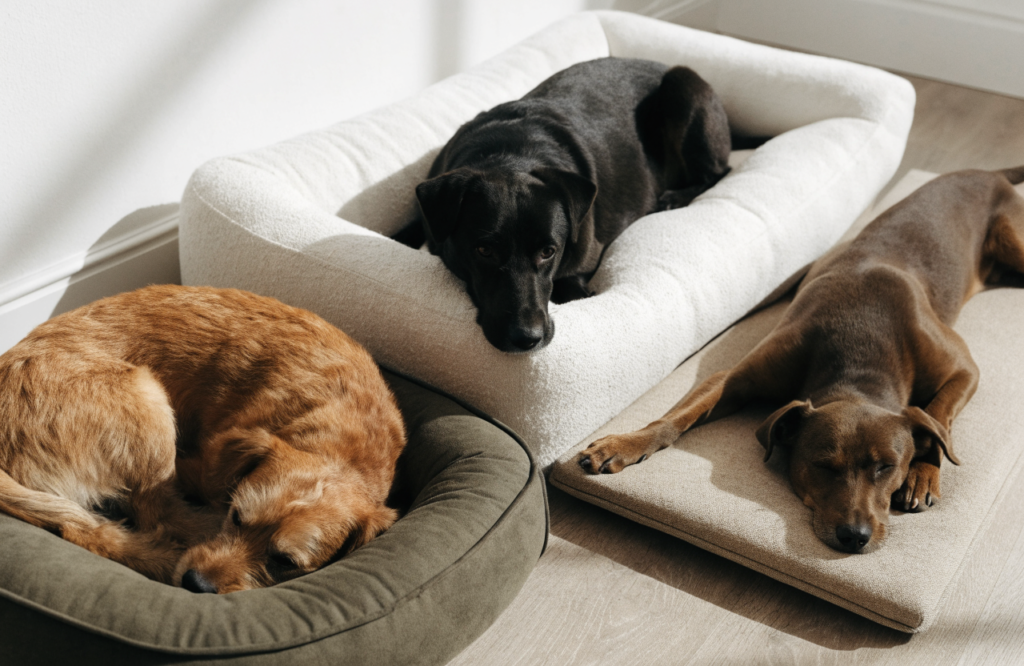
Donut bed vs bolster sofa vs flat orthopedic
| Question | Donut bed | Bolster sofa | Flat orthopedic |
|---|---|---|---|
| Best sleep style | Tight curl, head on the rim | Lean or partial sprawl, head on one edge | Full stretch on the side or back |
| Sense of enclosure | Highest | Moderate, usually one open side | None |
| Joint support | Low unless it has a foam base | Better on foam models with an open front | Highest, if the foam is thick and dense |
| Entry | Step over a full wall | Often a lowered front | Easiest |
| Typical weak point | Rim and center flatten | Bolster only on some sides | Foam quality varies widely |
| Who should start here | Curlers, small dogs, dogs that nest | Seniors who want a chin rest and easy access | Large, older, or arthritic sprawlers |
Many houses end up with two beds: a donut in a quiet corner and a flat foam bed where the dog stretches at night. That is a better outcome than forcing one shape to do both jobs.
Setup and how to keep it from going flat
Unpack it as soon as it arrives. Shake it, pull the rim into a round, and massage clumps of fill toward thin spots. Put it where the dog already naps, not in a new high-traffic corner, and leave a worn blanket or toy on it for the first few nights.
Wash the cover before the bed smells, not after the fill is soaked. Cold water and low heat, then reshape the rim while it is still warm. If the center thins, some beds can be restuffed. If the cover pills, the zipper fails, or the dog will not use it after a fair trial of a week or two, the size or the shape is wrong — not the dog.
A donut dog bed earns its place when three things line up: the dog curls, the inner nest fits that curl, and the fill is dense enough to keep the wall upright after washing. Get those right and the round shape does the job the photos promise. Get the inner size wrong and it is an expensive round pillow.