
A dog bed table is a side table, end table, or nightstand with a sleeping nook built into the base. The top holds a lamp, books, or a phone. The lower opening holds a cushion or a crate. Most models are made for small and medium dogs, not large breeds that need a full stretch-out bed.
The useful version solves two problems at once: a floor bed that always sits in the walkway, and a second piece of furniture you do not have room for. The weak version is a decorative shell with too little interior height, a top that flexes under a lamp, and materials a chewer can dismantle. Fit and construction decide which one you get.
What counts as a dog bed table
Retailers use the name for a few different products.
- Open end-table beds have a tabletop, often a drawer, and a three-sided cubby with a cushion. The dog walks in and out. These are lounging spots, not containment.
- Crate end tables put a kennel under the top, usually with wire or wood doors, a latch, and sometimes a removable tray. Some double as an actual indoor crate.
- Covered or igloo styles use a round or hooded bed that can hold a light object on top. The “table” function is secondary.
- Composite nightstand beds, such as New Age Pet’s ECOFLEX models, use a moisture-resistant wood-plastic frame with a cushioned cubby, a top, and often a shelf. One listed size is about 31 inches long, 22 inches wide, and 27.5 inches high, with a stated furniture weight capacity of 60 pounds.
Budget wooden “dog condo” side tables also appear in this category, sometimes under $50. Price alone does not tell you whether the opening is tall enough or the top is stable.
Open bed or enclosed crate
Choose the open design if the dog already has a preferred sleep spot and you mainly want that spot off the floor and next to the sofa or bed. Open sides give easier entry, more airflow, and less of a trapped feeling. Listings for common open models, including ALBAD-style and similar drawer tables, often rate them for dogs up to about 50 pounds. That rating is a weight claim, not a guarantee of stretch-out room.
Choose an enclosed crate table if you need a door, a den-like space, or a place the dog stays for short periods. Dual doors on adjacent sides matter more than they look: they let you push the piece against a wall and still open the entrance that faces the room. A removable tray is the difference between wiping a mess and living with it.
An enclosed furniture crate is a poor first crate for a puppy that is still learning housetraining. Many of these pieces have no divider panel, so you cannot shrink the space the way standard crate training requires. Rescue dogs that panic in small enclosed spaces are also a bad match for a lockable wood box. A wire crate, used only while training, is the more adjustable tool. The furniture piece can come later, once the dog already settles on cue.
Size the interior, not the photo
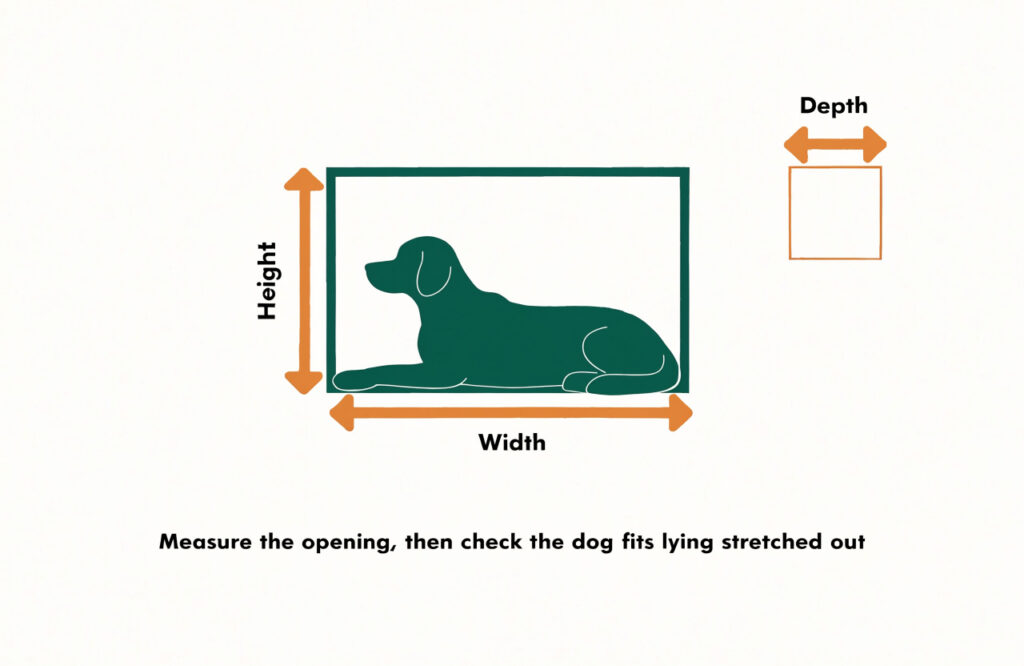
Product photos show the tabletop. The dog lives in the opening underneath.
Measure the dog in the position they actually sleep in. For a sprawler, measure from nose to the base of the tail while stretched on their side, then add several inches so paws are not hanging off the cushion. For a curler, the diameter of the curl matters more than length. Then measure floor to the top of the head or shoulders while standing. The dog should be able to stand, turn, and lie down without scraping the underside of the tabletop.
Confirm interior height and opening height on the listing. Exterior dimensions of roughly 30 by 22 by 28 inches are common and can still leave a short cubby once the top, drawer, and cushion thickness are subtracted. A lower lip at the entrance helps seniors and short-legged dogs. A high threshold turns the bed into a hurdle.
Buy for adult size if the dog is still growing. A piece that fits a 20-pound puppy often fails a 45-pound adult, and most of these tables are not sold with expansion kits.
Large breeds are the hard limit. A Labrador or Golden Retriever that stretches flat usually needs a bed in the 36- to 42-inch range. Very few dog bed tables offer that interior length and still look like an end table. For those dogs, a separate bed under a normal table, or a larger crate furniture piece used as a media console, is more honest than forcing a nightstand.
The top has to work as a table
Match the top height to the seat beside it. An end table that sits about level with the sofa arm, within a couple of inches, is reachable without leaning. A nightstand should sit near mattress height so a lamp and water glass are usable in the dark.
Check the stated top capacity before you put a ceramic lamp on it. Better crate-furniture listings often claim 100 to 220 pounds on the top. Budget particleboard tops can flex under far less, especially if the dog leans on the frame while climbing in. A low center of gravity and adjustable feet matter on uneven floors. The load is not only the lamp. A dog jumping in and out adds repeated sideways force.
Leave clearance for the door swing if the model has one. A crate table shoved tight into a corner can block its own latch.
Materials, cleaning, and chewing
Most mass-market pieces are engineered wood or particleboard with a steel frame or wire door. That combination can look like furniture and still be chewed through at the corners. Solid wood is sturdier and still not chew-proof. Composite frames such as ECOFLEX are sold as non-toxic and resistant to moisture and odor, which is the right priority for a bed that may see the occasional accident. They are still not a match for a determined chewer.
Skip decorative crate furniture for a dog that already gnaws table legs. Steel-framed models hold up better than hollow composite panels, but no furniture-style kennel replaces a heavy-duty wire crate during the worst chewing phase.
The cushion is half the product. A removable, washable cover is the minimum. A waterproof liner under the cover saves the foam. On crate models, a slide-out tray beats a fixed wood floor. If the listing does not say the cover is machine washable, assume hand washing and plan for a spare cover.
Where it earns its footprint
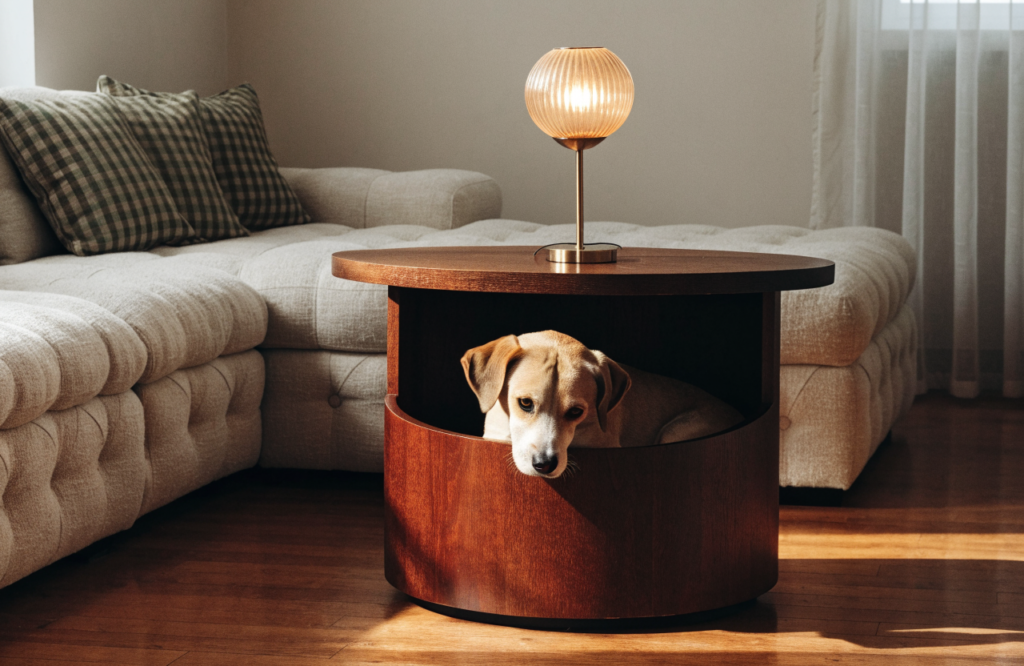
The strongest placement is the end of a sofa, where a side table was already going to sit. The dog gets a defined spot in the room you actually use, and the floor in front of the couch stays clear.
As a nightstand, it keeps a small dog near the bed without sharing the mattress. That only works if the dog is content at floor level. A piece that triggers barking to be lifted up will not solve the co-sleeping argument.
In a home office, the same idea applies beside a desk, provided the opening faces the person rather than the wall. Dogs that settle by watching you will ignore a cubby they cannot see out of.
Measure the floor footprint plus a path in front of the opening. A 31-inch table with a door that needs another foot to swing is not a small-space solution just because the listing says “apartment friendly.”
When to skip it
A dog bed table is the wrong buy if any of these are true.
- The adult dog cannot stand and turn in the listed interior.
- You need reliable containment for a dog that is not crate trained.
- The dog chews furniture.
- You want one bed for two medium dogs. A few double-crate consoles exist, but a standard end table does not.
- The top will hold a heavy lamp, a stack of books, and daily elbow weight, and the listing gives no capacity.
In those cases, a normal end table plus a washable floor bed, or a wire crate with a cover, costs less and fails more predictably. The combined piece is worth it when the dog is the right size, already likes a den or a cubby, and the room truly cannot hold both a table and a bed.
Questions people ask after comparing listings
Can a dog bed table replace a crate? Only the enclosed, latching models can, and only for a dog that already accepts a crate. Open cubbies are beds. They will not hold a dog that wants to leave.
Are these safe for puppies? They are a weak training crate. No divider, chewable edges, and a roomy interior work against housetraining. Use a standard crate until the puppy is reliable, then move to furniture if you still want the look.
What weight limit should I trust? Trust the interior dimensions over the marketing weight. A “50 pound” or “up to 70 pound” claim can describe a dog that fits only when curled. If the listing hides interior height, assume it is tight.
Do I need a special cushion? Use the included pad if the cover removes and the foam has a liner. Replace it when it flattens. A bed that is pretty and hard gets ignored.
Will it work for a cat too? Often yes, if the opening is low enough to step through and the cubby is not so deep that it feels like a trap. Cats usually care more about a view out than about stretching flat.