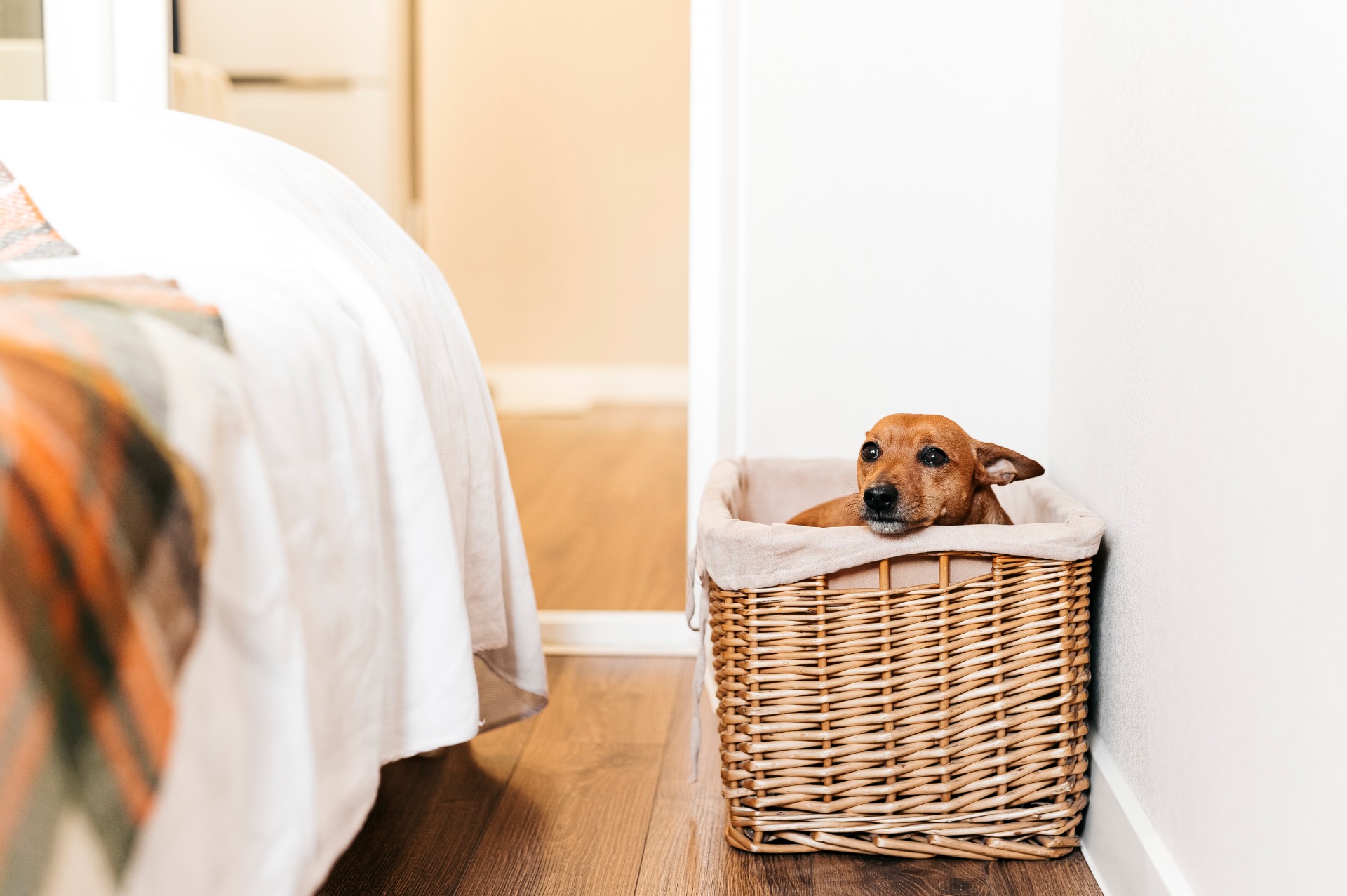

A dog day bed is a daytime lounger meant to live in a room with people, not a thin pad stuffed into a crate. Most versions are sofa-style, with a cushion and bolsters on three sides and an open front, or raised cots with a taut surface on a frame. The useful ones give a dog a defined place to nap between walks without forcing a stiff climb, a cramped curl, or a daily wash of your sofa. Adult dogs commonly rest 12 to 14 hours a day, so the bed they use in the afternoon matters as much as the one they use at night. The right choice starts with how your dog lies down, not with the fabric that matches the couch.
What separates a day bed from other dog beds
A day bed is built to sit in a living space and stay usable for short, repeated rests. It is furniture for a dog, not a substitute for a veterinary treatment plan and not automatically the same thing as a deep orthopedic mattress.
Three shapes cover most of what shops label a day bed:
- Sofa or couch beds have a raised back and side bolsters, with a lower or open front. The walls give a headrest for dogs that lean. The open side is the feature that matters for dogs who will not step over a high rim.
- Flat loungers are rectangular mattresses with little or no bolster. They suit dogs that sprawl, roll onto their back, or change position often.
- Elevated cots lift a mesh or fabric panel off the floor on a metal or plastic frame. Air moves underneath, which helps in warm rooms and keeps the surface off cold or damp floors. The tradeoff is less cushioning and a step up.
Bolstered nests and donut beds are a different category. They cradle a tight curl. A day bed is usually more open, because daytime rest often includes watching the room, shifting, and getting up quickly.
A bolster is not proof of joint support. It is a headrest and a visual boundary. Support comes from the sleeping surface underneath: foam depth and density on a cushion bed, or even tension on a cot.
Match the shape to the posture you already see
Watch a few naps before you buy. The place your dog chooses on their own is better evidence than a size chart.
Dogs that curl tight or press against a wall usually settle better with a back and sides they can lean into. The walls should not eat the whole sleeping area. Check the flat center, not the outside footprint.
Dogs that stretch on their side, or sleep with legs out, need an open rectangle long enough that hips and shoulders stay on the surface. A high bolster pressing into the legs is a reason they abandon the bed for the floor.
Dogs that run warm, pant indoors, or always pick tile over cushions often prefer a raised mesh cot. The surface stays firmer and cooler because air passes underneath. In a cold room, the same cot can feel too exposed unless you add a blanket the dog will actually stay on.
Senior dogs and dogs with hip or elbow trouble need a low front. A sofa profile only helps if they can step in and push up without a jump. A cot that looks supportive on paper fails if the frame is high enough that standing is the hard part.
Size the sleeping surface, not the product label

Bed sizes are not standardized. “Large” on one listing can be smaller than “medium” on another, and advertised dimensions usually include bolsters or the frame.
Measure your dog while they are lying in a relaxed stretch, from nose to the base of the tail, then note how wide they are with legs extended. Add roughly 6 to 12 inches (about 15 to 30 cm) so they can turn without hanging off. If they sleep curled, you can go a little smaller, but the interior still has to hold a full curl without both sides touching them at once.
Compare that number with the usable flat area. On a sofa bed, thick bolsters can remove several inches from each side. On a cot, the sleeping panel is smaller than the outer frame. When you are between sizes and the room allows it, the larger usable surface is the safer buy. A bed that is slightly too big can be made cozier with a folded blanket. A bed that is slightly too small cannot be fixed.
Weight ratings matter on raised frames. A light aluminum cot that is fine for a 30-pound dog can wobble or bend under a dog over about 50 pounds that jumps on and off all day. Look for a stated weight capacity and a frame that does not rack when you press a corner.
Support, height, and temperature are separate decisions
Softness and support are not the same. A plush cover can still let hips and elbows sink through to the floor. On a foam day bed, two specs matter more than the word “orthopedic.”
Depth. Lighter dogs compress foam less. A practical starting point used by bedding makers is about 3 inches for dogs under 25 pounds, 3 to 4 inches from 25 to 60 pounds, and 4 to 6 inches or more for heavier dogs. These are rules of thumb, not a veterinary standard.
Density. Density is mass per volume, usually in pounds per cubic foot or kilograms per cubic meter. It predicts how well foam keeps its shape better than thickness alone. Listings often omit it. Foam under about 1.8 to 2 lb/ft³ (roughly under 30 kg/m³) tends to flatten under daily use. Orthopedic-grade memory foam is commonly discussed in the range of about 2.5 to 4 lb/ft³. If a brand will not say what is inside, assume it is the cheaper fill. Press the center with your hand: it should give, then recover, and your hand should not hit the floor.
Memory foam holds heat. That is useful in a cool house and a problem for thick-coated dogs in summer. Gel layers and channel-cut foam are attempts to move air; they do not turn a deep foam bed into a cot. Elevated mesh stays cooler and firmer, and it does not compress over time the way foam does, but it will not cradle a dog that wants to sink in. Neither style replaces pain medication, weight management, or a vet exam for arthritis or hip dysplasia.
Entry height is the other limit. A dog that hesitates at the front edge will use the rug beside the bed. Low legs or a floor-level cushion are better than a tall frame if rising is already difficult.
Covers, frames, and what fails first
The cover should come off. “Machine washable” often applies only to the cover, not the foam. Do not wash a foam core unless the maker says it is safe. A waterproof liner between cover and foam saves the insert from accidents; check whether it wraps the whole core or only the top.
Bolsters collect the most slobber. If they do not unzip or wipe clean, the bed looks worse within weeks. Microsuede and canvas tend to hold up to digging better than loose plush. Plush feels warmer and sheds more hair into the pile.
On a cot, the weak points are corners, exposed fabric edges, and light joints. A dog that chews will find the edge of almost any mesh panel. Enclosed rails, as on some chew-resistant cot designs, reduce that, but no day bed is chew-proof if the dog is determined. Address the chewing; do not expect the bed to train it out.
Non-slip feet or a non-skid base matter on hard floors. A bed that slides when the dog steps on is a bed they stop trusting.
Where to put it so it gets used

Place the day bed where your dog already rests in the daytime: in sight of the main room, not in a closed spare bedroom they never enter. A sightline to people is usually more attractive than a quieter corner.
Keep it off a direct heat register and out of a draft. Raised cots on slippery floors need a rug underneath if the feet skid. Outdoor or patio use needs materials rated for weather, shade over the frame, and a check that metal does not sit in full sun.
If the dog ignores the new bed, do not add treats on top forever and call it training. Move it to the spot they already choose, keep the old blanket smell on it for a few days, and make the competing sofa slightly less available. Most refusals are size, entry height, or temperature, not stubbornness.
Mistakes that make a day bed fail
- Buying by exterior dimensions and discovering the bolsters leave no room to stretch.
- Treating a bolstered sofa shape as joint support when the fill is thin fiber.
- Choosing a high cot for a senior dog because elevated beds are marketed for arthritis, then watching them refuse the step.
- Skipping a removable cover because the fabric looks clean in the photo.
- Putting a foam lounger in a hot room for a double-coated dog that already sleeps on tile.
- Assuming one bed covers crate nights and living-room days. Crate pads are sized for the crate. A day bed is sized for the stretch.
A young, healthy, small dog often does fine on a simple cushion. A heavy adult, a senior, or a dog with known joint disease is where foam depth, a stable frame, and a low entry earn their cost. A day bed will not fix pain. It can remove the extra strain of sleeping on a hard floor or hauling up onto a human sofa.
Questions people ask before they buy
Is a dog day bed the same as an orthopedic bed? No. A day bed describes the job and the shape: a lounger for daytime use, often sofa-like or raised. Orthopedic describes the sleeping surface, usually thicker, higher-density foam meant to spread pressure. Some day beds are both. Many are only the shape.
Do dogs need a separate bed for the day? They need a reliable place they will use. If they already have a bed in the room where they nap, a second one is optional. A day bed helps when the night bed is in a crate, the sofa is off limits, or the floor is too hard or too cold for long rests.
How do I know it is big enough before it arrives? Use the maker’s interior or sleeping-surface measurement, not the outer size. Your dog’s stretched nose-to-tail length plus several inches should fit inside that flat area, with width for the way they lie.
Can an elevated day bed replace a foam bed for an older dog? Sometimes. A firm raised surface can make standing easier and keeps joints from sinking, if the dog can step on and off. Dogs that want deep cushioning, or that live in a cold house, usually do better on a low foam bed with a proper support layer.
What if my dog chews beds? Pick a cot with protected edges or a cover sold as chew-resistant, and still supervise. Persistent chewing is a behavior and management problem. A prettier fabric will not solve it.