
An orthopedic dog bed is a foam bed built to spread a dog’s weight across the sleeping surface instead of letting hips, elbows, and shoulders press into a hard floor or a flattened cushion. The word itself does not guarantee that. “Orthopedic” is a marketing label, not a regulated standard, so two beds with the same wording can differ sharply in foam density, thickness, and how long they hold their shape.
That gap matters because adult dogs spend roughly half the day lying down. For a senior dog, a heavy breed, or a dog with arthritis, the surface under them is one of the few comfort changes an owner can make at home. The useful question is not whether a bed is labeled orthopedic. It is whether the foam stays supportive under that particular dog, and whether the dog can get on and off it without a struggle.
What separates an orthopedic dog bed from a soft cushion
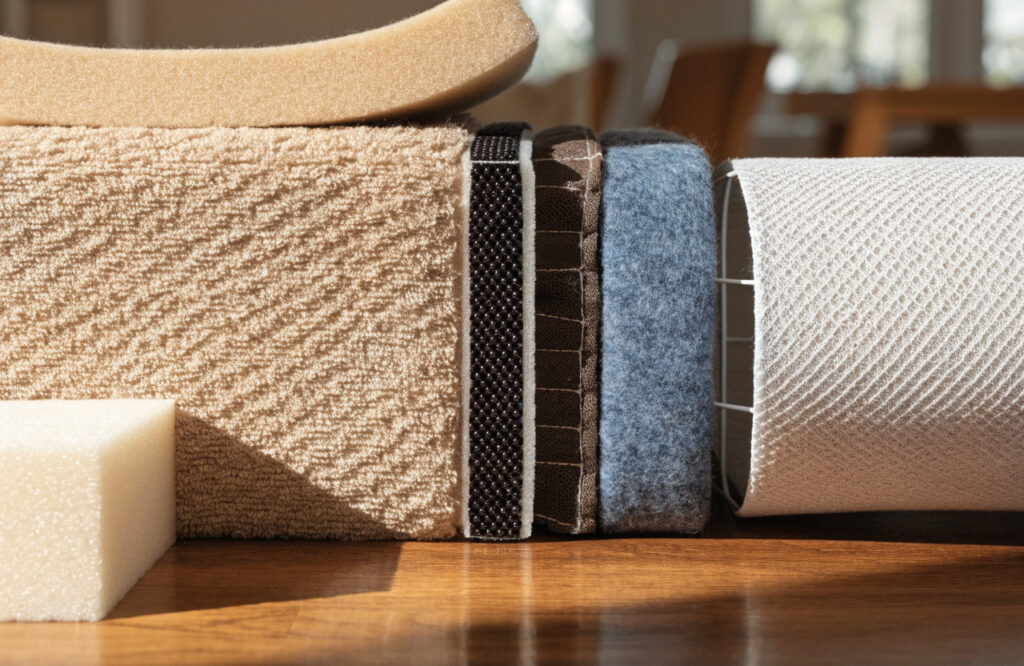
A standard dog bed is often polyester fill, a thin foam pad, or shredded foam inside a cover. Those materials feel soft at first and then compress under body weight. The heaviest points — usually the hips and shoulders — end up carrying most of the load, sometimes against the floor beneath the cover.
An orthopedic dog bed uses a solid or layered foam core meant to resist that collapse. Two ideas are doing the work:
- Pressure distribution. A surface that yields slightly but does not bottom out spreads contact force over a wider area. Cornell veterinarian Joseph Wakshlag has described the same principle used in human memory-foam mattresses: more even pressure means less concentration at bony points, which is more comfortable and lowers the chance of pressure sores in dogs that lie still for long periods.
- A stable base for getting up. A dog with stiff joints has to push off the bed. Foam that sinks to the floor makes that push harder. Foam that keeps a firm underlayer gives the dog something to lever against.
Neither effect treats arthritis. Bedding is environmental support. Diagnosis, weight control, appropriate exercise, and any pain medication still belong with a veterinarian. The American College of Veterinary Surgeons describes osteoarthritis management as several approaches used together, not a single product.
Which dogs are most likely to benefit
An orthopedic dog bed is most useful when body weight, joint disease, or long hours of rest make a thin pad inadequate.
Dogs that usually gain the most from a denser bed:
- Senior dogs that are slow to rise, stiff after sleep, or reluctant to lie on hard floors
- Large and giant breeds, whose hips and elbows put more load on the foam
- Dogs with diagnosed osteoarthritis, hip dysplasia, or elbow disease
- Dogs recovering from orthopedic surgery, once the veterinary team has cleared normal rest at home
- Dogs with elbow calluses or hair loss over bony points from lying on hard surfaces
A young, light, healthy dog on a decent cushion is not the same case. A supportive bed can still be reasonable preventive bedding for a breed prone to joint disease, but it will not show the same day-to-day difference.
Osteoarthritis is common, and heavier dogs are affected more often. A 2024 radiographic review of dogs older than eight found osteoarthritis in about 57% of examined elbows, 39% of shoulders, 36% of hips, and 36% of stifles, with a higher prevalence in heavier dogs. A smaller University of Tennessee study of medium and large dogs aged 4 to 10, none already diagnosed with arthritis, found radiographic osteoarthritis in 18 of 30 dogs. Many dogs have joint changes before owners notice a limp, which is one reason bedding gets upgraded only after stiffness is obvious.
What the evidence actually shows
Most claims about orthopedic dog beds are inferred from how foam behaves under weight, plus owner reports. Formal research is thin.
The clearest published example is a University of Pennsylvania School of Veterinary Medicine pilot study of the Big Barker therapeutic mattress. Forty dogs, each at least three years old and over 70 pounds, with radiologist-confirmed osteoarthritis, used the bed while owners completed pain and function questionnaires and activity monitors tracked movement. Owners reported less pain and stiffness and better joint function, gait, and quality of life. Collar monitors suggested quieter nights for a portion of the dogs: half had at least a 13% drop in nighttime activity, and a quarter had at least a 33% drop. The study was open-label and proof-of-concept. There was no comparison group on a different bed, and several outcomes were owner-reported. It supports the idea that a thick supportive mattress can change comfort in large arthritic dogs. It does not prove that every product labeled orthopedic will do the same.
Memory foam, dense orthopedic foam, and egg-crate
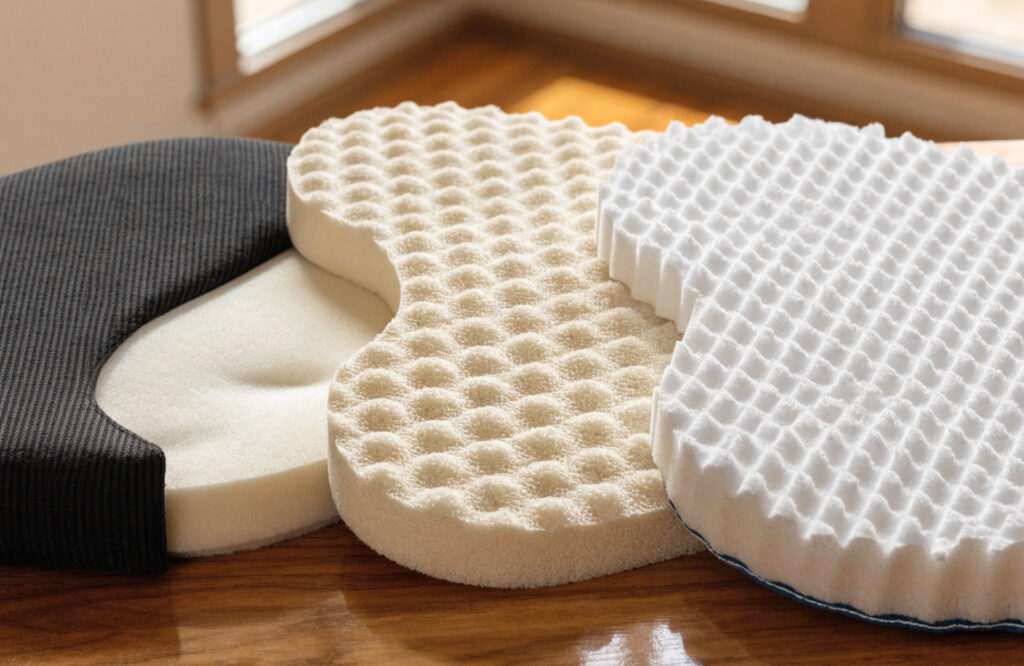
Foam type decides both the feel of the bed and how fast it fails. Listings often hide density. If a brand will not state it, assume the foam is on the lighter end.
| Foam | What it does | Where it falls short | Better fit |
|---|---|---|---|
| Memory foam (viscoelastic) | Contours and spreads pressure at hips, elbows, and shoulders | Can sleep warm; bottoms out if thin or low density; slow rebound can feel unstable for some dogs | Seniors, side sleepers, dogs with focal joint pain |
| High-density orthopedic or therapeutic foam | Holds shape, resists sagging, gives a firmer push-off surface | Less contouring at sharp bony points | Large and giant breeds, dogs that struggle to stand |
| Layered foam | Firm base plus a softer top layer | Only as good as the base density | Most households that want both support and cushion |
| Egg-crate foam | Airflow, lower price, light cushioning | Peaks compress; valleys do not support; flattens faster under heavy dogs | Small dogs, warm rooms, short-term or crate use |
| Shredded foam | Molds and is easy to ship | Shifts, clumps, and creates uneven spots | Dogs that nest, not dogs that need level joint support |
| Polyester fill | Soft and cheap | Collapses under weight | Occasional lounging, not joint support |
A practical rule used across buyer guides is a support-layer density of about 1.8 pounds per cubic foot or higher, with something closer to 2.0 or above preferred for large seniors. Density is not the same as firmness. A low-density foam can feel firm on day one and still pancake within months.
CertiPUR-US is one of the few independent checks available on pet-bed foam. Certified flexible polyurethane foam is tested for content and emissions: no ozone depleters, certain flame retardants, heavy metals, formaldehyde, or regulated phthalates, and low volatile organic compound emissions, plus durability criteria. It is not a medical endorsement. It does reduce the chance that a bed is made from poorly specified foam.
How thick the foam needs to be
Thickness only helps if the foam is dense enough not to collapse through that thickness. These ranges are buyer guidelines, not a veterinary dosing chart. The real test is bottoming out: press the center firmly with your palm or kneel on it. If you feel the floor, your dog’s hips will too.
| Dog weight | Useful foam depth |
|---|---|
| Under 25 lb | About 3–4 inches of decent foam |
| 25–60 lb | About 4–5 inches |
| 60–100 lb | About 5–6 inches, more if arthritis is advanced |
| Over 100 lb | About 6–7 inches or a layered system with a firm base |
A 3-inch egg-crate pad can be enough for a 12-pound terrier and inadequate for a 90-pound Labrador on the same night. Giant breeds and dogs that sleep stretched on their side need the deeper end of the range because more of the body weight lands on the hip and shoulder.
Size the bed to the sleeping posture, not the curled-up photo
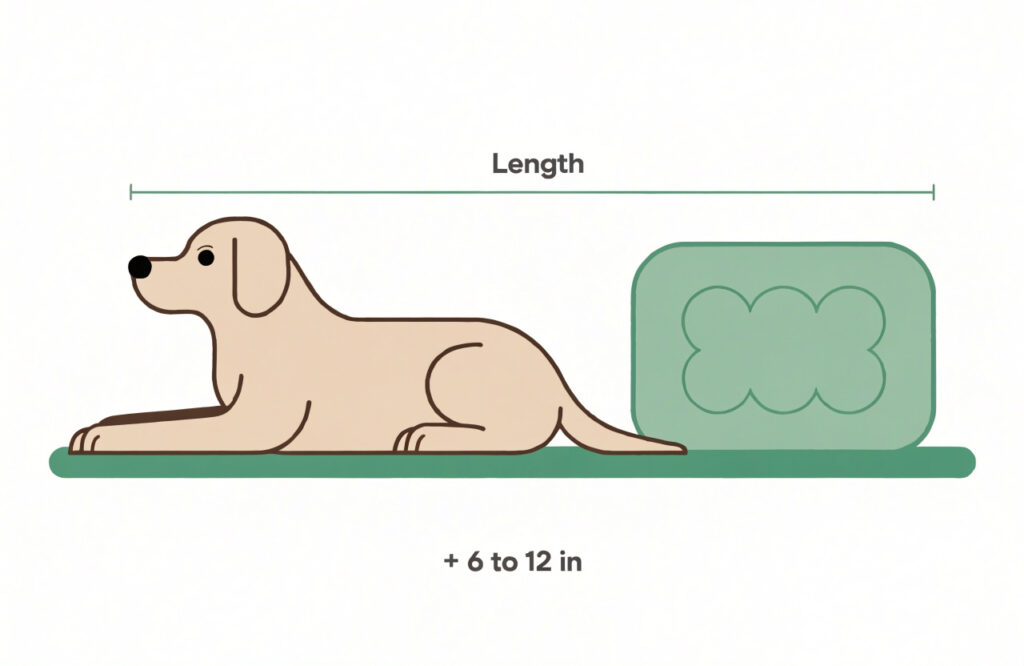
A bed that forces a stiff dog into a tight curl works against the point of the purchase. Measure the dog from nose to the base of the tail while lying in the posture they actually use — stretched on the side if that is how they sleep — then add roughly 6 to 12 inches. Sprawlers and dogs that shift position need the larger allowance. Curlers can live with less, but seniors often stop curling because the curl itself hurts.
Check width as well as length. A long, narrow bed leaves elbows and hocks hanging off the edge, which recreates the pressure points the foam was meant to avoid. Ignore “large” and “XL” labels until you have compared the listed sleep surface with your measurement. Many large-breed beds are sized for a 50- to 70-pound dog.
Features that matter after the foam is right
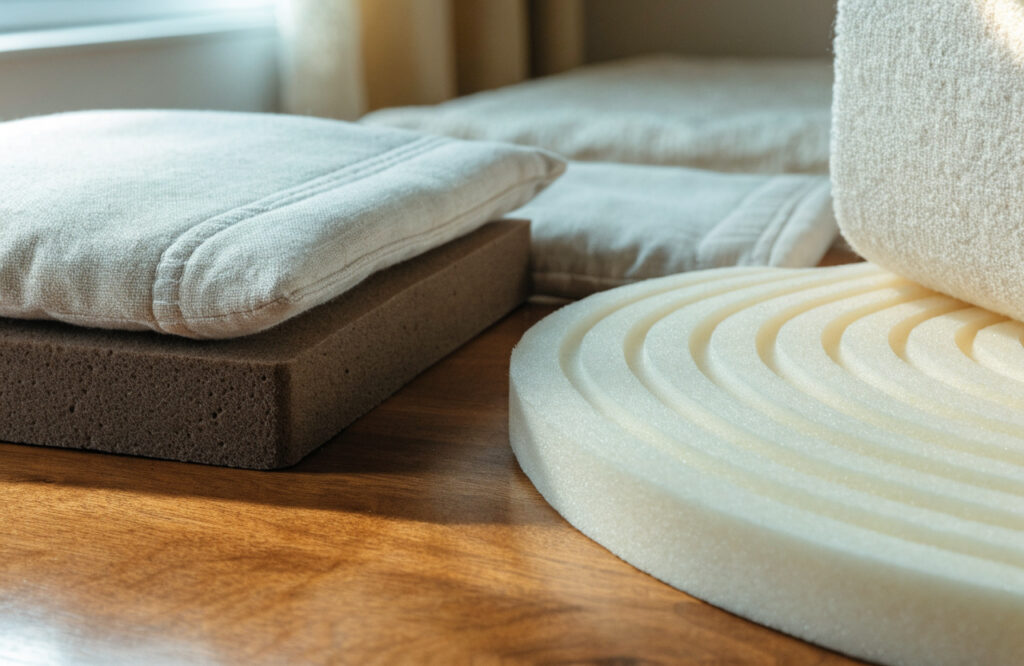
Foam is the support. The rest of the bed decides whether a stiff dog will use it.
- Low entry. A tall bolster on all four sides makes a dog step or climb. For arthritis or weakness, an open side, a front cutout, or a flat mattress profile is easier. Bolsters are useful for dogs that like to lean their head or back against an edge, and a problem when the edge is the obstacle.
- Non-slip base. A bed that slides on hard floors forces a weak dog to chase it while standing up. Test it on the actual floor, not in the product photo.
- Removable, washable cover and a waterproof liner. Seniors are more likely to dribble, drool, or have accidents. Foam that cannot be washed should stay behind a liner. Spot-clean the foam; soaking it breaks it down.
- Cover texture. Smooth, sturdy weaves are easier to clean and less likely to catch nails. Long faux fur sleeps warmer and hides less dirt than it appears to. Short-coated and double-coated dogs often run warm on memory foam; a cooler cover or a breathable room matters more than gel marketing.
- Chew resistance, if relevant. A dense foam bed is expensive to replace after a corner is excavated. Dogs that destroy bedding need a tougher cover, and some should not be left unsupervised with any soft bed.
Placement is part of the bed. Cold drafts and hard tile just outside the bed make the first step worse. A warm, draft-free spot, with a non-slip path to food and the door, does more for a stiff dog than a thicker bolster.
How to tell the bed is no longer doing the job
Support fades before the cover looks ruined. Replace or stop relying on the bed when:
- The center is permanently lower than the edges
- You can feel the floor through the foam under the dog’s usual lying spot
- The dog avoids the middle and sleeps on the firmer rim
- Morning stiffness returns after months of easier rising, with no other change in health or weight
- Shredded fill has migrated into lumps
Denser therapeutic-foam beds are often sold with multi-year sag warranties. Egg-crate and light memory foam more often compress in one to three years under a heavy dog. A warranty is only useful if the company defines sag in inches and will actually replace the core, not only the cover.
What an orthopedic dog bed will not fix
Difficulty rising can come from joint pain, spinal disease, weakness, obesity, or illness that has nothing to do with the floor. A new bed does not identify the cause. If a dog is limping, crying when lying down, unwilling to jump that they managed last month, or losing muscle over the hindquarters, veterinary assessment comes before another product search.
Weight is the other lever owners control. Extra body mass increases load on the same joints the bed is trying to unload. A supportive mattress does not offset a diet that keeps a dog heavy. Medication, joint supplements, and physical rehabilitation are separate decisions and should not be started or stopped because a bed arrived.
A simple way to decide
Match the bed to the dog in this order:
- Confirm the dog can use a low entrance on the floor you actually have.
- Choose solid or layered foam, not loose fill, if joint support is the goal.
- Set thickness from body weight, then check density or a no-sag warranty so the thickness is real after a month.
- Size to the stretched sleeping posture, with spare room at elbows and hocks.
- Add a washable cover and liner if the dog is older, drools, or has accidents.
- Recheck the center of the bed every few months with a firm press.
For a small dog with mild stiffness, a 3- to 4-inch memory-foam or egg-crate bed with a low side is often enough. For a large arthritic dog, the decision is usually a deeper, denser core — memory foam over a firm base, or a therapeutic foam slab — and a willingness to replace it when the center collapses. The label does not make that choice. The foam under the hips does.
Frequently asked questions
Are orthopedic dog beds worth the price? For a dog over about 50 pounds, a senior, or a dog with known joint disease, a bed that does not bottom out is one of the higher-value pieces of equipment in the house, because it is used for many hours a day. A cheap bed that flattens in a season is not cheaper if you buy it twice. For a healthy small dog, the premium is optional.
Is memory foam better than egg-crate foam? For pressure relief at hips and elbows, solid memory foam or a dense support core usually beats egg-crate. Egg-crate sleeps cooler and costs less, and it can be fine for light dogs. Under a heavy senior it compresses at the peaks and stops supporting.
Can an orthopedic bed be too soft? Yes. If the dog sinks until the spine or hips drop below the shoulders, getting up is harder, not easier. A slight contour with a stable base is the target. The palm test is more reliable than the word “plush.”
Do bolsters help arthritis? Only if the dog uses them for head or back support and can still enter without stepping over them. A three-sided bolster with one open end is the usual compromise. A high four-sided sofa bed is a poor match for a dog that already hesitates at curbs.
How often should the bed be replaced? When the foam no longer rebounds or the dog avoids the center — often within a couple of years for light egg-crate under a large dog, and longer for a dense core with a real sag warranty. Covers can be washed on their own schedule; washing does not restore collapsed foam.