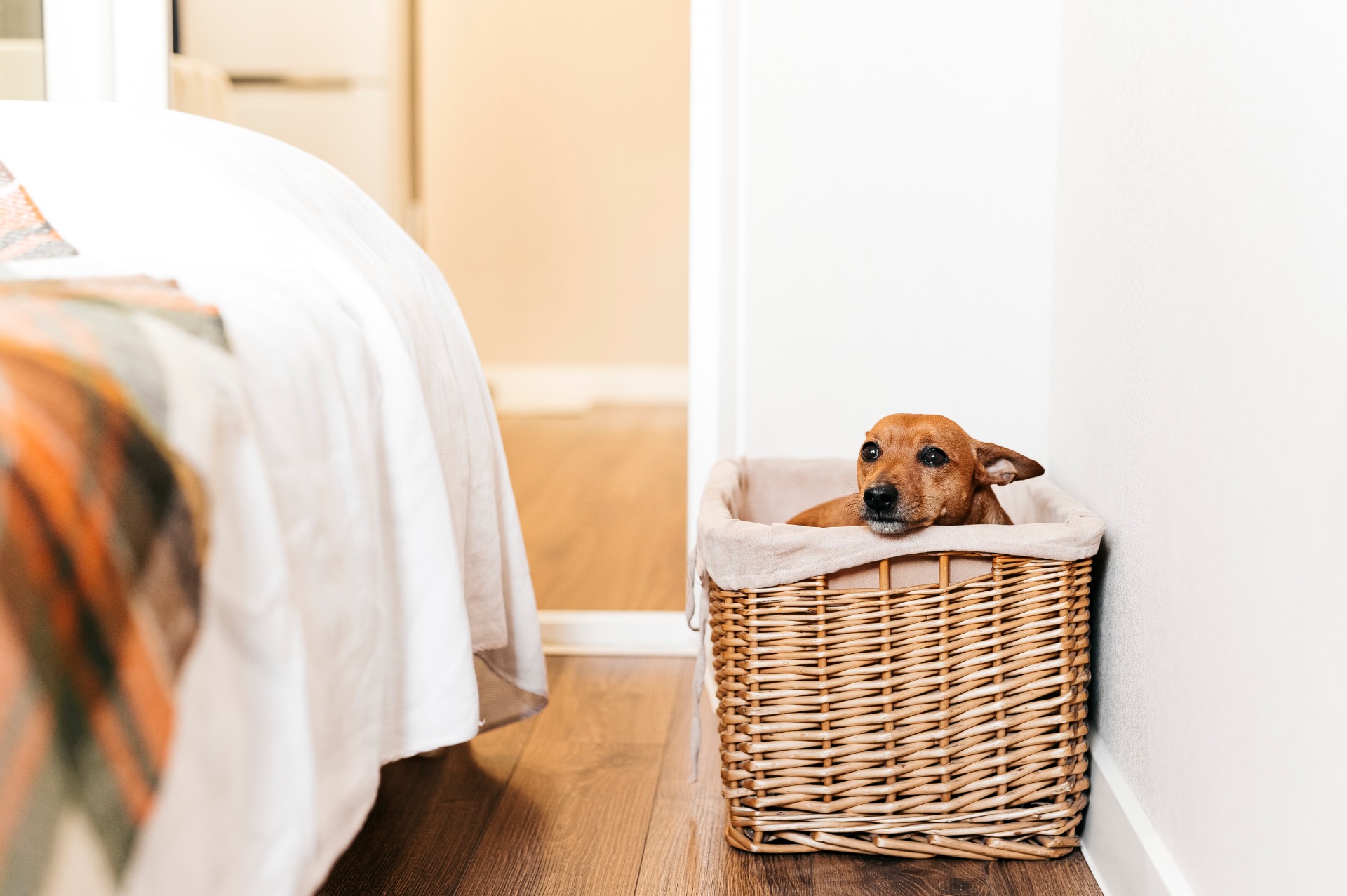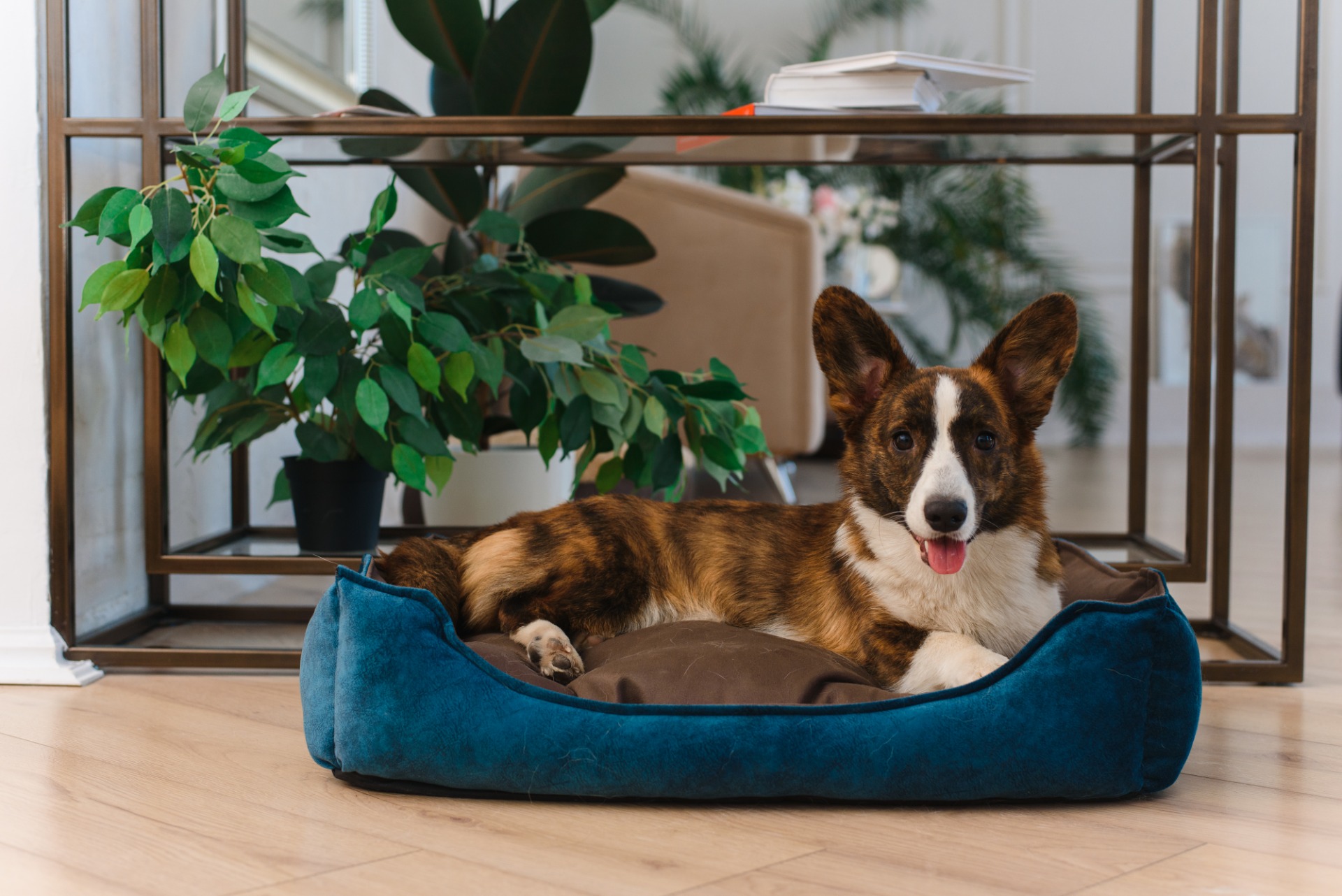

A dog bed cabinet is furniture with a sleeping space built into it: either an open nook with a cushion, or a crate-style kennel finished to look like a cabinet, end table, or sideboard. It solves a layout problem more than a sleep problem. The dog still needs a bed that fits; the cabinet is what keeps that bed from sitting in the middle of the room.
Search results for the phrase mix three different products. One is a cupboard or console with an open bed alcove at floor level and storage above. Another is indoor crate furniture: wood or wood-look panels around a barred compartment, often sold with a cushion and sold as an end table or TV stand. A third is a feeding cabinet with bowls and food storage, which is not a bed at all. The first two can work well. Buying the third when you wanted a sleeping spot is a common miss.
Open nook or enclosed crate
An open dog bed cabinet leaves the lower bay without a door, or with doors that stay open. The dog walks in, lies down, and can see the room. Storage sits above or beside the bed. Hallway cupboards, laundry units, and custom kitchen runs use this layout. A typical ready-made example is a tall storage cupboard with a lower bay roughly 34 inches wide, 18 inches deep, and 24 inches high — enough for a small or small-medium dog to curl up, not for a Labrador to stretch.
An enclosed dog bed cabinet is crate furniture. The sleeping compartment has a door, usually wire or mesh set in a wood frame, and the outside reads as a nightstand, console, or buffet. These pieces are for dogs that already use a crate, or that are being crate-trained, and for rooms where a wire kennel looks wrong. The top is often rated to hold a lamp or a small television. That rating is a furniture spec, not a promise the dog cannot rock the unit.
The two designs fail different dogs. A den-loving, crate-trained dog often settles faster behind a door. A dog that wants to watch the room, or that has never been asked to stay in a closed space, is more likely to use an open nook and ignore a latched cabinet. A strong chewer can destroy the edge of an open wood bay and can also work a particleboard crate frame if teeth can reach it. Neither style is a substitute for training.
Size the sleeping space, not the cabinet
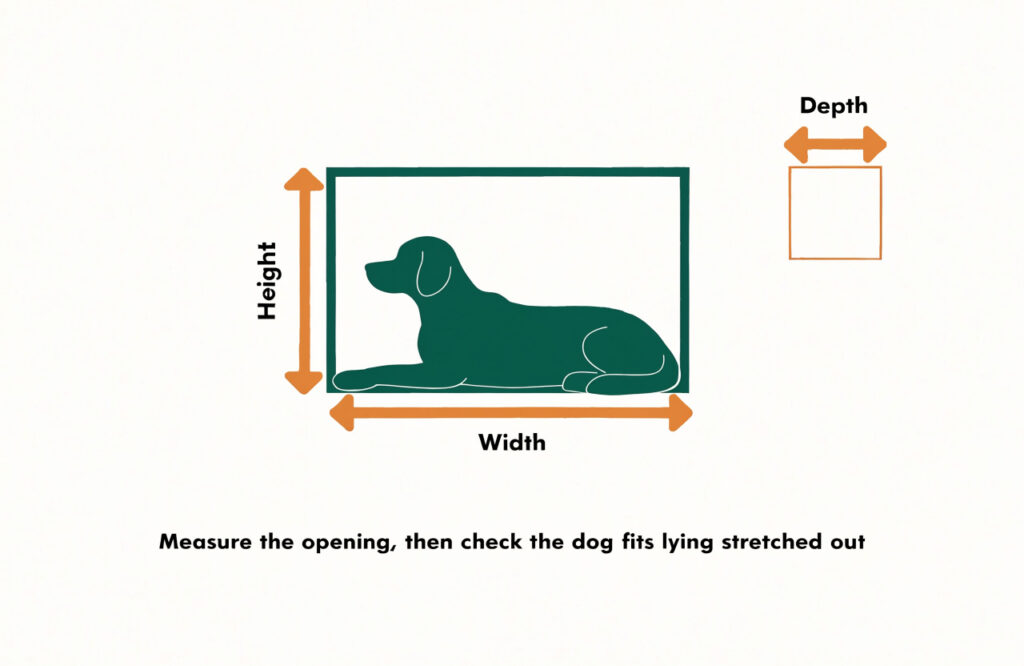
Manufacturers lead with outside dimensions because those decide whether the piece fits under a window or beside a sofa. The dog only cares about the inside.
Measure nose to the base of the tail, and floor to the top of the head or the tips of upright ears. The interior should let the dog stand without crouching, turn around, and lie on its side. A practical minimum is those body measurements plus a few inches in length and height. Thick panels, trim, and a raised tray steal space, so a cabinet listed as 36 inches wide may only offer about 30 inches inside.
| Dog | Typical interior length | What usually fits |
|---|---|---|
| Toy and small (under about 20 lb) | 20–26 in | Nightstand crates, small cupboard nooks |
| Medium (about 20–45 lb) | 28–36 in | End-table and console crates |
| Large (about 45–80 lb) | 40–48 in | Sideboard-style crates; most open nooks are too short |
| Giant breeds | 48 in and up | Few cabinet pieces; a floor bed or heavy wire crate is usually more honest |
Curlers can live with a slightly shorter bay. Sprawlers and deep-chested dogs cannot. If the listing only gives outside measurements, treat the fit as unknown until the seller confirms interior length, width, and height.
What to check before you buy
Ventilation is the spec most cabinet crates underplay. A wire crate is open on every side. A furniture crate is mostly wall. If bars or mesh exist only on the front door, warm air and odor stay in the box. Better pieces have openings on at least two sides, ideally three, with a more solid back if the dog likes a den. Do not push the unit against a radiator, and do not cover the vents with a throw just to hide the bars.
Doors and latches matter if the cabinet is meant to contain the dog. A magnetic catch is fine for an open-style door the dog is not supposed to defeat. A dog that paws at exits needs a latch that fully engages and hardware that does not loosen after a few weeks of leaning. Check the gap around the door; escape attempts usually start there.
Cleaning access decides whether the piece still looks acceptable in six months. A removable tray, a cushion with a washable cover, and enough clearance to wipe under the tray are the useful features. Urine that reaches particleboard or the floor seam is hard to get out of a closed cabinet. A waterproof liner under the bed, and a second cover so one can be washed, prevents most of that.
Materials split by price more than by marketing. Budget cabinet crates, often in the $100–$250 range, are commonly particleboard or similar engineered panel with a thin steel door. Mid-range pieces, roughly $250–$500, tend to have thicker frames, better latches, and sometimes a steel skeleton behind the wood look. Custom cupboard nooks and solid-wood units run much higher — designer dog-bed cupboards can sit around £1,500–£2,000 before fabric. Engineered panel is stable in normal indoor humidity. It is not chew-proof, and a soaked edge swells.
If the top will hold a TV, lamp, or someone leaning on it, use the stated weight limit and assemble every fastener. Screws in these units loosen as the dog moves. Recheck them after the first weeks.
Where it belongs
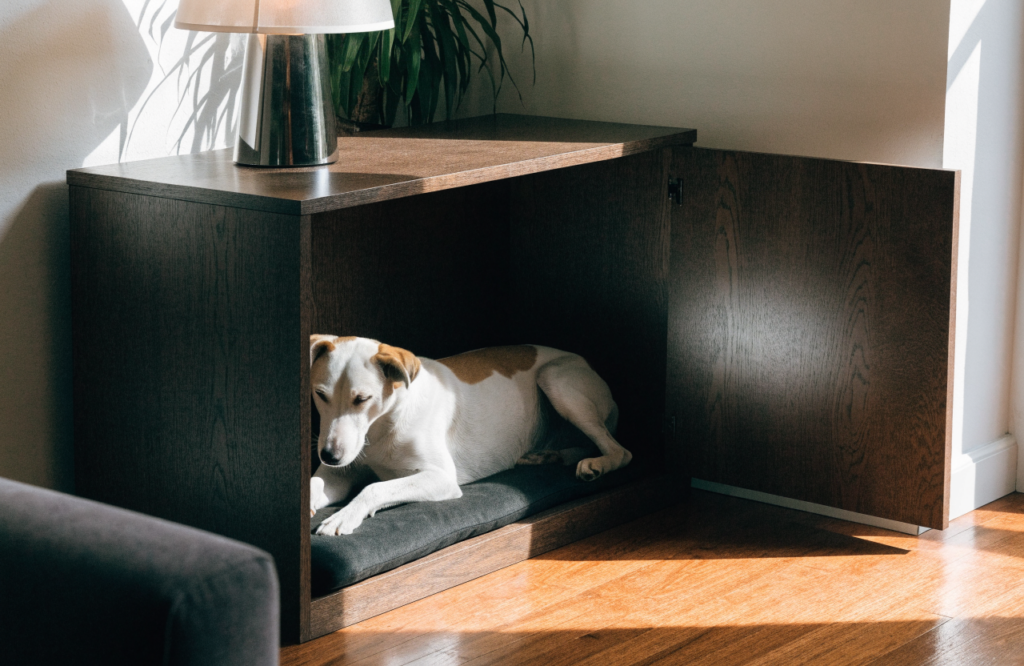
Place a dog bed cabinet where the dog already rests, not where the empty corner looks best in a photo. Living rooms work when the dog is meant to be with people. Bedrooms work for dogs that settle at night beside the bed, provided the interior is big enough and the door hardware is quiet. Kitchens and mudrooms suit open nooks, because the floor is usually wipeable and the dog can stay near the household without lying in the walkway.
Avoid three spots. Direct sun on a closed cabinet overheats the bay. A tight hallway turns the open side into a trip hazard and gives a nervous dog no way to step out without being stepped over. A room the dog has never been left in is a poor first crate location; the furniture does not make isolation easier.
Leave a little clearance at the back if the design vents there. An open nook can sit flush. A crate with a side door needs room for that door to swing.
Odor, heat, and chewing
Closed cabinets smell faster than open beds because bedding, hair, and any accident sit in still air. A daily sniff check and a weekly tray wipe stop most of it. If the smell remains after the cushion is washed, the source is usually under the tray, in a seam, or in foam that got wet. Replace the bed rather than layering fresh covers over a soaked one.
Heat is the other closed-cabinet problem. A dog that pants in the bay on a mild day needs more airflow or a shorter stay, not a thicker cushion. Open nooks run cooler and are easier to air out.
Chewing ends many of these pieces. A dog that already destroys wood, crate edges, or door frames should not be left with an unreinforced cabinet. Steel-framed doors and recessed trays help; they do not make particleboard safe. For that dog, a heavy wire or high-impact crate, with a furniture cover only if it does not block airflow, is the safer order of operations. The cabinet can come later, once the dog rests without working the edges.
Mistakes that waste the purchase
Matching the cabinet to the breed name on the listing, instead of a tape measure, is the usual error. So is assuming a pretty door means the dog will accept being shut in. A dog that has never been crate-trained needs the door left open, meals fed near the entrance, and short stays — the same steps as with any crate. The finish does not change that.
Another miss is buying a feeding station because the title says cabinet. Raised-bowl cabinets solve storage and meal height. They do not give the dog a legal sleeping place, and a fixed bowl height is not automatically better for every dog.
Oversizing the cushion creates the last problem. A thick bolster inside an already tight bay leaves the dog perched on the edge. The bed should fill the floor of the nook without blocking the door or the dog’s ability to stand.
Frequently asked questions
Is a dog bed cabinet the same as a dog crate? Only the enclosed version is. An open cupboard nook is a bed with storage. It will not hold a dog that needs to be confined.
Can a large dog use one? Some 42- to 48-inch crate cabinets have the interior length. Most decorative cupboard nooks do not. Confirm the inside length before assuming a Labrador or larger dog will fit.
Does the door have to stay shut? No. Many dogs use these as a den with the door open or removed. Shut it only if you need containment and the dog is comfortable with that.
Will it stop crate odor? No. Less mesh means odor shows up sooner if bedding stays damp. Removable, washable covers and a tray you can actually pull out matter more than the wood finish.