
A cooling dog bed is a passive surface, not a refrigerator. Elevated mesh cots keep a dog cooler by letting air move underneath the body. Gel mats and water pads absorb heat through contact, then warm up and need a break to feel cool again. Gel-infused foam mostly slows the heat buildup of ordinary foam rather than actively chilling the dog. The useful choice depends on whether your dog needs airflow, a cool contact surface, joint support, or all three — and none of these beds treats heatstroke.
Dogs shed heat mainly by panting and by blood flow to the skin. A normal body temperature sits around 101.5°F; heatstroke becomes a concern once it climbs above about 105°F. A bed can make rest more comfortable in a warm room. It cannot replace shade, water, airflow, or a cool indoor space when a dog is already overheating.
What “cooling” actually means on a product label
Most listings use the same word for four different mechanisms.
Airflow. An elevated cot lifts the dog off carpet, concrete, or sun-warmed ground so air can pass under the chest and belly. The effect does not fade the way a gel pad does, because nothing is storing the heat. It also does nothing if the air itself is hot and still, or if the bed sits in direct sun.
Contact cooling. A pressure-activated gel mat or a water-filled pad is cooler than the dog at first. Heat moves from the body into the material. Once that material warms, the advantage shrinks until the dog gets off and the pad sheds heat into the room. Manufacturers often describe a recharge of roughly 15 to 20 minutes of non-use. Treat that as a product claim, not a fixed medical duration.
Slower heat buildup. Memory foam traps heat. Gel beads or a “cool-touch” cover are usually added to offset that, not to create a cold surface. In Wirecutter’s comparison, a FurHaven cooling-gel bed rose about 9°F at the surface after five minutes of a pet lying on it, versus about 11°F on a standard foam bed — in line with the maker’s claim of a 1–2 degree difference, not a chilled pad.
Phase-change materials. Some pads absorb heat while the filling shifts state inside a set temperature range. Performance is product-specific and still finite. Verify what is actually inside the current model rather than trusting the word “cooling.”
If a listing does not say whether the bed is raised mesh, a sealed gel bladder, gel-infused foam, or a water reservoir, the label is not enough to judge it.
Elevated mesh: the airflow option
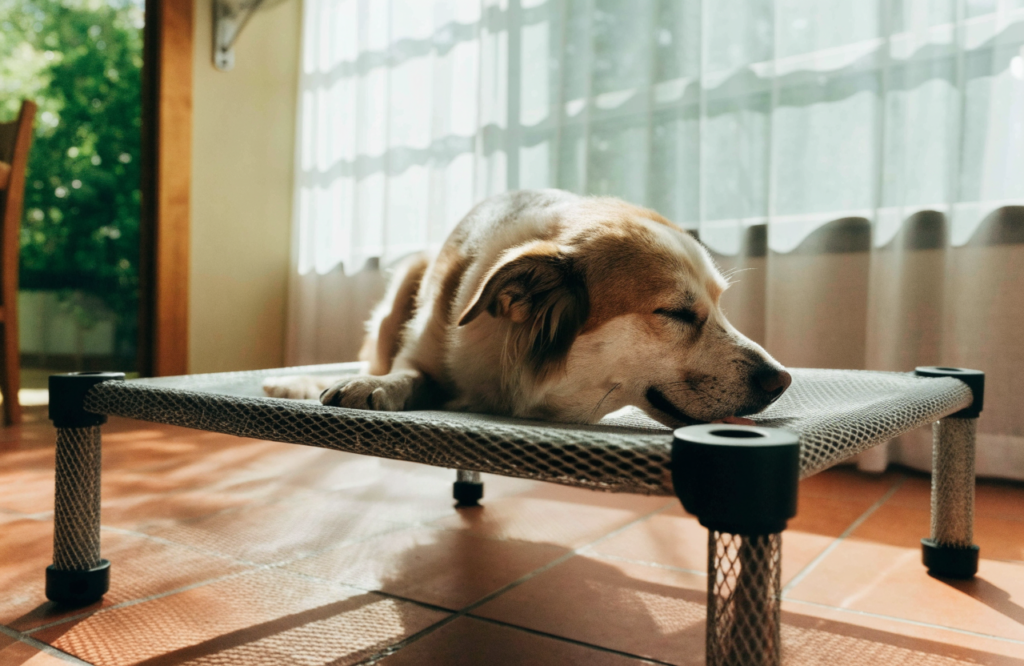
A raised cot is a taut mesh panel on a metal or plastic frame, usually a few inches off the floor. Heat that would otherwise radiate up from the floor has a gap to escape, and moving air can reach the underside of the dog.
This is the design that keeps working through a long nap, which is why it is the better default for a patio, a crate with the door open, or a dog that parks on one bed for hours. Mesh also hoses clean, which matters outdoors.
The tradeoffs are real. There is little cushioning, so a senior dog with stiff hips or a dog that needs orthopedic support may refuse it or wake sore. Short-legged, arthritic, or unsteady dogs can struggle with the step-up; a low frame or a ramp matters more than brand. Some dogs dislike the sway of loose mesh and will not settle until the fabric is taut. A bolster on an elevated bed adds a headrest, but thick padding around the edge can block the airflow you bought the cot for.
Chew-resistant frames (aluminum, heavy steel) survive better than thin tubular legs, but the mesh can still be torn. Outdoor use only helps in shade. A cot in full sun is a hammock over a hot deck.
Gel mats and water pads: cool on contact, then less so
A gel mat is a sealed, usually thin pad. The dog’s weight and body heat activate it. No plug, no water, no freezer — and most instructions say not to freeze it. It works well as an add-on: on a crate floor, beside a desk, in the back of a car during a supervised stop, or on top of a supportive bed the dog already uses.
The limit is physics. The pad is a heat sink with a fixed capacity. A dog that lies in one spot for hours will warm it. Flat gel pads generally stay cooler longer than thick gel-foam beds, because there is less insulating foam between the dog and the gel. Covering a mat with a blanket or thick duvet cancels the effect.
Water-filled pads use the same idea with more thermal mass, so they can feel cool longer, especially for a heavier dog. They are also heavier, slower to move, and dependent on a valve and seam that must stay intact. Fill only as the maker directs. Do not add ice, salt, or cleaners unless the instructions allow it.
Both types fail the same way if chewed. A puncture leaks, and the contents are not a toy.
Gel-foam beds: support first, cooling second
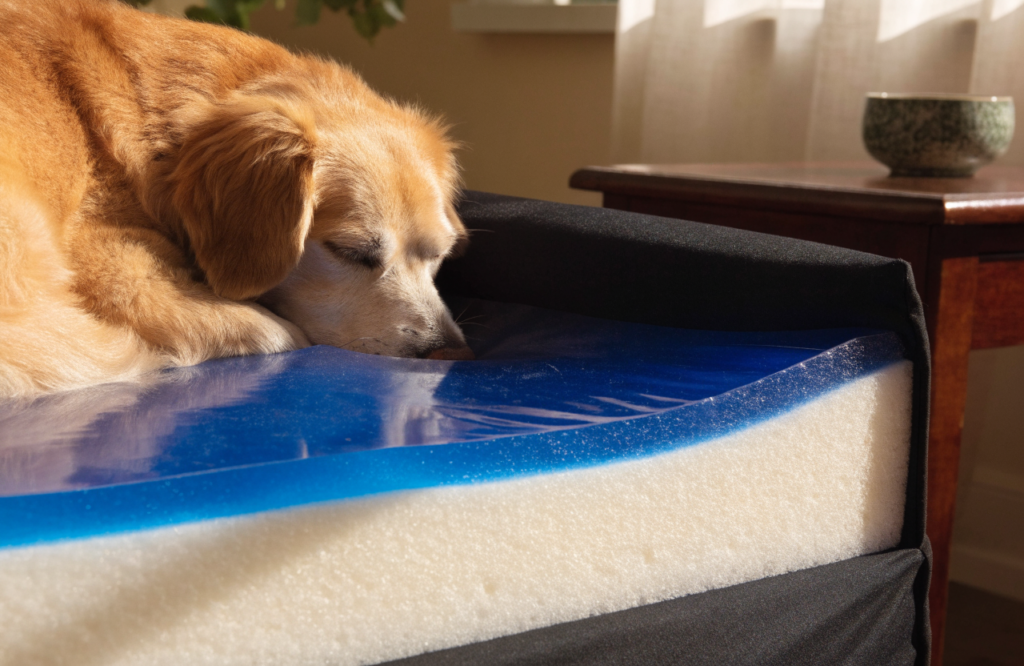
Choose this category when the dog needs give under the joints and the room is warm, not when you need the coolest possible surface. Open-cell foam, a breathable cover, and a gel layer can keep the sleeping surface from getting as hot as a standard memory-foam bed. The dog still sinks into a full-contact cushion that holds heat better than mesh or a thin mat.
Useful for seniors, large breeds, and dogs with arthritis who abandon a cot. Weak for a double-coated dog napping through a hot afternoon, and weak if the cover is thick plush — pile height fights the cooling claim. Washable covers matter, because a foam slab that cannot be cleaned becomes the reason the bed gets replaced.
A practical compromise is a supportive foam bed for night and a separate gel mat or cot for the hottest part of the day. Forcing one product to do both jobs is how people end up with a warm orthopedic bed labeled “cooling.”
Match the bed to the dog
| Situation | Start with | Skip as the only bed |
|---|---|---|
| Pants on the tile, sheds the blanket | Elevated cot or a thin gel mat | Thick bolstered foam |
| Stiff joints, slow to stand | Gel-foam or foam plus a thin mat on top | High cot with no step help |
| Crate, car, travel | Pressure-activated gel mat sized to the space | A heavy water bed or tall cot |
| Patio or yard in shade | Elevated mesh | Sealed gel in direct sun |
| Chews bedding | Tough elevated cot, supervised only | Gel or water pad left alone |
| Double coat, brachycephalic, overweight, senior | Cooler surface plus room airflow | Any bed in a closed hot room |
Size it so the dog can lie on a hip with legs extended, not only curled. A mat smaller than the chest and belly leaves the hottest contact points on the floor. Weight ratings on cots are real: a sagging mesh traps the dog in a pocket and cuts airflow.
Coat and face shape change the stakes. Thick-coated breeds, flat-faced dogs, overweight dogs, and seniors regulate heat less efficiently. A cooling bed is a comfort tool for them, not permission for midday exercise or a parked car.
Placement changes the result more than the brand
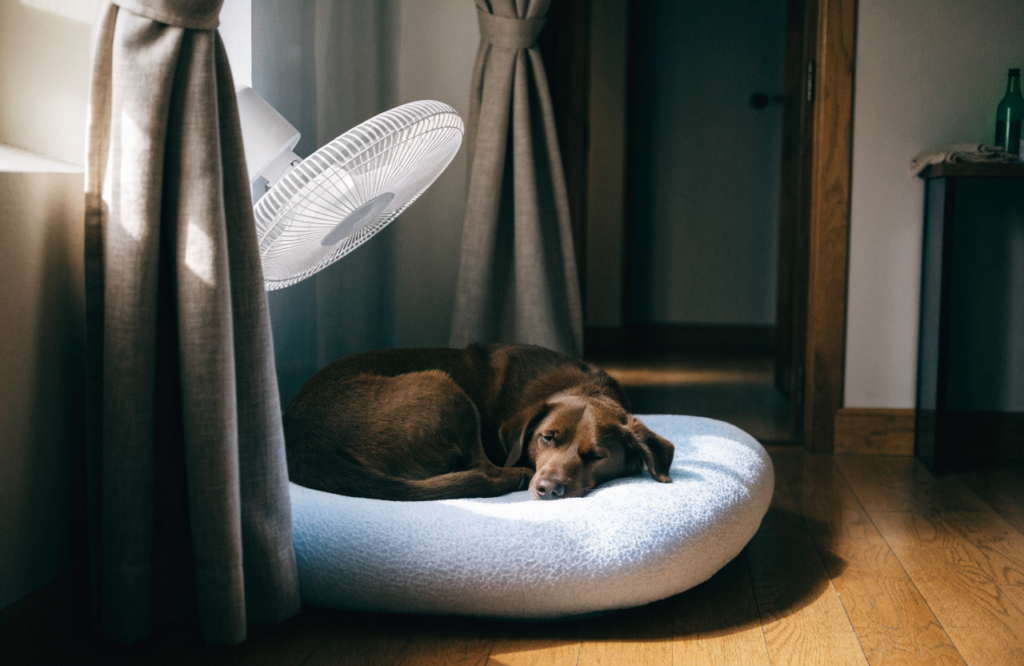
Put the bed where you would sit if you were hot. Shade, a room with a fan or air conditioning, and off radiant surfaces (sunlit concrete, a rug over a warm floor) matter more than gel versus mesh. A fan across an elevated cot multiplies the airflow design. The same fan does little for a gel mat buried under a blanket in a closed crate.
Do not use any cooling bed as the safety plan for a garage, enclosed porch, or car. Those spaces can still reach dangerous temperatures. Offer water nearby, and leave the dog a way to get off the surface. A dog that migrates to the bathroom tile is giving you data: the bed is not winning.
Chewing, leaks, and the hydrogel warning
ASPCA Poison Control has warned that some hydrogel cooling pads — and similar gel products not made for pets — have been linked to unexpected neurologic signs after ingestion, including tremors, unsteadiness, sound or touch sensitivity, a fast heart rate, and in reported cases seizures and death. The concern is not only the polymer named on the label; manufacturing byproducts such as acrylamide are suspected. If a dog punctures a pad and may have swallowed filling, contact a veterinarian or ASPCA Poison Control (888-426-4435). Neurologic signs are an emergency.
Practical rules follow from that:
- Inspect seams, valves, and the surface before each use. Retire a swollen, damp, or torn pad.
- Do not leave a known chewer unsupervised with a gel or water bed. A metal-frame cot is the lower-risk rest surface, and even that needs supervision if the dog eats mesh.
- Human headache wraps and cooling masks are not dog beds. Keep them out of reach.
- “Non-toxic” on a listing is not a guarantee once the product is chewed open.
How to tell whether it is helping
You do not need a lab. Watch the dog for a few hot afternoons.
A useful bed gets chosen over the bare floor, with looser panting once the dog is settled, and a coat that is not damp where it contacts the surface. A gel mat that feels room-temperature under your hand after 20 minutes of occupancy has done what it can until it recharges. A cot the dog refuses, or slips off, is the wrong height or the wrong feel — not proof that “cooling beds do not work.”
Early overheating is a different problem: heavy panting, rapid breathing, excessive drooling, bright red gums and tongue, skin hot to the touch, restlessness, or wobbliness. Move the dog to a cool, ventilated space, offer water, wet the underside with cool (not ice-cold) water, and use a fan. AKC guidance treats body temperature above 105°F as heatstroke territory and says not to drive the temperature below about 103°F during cooling, because it can keep falling. This is a veterinary emergency, not a bedding problem.
Mistakes that make a cooling bed useless
- Buying gel-foam because the title says cooling, then wondering why a two-hour nap still feels warm.
- Covering a gel mat with a blanket “so it is softer.”
- Freezing a pad the instructions say not to freeze. Some gels can crack or damage the shell.
- Using the bed in full sun, or as the only plan for a dog left outside.
- Ignoring entry height for an older dog, then concluding the dog “does not like being cool.”
- Treating a punctured pad as still safe because the leak looks small.
Frequently asked questions
Do cooling dog beds really work? Elevated cots work by airflow and do not “wear out” during a nap. Gel and water pads work until they warm up. Gel-foam beds usually run only slightly cooler than regular foam. All of them depend on a room that is not already dangerously hot.
Can a dog sleep on a cooling mat overnight? Many do, if the mat is intact and the dog does not chew it. Expect the surface to warm during continuous contact. Leave room to move off it. Do not rely on it overnight in a hot closed crate.
Are elevated beds colder in winter? They can be. Air under the dog that feels good in July feels drafty in January. A cot is a seasonal or warm-room bed for many dogs, not the only bed in the house.
Is a cooling bed enough for a husky, bulldog, or senior in a heat wave? No. Those dogs need a cool room, water, and limited exertion. The bed is an extra surface, not environmental control. Flat-faced dogs can worsen quickly; treat heavy panting as a reason to cool the room and call a vet, not a reason to buy a different mat.