
A built-in dog bed is a sleeping place fixed into furniture or the room itself — a cabinet cubby, a window seat, a nook under a human bed, or a fitted space under the stairs — rather than a loose cushion that can be shoved aside. It works when the usable floor is large enough for the dog’s real sleep posture, the entry is low enough to use without a jump, and the cover and floor can be cleaned. A handsome shell with a cramped, hot, or hard interior gets ignored.
The appeal is mostly practical. A fixed bed keeps a large cushion from migrating across the room, gives a den-like edge for dogs that like to lean, and can hide the bed when guests arrive. It fails when the design starts with the cabinet and only later asks whether the dog can stand, turn, and lie down inside it.
What counts as a built-in dog bed
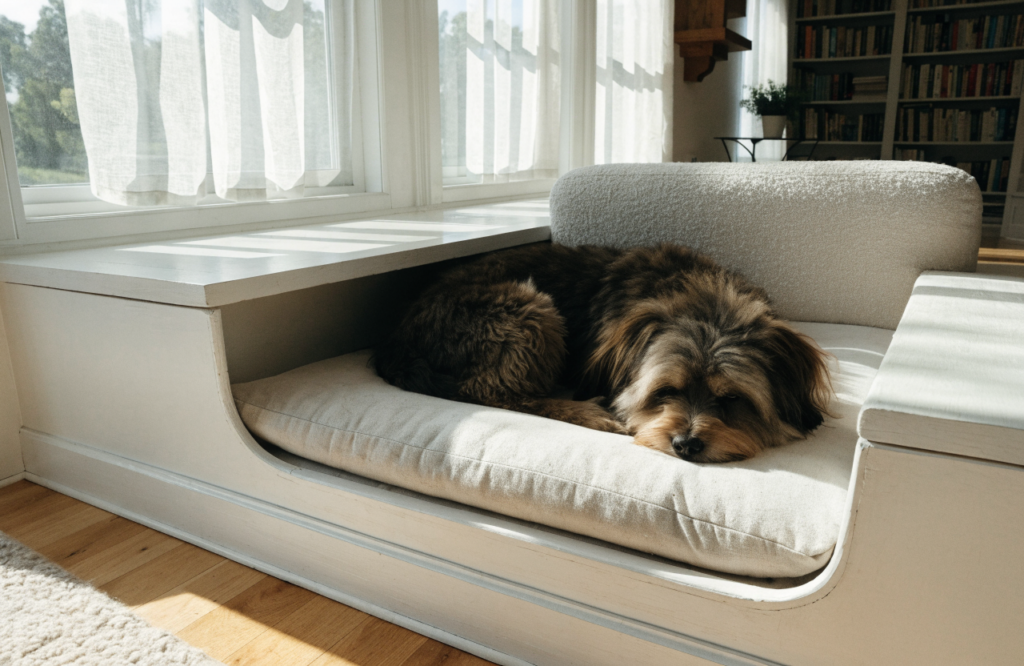
Three versions get lumped under the same search.
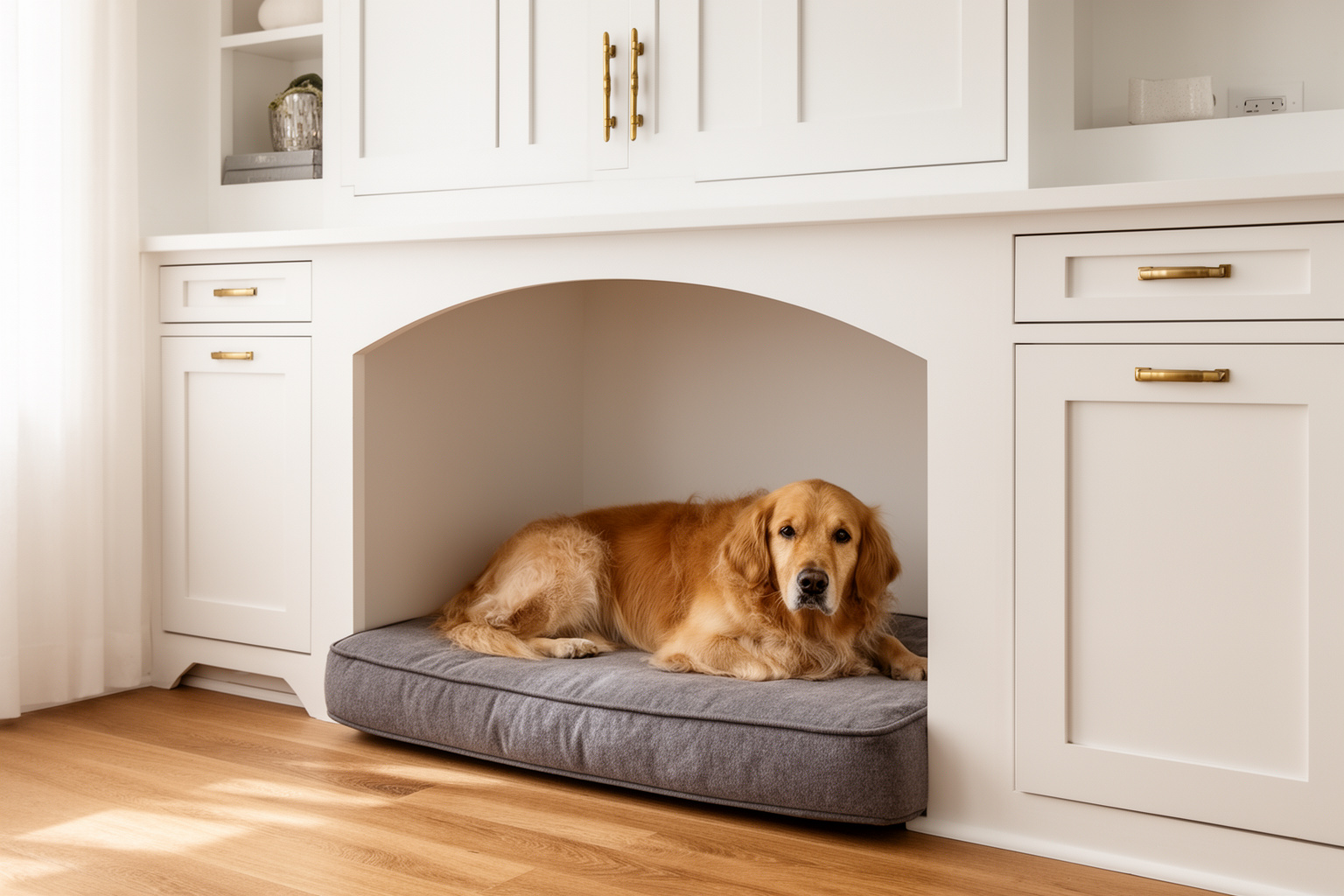
A furniture built-in is a nightstand, bench, window seat, sideboard, or bed frame with a permanent sleeping bay. The mattress or pad sits in a recess, often with a raised lip or partial walls. Some human beds use the space under the mattress platform as a side-entry nook so the dog stays close without sharing the mattress.
An architectural built-in uses a fixed part of the house: the triangle under the stairs, an alcove beside a chimney, or a mudroom cubby framed like a closet. These are carpentry projects, not pet-store products, and they run into wiring, plumbing, and, under stairs, fire-separation rules.
A converted piece is an existing drawer, crate cabinet, or open shelf fitted with a washable pad. It can look built-in, but the structure was not designed for a dog’s weight, chewing, or cleaning, so the joints and finish need a harder look than a purpose-built bay.
A freestanding bolster bed that merely looks like a sofa is not a built-in. It can be the right purchase. It just does not solve the “fixed, fitted, and out of the walkway” problem.
Decide the job before the look
The same opening can serve very different jobs, and the job decides the details.
A sleep den needs a quiet corner, a supportive pad, and enough wall or bolster for the dog to press against. It does not need a door.
A crate-style bay, with a gate or closing panel, is a containment space. That raises the bar: the dog must be able to stand, turn, and lie down, the air must move, and water has to be available if the dog will be shut in for more than a short stretch. A pretty cabinet door with no vent is a bad crate.
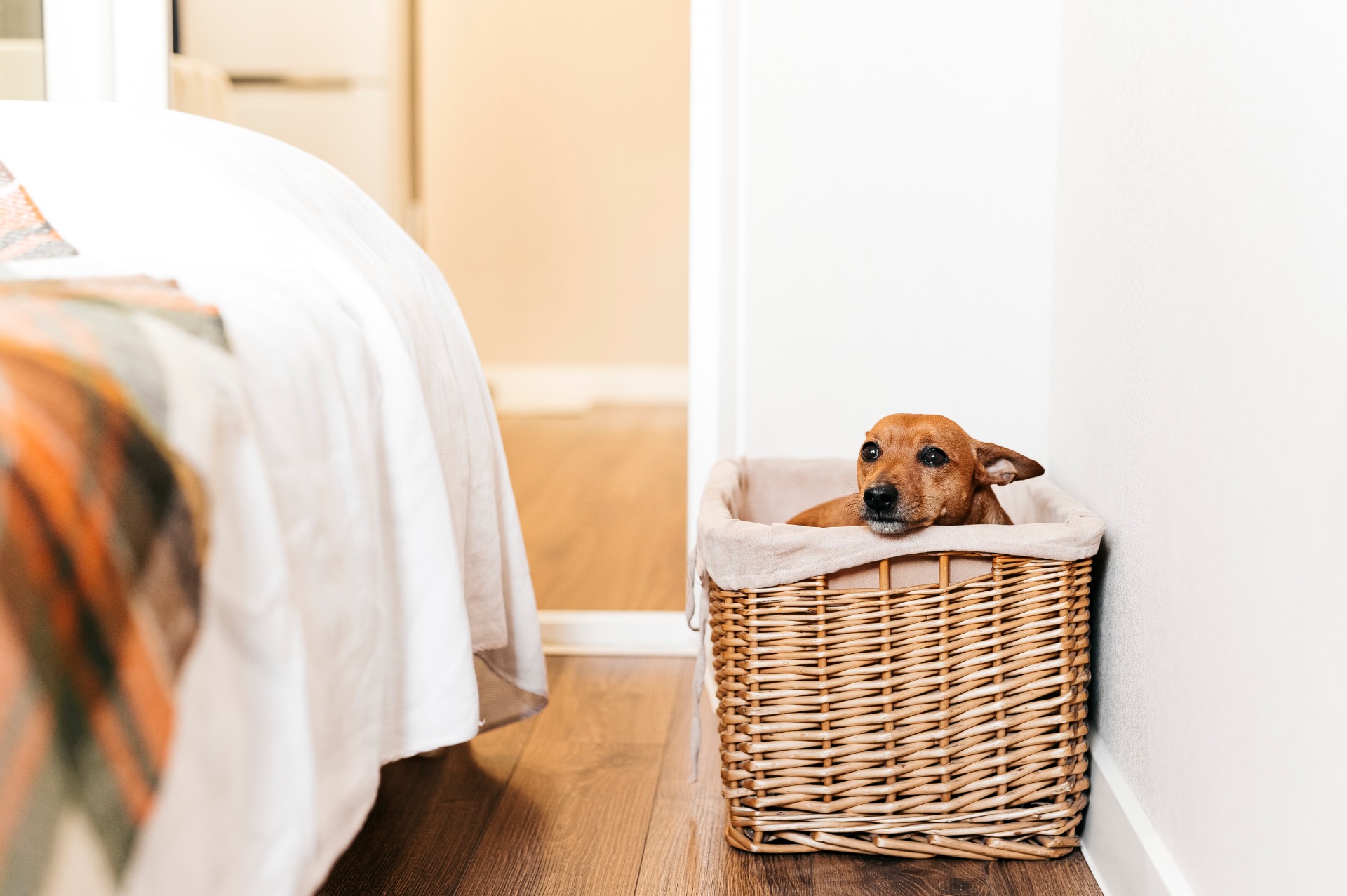
A proximity bed, usually beside or under the human bed, is for dogs that settle only when they can see or hear their person. Entry height matters more here than anywhere else. If the lip is awkward, the dog skips the nook and jumps up anyway.
A storage-plus-bed piece, such as a bench with a drawer beside the pad, only works if the sleeping surface is not the leftover space after the drawers are planned.
If two jobs conflict, size the sleep surface first. Decor and storage follow.
Size the opening and the floor, not the cabinet outside
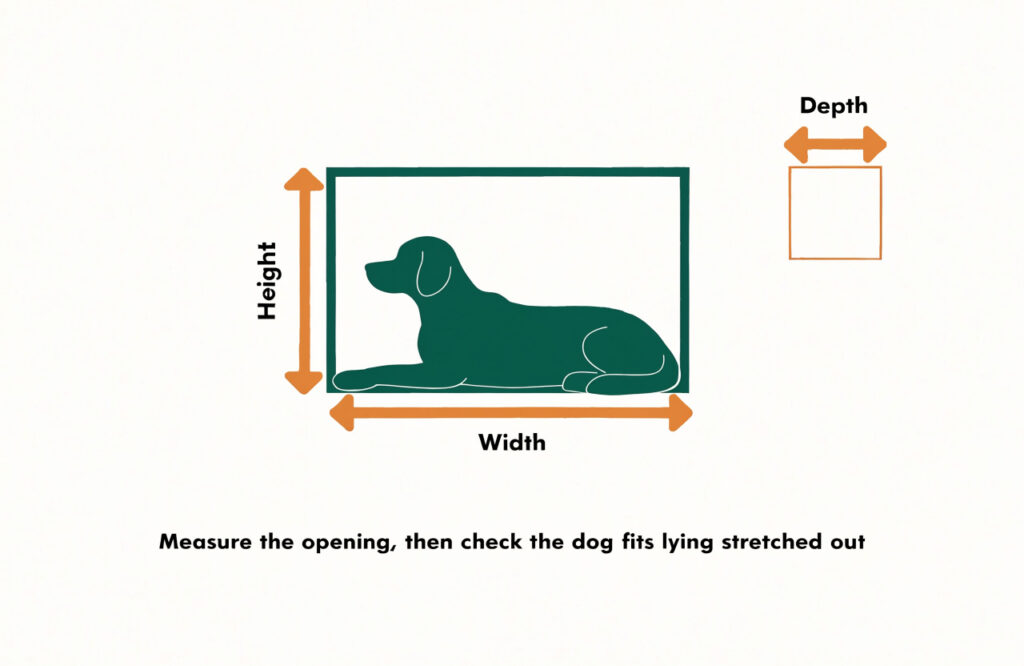
Labels on dog beds are loose. The number that matters is the clear interior after bolsters, lips, and door frames are subtracted.
Measure the dog from nose to the base of the tail while stretched out, then add about 6 to 12 inches. That is a practical minimum length for the sleeping surface. Curlers can live with less length if the width still lets them turn; sprawlers need the extra. When a dog is between sizes, size up, unless the dog is a small anxious curler that avoids open space.
Also measure:
- Shoulder height while standing, then add several inches of head clearance if the bay has a lid or a low soffit. Under-stair guides often use at least 6 inches above shoulder height and a length around 1.5 times nose-to-tail body length as a planning floor.
- Chest width, plus room to turn without scraping the jamb.
- Entry height from the floor to the top of the lip or cushion. Senior and short-legged dogs often abandon a bay they have to hop into.
Rough starting points, not breed laws:
| Dog | Clear floor to aim for | Notes |
|---|---|---|
| Under about 25 lb | 20–30 inches long | Snug can feel safer; still leave a turn |
| 25–50 lb | 30–40 inches long | Check chest width on bulldog-type bodies |
| 50–90 lb | 40–50 inches long | Orthopedic pad thickness eats height |
| Over 90 lb | 50 inches and up | Floor must not flex; entry must stay low |
A Labrador that stretches to 36 inches needs a bay nearer 42–48 inches, not a medium cabinet that looks roomy from the hallway. Weight charts are a cross-check only. A long, light sighthound and a compact, heavy bulldog of similar pounds do not need the same rectangle.
Match the bay to how the dog sleeps and moves
Watch a few nights before cutting plywood or ordering a cabinet.
Curlers and leaners do well with a partial wall, bolster, or three-sided recess. The edge is the product. A fully open platform wastes that preference.
Sprawlers need width and a flat center. High bolsters that steal six inches from each side turn a “large” bay into a medium one.
Seniors and dogs with stiff joints need a low entry, a firm supportive pad, and room to shift. Memory foam is often recommended for arthritic dogs because it spreads pressure; it is not a medical treatment, and a foam pad that is too small or too soft to reach the floor still fails. A veterinarian is the right person to ask if the stiffness is new.
Anxious dogs often settle faster in a covered or sided bay placed where they can still see the room or the bed. Full isolation in a closed cupboard at the far end of the house is a different, and usually worse, idea.
Chewers need tightly woven, replaceable covers and no dangling cords, exposed foam edges, or loose trim. A linen-look interior on a dog that mouths fabric is a short experiment.
Hot sleepers, including many thick-coated breeds, do better with a breathable pad and an open front than with a cave. Cold sleepers can take a washable blanket on top of the pad; the blanket should not be the only structure.
Materials that survive daily use
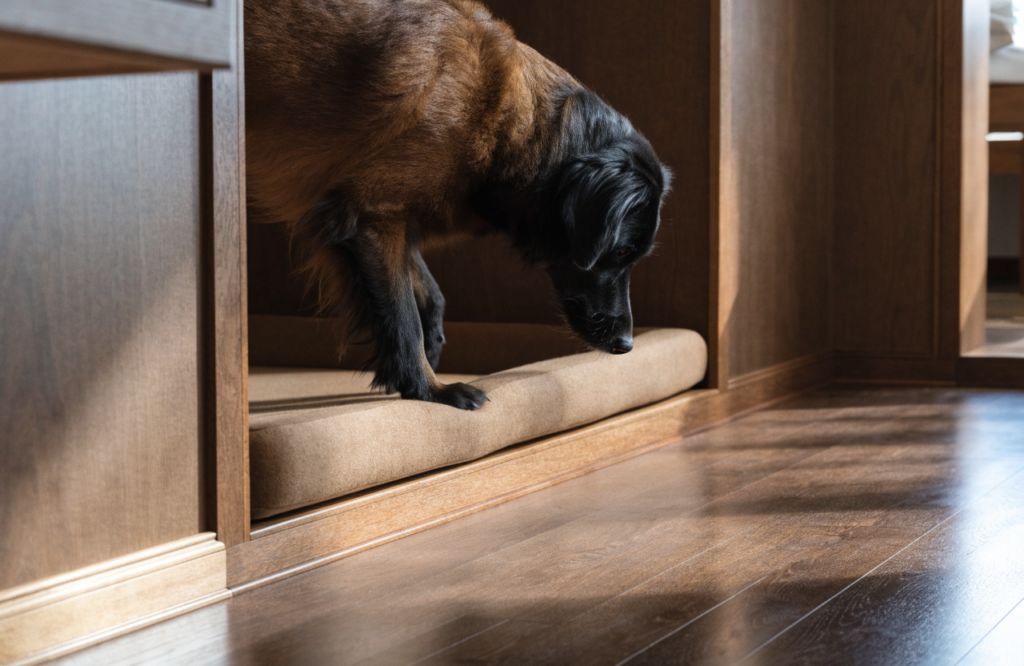
The frame should carry the dog’s weight without bounce. Plywood and solid wood are the usual choices for a fixed bay. Particleboard and thin MDF swell if a water bowl spills and sag under a heavy dog unless the span is short and well supported. Corners on a converted drawer need brackets or blocks; old joints were not built for someone launching out of bed at 6 a.m.
Edges should be rounded or banded. Splinters and screw heads at nose height are a common miss on first builds.
Finishes need to be fully cured before the dog moves in. Dogs lick, chew, and lie on the surface for hours. A paint or clear coat sold for interior wood, applied and dried to the maker’s schedule, is the normal route. Skip anything still tacky, and do not leave sanding dust in the bay.
The pad is a separate decision from the cabinet. Loose polyester fill collapses under larger dogs. A denser foam pad holds shape longer. CertiPUR-US is a useful foam certification when you can find it, because the dog is in contact with the surface for long periods. The non-negotiable feature is a removable, machine-washable cover. A built-in that cannot be stripped will hold odor no matter how good the wood looks.
The floor of the bay should be wipeable and non-slip: a fitted pad with a grippy underside, or a thin mat under the cushion. Wall-to-wall carpet inside a closed cubby is hard to dry.
Ventilation, heat, and enclosure rules
An open-front cubby in a living room rarely has an airflow problem. A door, a deep under-stair closet, or a lid does.
Warm air and moisture collect in small boxes. Passive vents — a low intake and a high outlet — are a standard way to keep an enclosed bay from going stale. A mesh panel in the door does the same job with less carpentry. If the only air path is a crack under the door, the bay is too closed for anything but brief use.
Under stairs, look before you cut. Wiring, plumbing, and ducts often run there. Load-bearing studs in the planned opening are a reason to stop and ask a builder or structural engineer. Many residential codes also require fire-resistant gypsum on the walls of an enclosed space under interior stairs. Local rules differ, so a finished under-stair kennel is a permitted carpentry job, not only a pet project.
A gated bay is not a place to leave a dog for long stretches without water, and it is a poor plan for a dog that panics in confinement. If the goal is only sleep, leave the front open.
Where a built-in earns its space
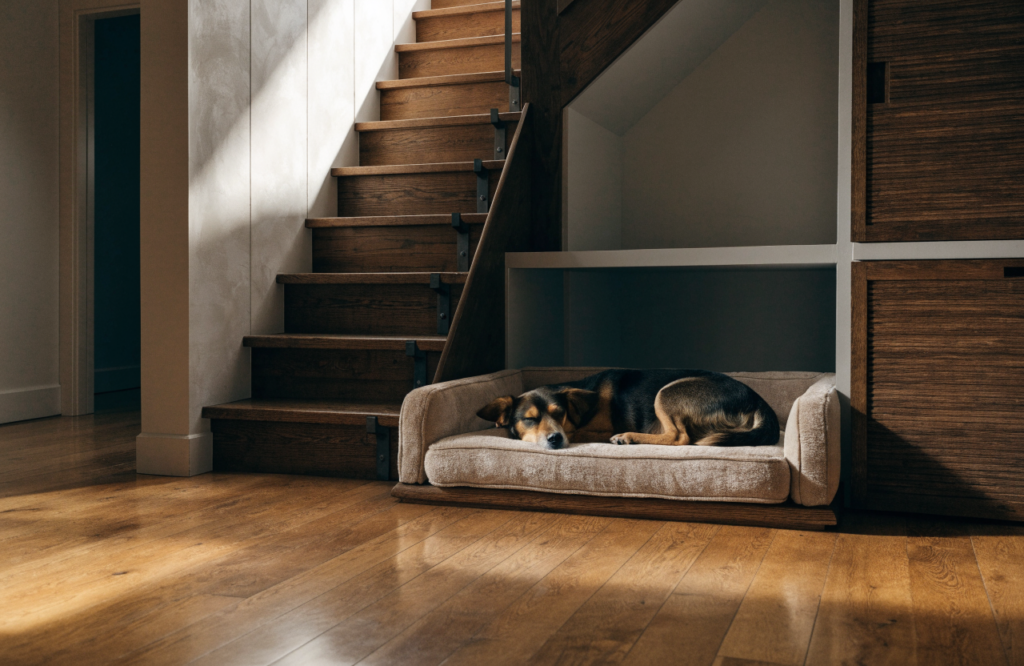
Under the stairs is the classic use of dead volume, provided the tall end clears the dog’s head and the short end is not a crawl the dog gets stuck in. Put the bed in the taller portion and use the low end for storage you can reach from outside.
Beside or under the human bed suits dogs that will not settle across the room. The platform above has to stay stiff, the side entry has to meet the dog’s shoulder height with spare room, and the opening should not sit where feet land in the dark. A bumper or partial panel keeps the pad from walking out.
A window seat or bench works in a room where the dog already lies in a patch of sun, as long as summer glass does not turn the bay into a heat trap. A mudroom cubby keeps wet dogs off the sofa, but the pad then needs a cover that can be washed often and a floor that tolerates damp paws.
A living-room cabinet bed is mostly a styling choice. It succeeds when the bay faces the room, not a wall, and when the walkway in front stays clear so the dog is not stepped over every time someone crosses the rug.
Ready-made, custom, or a conversion
| Route | Best when | Watch for |
|---|---|---|
| Ready-made pet cabinet or bed-frame nook | You want a known size and a washable insert | Interior smaller than the outer footprint; high lips |
| Custom carpentry | The space is odd (stairs, alcove) or the dog is very large | Cost, permits, fire and structure rules |
| Furniture conversion | You already own a sturdy frame | Weak joints, poor finishes, no ventilation, particleboard |
| Freestanding bed in a reserved niche | You may move house or change dogs | It will not look “built-in,” but it is easier to wash and replace |
Custom is often the only honest fit for a giant breed or a sloped under-stair void. It is rarely necessary for a 20-pound curler, who may be better served by a standard bolster bed inside a simple open shelf. Conversions save money only if the donor piece is solid. Reinforcing a wobbly drawer can cost as much time as building a small box.
Mistakes that make the dog skip the bay
The usable surface is smaller than the dog. People measure the cabinet face and forget the lip, the door stop, and the bolster.
The entry is a step. A four-inch lip is nothing to a young Labrador and a daily refusal for a short-legged or older dog.
The bay is a closed box. No vent, a solid door, and a deep shelf read as a cupboard, not a bed.
The pad cannot be washed. Odor builds, the dog avoids it, and the cabinet gets blamed.
The spot is in a draft, a doorway, or the main path to the kitchen. Dogs abandon beds they get stepped near.
The foam is a thin topper on a hard plywood floor. The cabinet can be perfect and the bed still feels like a board.
The finish is fresh. Moving a dog in before coatings have cured is an avoidable exposure.
How to get a dog to use it
Place the bay where the dog already rests, or within sight of that spot, rather than in a new room. Put an unwashed blanket or a T-shirt that already smells like the household on the pad. Feed a few meals or scatter high-value treats in the opening so the bay predicts something good. Sit nearby and ignore the dog; hovering and pushing them in usually backfires.
Do not close a door on a dog that has not chosen the space calmly with the door open. If the dog still sleeps elsewhere after a week or two of easy access, the size, entry, surface, or location is wrong. Changing the pad or dropping the lip fixes more beds than another round of training.
Frequently asked questions
Is a built-in dog bed the same as a dog crate?
Only if you add a secure gate and meet crate rules: stand, turn, lie down, airflow, and water for any real confinement. An open cabinet bed is furniture, not a crate.
Can you put a built-in dog bed under the stairs?
Yes, if the dog can stand and turn in the tall section, vents or an open front move air, and you check structure, services, and local fire rules before enclosing the void. A mattress shoved into an unfinished closet is not the same project.
What should go inside the bay?
A supportive pad with a washable cover, sized to the clear interior. Add a blanket only if the dog uses one. Fixed bowls are optional and belong where they cannot soak the foam.
Are built-in beds better for senior dogs?
They can be, if the entry is low and the pad is supportive. A high lip or a soft pad that bottoms out is worse than a simple floor bed with a good mattress.
What if the dog chews the frame?
Use a tighter weave, cover exposed foam, and round or cap edges. Chronic chewing is often boredom or anxiety, which a nicer cabinet will not fix on its own.