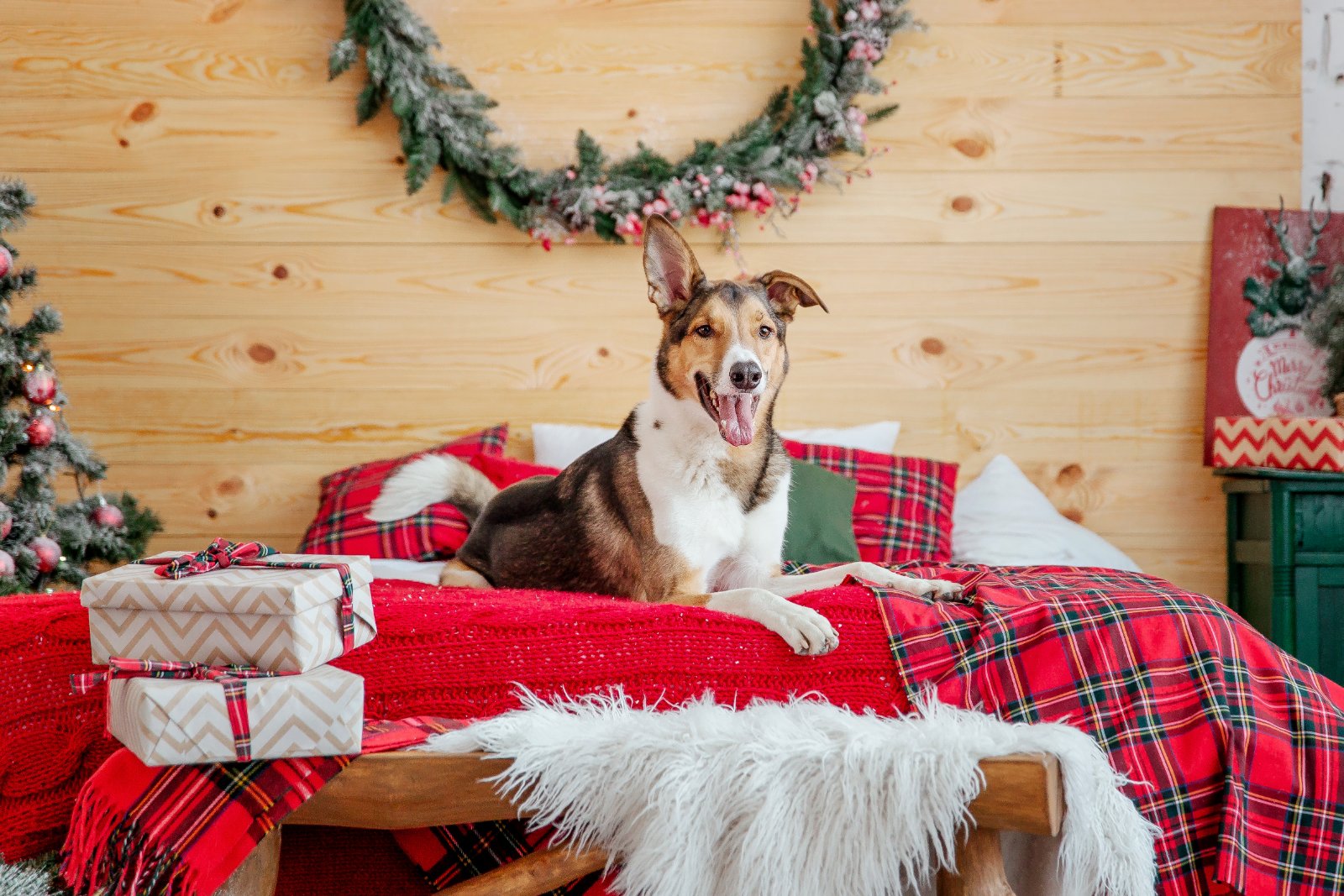

A Christmas dog bed is a regular pet bed dressed in holiday colors or shapes—plaid, snowmen, gingerbread houses, sleighs, Nordic prints—rather than a different kind of furniture. The useful version is the one your dog will sleep in after the tree comes down: the right length for how they actually lie, a cover you can wash, and no loose trim they can pull off.
Most of the festive beds sold in pet shops and big-box stores are built for small dogs and cats. Larger dogs are often better served by a plain supportive bed plus a washable holiday cover or blanket. The decoration is optional. Fit, fill, and cleaning are not.
What buyers are usually looking at
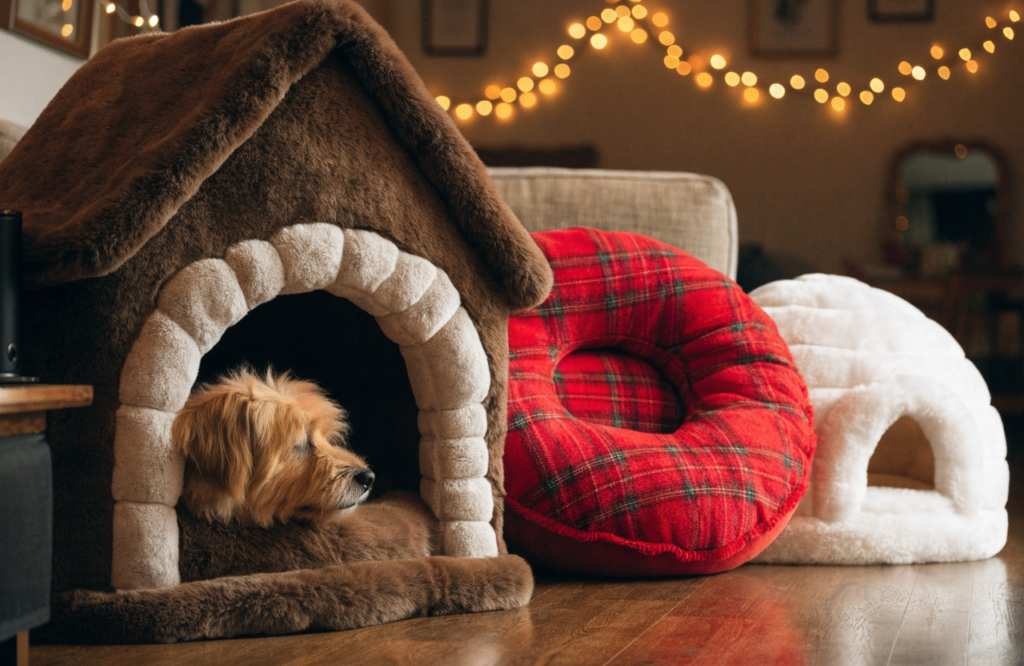
Retail “Christmas dog beds” fall into a few repeated forms.
Cave and house beds look like gingerbread cottages, Christmas trees, or igloos. The raised opening and enclosed sides suit dogs that curl and like a den. Interior space is often smaller than the outside photo suggests, so measure the sleeping floor, not the silhouette.
Bolster and cuddler beds use a raised rim in red, buffalo check, fair isle, or a Santa-belt print. The rim gives a headrest and a sense of a boundary. Dogs that sprawl on their side need a rim low enough that they are not forced into a tight circle.
Flat mats and crate pads carry a holiday print on a thin pad. These work inside a crate, under a tree for short rests, or as a washable layer on a bed you already own. They do not replace an orthopedic cushion for a senior dog.
Novelty shapes—sleighs, stockings, oversized ornaments—are mostly décor. Check whether the sleeping surface is flat and stable, and whether any buckle, bell, or appliqué is stitched on or can be chewed free.
Patterns that are not Christmas-specific, such as red plaid or simple Nordic knits, are easier to leave out in January. A gingerbread house usually looks out of place by February.
Match the bed to how the dog sleeps
Labels such as “small” and “large” are not standardized. Measure the dog lying down, relaxed, from the tip of the nose to the base of the tail (not the tip of the tail). Add about 6 inches for a dog that curls tightly, and 10 to 12 inches for a dog that stretches out. Width should clear the shoulders with a few inches to spare.
A cave bed that looks roomy in a product photo can still be too short once the dog turns around inside it. If the dog hangs a hip or a shoulder off the edge every night, the bed is too small, festive print or not.
Support depends on the dog, not the season. Puppies and heavy chewers are a poor match for exposed foam: a chewed memory-foam slab is expensive to replace, and loose foam is a swallowing risk. A washable mat or a bed with a tough, fully enclosed cover is the safer holiday gift until destructive chewing settles. Older dogs, and dogs with stiff joints, need a firm, even surface more than a plush novelty shell. A thin festive cover over a bed they already use is often more useful than a cute cave they will not fit in.
Fabric, washing, and what not to leave within reach
Most holiday beds are polyester, sherpa, or a similar synthetic plush over polyfill or foam. That is normal for the category. What matters is whether the cover comes off.
A removable, machine-washable cover is the feature that decides whether the bed survives December. Holiday traffic means more mud, salt, treats, and the occasional accident. Wash the cover on the cycle the care label allows, with a mild, fragrance-free detergent, and dry it completely before the dog uses it again. Damp fill grows mildew. Foam inserts generally should not go in the washer; spot-clean them and let them air dry. If the label and a general tip disagree, follow the label.
Skip loose ribbons, bells, tinsel-style trim, and anything that can be pulled off in one tug. A dog that chews beds will treat a gingerbread-house door the same way it treats a toy. Keep the bed away from low-hanging ornaments, light strands, and tinsel on the tree itself—those are separate hazards from the bed, but they sit in the same room.
Non-slip bottoms help on wood and tile. A bed that slides every time the dog circles will be abandoned for the rug.
Where it belongs during the holidays
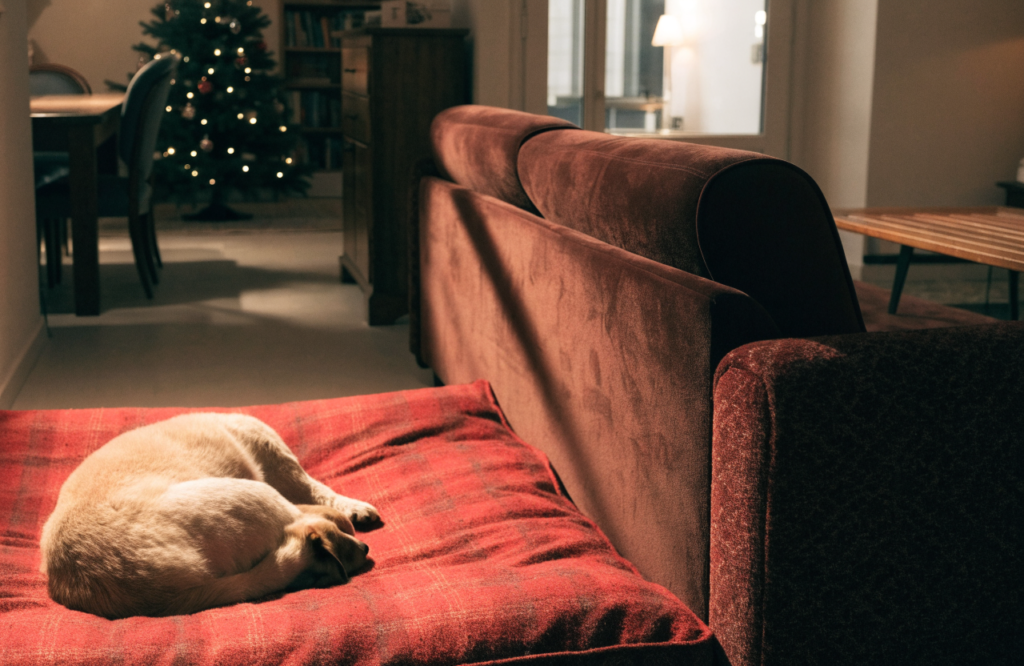
Place it where the dog already rests when the house is busy: a corner of the living room with a clear view of the family, beside a sofa, or in a quiet adjacent room if gatherings overwhelm them. Under the tree looks good in photos and is a poor default if the dog guards gifts, knocks ornaments, or gets stepped on.
A second, familiar bed in a quieter room is useful when visitors, music, and cooking run late. The new bed does not have to be the only bed.
When it is a good gift, and when it is not
A Christmas dog bed is a reasonable gift when you know the dog’s size, sleep style, and chewing habits, and when the bed will still be usable in January. A plaid bolster in the right dimensions, or a washable holiday cover for a bed the dog already likes, clears that bar.
It is a weak gift when you are buying for a dog you have not measured, when the only options in the theme are extra-small caves, or when the dog is a senior who needs joint support the novelty bed does not provide. In those cases a plain orthopedic bed, a larger bolster, or a crate pad is the better present, with a festive blanket on top if you still want the photo.
Dogs often ignore a new bed for days. Putting an unwashed item that smells only of the store into a high-traffic room on Christmas morning is a common reason. A piece of their current bedding, or a worn T-shirt, on the new bed usually speeds the switch. Cats will also claim it; that is a space problem, not a training failure.
Mistakes that leave the bed empty
- Buying the print first and checking interior dimensions second.
- Choosing a cave for a dog that sleeps stretched on its side.
- Assuming “machine washable” includes the foam core.
- Leaving appliqués and dangling trim on a bed used by a chewer.
- Replacing the only quiet resting spot with a bed under the tree during a loud party.
- Expecting a holiday bed to fix joint pain that needs a firmer, deeper cushion.
Questions people ask after they start shopping
Are Christmas dog beds only for small dogs? Most shaped holiday beds—houses, trees, sleighs—are made in extra-small and small sizes. Medium and large options exist mainly as rectangular bolsters and mats with a seasonal print. For a large dog, size the sleeping surface first, then add the holiday look with a cover or blanket.
Can the bed stay out after Christmas? Yes, if the pattern is not loudly seasonal and the bed still fits. Solid red, simple plaid, and fair-isle styles read as winter bedding rather than a prop. Strongly shaped novelty beds are the ones people pack away.
How often should the cover be washed in December? More often than in a quiet month. A removable cover every one to two weeks is a practical baseline when the dog is inside more, guests are over, and floors are dirty; wash sooner after mud, salt, or an accident. Dry it fully before reuse.
Is a heated or self-warming pad a Christmas bed? Not by itself. Self-warming mats reflect body heat and have no cord; plug-in heated pads are a separate product with their own chew and supervision limits. Either can sit under a festive cover. They are not required for a dog that already sleeps warmly indoors.