
A coffee table dog bed only works when the sleeping space is sized to the dog and the tabletop still works at sofa height. Most pieces sold under that name are furniture-style crates or open cubbies with a flat top, and the useful ones give a small or medium dog a den in the middle of the room without turning the living room into a kennel aisle.
Dogs already treat the space under a coffee table as a bed. A low roof, a view of the room, and a spot near people match a common denning habit: veterinary sources describe it as a normal preference for a sheltered place where a dog can watch household activity without being in the middle of it. A purpose-built coffee table dog bed formalizes that spot. It does not invent a new behavior.
The Amish-made Caledonia is the enclosed version of the idea: a solid-wood coffee table with a gated sleeping compartment and a removable pad underneath.
Three designs, and only one is a true coffee table
Shoppers use “coffee table dog bed” for three different pieces. Mixing them up is the main reason these purchases disappoint.
Open raised table. A normal coffee table, or a purpose-built frame, with a cushion in the open space underneath. Entry is from one or more sides. Height can stay in the usual coffee-table range, about 16 to 18 inches, because the dog does not have to stand fully upright inside a box. This suits dogs who already nap under the existing table and do not need to be contained.
Furniture crate with a flat top. Wood or engineered wood over a metal or slatted enclosure, often with a door and a plastic tray. Listings market these as coffee tables, end tables, and TV stands interchangeably. Interior height has to let the dog stand and turn, so the finished piece is often 24 to 32 inches tall or more. That is end-table or console height, not coffee-table height. A 28-inch top next to a sofa with a 18-inch seat is awkward to reach and blocks sightlines.
End table or nightstand with a bed. Same idea, smaller footprint, placed beside the sofa or bed. These are easier to size correctly because they do not have to serve as the room’s main table. Many of the better-reviewed products in this category are actually end tables.
A gated end-table crate is the more common commercial version. It works beside a sofa; it rarely replaces a low coffee table.
Custom solid-wood versions exist. DutchCrafters’ Caledonia dog-crate coffee table, for example, is sold as a solid-wood piece with a drawer, a lockable door, and a 2-inch pad with a removable water-resistant cover, listed from roughly $2,400 depending on wood and fabric. Mass-market wood-and-metal crates are commonly listed from about $100 to $400. The price gap is mostly materials and joinery, not a different idea.
Size the sleeping space, not the tabletop
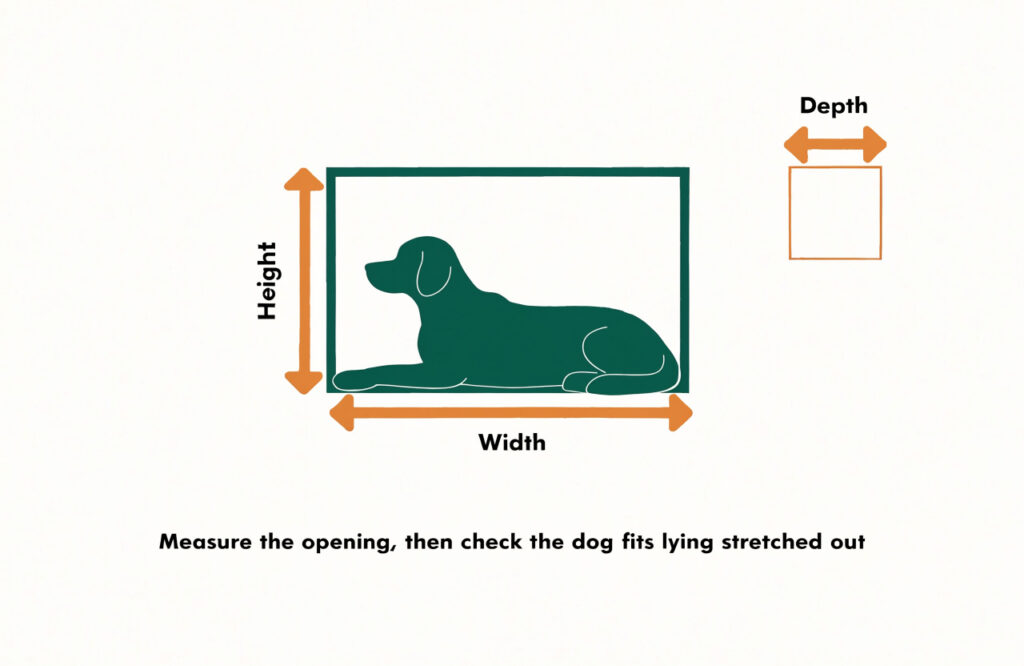
The ASPCA’s crate rule is the right minimum for any enclosed version: the dog should be able to stand up, turn around, and lie down without hitting the top or sides. For an already housetrained dog who will not be shut in for long stretches, a larger space is fine. For a puppy still learning where to toilet, a too-big enclosure can be counterproductive, because the dog can soil one end and sleep at the other.
Measure the dog, then compare those numbers to interior dimensions, not the outside of the furniture.
- Length from nose to the base of the tail, with the dog standing or stretched. Add at least 4 inches for a crate; add 6 to 12 inches if the space is an open bed and the dog sprawls.
- Height from the floor to the top of the head or ears while standing. Add at least 4 inches so the dog is not brushing the underside of the top.
- Width enough to turn and to lie on the side. A curled sleeper needs less than a dog who splays.
A medium furniture crate is often listed around 24 to 30 inches of interior length and suited to dogs in the 15- to 40-pound range, with breed examples such as French bulldogs, corgis, beagles, and cocker spaniels. Those labels are not standardized. A long-backed dachshund and a compact French bulldog of the same weight need different floor plans. Large and giant breeds rarely fit a piece that still looks like a coffee table; the enclosure becomes a sideboard.
The cushion steals space. A 3-inch pad inside a marginal crate means the dog can no longer stand. If the listing does not separate interior height from pad thickness, assume the pad will eat that margin.
Table height and top strength are separate problems
A coffee table should sit near sofa-seat height so a mug is in reach. Sofa seats commonly land around 17 to 19 inches, so a usable coffee table top is usually 16 to 18 inches. An enclosed bed for any dog taller than a toy breed fights that number.
If the dog is medium-sized and you want a real coffee table, use an open design: ordinary table height, open sides, bed on the floor underneath. If you need a door, treat the piece as an end table or a low media console and keep a separate, lower surface for drinks.
Top load is the other spec that listings blur. Some engineered-wood crate tables advertise a top capacity around 100 to 200 pounds. That is a stated rating for static weight, not an invitation to sit, kneel, or let a child climb. Particleboard tops also dent and stain more easily than solid wood once drinks and remote controls live there. Check for a lip or raised edge if you want spills contained, and look at whether the top is a finished panel or a thin skin over the crate frame.
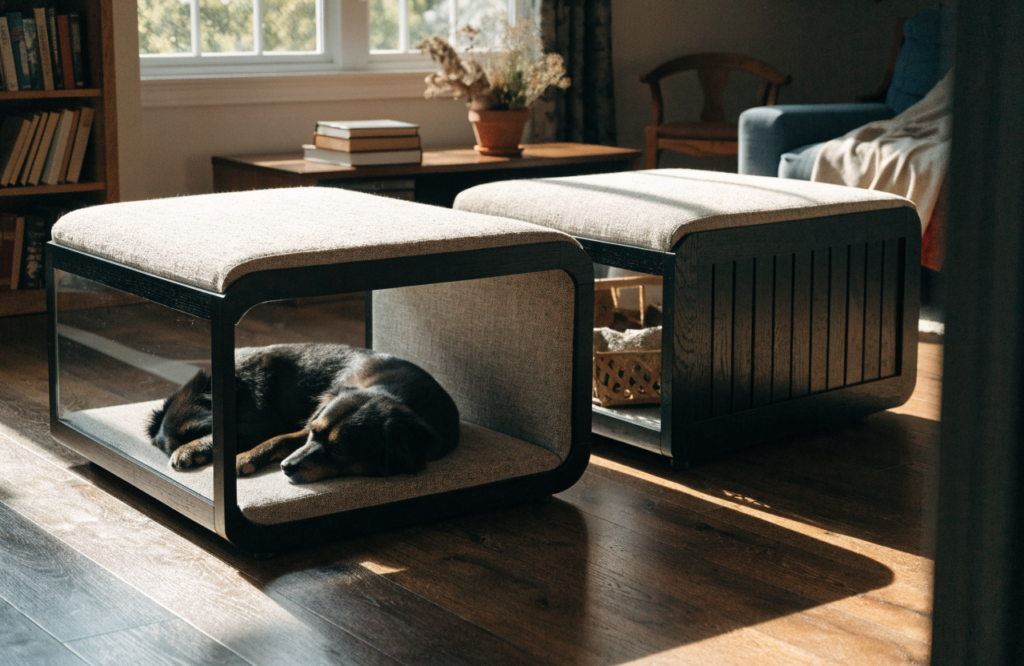
Open-sided frames keep the bed low and easy to enter. Steps help small or older dogs, but they also eat floor space in front of the sofa.
Open bed or closed door
Choose the enclosure based on what the dog needs during the hours you are home, not on how the product photographs.
An open cubby is the better coffee table dog bed for a dog who already sleeps under furniture, is reliable when guests arrive, and mainly wants a defined nap spot near the sofa. Airflow is automatic. Cleaning is a matter of pulling the cover. The downside is that nothing stops the dog from leaving, and nothing stops a toddler or another pet from climbing in.
A door is useful when you need a short hold — a delivery, a guest the dog should not rush, a meal on the table. It is a poor substitute for a proper crate if the dog is destructive, not housetrained, or panicked by confinement. Furniture crates are often weaker than a heavy wire crate: latches can be simpler, bars or slats may be spaced for looks rather than escape prevention, and particleboard does not survive a determined chewer. Veterinary and welfare guidance is consistent that a crate is a resting place, not a fix for a dog who is left too long. Puppies, in particular, should not be shut in for more than an hour or two at a time except overnight.
Ventilation matters more on the closed version. At least two sides should be open to airflow; a solid box with one small window gets stuffy. Slat or bar spacing has to be narrow enough that a paw, jaw, or collar cannot lodge in it. Skip pieces placed against a radiator or in full sun. A den under a table should be sheltered, not hot.
What to put inside, and what to keep off the top
The bed itself should be removable. A crate pad or flat orthopedic mat works better than a bolstered sofa bed, which wastes interior space. A washable, water-resistant cover matters more here than in a bedroom corner, because this bed sits where drinks get set down. Avoid thick memory foam if the interior height is already tight.
Do not store leashes, medications, or food bags in an open cubby the dog can reach. A drawer is only useful if it closes fully and sits outside the sleeping compartment.
On the top, assume fur, drool, and the occasional nose print. A sealed wood finish or a laminate that can be wiped is more practical than an open-grain or light fabric inset. Heavy lamps on a tall, narrow crate table make the whole piece easier to tip if a dog bumps it while entering. Wider coffee-table footprints are more stable than nightstand-shaped crates used in the center of the room.
When this furniture is the wrong answer
Skip a coffee table dog bed if:
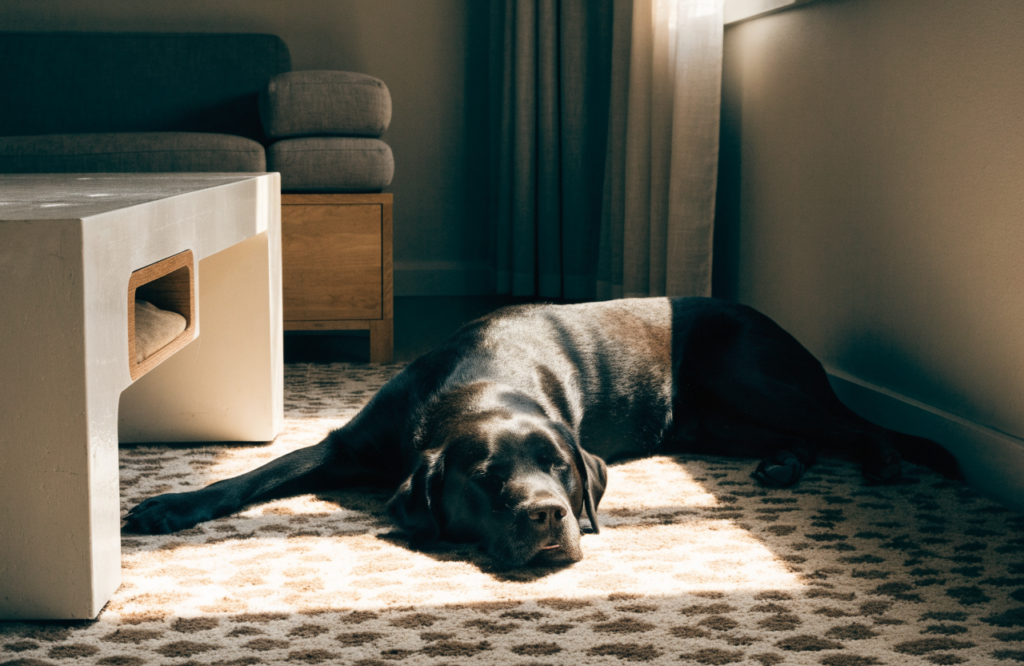
- The dog is large, long, or a sprawler. Floor space under a real coffee table will not give a Labrador a full stretch, and a crate big enough for that dog will dominate the seating area.
- The dog guards beds or is nervous in small spaces. Forcing a den can make the guarding worse.
- You need serious containment. A furniture piece is a poor training crate.
- The living room is the only path through the house. A 30-inch-deep enclosure in the traffic lane becomes an obstacle.
- The dog is a persistent chewer of wood. Solid hardwood edges hold up better than soft pine or exposed particleboard, but none of these are chew toys.
- Someone in the house needs the coffee table at a strict height, for example to rise from a chair using the table edge for support. A taller crate table changes that reach.
An old coffee table flipped into a floor bed — a project that has circulated for years, sometimes done for the cost of paint and a cushion — solves a different problem. It gives up the table. It can be a reasonable spare bed for a small dog. It is not a dual-purpose piece.
A buying check that prevents the usual return
Before ordering, write down four numbers: the dog’s nose-to-tail-base length, standing height, weight, and the clear floor width between sofa and the far side of the rug. Then require the product page to give interior length, width, and height, door swing, and top height. If only exterior dimensions are listed, assume the usable bed is several inches smaller in each direction once the frame and pad are counted.
Match the top height to how you actually use the table. Place an enclosed crate beside the sofa if the dog needs a door. Use an open, low table in the center if the dog only wants the den they have already chosen. In both cases the useful test is the same: the dog can enter, turn, and lie flat, and you can still set a cup down without leaning over a box.