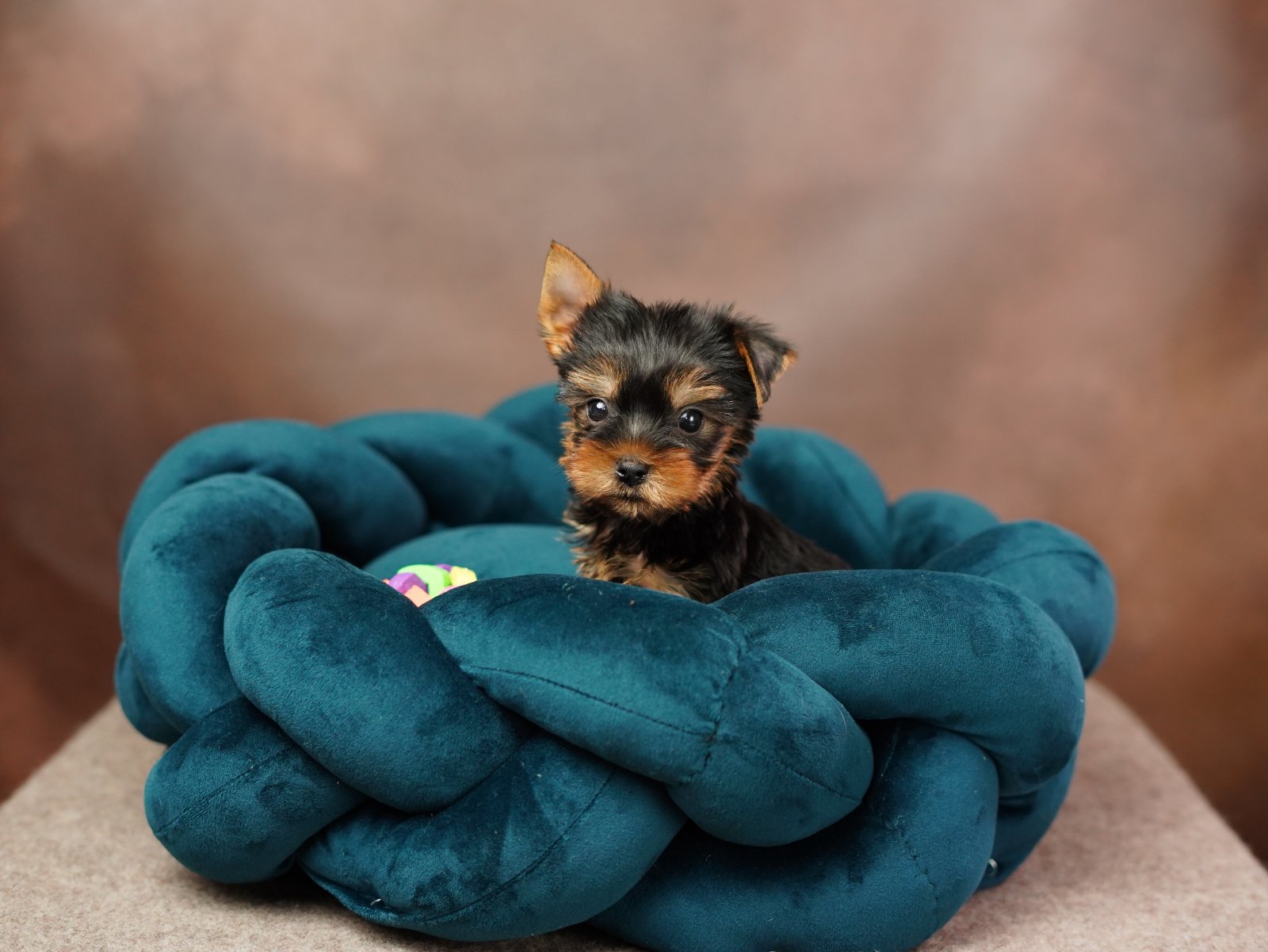

A custom dog bed is worth ordering when a standard size, shape, or cover will not match the dog in front of you or the spot the bed has to fit. The useful version is not a logo on a pillow. It is a bed cut to a measured sleeping length, filled with a solid foam slab thick enough that a heavy dog does not hit the floor, and finished with a cover you can remove and wash. Most of the price difference between a good custom bed and a disappointing one sits in those three specs, not in the fabric color.
When a custom dog bed solves a real problem
Standard beds fail in predictable ways. Size labels are not consistent across brands: one maker’s large can be several inches shorter than another’s. Giant and long-bodied dogs often spill off the biggest stock size. Crate pads, window seats, built-in benches, and oddly shaped corners rarely match a catalog rectangle. A good cover sometimes outlasts a flattened insert, and only a refill or a made-to-measure cushion makes sense.
Custom is the wrong spend when the dog is an average size, sleeps in an open room, and would be fine on a well-built stock orthopedic bed. In that case you are paying for sewing and lead time, not for better sleep.
The jobs custom actually does well:
- Exact outer dimensions for a crate, kennel, cabinet, or window seat
- Extra length for a sprawler who measures longer than any stock “XL”
- A replacement foam core for a cover that is still sound
- A fabric chosen for heavy shedding, drool, or frequent washing rather than whatever is in stock
- A low entry height for a senior who cannot step over a tall bolster
Style alone is a weak reason. If the only difference is a pattern, a stock bed in a fabric you like is usually the better buy.
Measure the dog and the space before you order
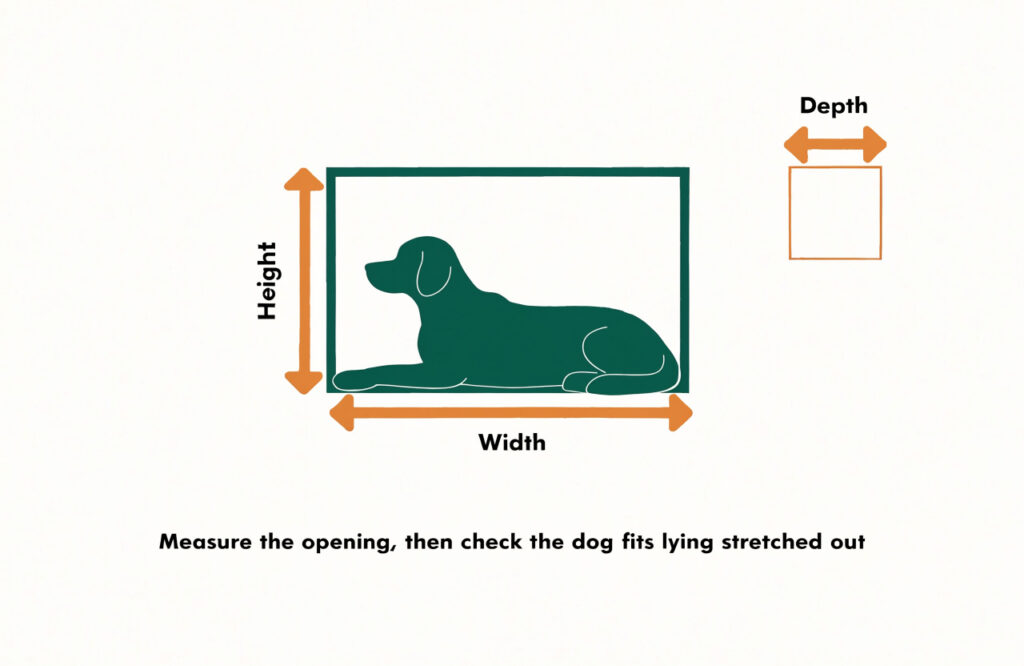
Order from inches or centimeters, not from “medium” or “large.” Brand size names do not line up.
Measure the dog lying in the position they actually use, from the tip of the nose to the base of the tail (where the tail meets the body, not the tail tip). Add margin for turning:
- Curlers who stay tucked: about 6 inches (15 cm) beyond that length
- Sprawlers who stretch fully: 10 to 12 inches (25 to 30 cm)
If the number falls between two options, size up. A bed that is a little large can be made cozier with a folded blanket. A bed that is too short leaves hips or elbows on the floor, which defeats the point of an orthopedic fill.
Also measure the place the bed has to live. A custom crate pad should be slightly smaller than the crate floor so it does not buckle. A window-seat cushion should match the seat depth, not the dog’s ideal sprawl length, if those two numbers conflict. Write down both numbers and tell the maker which one is the limit.
Sleep style still decides the shape. A flat mattress suits stretchers. A bolster or nest suits dogs who curl and lean. A tall bolster is a poor choice for an arthritic dog who struggles to step in; a low side or an open front is the better custom request.
Specify the fill, because “orthopedic” is not a standard
“Orthopedic” on a dog bed is a marketing word. No regulator defines how thick, dense, or supportive the foam has to be. Two beds with the same label can be a solid slab or a bag of shredded foam.
What holds up under a dog is a solid piece of foam, not loose fiberfill and not shredded memory foam. Fiberfill shifts and flattens. Shredded foam clumps and leaves thin spots. A solid slab distributes weight across one surface, which is what matters for elbows, hips, and older joints.
Thickness is the first number to ask for. Guides used by foam cutters and large-breed bed makers commonly use ranges like these:
| Dog weight | Solid foam thickness to ask for |
|---|---|
| Under about 40 lb (18 kg) | 3 to 4 inches |
| 40 to 80 lb (18 to 36 kg) | 4 to 5 inches |
| Over 80 lb (36 kg) | 5 to 7 inches, often as two layers |
Density is the second number. Foam density, listed in pounds per cubic foot (lb/ft³) or kilograms per cubic meter, describes how much material is in the foam. Higher density generally holds shape longer under repeated weight. Pet-bed foam guides often treat about 3 lb/ft³ as a floor for a supportive core, and 3.5 lb/ft³ or higher for heavier dogs. A soft top layer over a firmer base is a common custom build: the top contours, the base stops the dog from bottoming out.
Press the sample or ask the maker what happens under the dog’s weight. If a palm can feel the floor through the foam, the hips will too.
CertiPUR-US is worth asking about if the bed will live indoors. It is a content and emissions certification for flexible polyurethane foam: certified foam is made without certain flame retardants, heavy metals, formaldehyde, and regulated phthalates, and it is tested for low volatile organic compound emissions. It is not a comfort rating and it does not prove the foam is dense enough. A clean thin foam still bottoms out.
Avoid egg-crate foam as the only support layer. The peaks feel soft and the valleys are thin, so support is uneven once a dog settles into the gaps.
Choose a cover you can actually maintain
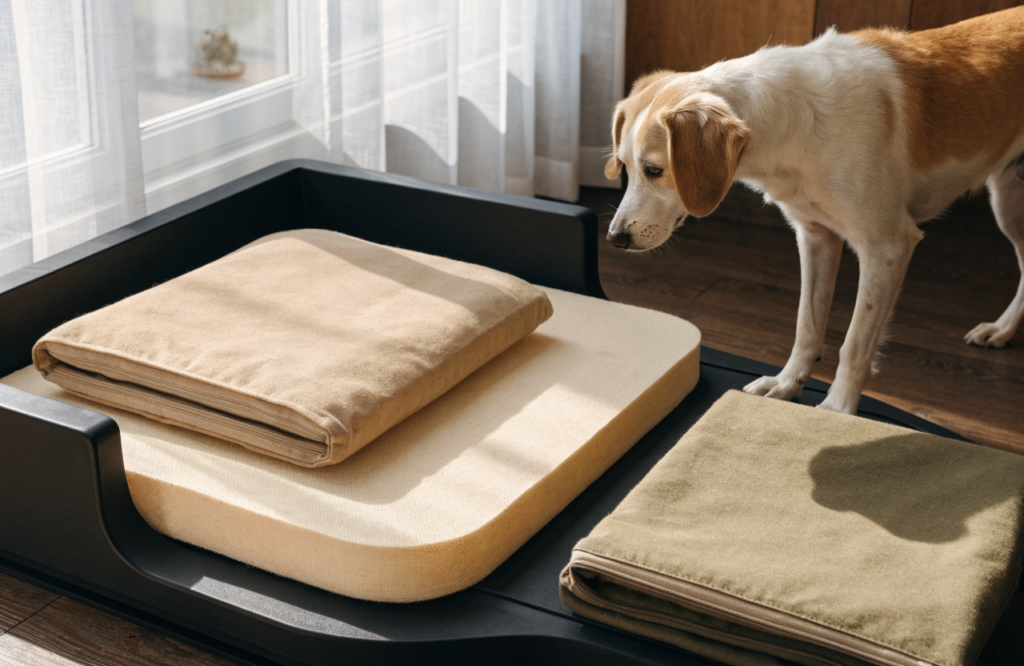
The cover is what you live with. The foam is what the dog sleeps on. A custom order should separate the two.
A removable, machine-washable cover is the minimum. Dogs bring in dirt, dander, and the occasional accident. A bed that can only be spot-cleaned becomes an odor problem. Ask whether the zipper runs far enough around the cushion to get the foam in and out without tearing the seam, and whether a waterproof or water-resistant liner sits between cover and foam. The liner is what keeps a mess from soaking the core you just paid to have cut.
Fabric should follow the dog, not the room photo:
- Tight-weave cotton or cotton-blend upholstery sheds less hair and stands up to digging better than loose plush.
- Performance or stain-resistant weaves help with drool and muddy paws; messes sit on the surface instead of soaking in.
- Fleece or sherpa suits dogs who nest and homes that run cold. It holds hair and is a poor choice for heavy chewers.
- Canvas or ballistic-style cloth is the realistic ask for a dog that mouths bedding. No fabric is chew-proof. A dog that destroys beds needs supervision and more appropriate chew outlets; a custom cover will not fix that.
Replacement covers are their own custom product. If the original foam is still firm, ordering only a new cover is cheaper than a full bed and keeps a known-good size.
Custom versus a stock bed
| Decision | Stock bed | Custom bed |
|---|---|---|
| Fit | Fine if the dog matches a real listed dimension | Better for crates, furniture, long dogs, odd corners |
| Foam transparency | Often “memory foam” with no density or thickness | You can require both numbers before you pay |
| Lead time | Ships now | Days to weeks; measure twice |
| Price | Mainstream orthopedic beds often land around $35 to $150; premium and giant-breed beds commonly $120 to $360; designer pieces can run much higher | Often similar to premium stock once size and foam are honest; small custom covers can start lower, full foam cushions for large dogs cost more |
| Returns | Usually easier | Often final sale once cut |
| Best use | Average dog, open floor space, known brand specs | Nonstandard size, refill, or a spec the catalog will not publish |
Price ranges move with size and foam. A useful comparison is the cost of the right size and construction for the same dog, not the cheapest bed in the category. Replacing a flattened fiberfill bed every few months can cost more over two or three years than one solid-foam custom cushion with a spare cover.
Mistakes that waste a custom order
Ordering from a standing height measurement. Length lying down is what the bed has to cover. A tall, light dog can need a large surface and still be fine on moderate foam thickness. A short, heavy dog can need a smaller footprint and a denser core.
Trusting the word orthopedic without a thickness and a density. If the maker cannot answer, treat that as the answer.
Skipping the liner. A beautiful cover over unprotected foam is one accident away from a ruined insert.
Bolsters on every side for a dog with hip or mobility trouble. Containment feels cozy in a product photo and becomes a barrier at 2 a.m.
Ignoring chew and wash reality. Plush custom beds look finished and fail fast on diggers. Confirm the cover wash temperature and whether the foam can be aired if the liner fails.
Buying custom only for a monogram. Personalization does not change support. Spend the budget on foam depth and a second cover if the dog is hard on bedding.
Questions worth asking before you pay
How thick is the foam, and is it a solid slab or shredded? What density is the core, and is there a separate support layer? Is the foam CertiPUR-US certified, or an equivalent content and emissions standard? Does the cover unzip fully and wash, and is there a waterproof liner? What are the finished outer dimensions, not the size name? What is the return policy once the piece is cut?
Those answers tell you whether the custom dog bed is a fitted solution or a stock bed with a longer wait.