
A crate training puppy schedule works when daytime stretches stay shorter than the puppy can actually hold, nights include a planned break at first, and the crate is a place the puppy already likes before the door stays shut. For most puppies that means 30 to 90 minutes in the crate during the day at 8 to 12 weeks, lengthening toward 2 to 3 hours by 4 to 5 months, with overnight stretches that grow faster than daytime ones because sleep slows the need to go.
The American Kennel Club’s house-training rule of thumb is about one hour of bladder control for each month of age: roughly 2 hours at 8 weeks and about 3 hours at 12 weeks, often a little longer while asleep and shorter right after eating, drinking, or play. The ASPCA’s crate guidance is stricter on confinement itself: young puppies should not be crated for more than an hour or two at a time, except at night, and an adult dog should not be crated for more than about four hours at a stretch.
How long crate time should last at each age
Treat the hour-per-month figure as a ceiling, not a target. A puppy who has just eaten, played hard, or woken from a nap often needs to go well before that ceiling. Small and toy breeds often need shorter intervals than the formula suggests. If accidents happen in a correctly sized crate, shorten the stretch before you assume a training failure.
| Age | Realistic daytime crate stretch | Overnight | What usually changes |
|---|---|---|---|
| 8–10 weeks | 30–60 minutes | 2–4 hours, often 1–2 breaks | Meals in or beside the crate; door open when you can supervise |
| 10–12 weeks | 45–90 minutes | Often one middle-of-night break | Short absences from the room, then the house |
| 3–4 months | 1–2 hours | Many sleep 5–7 hours; some still need one break | Naps become predictable; crate can move to its long-term spot |
| 4–6 months | 2–3 hours, rarely past 4 | Most sleep through | Daytime crate becomes a nap and safety tool, not the whole day |
| 6 months and up | 3–4 hours if calm and empty | Full night for most healthy dogs | Goal shifts toward free time at home once chewing and housetraining are reliable |
Puppies also sleep a large share of the day, often in the range of 18 to 20 hours in the early months. A schedule that uses the crate for those naps is doing useful work. A schedule that stacks those naps into one long confinement is not.
The crate has to be the right size for this to work. It should let the puppy stand, turn around, and lie down, but not leave enough spare floor to soil one end and sleep at the other. An adult-sized crate with a divider panel is the usual fix.
Build the day around triggers, not only the clock
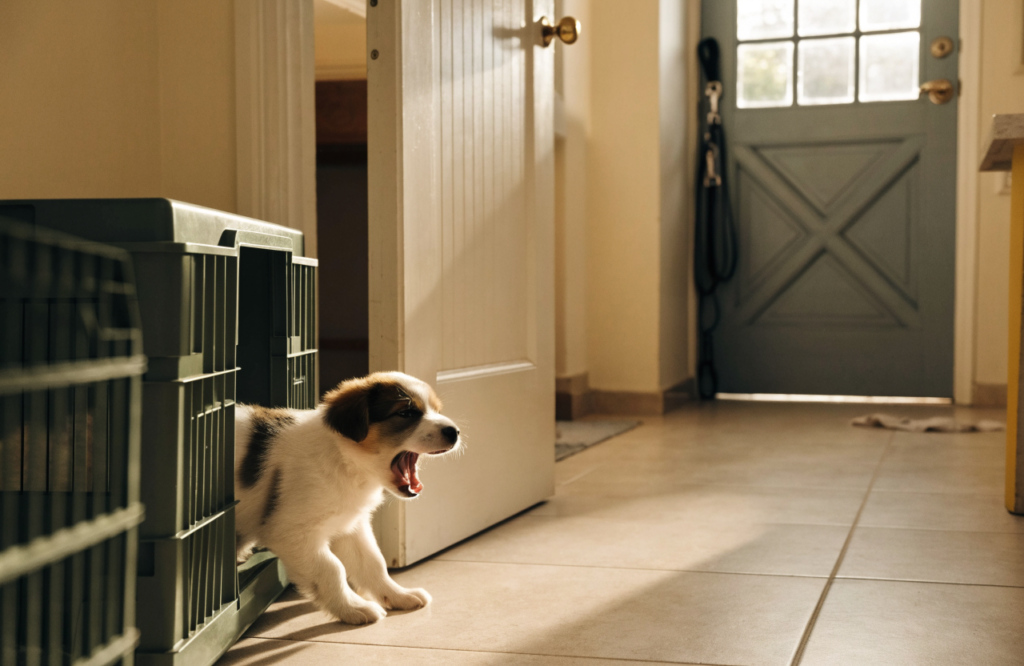
A clock schedule fails when it ignores the moments a puppy almost always needs to go: immediately after waking, within 10 to 30 minutes of a meal, after drinking, and after play. Those trips outrank the timer.
A workable loop looks like this:
- Out of the crate and straight to the potty spot. Carry a very young puppy if the walk to the door is long enough for an accident.
- Reward the outdoor elimination calmly, then offer a short play or training window.
- Potty again before the crate if the play window ran long.
- Into the crate with a safe chew for a nap that fits the age limit above.
- Repeat. Water stays available during awake time; lifting the bowl an hour or two before bed can reduce the first overnight trip, but do not withhold water after exercise.
Three meals a day is typical from about 8 weeks through 6 months. Predictable meals make the post-meal potty trip predictable too.
Sample day at 8 to 12 weeks
This is the hands-on stage. Expect to be nearby for most of it. Times are a template, not a rule.
- 6:30 a.m. Out of the crate, straight outside. Breakfast in or just inside the crate. Outside again 10 to 20 minutes later.
- 7:15 a.m. Five to ten minutes of calm play or a short training rep, then a potty trip.
- 7:30–8:15 a.m. Crate nap, door closed only if the puppy is already comfortable with a closed door.
- 8:15 a.m. Outside, supervised floor time, another short nap by mid-morning.
- Noon. Lunch, outside, brief play, crate nap of 45 to 75 minutes.
- Afternoon. Repeat the out-play-potty-nap loop two or three times. Keep each closed-door stretch near 30 to 60 minutes at 8 to 10 weeks, and under about 90 minutes by 12 weeks.
- 5:30 p.m. Dinner, outside, family time with supervision. Pull water about 1 to 2 hours before bed if nights are messy, and offer a last drink earlier in the evening.
- 10:00–10:30 p.m. Final potty, into the crate beside your bed.
- Overnight. Plan one break around 2 to 4 a.m. at 8 to 10 weeks. Keep lights low, skip play, and return to the crate. Many 12-week-old puppies drop to one break or none; do not force a full night if the puppy is waking and circling.
Sample day at 3 to 4 months
Bladder control is improving, but the puppy still cannot be left for a workday. Daytime crate naps of 1 to 2 hours are reasonable if the puppy goes out right before and right after, and if the crate stays clean.
- Morning: potty, breakfast, 15 to 20 minutes of play or a walk appropriate to age and vaccination status, potty, crate nap.
- Late morning: potty, supervised free time and a short training session, potty, crate.
- Midday: lunch for puppies still on three meals, potty, play, nap.
- Afternoon: one longer outing or socialization window, then a nap.
- Evening: dinner, family time, a wind-down hour with fewer exciting games, last potty, bed.
Many puppies in this window sleep 6 hours or so at night. If yours still wakes once, take the trip and end it. A party at 3 a.m. teaches the puppy that night crying produces play.
Sample day at 4 to 6 months
Daytime stretches of 2 to 3 hours are realistic for many puppies, with 4 hours as a cautious ceiling rather than a goal. The ASPCA’s adult limit of about four hours is a sensible cap even as the puppy matures. Overnight, most healthy puppies this age sleep through if the last outing is late and the crate is not oversized.
Keep at least one real exercise block and one training block outside the crate. A puppy who only leaves the crate to eliminate will not settle well in it, because the crate becomes the only place life is boring.
How the first two weeks make the schedule possible
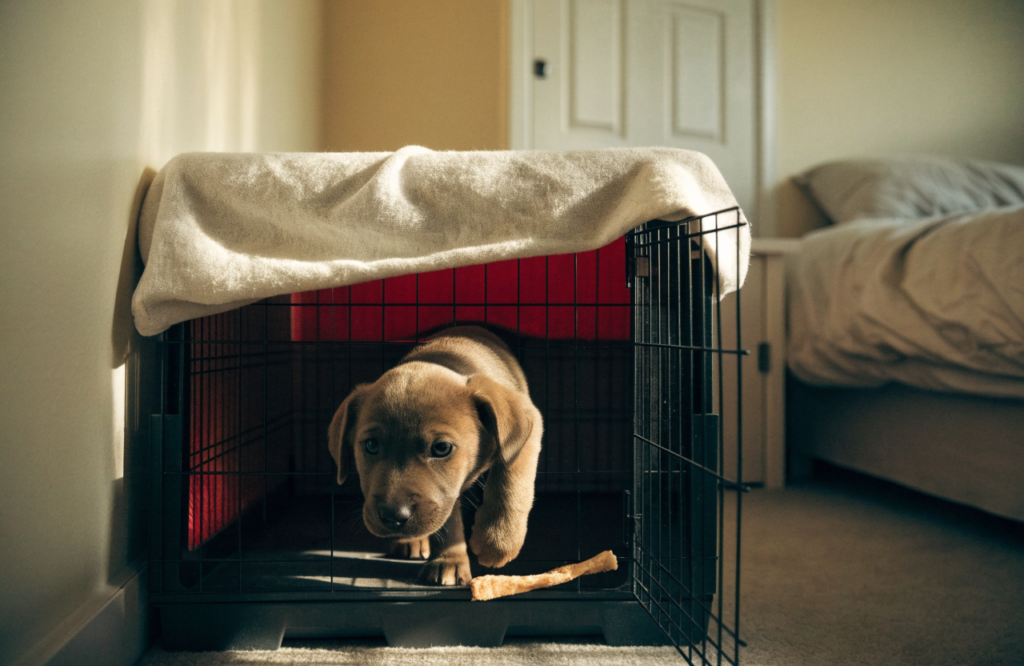
A schedule assumes the puppy will go in and stay quiet. That has to be taught before you need a two-hour nap.
- Days 1 to 3: crate in a room you use, door open. Toss treats just inside and let the puppy come back out. Feed meals at the entrance, then just inside.
- Next: close the door only while the puppy is eating, and open it before they finish and start asking to leave. Add a cue such as “kennel” once going in is easy.
- Then: sit nearby with the door closed for a few minutes, offering a chew. Step out of sight for a few seconds and return before fussing starts.
- Only after calm short stays: leave the room for half a minute, then a few minutes, varying the length so absence does not always get longer.
The ASPCA’s introduction sequence is the same idea: lure with treats, add a cue, close the door briefly, then switch to a longer-lasting chew once the puppy can stay calm between treats. If panting, drooling, scratching, or refusing food shows up, go back one step. Most puppies need a couple of weeks, not a couple of days, before a closed door is uneventful.
Night one can still happen beside the bed even if daytime training is unfinished. Proximity lets you hear a real need to go, and it reduces the “I am alone” panic that makes early crate training look like it failed.
Adjusting the schedule if you leave the house
A young puppy cannot cover a full workday in a crate. Options that respect the time limits:
- A midday visit from you, a sitter, or a trusted neighbor for a potty break, a short play, and a reset of the crate.
- A dog-proofed pen or room with a bed, water, and a toilet area, once the puppy is past the earliest weeks and you cannot get home. The ASPCA suggests this for absences longer than about four hours rather than stretching the crate.
- Splitting the day so the longest closed-door block matches the age row in the table, not your commute.
Crating through the workday “because the puppy sleeps anyway” is the most common way owners create both accidents and a puppy who hates the crate. Sleeping is not the same as being able to hold it for eight hours.
Mistakes that undo a crate schedule
- Using the theoretical hold time as the session length. Build in a margin, especially after meals.
- A crate large enough to soil one end and sleep at the other. Use the divider until housetraining is solid.
- Letting the puppy out while crying. Wait for a brief pause, then open the door. If the crying is paired with circling or has gone on past the known hold time, take a boring potty trip and return to the crate.
- Crating as punishment. The crate has to stay a rest place. Occasional time-outs only work if most crate visits are still positive, and regular time-outs are a sign the plan needs a trainer, not a longer sentence.
- Skipping the potty trip after every nap. The nap ending is one of the highest-risk moments.
- Leaving collars on in the crate, or offering chews that can break into swallowable pieces.
When the schedule is not working
Accidents in the crate usually mean the stretch is too long, the crate is too big, or there is a medical issue. Shorten the interval first. If a puppy cannot hold even a short, calm stretch, or suddenly regresses, a vet check is the right next step before more training.
Whining at a predictable potty time is information. Whining the moment you leave the room, with no need to eliminate, is a training gap: shorten absences, add a chew, and return before the fuss peaks. Do not add hours to “tire them out.”
Refusal to enter is almost always a door that closed too soon. Go back to open-door meals and treat tosses for several days. A puppy who will not take food in the crate is not ready for a closed door.
Some puppies do better in a pen than a crate for daytime rest. Crate training is a management tool, not a requirement. The schedule principles — frequent potty trips, enforced rest, no unsupervised freedom until habits are reliable — still apply.
Questions owners ask after the first week
Should water stay in the crate? During short daytime naps, no. During long absences in a pen, yes. Overnight, most people remove it an hour or two before bed so the first stretch is manageable, then restore free access in the morning.
When can the middle-of-the-night trip stop? When the puppy is sleeping through on their own for several nights, not when the calendar says they should. For many puppies that is somewhere between 12 and 16 weeks. Forcing it earlier produces crate accidents and teaches the puppy that the bed is a toilet.
Is all-day crating acceptable at 6 months? No. Three to four hours at a stretch is a reasonable adult-style cap if the dog is exercised before and after. The long-term goal the ASPCA describes is a dog who can be left loose once housetraining and chewing are reliable, with the crate remaining a bed rather than a daily lockup.
What if my puppy soils the crate and then lies in it? Shrink the space with a divider, confirm you are not exceeding the age limit, and clean with an enzymatic cleaner so the smell does not mark the spot as a toilet. A puppy who repeatedly soils a snug crate may be over threshold or unwell, not “spiteful.”