
Puppy biting is normal play and exploration, not a sign that a young dog is aggressive. The training that works is a short sequence: keep teeth off skin by swapping in a toy, end the game the moment a bite is too hard, and prevent the overtired, overstimulated states that make nipping almost automatic. Most puppies improve steadily with that pattern; harsh corrections usually make it worse.
Why puppies bite, and why “stop all mouthing” is the wrong first goal
A puppy’s mouth is how they investigate floors, furniture, other dogs, and people. Littermates spend a large share of play chasing, wrestling, and biting each other. When one bites too hard, the other yelps and quits. That feedback is how dogs learn bite inhibition: control over how hard they close their jaws. The American Society for the Prevention of Cruelty to Animals treats that lesson as the first objective with people, because a dog that has only ever been told “never use your mouth” has not practiced being gentle. A dog that has practiced a soft mouth is less likely to break skin if they ever mouth someone in fear or pain later.
Three drivers explain most household nipping.
Play and exploration
Hands that wiggle, loose sleeves, and moving ankles look like littermates. If those targets sometimes produce a fun chase, the puppy files “teeth on people” under games that work.
Teething
Puppies have 28 baby teeth. Adult dogs have 42. Baby teeth start coming in within the first few weeks of life, and they begin falling out around three to four months as the adult set erupts. The American Kennel Club notes that the full teething stretch can last until about six months, with sore gums, drooling, and extra chewing. A puppy in that window needs legal things to gnaw. Taking the mouth away without a replacement leaves the discomfort unsolved.
Overtiredness and overstimulation
Frantic ankle-biting late in the evening is often a tired puppy who has lost the ability to settle, not a puppy who has forgotten the rules. The AKC’s guidance on teething and nipping explicitly links increased mouthing with fatigue, and notes that a calm break in a crate or pen often ends in a nap. Training only works if the puppy is awake enough to learn.
Play biting is not the same as aggression. AKC chief veterinarian Dr. Jerry Klein has said play biting does not mean a puppy is vicious. Stiff posture, hard staring, growling over food or a resting spot, or bites that escalate rather than soften are different problems and need a qualified trainer or veterinary behaviorist, not a longer game of redirect.
Teach bite inhibition before you demand zero contact
Early on, the useful standard is “softer,” not “never.” A practical progression used by trainers who follow the ASPCA approach:
- For the first stretch of training, tolerate gentle mouthing during play and respond only when the pressure crosses your limit.
- Mark that harder bite immediately, then withdraw the fun.
- Once hard bites are rare, tighten the limit so moderate pressure also ends the game.
- Later, treat any teeth on skin as the cue to stop, and keep chewing on toys.
Puppies older than about five months, or any puppy whose mouthing already hurts, can skip the “allow gentle mouthing” phase and go straight to ending the interaction whenever teeth touch skin.
The yelp-and-pause method
This copies littermate feedback. The ASPCA version is specific:
- Let normal play continue.
- The instant a bite is especially hard, make a high-pitched yelp and let the hand go limp.
- If the puppy startles and stops, praise the pause or a lick, then resume.
- If they bite hard again, yelp again.
- Cap this at about three repeats in a 15-minute period. Endless yelping becomes noise.
If the yelp alone does not change anything, switch to a short time-out: after the yelp, remove your hand and either ignore the puppy for 10 to 20 seconds or leave their reach for that long. Return and offer a toy, not your fingers.
When a yelp makes biting worse
Some puppies treat a squeal as an invitation to play harder. The AKC flags this directly: a loud reaction can be stimulating, and yelling can function as attention, which is a reward. If your puppy’s eyes brighten and the mouthing speeds up after “ow,” drop the sound. Freeze, tuck your hands, turn away, or step behind a gate. Trainer Kathy Santo, writing for the AKC, describes tucking the hands and turning as a mild calming signal and a small withdrawal of attention. The pause is the lesson. The noise is optional.
How to tighten the standard
Do not announce a new rule and expect one afternoon to install it. Keep the same consequence and slowly move the line. Week to week, what counted as “acceptable” gets softer until skin is off-limits and toys are the only chewing target. Inconsistent households undo this: one person who still wrestles with bare hands teaches the puppy that the rule depends on who is in the room.
Redirect teeth onto something you actually want chewed
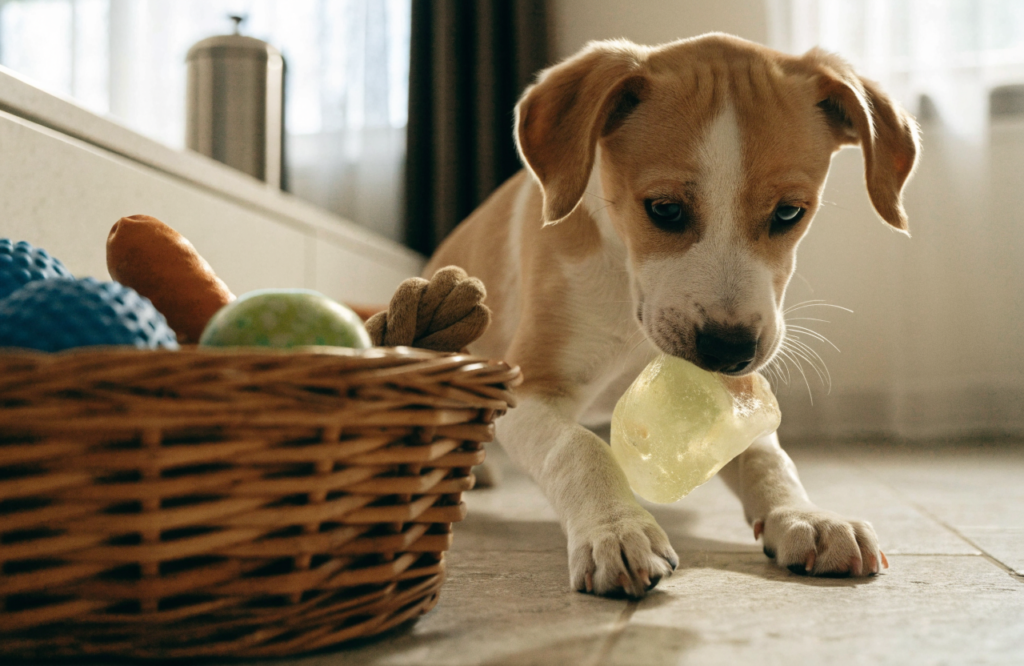
Inhibition training says how hard. Redirection says where. Keep a soft toy or long tug within arm’s reach in every room you use. When the mouth moves toward a hand, ankle, or sleeve, trade: offer the toy at the mouth, and praise when teeth land on it. A longer toy keeps your fingers out of the grip.
Useful chew options during teething include rubber toys that can be chilled, and a food-stuffed toy frozen ahead of time. The AKC specifically suggests a frozen stuffed Kong-style toy for a puppy who needs to settle. Rotate two or three toys so they stay interesting, and pick up socks, shoes, and children’s toys that have been rehearsing the wrong target. Do not play tug with your hand as the rope. That rehearsal is exactly what you are trying to erase.
If the puppy drops the toy and returns to skin, do not push them off. Pushing is movement, and movement restarts the game. Stop, offer the toy once more, and if teeth come back to you, go to the time-out.
Use a reverse time-out when redirection fails
A reverse time-out removes you, not the puppy. Teeth on skin, then:
- Stop moving the bitten body part.
- Say a calm marker if you want one (“too bad,” “oops”), without a lecture.
- Step over a baby gate or into another room for 10 to 20 seconds.
- Come back, offer a toy, and continue only if the mouth stays on the toy.
The ASPCA’s window of 10 to 20 seconds is long enough to make the point and short enough that the puppy can connect it to the bite. A five-minute exile often just confuses them. If you cannot leave, a drag-free pen or a tether (only while you are present) lets you step out of range. Never leave a puppy unsupervised on a leash.
Repeat the same sequence every time. Occasional “just this once” roughhousing is enough to keep the habit alive, because intermittent rewards are powerful.
Lower arousal before the bite starts
Most painful sessions are predictable. The puppy has been awake a long stretch, play has gotten faster, or someone is walking through the room in loose pants. Act one step earlier:
- End play while the puppy can still take a treat and sit, not after they have boiled over.
- Use sniffing games and food puzzles when wrestle-play keeps tipping into biting. Nose work burns energy without rehearsing mouth-on-skin.
- Build in a nap after roughly an hour of awake time if biting reliably spikes. A covered crate or pen, a chew, and quiet is management, not punishment.
- Skip running games with children until the puppy can disengage on cue.
Reward the boring successes. A puppy who approaches with four paws on the floor, carries a toy, or licks instead of nips should get the attention. If people only respond once teeth are involved, biting becomes the most reliable way to start an interaction.
Puppy biting training tips for the situations that actually happen
Hands and arms
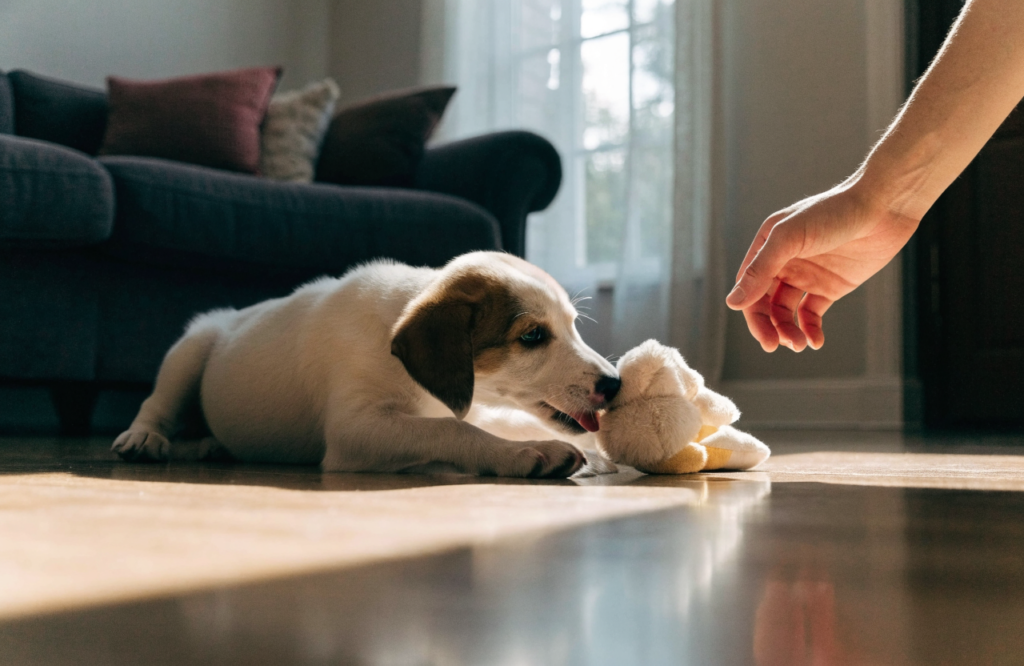
Pet with slow hands. If the puppy mouths as you reach, offer a toy before the hand arrives, or ask for a sit and feed with the other hand so the mouth is busy. Hand-feeding meals, given only when the mouth is soft, is a daily rehearsal of gentle contact. Stop the instant teeth press, and resume when the mouth softens.
Ankles, pant legs, and zoomies
Stand still. Moving feet are prey. Keep a toy by the door you enter through, and toss it sideways so the puppy chases the object instead of your cuffs. If they latch onto clothing, freeze and wait for a release, then redirect or leave. Yanking the fabric often tightens the grip. House rules that help: no loose robe hems during the worst weeks, and no games of chase-the-toddler.
Children
Children should not be the ones delivering consequences. Their instinct is to squeal and run, which is a perfect game from the puppy’s side. Supervise every interaction. Teach kids to “be a tree” (stand still, hands folded) and call an adult, who does the reverse time-out. Do not leave a puppy and a young child alone in a room, even if both seem calm. A child’s sudden movement is enough to restart mouthing, and a child’s skin is easier to break.
What not to do
These responses are common and reliably backfire:
- Holding the muzzle shut, scruffing, pinning, or “alpha rolling.” These frighten a puppy and can turn play mouthing into defensive biting.
- Tapping or smacking the nose. Hands become something to dodge or snap at.
- Pushing a hand deeper into the mouth. That triggers a harder bite reflex.
- Biting the puppy back. It does not translate as a correction.
- Roughhousing with bare hands, then expecting the puppy to know fingers are off-limits an hour later.
- Bitter spray on skin. Some puppies ignore it, and it does not teach an alternative behavior.
PetMD’s summary matches the welfare guidance from the ASPCA and AKC: punishment teaches a puppy to suppress or escalate. It does not teach where chewing is allowed.
How long improvement takes, and when to get help
Expect messy weeks, not a single breakthrough. Teething pressure eases as adult teeth finish coming in around six months, and many puppies are markedly easier by five to six months if the household has been consistent. The AKC recommends consulting an experienced trainer or behavior specialist if you have not been able to moderate play biting by about six months.
Get help sooner if you see any of the following:
- Bites that break skin and are getting harder, not softer.
- Growling with a stiff body, not the loose, bouncy posture of play.
- Guarding food, chews, or a resting place.
- Mouthing that is clearly fear-based, such as snapping when reached for or picked up.
A certified positive-reinforcement trainer or a veterinary behaviorist can separate normal puppy mouthing from a pain, fear, or medical problem. Sore gums, an ear infection, or a puppy who missed littermate play can all change the picture.
Frequently asked questions
Should I let my puppy mouth my hands at all?
For a young puppy who is not yet hurting you, brief gentle mouthing can be part of teaching bite inhibition, which is the ASPCA’s first goal. The moment pressure is too hard, play stops. If mouthing already bruises or punctures, or the puppy is older than about five months, skip that stage and end contact whenever teeth touch skin, while still giving plenty of legal chews.
Why does my puppy bite more at night?
Late-day biting is often overtiredness. Shorten the awake window, add a chew, and use a calm pen or crate break before the frenzy starts. Training cues land poorly once the puppy is past the point of settling.
Will puppy biting stop on its own?
Teething discomfort fades, but the habit of using people as toys does not reliably fade without feedback. Puppies who were rewarded for ankle chasing with movement and noise often keep a version of that game into adolescence. Consistency in the first months is what shortens it.
Is a high-pitched “ow” required?
No. It helps some puppies because it resembles a littermate yelp, and the ASPCA and AKC both describe it. If your puppy gets more excited, skip it and withdraw attention for 10 to 20 seconds. The consequence matters more than the sound.