
Leash training a puppy works best when it starts at home, in sessions measured in minutes, before the first sidewalk walk ever happens. A puppy does not arrive knowing that a strap means “walk beside a person.” Pulling, freezing, and chewing the leash are ordinary responses to a new sensation and a world full of smells. The useful goal is not a perfect heel. It is a puppy who accepts the gear, keeps the leash slack most of the time, and can be guided without being dragged.
That skill is built in stages: equipment first, indoor movement second, quiet outdoor practice only after your veterinarian says public ground is safe.
When leash training a puppy should start
Start the day the puppy comes home, usually around 8 weeks. Certified trainer Michele Miller, quoted by the American Kennel Club, puts it directly: leash work begins before the first walk.
Two phases get mixed up and cause most early failures.
Indoors, from the first week home. Collar or harness, then a light leash, in a familiar room. The puppy is not ready for parks, pet-store floors, or busy sidewalks until core vaccines are complete and your vet clears outdoor exposure. That clearance is often around 16 weeks, sometimes sooner or later depending on local disease risk and the vaccine schedule. A fenced yard can be a middle step if your vet agrees the risk is low.
Outdoors, after clearance. Skills learned in the hallway often fall apart on the first block. Smells, traffic, and other dogs reset the difficulty. Plan to re-teach the same loose-leash rule in easier outdoor places before asking for it on a busy street.
Short sessions matter more than long ones. At 8 weeks, a minute or two of focused practice is enough. By 12 to 16 weeks, a few minutes of walking mixed with sniffing is realistic. End while the puppy is still willing.
Gear that helps instead of fighting the puppy
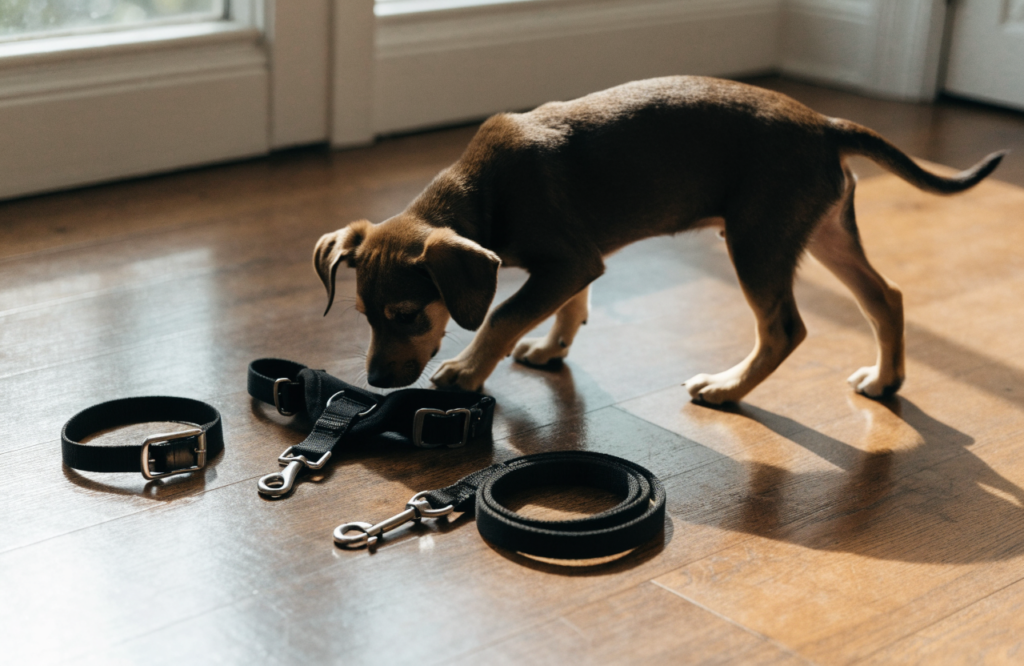
A collar, a harness, and a leash do different jobs. Using the wrong one for walking is a common reason training stalls.
| Item | Better choice for most puppies | Why it matters |
|---|---|---|
| ID collar | Flat buckle collar, two fingers of slack | Tags stay on the dog. Not ideal as the only walking attachment if the puppy pulls hard. |
| Walking attachment | Well-fitted harness, often a front-clip style for larger puppies | Shifts pressure off the neck. A front clip turns the chest toward you when the puppy surges ahead. |
| Leash | Light, fixed length, about 4 to 6 feet | Enough room to keep slack without the puppy getting far enough to build speed. |
| Treats | Pea-sized, high-value pieces (chicken, cheese, hot dog) | Ordinary kibble often loses to outdoor smells. |
Skip retractable leashes while the skill is being learned. The cord rewards forward pressure by paying out more length, which is the opposite of a loose leash. Bungee leashes create a similar problem: the puppy can lean into the stretch and still move ahead. Save those for a dog who already walks politely, if you want them at all.
Fit matters. A harness that rides up into the armpits or a collar that slips over the head teaches the puppy to fight the equipment. Recheck fit every week or two. Puppies grow fast.
How to introduce the collar, harness, and leash
Do this before any walking practice. The order is the point: the gear predicts something good, not restraint.
- Put the collar or harness on just before a meal, a chew, or a short play session. If the puppy scratches at it, distract with food rather than taking it off immediately. Removing it the second they object teaches that scratching makes the gear disappear.
- Leave it on for a few minutes, then take it off while the puppy is calm. Build up to wearing it around the house during ordinary time.
- Clip on a light leash and let it drag under supervision. Reward the puppy for moving around with it attached. Step on the leash only if you need to stop a dash; do not use that as a correction.
- Pick up the handle and follow the puppy. You are not steering yet. You are teaching that a person holding the leash is not a threat.
If the puppy runs from the harness or bites your hands while you fasten it, you have moved too fast. Go back to showing the gear, feeding a treat for looking at it, then for letting it touch the body, then for one strap. Clip the leash only when all four feet are on the floor. The American Society for the Prevention of Cruelty to Animals uses the same idea for excited jumping at the door: the outing starts after the puppy is settled, not while they are bouncing.
Teaching a loose leash, one or two steps at a time
Loose-leash walking means the leash has a visible curve. Tension means the walk pauses. That rule is simple enough for a puppy and consistent enough to learn.
Start in a hallway or quiet room with treats in the hand on the side you want the puppy to walk. Left is traditional; either side works if you stick to it.
- Take one step. The moment the puppy moves with you and the leash stays slack, mark it with a word such as “yes” or a click, and feed a treat at hip or shoulder height on that side. Feeding at your leg, not out in front, keeps them from lunging ahead for the food.
- Add steps only when one or two are reliable. Early on, a treat every couple of steps is normal. You will thin that out later.
- Give the movement a cue once the puppy is following reliably: “let’s go” or “with me,” said as you start. A cue without the reward history behind it is just noise.
- When the puppy hits the end of the leash, stop. Say their name. When they look back or step toward you and the leash softens, mark, treat, and move again. The American Kennel Club describes this check-in as the habit that replaces pulling.
- Change direction before the puppy builds a full head of steam. A turn is easier to reward than a recovery from a hard pull.
Outside, the same rule applies, with a lower standard. A puppy who can do ten slack steps in the kitchen may manage two on the sidewalk. Pay those two. If treats stop working, the environment is too hard or the food is too boring. Move somewhere quieter or upgrade the treat before you upgrade the distance.
Sniffing is not a failure. A walk that is only structured heeling frustrates most puppies. Use a release such as “go sniff,” let them investigate for a short time, then call them back into position and pay the return. Planned sniffing often reduces pulling more than constant correcting does.
How long a puppy should actually walk
A widely repeated guideline is about five minutes of structured walking per month of age, once or twice a day: roughly 10 minutes per outing at 2 months, 15 at 3 months, 20 at 4 months. Versions of this appear in UK Kennel Club and British Veterinary Association puppy materials. It is a cautious rule of thumb, not a researched limit.
What it is useful for is forced, human-paced walking on a leash, where the puppy cannot choose to stop. Gentle sniffing, short play, and self-paced exploration in a safe yard are different loads on growing joints. A 2012 study of several large breeds found that early stair exercise was linked with higher hip dysplasia risk, while varied off-leash movement on uneven ground was not harmful in the same way. Large and giant breeds deserve extra caution with long, repetitive walks and with stairs until growth plates close.
Watch the puppy, not the clock. Sitting down, lagging, or frantic leash biting late in an outing usually means the session was too long or too stimulating. Ask your vet for a limit that fits breed, size, and any orthopedic concern.
Pulling, freezing, and leash biting
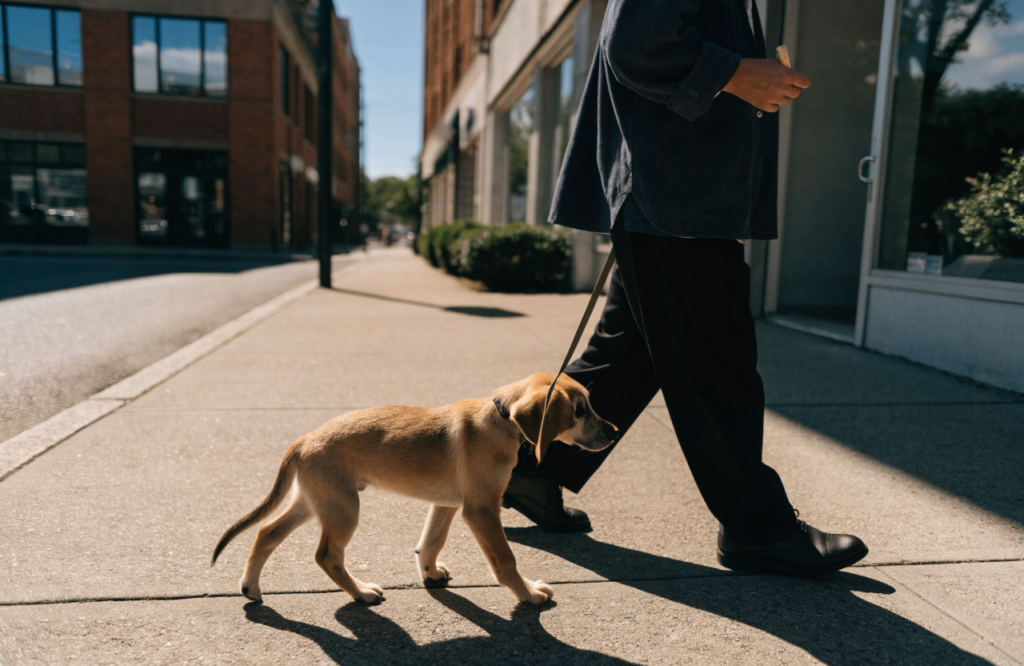
These three problems look like disobedience. They usually are not.
Pulling. The sidewalk rewards the puppy for going forward: new smells, the chance of a person or dog. If tension still gets them there, pulling works. Stop when the leash tightens. Move only when it slackens. If stopping is not enough, turn and walk the other way, then reward the moment they catch up with a loose leash. Do not yank. A collar correction teaches neck pressure, not position, and a hard jerk can injure a puppy.
Do not practice this on a route full of dogs and food smells. Go back to the yard until stops and turns work there.
Freezing or refusing to move. Treat this as uncertainty, fatigue, or overwhelm before you treat it as stubbornness. Dragging a planted puppy pairs the outdoors with being pulled. Crouch, wait, and toss a treat a step ahead. Shorten the outing. If freezing happens in the same spot every time, that place is too hard. A puppy who suddenly refuses walks they used to enjoy should be checked by a vet. Pain and nausea both show up as “won’t walk.”
Biting or tugging the leash. Common during teething and when the puppy is over-aroused. The ASPCA notes that some dogs do it because the tug game is fun, especially near exciting triggers. Stop moving so the leash goes dead. Offer a treat at the nose or a tug toy as the legal thing to grab. Reward the release, then reward a few steps of calm walking. A bitter spray on the leash can help some puppies; reapply it, because it fades. A chain leash is sometimes suggested because many dogs dislike biting metal, but it is hard on hands and can catch a tooth. Redirection is the cleaner first step.
If leash biting turns into spinning, barking, or lunging at people and dogs, add distance before you add training. That pattern is usually frustration or fear, and it gets worse if the puppy is marched closer to the trigger.
Mistakes that slow leash training down
- Waiting for the first outdoor walk to introduce the leash. The novel street and the novel gear arrive together, and the puppy loses.
- Holding the leash short and tight “for control.” Constant tension becomes the normal feel of a walk.
- Letting one family member stop for pulls while another lets the puppy tow them to the corner. The puppy learns that pulling sometimes works, which is enough to keep the habit.
- Using the walk as the only exercise. A bored, under-slept puppy will grab the leash. Puppies this age still need several naps a day. A short play session before you leave can take the edge off, as long as it does not tip them into overtired zoomies.
- Correcting harder when adolescence hits. Between about 6 and 12 months, many puppies who walked well start pulling and ignoring cues again. That is a normal dip in impulse control, not proof the early training failed. Return to higher treat rates and easier routes for a few weeks.
Puppy classes with a reward-based trainer are worth it if pulling or fear shows up early. A six-month-old who already rehearses hard pulling is harder to reshape than an eight-week-old learning the leash in a hallway.
Frequently asked questions
Can leash training start before vaccines are finished? Yes, indoors. Public outdoor practice should wait for your vet’s go-ahead, because parvovirus and similar risks depend on local exposure and the vaccine series.
Should a puppy walk on a collar or a harness? Use a flat collar for identification. Attach the leash to a well-fitted harness for walks, especially if the puppy pulls. The AKC notes that a front-clip harness gives more steering help with larger puppies.
How long until a puppy walks politely? Indoor comfort with the gear often takes a couple of weeks of short sessions. Reliable loose-leash walking around distractions usually takes months of practice, with a setback in adolescence. Consistency across handlers matters more than the exact timeline.
What if my puppy only walks well toward home? Heading home is more rewarding than heading out. Practice short outings that end before the puppy is desperate to turn around, and pay generously on the outbound leg so leaving the house predicts food, not only the return.