
Most puppy potty training succeeds or fails on timing, not on discipline. A young puppy cannot hold urine the way an adult dog can, so the practical goal is to get them to the right place before an accident happens, then reward that choice immediately. The American Society for the Prevention of Cruelty to Animals (ASPCA) and the American Kennel Club (AKC) both treat house training as a management problem: frequent trips, close supervision, a small safe area when you cannot watch, and no punishment for messes you find later. Follow that pattern and most puppies become reliable outdoors well before their first birthday, even if overnight control arrives sooner than daytime control.
How long a puppy can actually hold it
A useful rule of thumb, repeated by the AKC, is that a puppy can hold urine for roughly as many hours as their age in months, plus one, up to about 9 to 12 months. A 2-month-old is often near a 3-hour maximum; a 4-month-old near 5 hours. That figure is a ceiling for a resting puppy, not a schedule. Active play, a full water bowl, excitement, and small breeds often shorten it. Full voluntary bladder control is also limited before about 16 weeks, so an 8-week-old who “should” wait two hours may still need a trip every 30 to 60 minutes while awake.
Take the puppy out on a trigger, not only on the clock:
- First thing in the morning and last thing at night
- Right after waking from a nap or leaving a crate
- Within 5 to 30 minutes after a meal (sooner for younger puppies)
- After drinking, play, or a long chew session
The ASPCA recommends starting with a trip every couple of hours, and more often if accidents are still common. Give at least five minutes at the spot. If nothing happens, bring them back inside, confine them for about 15 minutes, and try again. Do not turn a failed potty trip into free play indoors.
Overnight stretches are usually longer than daytime ones because the puppy is asleep. Even so, many 8- to 12-week-old puppies still need one middle-of-the-night trip. A crate in the bedroom makes that easier to hear and less stressful than isolating the puppy in another room.
A simple daytime routine
Feed on a schedule rather than leaving food down all day. Scheduled meals make bowel movements more predictable, which is half of potty training. A workable pattern for an 8- to 12-week-old looks like this:
- Wake, carry or leash straight to the potty spot, wait quietly, reward if they go.
- Meal, then back outside within 15 to 30 minutes.
- Short supervised play or a training session, then outside again.
- Nap in a crate or pen sized for sleep, not roaming.
- Outside the moment they wake.
- Repeat through the day, with a final trip right before bed.
Use the same outdoor spot each time so scent helps them recognize the purpose of the trip. A short cue such as “go potty,” said calmly once they start to eliminate, can later become a prompt. Stay boring until they finish. Talking, tugging the leash, or starting a game usually delays the result. After they finish, the reward is the party: a high-value treat reserved for outdoor elimination, plus praise, and then a short walk or play. Ending the outing the second they finish teaches some puppies to hold it so the fun lasts longer.
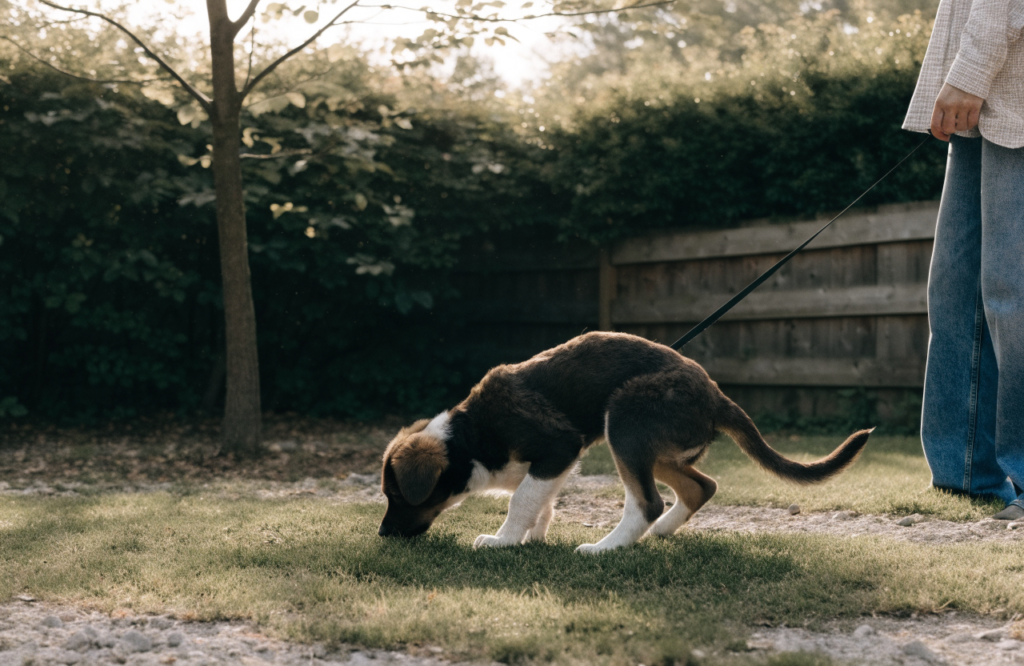
Even in a fenced yard, a leash during training trips keeps the outing about elimination rather than exploring. Freedom to sniff the whole yard can wait until the habit is solid.
Supervision and a den that stays clean
When you can watch, keep the puppy in the same room as you, or tether them to you with a lightweight leash. Sniffing, circling, and a stiff-legged walk are the usual warnings. Interrupt those calmly and go outside at once.
When you cannot watch, confine them. Dogs generally avoid soiling the place they sleep, which is why a crate helps. The ASPCA notes that a crate used for house training should be large enough to stand, turn around, and lie down, but not so large that the puppy can toilet at one end and sleep at the other. A divider panel that grows with the puppy solves this. Young puppies should not be crated for long daytime stretches; an hour or two at a time is a safer starting point than an adult schedule, with a potty break the moment they wake. Nighttime is the exception, with a break if they signal.
If you will be gone longer than the puppy can hold it, a crate alone is the wrong tool. Use a puppy-proofed room or exercise pen that includes a bed and, if needed, a designated indoor toilet such as a pad or grass patch. Pads are a reasonable bridge for apartments, bad weather, or very young puppies, but mixing pads and outdoor training without a clear plan often slows the outdoor habit. Pick one primary location while the puppy is learning.
What to do with an accident
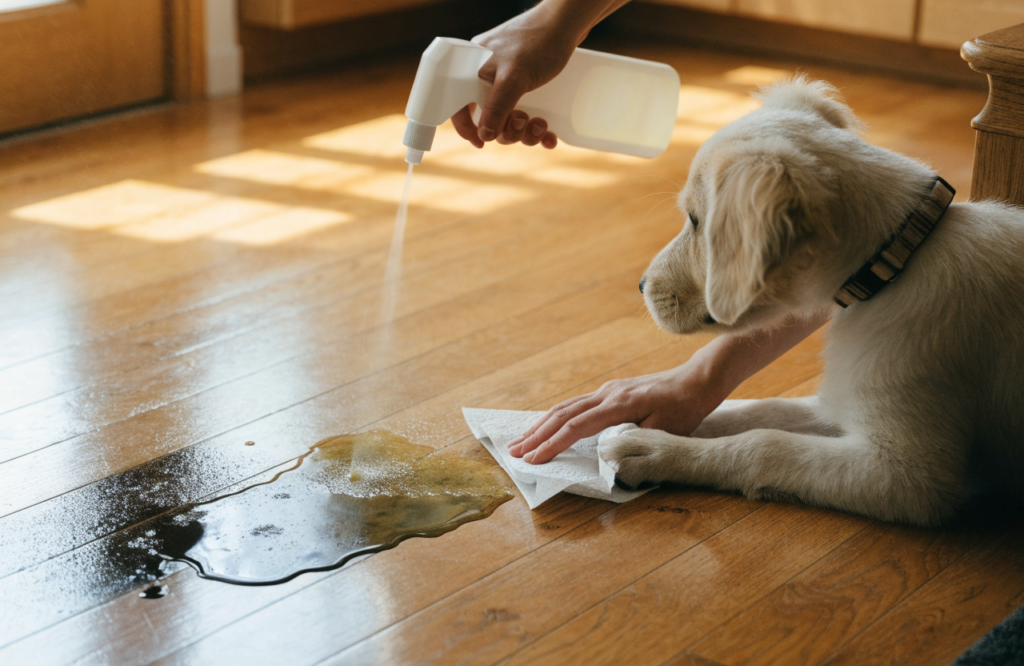
If you catch the puppy mid-squat, a calm interrupt such as a clap or a neutral “uh-oh” can stop them long enough to get outside. Reward only if they finish in the right place. Do not scold.
If you find the mess later, clean it and move on. A puppy cannot connect punishment with an act that already ended, and scolding after the fact often teaches them to hide and eliminate out of sight. Rubbing a nose in urine does not teach location; it teaches fear. Clean with an enzymatic cleaner made for pet urine so the smell does not mark the spot as a toilet. Ordinary household cleaners often leave odor that dogs can still detect.
Mistakes that keep accidents going
- Waiting for a signal you will miss. Anticipating meals, naps, and play beats watching for circling.
- Too much freedom too soon. A quiet week in one room is not a reason to open the whole house. Add space only after accidents in the current area have stopped.
- A crate used as punishment. The den has to stay a rest place, or the puppy will resist it and may soil it from stress.
- Weak or late rewards. A biscuit five minutes later does not compete with the relief of going wherever they are standing. Treat within a second or two of finishing.
- Inconsistent location. Pads in the kitchen on weekdays and the yard on weekends confuse a puppy that is still learning the rule.
- Free feeding. An open food bowl makes bowel timing harder to predict.
When the schedule is not enough
AKC chief veterinarian Dr. Jerry Klein has noted that a puppy whose training started early is often dependable most of the time by about six months, but lack of progress is a reason for a veterinary check. Frequent squatting with little output, straining, blood in the urine, excessive drinking, or a sudden return of accidents in a previously reliable puppy can point to a urinary tract infection or another medical issue rather than a training failure. Toy breeds and some individuals simply need more trips than the age-plus-one estimate suggests. Treat the rule as a planning aid, not a test the puppy can fail.
Expect occasional slips during teething, a schedule change, guests, or a stomach upset. Shrink freedom back to the last successful setup, restart frequent trips, and most puppies recover the habit without a new method.
Frequently asked questions
How many times a day does a new puppy need to go out? An 8- to 12-week-old often needs a trip every one to two hours while awake, plus after every meal, nap, and play session. That can mean a dozen or more outings a day at the start.
Can I potty train without a crate? Yes, if someone can supervise whenever the puppy is loose, or if you use a pen and a tether. The crate only speeds things up because most puppies will not soil a small sleeping area. It is a tool, not a requirement.
When is a puppy housetrained? A practical marker is about two weeks without accidents, plus a consistent signal such as waiting by the door, while still on a schedule. Full reliability often lands between four and six months if training was consistent, and some dogs need closer to a year before unsupervised freedom is wise.
Should I take water away at night? Do not restrict water as a training tactic. Offer normal access through the day, take a last trip out after the evening drink, and get up if the puppy signals overnight. Water restriction can hide a medical problem and is unnecessary if the schedule is tight.