
Golden retriever puppy training works best when it starts the day the puppy comes home, usually around 8 weeks, and stays short, consistent, and reward-based. The first priorities are a potty routine, a comfortable crate, name recognition, gentle handling, and calm exposure to everyday life. Sit, come, leave it, and leash manners come next. Mouthing and jumping are normal at this age, especially in a breed bred to carry things, and they improve with redirection and clear rules rather than punishment.
Goldens learn quickly because they are food-motivated and eager to work with people. They also get bored, overstimulated, and mouthy when sessions run too long or rules change from person to person. A useful plan follows the puppy’s age instead of a fixed list of tricks.
What to set up before the first lesson
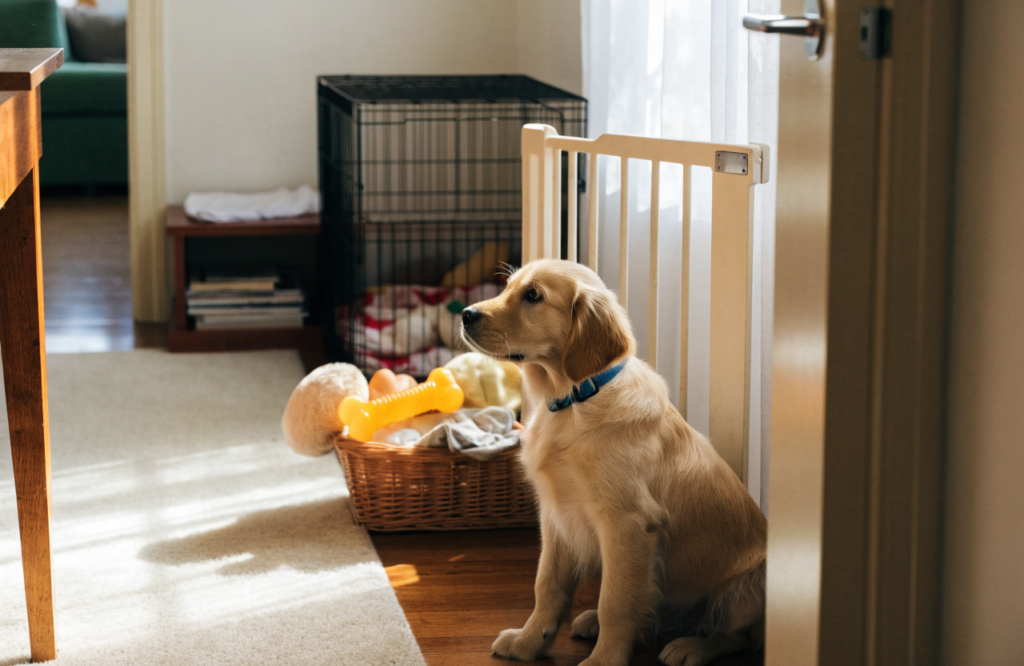
Training fails more often from unclear management than from a slow puppy. Before teaching cues, set the environment so the right choice is easy.
A crate should be large enough for the puppy to stand, turn, and lie down, but not so large that a corner becomes a bathroom. Many owners use a divider and expand it as the puppy grows. Feed meals in the crate, toss treats inside, and keep early sessions brief so the crate means rest, not isolation. Daytime crate time should stay short. A common guideline is about one hour per month of age during the day, with a potty break afterward. Night stretches can be longer once the puppy is settling, but young puppies still need at least one overnight trip outside.
Supervision matters as much as the crate. Until house training is reliable, the puppy is either on a leash with you, in a pen, or in the crate. Free roaming of the house is how accidents and chewing become habits.
Rewards should be small and fast. Break soft treats into pea-sized pieces. A marker word such as “yes,” said the instant the puppy does the right thing, tells the puppy exactly which action earned the food. Play and praise work too, but food is usually the clearest paycheck for a young Golden.
Sessions of 3 to 10 minutes, repeated a few times a day, beat one long drill. End while the puppy is still succeeding.
Golden retriever puppy training by age
| Age | Main focus | What to expect |
|---|---|---|
| 8–10 weeks | Name, potty schedule, crate, handling, trust | Short attention, frequent accidents, sharp baby teeth |
| 10–16 weeks | Socialization, sit, down, come, bite inhibition, leash indoors | Socialization window is closing; learning is fast if exposure stays positive |
| 4–6 months | Loose-leash walking, leave it, drop it, impulse control | More energy, teething peak, better coordination |
| 6–18 months | Proofing cues around distractions, holding manners through adolescence | Skills often look “forgotten”; this is developmental, not a failed puppy |
| 18 months and older | Reliability and maintenance | Adult habits stick if practice continues |
8 to 16 weeks: foundations and socialization
Say the puppy’s name, and reward eye contact. That single habit makes every later cue easier.
Potty trips should happen after waking, after meals, after play, and before naps, plus on a timer during waking hours. A rough bladder guideline is about one hour of holding per month of age, so an 8-week-old often needs a break every 60 to 90 minutes. Large-breed puppies frequently lack reliable control until around 4 to 6 months, so accidents after that age are still common and not a sign the routine has failed. Take the puppy on a leash to the same outdoor spot, use a calm cue such as “go potty,” and reward within a second or two of finishing. If nothing happens in a few minutes, come back inside, confine the puppy, and try again shortly. Indoor play should not start until the puppy has gone.
Handle paws, ears, mouth, and collar for a few seconds at a time, then reward. Goldens need regular brushing and nail care as adults. Puppies that only get touched when something unpleasant happens often fight grooming later.
The socialization period is widely described as running from early puppyhood through about 14 to 16 weeks. Positive, controlled exposure during this window shapes how the adult dog reacts to people, sounds, surfaces, and novelty. The American Veterinary Society of Animal Behavior advises starting socialization early and notes that the behavior risk of missing this period can outweigh disease risk when exposure is planned carefully. That does not mean dog parks or unknown dogs. It means carrying the puppy in public areas, meeting vaccinated, calm dogs, walking on different surfaces, and hearing household sounds at a distance the puppy can tolerate. Pair new things with treats. If the puppy freezes, hides, or tries to escape, increase distance and end the exposure. Puppy classes that use reward-based methods are a practical way to combine training and social contact once your veterinarian clears the timing.
4 to 6 months: manners and impulse control
Teach sit by holding a treat at the nose and moving it slightly up and back so the rear drops, then mark and reward. Down follows the same lure, moved from the nose to the floor between the front paws. Come is practiced indoors on a leash or long line: say the cue once, move away, reward the arrival heavily. Never call the puppy to you for something unpleasant.
Leave it is especially useful for this breed. Goldens investigate the world by mouth and will pick up socks, rocks, food scraps, and anything that smells interesting. Hold a treat in a closed fist, wait for the puppy to back off, then reward from the other hand. Drop it is taught by trading: offer a better treat so the puppy releases the item, then give the item back sometimes so releasing does not always mean losing the prize.
Leash walking starts in the house or yard. Reward the puppy for walking near your leg for a few steps. If the leash tightens, stop. Movement resumes when the leash slackens. Long neighborhood walks are not the goal yet. Young joints and short attention spans do better with several brief outings.
6 to 18 months: the regression most owners do not expect
Many Goldens become less reliable between about 6 and 18 months. Recall gets slower, jumping returns, and a previously calm puppy may ignore cues that worked in the kitchen. Hormonal changes and a stronger interest in the environment drive this phase. The useful response is shorter sessions, higher-value rewards, and a return to easier versions of the skill, not harsher corrections. A long line keeps the puppy safe while recall is rebuilt. Off-leash freedom in unfenced areas should wait until the dog comes back reliably around real distractions.
How to teach a cue so it actually sticks
Most early skills follow the same sequence.
- Lure the action with a treat so the puppy performs it.
- Mark the exact moment with “yes” or a click.
- Deliver the treat immediately.
- Release the puppy with a word such as “free” so sit and down have a clear end.
Add the spoken cue only after the puppy is offering the action reliably. Say the cue once. Repeating “sit, sit, sit” teaches the puppy to wait for the third repetition. Practice in a quiet room first, then add duration, distance, and distraction one at a time. A sit that lasts three seconds in the kitchen is a different skill from a sit at the front door while guests arrive.
Everyone in the household should use the same words and the same rules. A puppy that is allowed on the couch by one person and corrected by another learns that the rules are random.
Mouthing, jumping, and chewing
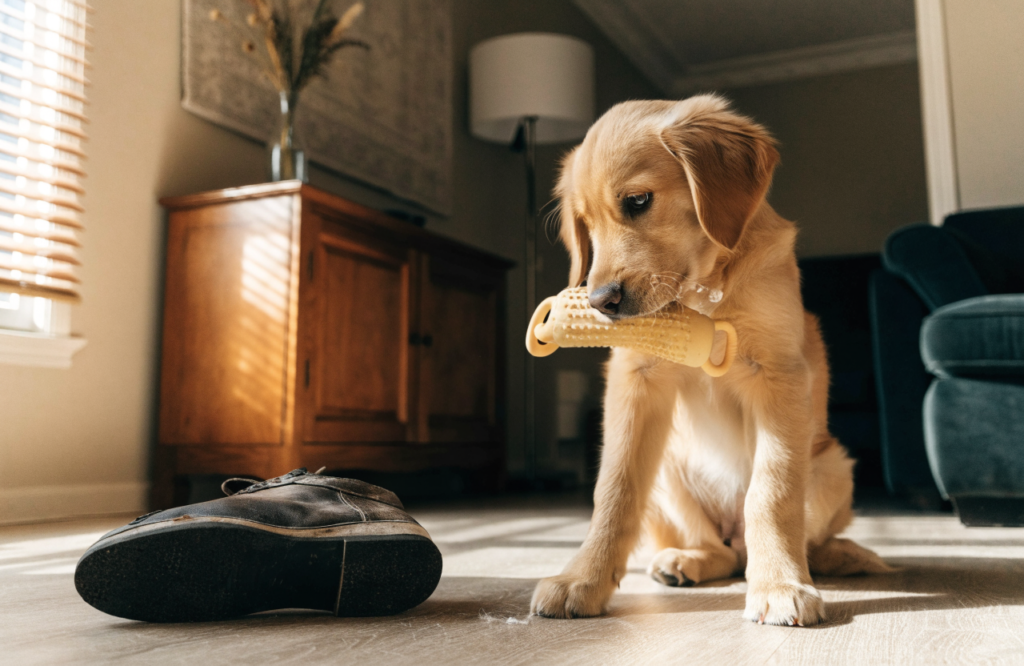
Golden retriever puppies mouth because they are teething, playing, overtired, or doing what the breed was selected to do: hold objects. Peak nipping often falls between about 8 and 16 weeks, when baby teeth are sharpest, and can flare again in adolescence. Normal play mouthing looks loose and wiggly and stops when you disengage. Stiff posture, a hard stare, or biting that continues after you withdraw is a reason to pause training and ask a veterinarian or a certified reward-based trainer.
For hard mouthing, a short high-pitched “ouch” followed by turning away for 10 to 20 seconds copies the feedback littermates give. Then redirect to a toy. Frozen wet washcloths and rubber chew toys help during teething. Rough wrestling with hands teaches the opposite lesson. If the puppy is bitey late in the evening, the usual cause is fatigue, and a nap fixes more than another training rep.
Jumping is greeting behavior that got rewarded by attention. Turn away or step back when paws come up. Mark and treat when all four feet are on the floor, or ask for a sit and reward that instead. Guests need the same rule, or the puppy learns that jumping works on new people.
Chewing on furniture usually means the puppy was unsupervised with too few legal outlets. Management plus appropriate chews prevents the habit. Punishment after the fact does not connect to the earlier chew.
Mistakes that make training take longer
Punishment-based tools and methods, including leash jerks, alpha rolls, and shock, are discouraged by major veterinary behavior organizations because they increase fear and can damage trust. Goldens are sensitive to handler frustration. Yelling often raises arousal and makes mouthing worse.
Other common setbacks:
- Waiting until the puppy is “older” to start. Habits form from the first day home.
- Training only when there is a problem. Short practice during calm moments builds the skill you need during chaos.
- Free-feeding and irregular potty times. A schedule makes elimination predictable.
- Flooding a nervous puppy with too many new experiences in one outing. One calm, successful exposure beats five overwhelming ones.
- Stopping practice once basic cues work at home. Reliability in the real world needs repetition around distractions.
When to get help
A group puppy class with reward-based methods is useful for most families. Seek a veterinarian or a certified behavior professional sooner if the puppy shows intense fear, guarding of food or toys that escalates, or biting that breaks skin and does not respond to consistent redirection. Medical issues, including urinary tract infections, can also look like a house-training failure.
Frequently asked questions
How long does potty training take? Many puppies show a clear pattern within a few weeks of a strict schedule, but full reliability often takes several months. Large breeds commonly lack dependable bladder control until around 4 to 6 months. Accidents after that point usually mean the interval was too long or supervision slipped.
Can training wait until vaccinations are finished? Basic home training should not wait. Socialization should be planned with your veterinarian so the puppy meets the world in lower-risk ways, such as carried outings and contact with known vaccinated dogs, rather than missing the early learning window entirely.
How much exercise does a golden retriever puppy need? Short play sessions, training, and brief walks matched to age are enough. Forced long runs and repetitive jumping are hard on growing joints. Mental work, such as food puzzles and short training games, tires many Goldens more cleanly than extra physical exercise.
Will my puppy outgrow biting and jumping? Mouthing usually softens as adult teeth come in and bite inhibition is practiced, often becoming manageable by about 6 to 12 months if the rules stay consistent. Jumping does not fade on its own if it still earns attention.