
A DIY dog bed cover is a removable slipcover sized to the cushion you already have, not a new bed. Most worn covers fail at the zipper, the corners, or the thin outer fabric, while the foam underneath is still usable. A fitted envelope cover or a boxed slipcover lets you wash the dirty layer and leave the insert alone.
Replacement covers are often discontinued, sold only in one depth, or priced close to a new bed. A homemade cover solves that only if it is cut to the real depth of the cushion, made from a fabric the dog will not shred in a week, and closed so it can come off for the wash. Style matters as much as sewing skill: a flat pillow-style bed and a bolster bed need different patterns.
Match the cover to the bed and the dog
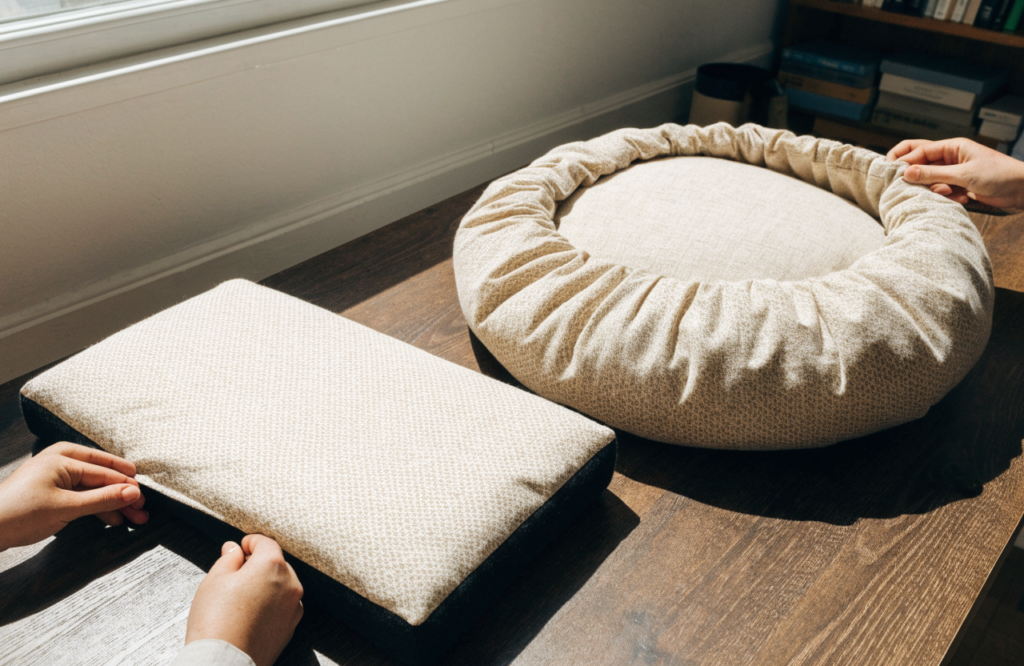
Start with the insert, not the fabric. A cover that looks right on a flat rectangle will gap, twist, or refuse to go on a bolster or a multi-piece orthopedic bed.
Flat cushion beds are the straightforward project. These are a single foam slab or a stuffed pillow. An envelope cover, built like an oversized pillowcase with an overlapping back, is enough for a dog that lies down and stays. Boxing the corners, or sewing separate side panels, keeps the cover from looking baggy on thicker foam.
Bolster and raised-rim beds are a different shape. The rim is usually a separate tube or a sewn channel, and the center cushion sits lower. One flat piece of fabric cannot follow both surfaces. Either make a cover only for the center pad and leave the bolster in its original cover, or treat the bed as a box cushion and sew a top, a bottom, and side strips. If the original cover is torn but still holding the shape together, patch the tear from the inside and add a washable top layer instead of rebuilding the whole structure.
Round beds use the same idea with one change in measuring. Cut the top and bottom as circles with the diameter of the bed plus seam allowance, and cut the side as one long strip equal to the circumference plus seam allowance, and as wide as the bed height plus seam allowance.
Skip a full cover when the foam is saturated, crumbling, or smells after a wash and a full dry. Fabric will not fix a failed insert. A cover is also a poor fix for a determined chewer if every seam and zipper sits where the dog can mouth it. In that case, fewer seams and a hidden closure matter more than a decorative print.
Measure so the cover fits and still comes off

Measure the cushion, not the old cover. Old covers stretch and sag. Write down three numbers: length, width, and height at the thickest point, including any piping. Measure twice, once with the bed uncompressed and once while you press the center the way the dog lies on it. Use the uncompressed size for cutting, then plan a little ease so the cover is snug but not drum-tight.
Prewash cotton, canvas, denim, and linen. Those fabrics shrink. Outdoor fabric and coated waterproof cloth usually should not be machine-washed before sewing; check the bolt end or the seller’s care note.
Use these as cutting formulas for a rectangular flat bed. They assume a 1/2 inch (1.3 cm) seam allowance.
| Piece | Formula | Why |
|---|---|---|
| Envelope top | Length + height + 1 in; width + (2 × height) + 1 in | Covers the top and wraps the side edges |
| Envelope back, two flaps | Each flap: (length + height + 1 in) ÷ 2, plus 4–6 in overlap; same width as the top | Overlap is what holds the cushion in |
| Boxed top and bottom | Length + 1 in by width + 1 in | 1/2 in seam on each edge |
| Boxed sides | Two long sides: length + 1 in by height + 1 in. Two short sides: width + 1 in by height + 1 in | Side height must match the real foam thickness |
| Zipper panel | Split one long side into two strips whose widths add up to height + 1 in, plus extra for the zipper seam | Gives a clean opening on the back or bottom |
The overlap on an envelope cover should be at least 6 inches (15 cm) on a medium bed and 8–10 inches (20–25 cm) on a large one. Less than that and the cushion walks out when the dog circles. More than that and the flap bunches under the dog.
Do not add “a little extra just in case” on every edge. Extra length makes a loose cover that twists. If you are unsure, cut the pieces, pin them wrong sides together around the cushion, and check the fit before you sew. That check saves more covers than any pattern.
Choose fabric for the dog you have
Pretty quilting cotton fails first. A dog bed cover needs a tight weave the dog’s nails cannot part, and a care method you will actually use.
| Fabric | Works well when | Weak point |
|---|---|---|
| 10–12 oz cotton canvas or duck | Digging, daily washing, most indoor beds | Holds moisture unless you add a liner |
| Denim or bull denim, about 10 oz | Large dogs, heavy nesting | Heavy when wet; can be stiff on a home machine |
| Outdoor acrylic or solution-dyed fabric | Porch beds, drool, light rain | Less soft; some versions are slippery |
| Fleece or minky, anti-pill | Small, calm dogs that want warmth | Pills, holds hair, tears if the dog digs |
| Ballistic or high-denier nylon | Mouthing and clawing | Can feel slick and hold heat |
| Coated waterproof cloth or a PUL-type liner | Incontinence, used as an inner layer | Crinkly versions annoy some dogs; outer waterproof layers get hot |
A weave you cannot see daylight through spreads a claw across many threads instead of a few. That is why canvas and denim outlast a soft printed cotton of the same size. Upholstery fabric is durable, but test a scrap on your machine with a heavy needle (90/14 or 100/16) before you cut the whole bed.
Avoid loose knits, thin flannel by itself, and anything with a vinyl face that crackles. Also skip fabric with sequins, loose ribbons, or long pile if the dog chews. Those details become the first thing in the mouth.
Buy a little more than the math. A 54–60 inch (137–152 cm) wide canvas usually covers a medium bed from 2 yards (1.8 m) and a large bed from 2.5–3 yards (2.3–2.7 m), depending on whether you are making an envelope or a boxed cover with sides. Patterned fabric needs extra for matching.
Sew an envelope cover for a flat bed

This is the right first project if you can sew a straight line. It is a pillowcase with a deep overlap on the back, not a fitted sheet.
- Prewash and press the fabric. Cut the top and the two back flaps using the table above. Hem the overlap edge of each back flap: fold 1/2 inch (1.3 cm) to the wrong side, fold again, and stitch.
- Lay the top right side up. Place one back flap on it, right sides together, raw edges matched, hemmed edge toward the center. Place the second flap on the opposite end so the hemmed edges overlap in the middle by your planned 6–10 inches.
- Pin all the way around. The overlap should be pinned only at the outer edges, not stitched shut.
- Sew a 1/2 inch seam around the whole rectangle. Pivot at the corners with the needle down. Backstitch at the start and end.
- Clip the corners, turn the cover right side out, and push the corners out with a blunt tool. Press.
- Slide the cushion in through the overlap. The opening belongs on the underside.
If the cover is loose only at the corners, you can box them. With the cover wrong side out, pull each corner so the side seam and the end seam sit on top of each other, measure in from the point by half the bed height, mark a line across, and stitch. That turns a flat bag into a shallow box and stops the corners from flopping.
Use a slightly longer stitch than you would on a shirt, about 2.5–3 mm, and a strong polyester thread. Cotton thread wears faster against foam and repeated washing. Finish the raw seam with a zigzag or an overlock if the fabric frays. Canvas frays less than lightweight cotton, but an unfinished seam still unravels at the corners after several washes.
A no-sew cover, and when it is not enough
A no-sew cover is a large rectangle folded around the bed like wrapping a present, with the overlap on the bottom. It is useful as a temporary layer or for a calm dog. It is a poor long-term cover for a digger.
Cut one piece: length = bed length + (2 × height) + 8 inches; width = bed width + (2 × height) + 4 inches. Fold every raw edge 1/2 inch to the wrong side and hold it with fusible hem tape or fabric glue made for washable hems, pressed according to the product directions. Center the bed, fold the short ends up and under, then fold the long sides so one overlaps the other by several inches. Hold the overlap with wide sew-on or adhesive hook-and-loop tape, not with a light strip of wardrobe tape.
The failure point is the closure. Glue and light tape let go in the wash or when the dog paws the edge. If you cannot sew at all, wide hook-and-loop on the overlap is the version worth making. If the dog digs, this style will bunch no matter how carefully you fold it. Move to a sewn envelope or a boxed cover.
Fleece “duvet” covers closed with large buttons are another low-skill option, but buttons and buttonholes are chew targets. Place any closure on the underside, and do not use buttons small enough to swallow if they pull off.
Boxed cover with a zipper or hook-and-loop for diggers and thicker beds
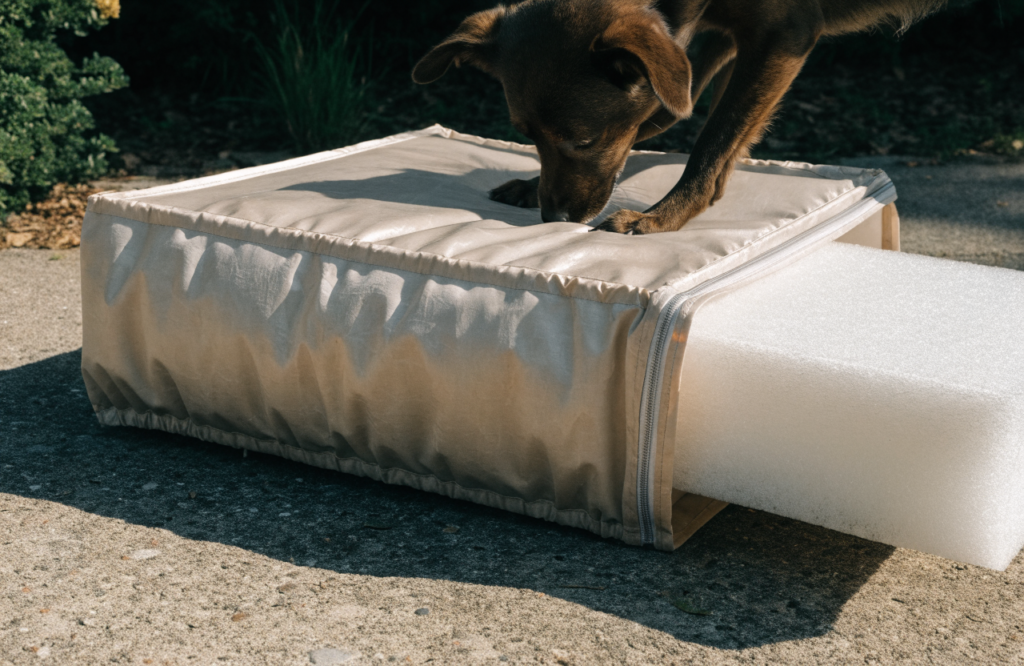
A boxed cover has a top, a bottom, and four sides, so the fabric follows the foam instead of draping. Use it when the bed is more than about 4 inches (10 cm) thick, when an envelope cover twists, or when you want the opening on the back edge rather than under the dog.
Sew the zipper into one long side first. Split that side panel, baste the two strips together along the opening edge, press the seam open, and stitch the zipper behind the basting. A zipper a few inches shorter than the side is easier to install than one that runs corner to corner. Unpick the basting after the zipper is in. A zipper garage, or a small fabric overlap at the pull, keeps the pull from sitting against the dog’s mouth.
Join the four side pieces into a loop, stopping 1/2 inch short of each corner so you can pivot later. Pin the side loop to the top, right sides together, matching corners, and sew. Repeat with the bottom. Clip the seam allowance at the corners, turn the cover, and test the cushion before you trim anything.
Hook-and-loop tape is easier than a zipper and fine on the underside or the back edge. Sew the hook side to one flap and the loop side to the other, with the tape ending about 1 inch short of each corner so the corners can turn. A full-length zipper on the top face looks neat and gets chewed. Hide the closure.
For a bolster, do not force one pattern over the whole bed unless you are comfortable sewing curves and channels. A center-cushion cover plus the original bolster cover is the version most people finish.
Add a waterproof layer without a slippery bed
Waterproof fabric as the outer cover protects the foam and often makes the bed hot and slick. Many dogs then scratch at it. A better split for indoor beds is a breathable outer cover and a separate moisture barrier inside.
Cut a waterproof crib sheet, a furniture pad, or a piece of polyurethane-laminate fabric slightly smaller than the top of the cushion. Lay it on the foam, then pull the decorative cover over both. Smooth it from the back corners forward so it does not fold under the dog. This layer catches drool and the occasional accident, and it can be wiped or washed on its own.
If accidents are frequent, a coated outer fabric is reasonable. Choose one that does not crinkle, and expect to add a thin cotton or fleece throw on top in warm weather. Never enclose wet foam. Smell returns as soon as trapped moisture warms up.
Fit problems, washing, and the mistakes that ruin the first cover
The cover will not go on. The height was left out of the cut, or there is no ease. Recut the sides, or add a strip rather than forcing the zipper. A zipper that only closes halfway will split.
The cover twists or the cushion walks out. The overlap is too short, or the cover is loose. Deepen the envelope flap, box the corners, or add hook-and-loop inside the overlap.
Corners wear through. That is claw traffic, not bad luck. Reinforce the inside of each corner with a scrap of canvas before the hole opens, and keep seams away from the exact corner point when you can.
The dog pulls the closure. Move it to the bottom. Cover a zipper pull with a small fabric tab. On a chewer, an overlap with no hardware lasts longer than a visible zipper.
Color crocks onto the dog. Dark new denim can transfer when damp. Wash the cover once before it goes on a light-colored dog.
Wash the cover alone or with towels, in cold or warm water, and dry it fully before it goes back on the foam. Zippers should be closed. Hook-and-loop should be fastened so it does not catch the rest of the load. Baking soda in the wash helps odor; it does not replace a dry insert. If the bed is too big for the machine, wash the cover at a laundromat or spot-clean and line-dry. Do not put the foam in the dryer to “freshen” it if it is memory foam; heat can damage some foams. Air it instead.
A first cover that is a little plain and a little tight is more useful than a piped, monogrammed one that gapes. Piping, ties, and labels can wait until you know the dog will leave the seams alone.
Questions people ask after the first cover
Can this be done without a sewing machine? Yes, as an envelope wrap closed with wide hook-and-loop, or as a hand-sewn pillowcase with a simple running stitch and a backstitch at stress points. Hand sewing a boxed zipper cover is slow and hard to keep square. For a digger, a machine-sewn envelope is the better use of time.
What if the original cover is the only thing holding the bed together? Patch tears from the inside with a heavy scrap, or use an iron-on patch rated for the fabric, then put the new slipcover over the repaired one. Rebuilding a five-piece bolster from scratch is a much larger project than a center-pad cover.
How do I keep hair from sticking? Tight canvas and denim release hair more easily than fleece. A rubber brush or a damp rubber glove lifts hair off a dry cover. Washing inside out helps, but the weave matters more than the detergent.
Is outdoor fabric safe indoors? It is fine if it has no strong chemical odor after airing and the dog is not licking a fresh coating. Use it as the shell or as the liner, not as a chew toy. Ventilate the room while it off-gasses if it smells new.
How many covers are worth making? Two. One stays on the bed while the other is washed and dried. A single cover often goes back on damp, which is how foam starts to smell.